Prepared by: Gianne T. Gregorio RN
Learning Objectives:
 Ability to perform a comprehensive respiratory assessment.
 Appropriate documentation of respiratory assessment:
– Pulse oximetry
– Rate, rhythm and effort
– Inspect, observe and listen
 Define and identify signs and symptoms of common
respiratory diseases.
 Differentiate normal and abnormal lung sounds
 Understand treatments and devices used in respiratory
care.
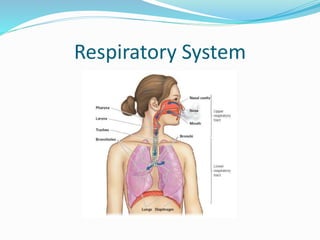
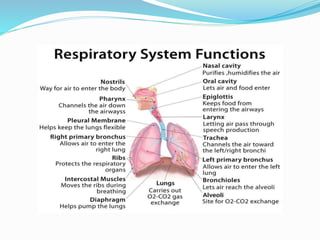
Respiratory System
Respiratory Assessment
 A respiratory assessment is an external assessment of ventilation
that includes observations of the rate, depth and pattern of
respirations.
 An accurate assessment of respiration depends on recognizing
normal thoracic and abdominal movements.
 On inspiration, the diaphragm contracts, causing abdominal
organs to move downward and forward, increasing the vertical
space of the chest cavity.
 At the same time, the ribs lift upward and outward, and the
sternum lifts outward to aid the transverse expansion of the
lungs.
 On expiration, the diaphragm relaxes upward, the ribs and
sternum return to their relaxed position, and the abdominal
organs return to their original position.
Assess the patient for signs and symptoms of
respiratory changes:
 Complaints of shortness of breath (dyspnea)
 Bluish or cyanotic appearance of the nail beds, lips,
mucous membranes and skin
 Restlessness, irritability, confusion, decreased level of
consciousness
 Pain during inspiration and expiration
 Labored or difficult breathing
 Orthopnea
 Use of accessory muscles
 Abnormal breath sounds such as wheezes, rhonchi or rales
 Inability to breathe spontaneously
 Thick, frothy, blood-tinged or copious sputum production
 Paradoxical chest wall movement
Assess the patient for factors that influence the
character of respirations:
Activity
Anxiety
Acute pain
Gastric distention
 Medications
 Body position
Presence of abdominal incisions or dressings
Fever
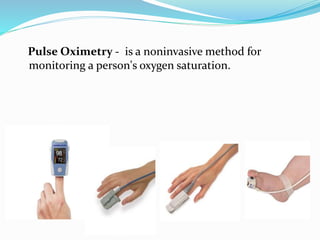
Pulse Oximetry - is a noninvasive method for
monitoring a person's oxygen saturation.
Assessing Rate, Rhythm and Effort
Inspect and Observe:
 Keep pt comfortable by allowing them to sit upright.
 Provide emotional support to reduce anxiety
associated with dyspnea.
 Observe the shape and symmetry of the chest (a
normal adult’s thorax is wider in transverse
diameter than its anterior to posterior diameter).
 Older adults may have developed a barrel chest due
to COPD which may reduce chest expansion
 Observe for shortness of breath with and without
exertion and orthopnea (the need to be in a upright
or forward-leaning position to get an adequate
breath) seen in pts with COPD
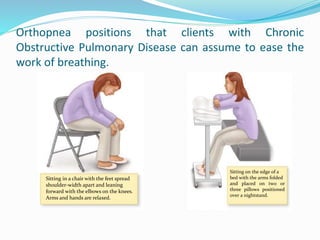
Orthopnea positions that clients with Chronic
Obstructive Pulmonary Disease can assume to ease the
work of breathing.
Sitting in a chair with the feet spread
shoulder-width apart and leaning
forward with the elbows on the knees.
Arms and hands are relaxed.
Sitting on the edge of a
bed with the arms folded
and placed on two or
three pillows positioned
over a nightstand.
Inspect and Observe: Back
Palpate your pt’s back at the level of the 10th rib with
your thumbs on each side of the spine and your fingers
spread laterally.
Ask pt to take deep breaths as you assess the adequacy
and equality of breath.
 Patient with an area of consolidation, as seen in
conditions such as pneumonia and lung tumors, may
have reduced expansion of the affected side resulting
in a minimal or absent movement of your hand.
Reduced lung expansion may be also a sign of a
pneumothorax.
Inspect and Observe: Thorax
 Place your palm (or palms) lightly over the thorax and palpate for
tenderness, alignment, bulging, and retractions of the chest and
intercostal spaces.
 Use the pads of your fingers to palpate the front and back of the
thorax
 Pass your fingers over the resident’s ribs and any scars, lumps,
lesions or ulcerations .
 Note the temperature, turgor and moisture (muscles should feel
firm and smooth).
Listen Up:
 Auscultate your pt’s back, chest and sides to listen for the
presence of normal and abnormal breath sounds.
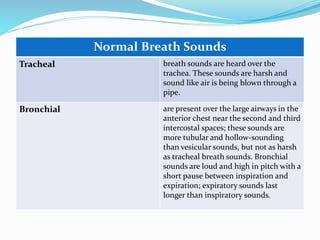
Normal Breath Sounds
Tracheal breath sounds are heard over the
trachea. These sounds are harsh and
sound like air is being blown through a
pipe.
Bronchial are present over the large airways in the
anterior chest near the second and third
intercostal spaces; these sounds are
more tubular and hollow-sounding
than vesicular sounds, but not as harsh
as tracheal breath sounds. Bronchial
sounds are loud and high in pitch with a
short pause between inspiration and
expiration; expiratory sounds last
longer than inspiratory sounds.
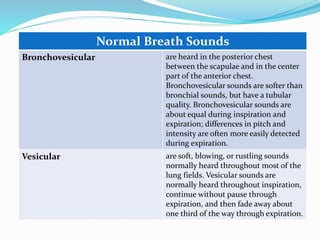
Normal Breath Sounds
Bronchovesicular are heard in the posterior chest
between the scapulae and in the center
part of the anterior chest.
Bronchovesicular sounds are softer than
bronchial sounds, but have a tubular
quality. Bronchovesicular sounds are
about equal during inspiration and
expiration; differences in pitch and
intensity are often more easily detected
during expiration.
Vesicular are soft, blowing, or rustling sounds
normally heard throughout most of the
lung fields. Vesicular sounds are
normally heard throughout inspiration,
continue without pause through
expiration, and then fade away about
one third of the way through expiration.
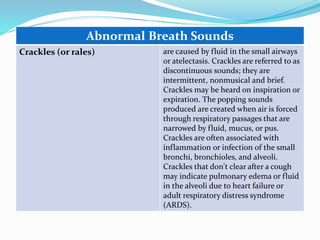
Abnormal Breath Sounds
Crackles (or rales) are caused by fluid in the small airways
or atelectasis. Crackles are referred to as
discontinuous sounds; they are
intermittent, nonmusical and brief.
Crackles may be heard on inspiration or
expiration. The popping sounds
produced are created when air is forced
through respiratory passages that are
narrowed by fluid, mucus, or pus.
Crackles are often associated with
inflammation or infection of the small
bronchi, bronchioles, and alveoli.
Crackles that don't clear after a cough
may indicate pulmonary edema or fluid
in the alveoli due to heart failure or
adult respiratory distress syndrome
(ARDS).
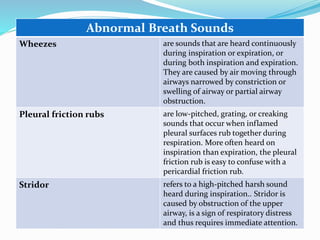
Abnormal Breath Sounds
Wheezes are sounds that are heard continuously
during inspiration or expiration, or
during both inspiration and expiration.
They are caused by air moving through
airways narrowed by constriction or
swelling of airway or partial airway
obstruction.
Pleural friction rubs are low-pitched, grating, or creaking
sounds that occur when inflamed
pleural surfaces rub together during
respiration. More often heard on
inspiration than expiration, the pleural
friction rub is easy to confuse with a
pericardial friction rub.
Stridor refers to a high-pitched harsh sound
heard during inspiration.. Stridor is
caused by obstruction of the upper
airway, is a sign of respiratory distress
and thus requires immediate attention.
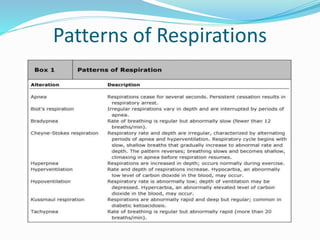
Patterns of Respirations
Common Respiratory Illnesses
 Asthma - is a chronic inflammatory disease that affects
the airways and is characterized by reversible airway
obstruction, airway inflammation and increased airway
responsiveness to a variety of stimuli.
- During an exacerbation, there is an early-phase
bronchoconstriction and a late-phase airway
inflammation, and the bronchoconstriction,
bronchospasm and the airway inflammation must be
treated.
- If the patient is experiencing an asthma exacerbation,
rescue relief medications should be progressively
administered to relieve symptoms and the patient should
be monitored closely.
Diagnostic test
Spirometry -is a simple breathing test that measures
how much and how fast you can blow air out of your
lungs.
Methacholine or mannitol challenge tests-During this
tests, you will inhale increasing amounts of either
methacholine aerosol mist or mannitol dry powder
inhaler before and after lung function tests. The test is
positive when your lung function drops during the
challenge.
Patient and Family Education
 Assure the patient and family that asthma symptoms
can be controlled when managed properly .
 Proper self-management helps keep the asthma under
control.
Documentation for Asthma
 Frequency of daytime symptoms
Frequency of nighttime symptoms
 Frequency of short-acting beta2 agonist use
 Current asthma severity
Revisions or updates to the asthma action plan
Unexpected outcomes and related interventions
 Patient and family education
Peak flow rate results
 Pneumonia -Inflammation of the pulmonary
parenchyma or alveoli or both, caused by a virus,
mycoplasmal agents, bacteria, or aspiration of foreign
substances.
Pneumonia may cause the following signs and symptoms:
 Acute or insidious onset
 Symptoms range from mild fever, slight cough, and
malaise to high fever, severe cough, and diaphoresis.
 Nonproductive or productive cough of small amounts of
whitish sputum
 Wheezes or fine crackles
Diagnostic test
 Chest x ray to look for inflammation in your lungs. A
chest x ray is the best test for diagnosing pneumonia.
However, this test won't tell your doctor what kind of
germ is causing the pneumonia.
 Blood tests such as a complete blood count (CBC) to
see if your immune system is actively fighting an
infection.
 Blood culture to find out whether you have a bacterial
infection that has spread to your bloodstream. If so,
your doctor can decide how to treat the infection.
Prevention Measures
 Influenza vaccination annually helps prevent
pneumonia
 Pneumococcal vaccination
1. Helps prevent 23 different strains of bacterial
pneumonia (although there are many more strains of
bacterial pneumonia).
2. Is effective for a shorter amount of time in older
adults.
3. Should be administered every five years.
 Positive Infection Control Program (healthcare-
associated infections)
 Dental/oral hygiene causes for aspiration pneumonia
– Dependent feeding (dysphagia)
– Dependent oral hygiene
– Missing teeth (infected teeth)
– Tube feeding
– Multiple medications
Documentation
Respiratory rate, depth and breathing pattern
Type and amount of supplemental oxygen therapy or
respiratory support
Spirometer readings pre- and post-breathing treatments
 IV and/or oral medication given
Unexpected outcomes and related nursing interventions
Patient and family education
Pain assessment and management
 COPD, which includes chronic bronchitis and
emphysema, is a chronic lung disease that makes it
hard to breathe, also known as dyspnea.
 Damage to the airways in the resident’s lungs leads to
shortness of breath, impacting their ability to work,
exercise, sleep and perform everyday activities.
Diagnostic test
 Spirometry - The most effective and common method
for diagnosing COPD also known as a pulmonary
function test or PFT. This easy, painless test measures
lung function and capacity.
 Bronchodilator reversibility test - For this test, you’ll
undergo a standard spirometry test to get a baseline
measurement of how well your lungs are working.
Then, after about 15 minutes, you’ll take a dose of
bronchodilator medication and repeat the spirometry
test.
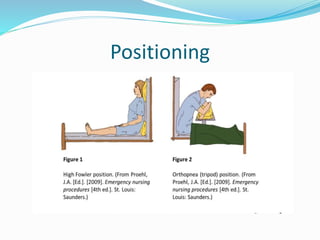
Positioning
COPD Care
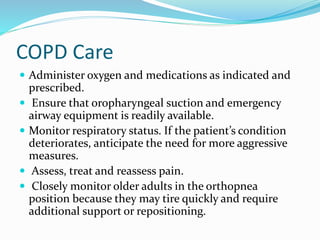
 Administer oxygen and medications as indicated and
prescribed.
 Ensure that oropharyngeal suction and emergency
airway equipment is readily available.
 Monitor respiratory status. If the patient’s condition
deteriorates, anticipate the need for more aggressive
measures.
 Assess, treat and reassess pain.
 Closely monitor older adults in the orthopnea
position because they may tire quickly and require
additional support or repositioning.
Documentation
 Frequency of symptoms observed and reported
Care provided
Position that offers patient the most relief
 Unexpected outcomes and related interventions
Patient and family education
RESPIRATORY ALKALOSIS
 Respiratory alkalosis occurs when the levels of carbon
dioxide and oxygen in the blood are not balanced.
 Respiratory alkalosis occurs when you breathe too fast
or too deep and carbon dioxide levels drop too low.
This causes the pH of the blood to rise and become too
alkaline.
 Hyperventilation is typically the underlying cause of
respiratory alkalosis. Hyperventilation is also known as
overbreathing. Someone who is hyperventilating
breathes very deeply or rapidly.
Panic attacks and anxiety are the most common causes of
hyperventilation. However, they’re not the only possible
causes. Others include:
 heart attack
 pain
 drug use
 asthma
 fever
 chronic obstructive pulmonary disease
 infection
 pulmonary embolism
 pregnancy
Causes of hyperventilation
Symptoms of respiratory alkalosis
 Overbreathing is a sign that respiratory alkalosis is likely to
develop. However, low carbon dioxide levels in the blood
also have a number of physical effects, including:
 dizziness
 bloating
 feeling lightheaded
 numbness or muscle spasms in the hands and feet
 discomfort in the chest area
 confusion
 dry mouth
 tingling in the arms
 heart palpitations
 feeling short of breath
Causes:
This may be due to a decrease in respiratory rate or
decrease in air movement due to an underlying
condition such as:
 asthma
 COPD
 pneumonia
 sleep apnea
Treatment for respiratory alkalosis
Breathe into a paper bag
 Fill the paper bag with carbon dioxide by exhaling into
it.
 Breathe the exhaled air from the bag back into the
lungs.
 Repeat this several times.
Doing this several times can give the body the carbon
dioxide it needs and bring levels back up to where they
should be.
RESPIRATORY ACIDOSIS
 Respiratory acidosis is a condition that occurs when
the lungs can’t remove enough of the carbon dioxide
(CO2) produced by the body. Excess CO2 causes the
pH of blood and other bodily fluids to decrease,
making them too acidic. Normally, the body is able to
balance the ions that control acidity. This balance is
measured on a pH scale from 0 to 14. Acidosis occurs
when the pH of the blood falls below 7.35 (normal
blood pH is between 7.35 and 7.45).
 Respiratory acidosis is typically caused by an
underlying disease or condition. This is also called
respiratory failure or ventilatory failure.
Forms of respiratory acidosis
 Acute respiratory acidosis occurs quickly. It’s a
medical emergency. Left untreated, symptoms will get
progressively worse. It can become life-threatening.
 Chronic respiratory acidosis develops over time. It
doesn’t cause symptoms. Instead, the body adapts to
the increased acidity. For example, the kidneys
produce more bicarbonate to help maintain balance.
Symptoms of respiratory acidosis
Initial signs of acute
respiratory acidosis
include:
 headache
 anxiety
 blurred vision
 restlessness
 confusion
Without treatment,
other symptoms may
occur. These include:
sleepiness or fatigue
lethargy
delirium or confusion
shortness of breath
coma
Treatment for respiratory acidosis
Acute form
Treating acute acidosis
usually means
addressing the
underlying cause. For
example, your airway
may need to be
cleared. This must be
done as soon as
possible. Artificial
ventilation may also be
needed.
Chronic form
If you have the chronic form of this
disease, your treatment will focus on
managing any underlying conditions. The
goal is to improve airway function. Some
strategies include:
•antibiotics (to treat infection)
•diuretics (to reduce excess fluid
affecting the heart and lungs)
•bronchodilators (to expand the airways)
•corticosteroids (to reduce
inflammation)
•mechanical ventilation (in severe cases)
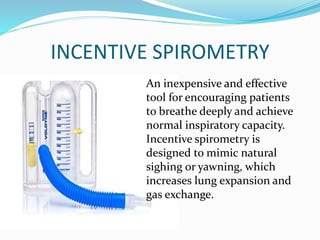
INCENTIVE SPIROMETRY
An inexpensive and effective
tool for encouraging patients
to breathe deeply and achieve
normal inspiratory capacity.
Incentive spirometry is
designed to mimic natural
sighing or yawning, which
increases lung expansion and
gas exchange.
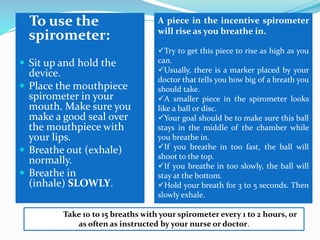
To use the
spirometer:
 Sit up and hold the
device.
 Place the mouthpiece
spirometer in your
mouth. Make sure you
make a good seal over
the mouthpiece with
your lips.
 Breathe out (exhale)
normally.
 Breathe in
(inhale) SLOWLY.
A piece in the incentive spirometer
will rise as you breathe in.
Try to get this piece to rise as high as you
can.
Usually, there is a marker placed by your
doctor that tells you how big of a breath you
should take.
A smaller piece in the spirometer looks
like a ball or disc.
Your goal should be to make sure this ball
stays in the middle of the chamber while
you breathe in.
If you breathe in too fast, the ball will
shoot to the top.
If you breathe in too slowly, the ball will
stay at the bottom.
Hold your breath for 3 to 5 seconds. Then
slowly exhale.
Take 10 to 15 breaths with your spirometer every 1 to 2 hours, or
as often as instructed by your nurse or doctor.
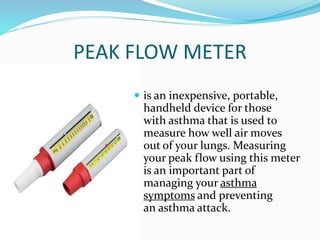
PEAK FLOW METER
 is an inexpensive, portable,
handheld device for those
with asthma that is used to
measure how well air moves
out of your lungs. Measuring
your peak flow using this meter
is an important part of
managing your asthma
symptoms and preventing
an asthma attack.
How To use the Peak Flow Meter for Asthma?
√ Stand up or sit up straight.
√ Make sure the indicator is at the bottom of the meter (zero).
√ Take a deep breath in, filling the lungs completely.
√ Place the mouthpiece in your mouth; lightly bite with
your teeth and close your lips on it. Be sure your tongue is away
from the mouthpiece.
√ Blast the air out as hard and as fast as possible in a single blow.
√ Remove the meter from your mouth.
√ Record the number that appears on the meter and then repeat
steps one through seven two more times.
√ Record the highest of the three readings in an asthma diary. This
reading is your peak expiratory flow (PEF).
√ To ensure the results of your peak flow meter are comparable, be
sure to use your meter the same way each
Recommendations
 Record respirations for a full minute to monitor the
respiration pattern and to ensure accuracy of the
observation
 If a patient has been prescribed oxygen, ensure the
oxygen mask or nasal cannula is correctly placed prior
to recording respirations, and also check that the
oxygen flow rate is set as prescribed and recorded on
the observation chart.
 Hand hygiene/Wash hands thoroughly between
patients - to eliminate the risk of cross infection.
References:
 https://healthinsight.org/tools-and-resources/send/128-
educational-resources/586-respiratory-assessment-and-
treatments
 https://my.clevelandclinic.org/health/diagnostics/895
8-asthma-testing--diagnosis/test-details
 https://www.nhlbi.nih.gov/health-topics/pneumonia
 https://www.healthline.com/health/copd/tests-
diagnosis
 http://www.rnceus.com/resp/respabn.html
 https://www.healthline.com/health

Respiratory Assessment

  • 1.
    Prepared by: GianneT. Gregorio RN
  • 2.
    Learning Objectives:  Abilityto perform a comprehensive respiratory assessment.  Appropriate documentation of respiratory assessment: – Pulse oximetry – Rate, rhythm and effort – Inspect, observe and listen  Define and identify signs and symptoms of common respiratory diseases.  Differentiate normal and abnormal lung sounds  Understand treatments and devices used in respiratory care.
  • 3.
  • 5.
    Respiratory Assessment  Arespiratory assessment is an external assessment of ventilation that includes observations of the rate, depth and pattern of respirations.  An accurate assessment of respiration depends on recognizing normal thoracic and abdominal movements.  On inspiration, the diaphragm contracts, causing abdominal organs to move downward and forward, increasing the vertical space of the chest cavity.  At the same time, the ribs lift upward and outward, and the sternum lifts outward to aid the transverse expansion of the lungs.  On expiration, the diaphragm relaxes upward, the ribs and sternum return to their relaxed position, and the abdominal organs return to their original position.
  • 6.
    Assess the patientfor signs and symptoms of respiratory changes:  Complaints of shortness of breath (dyspnea)  Bluish or cyanotic appearance of the nail beds, lips, mucous membranes and skin  Restlessness, irritability, confusion, decreased level of consciousness  Pain during inspiration and expiration  Labored or difficult breathing  Orthopnea  Use of accessory muscles  Abnormal breath sounds such as wheezes, rhonchi or rales  Inability to breathe spontaneously  Thick, frothy, blood-tinged or copious sputum production  Paradoxical chest wall movement
  • 7.
    Assess the patientfor factors that influence the character of respirations: Activity Anxiety Acute pain Gastric distention  Medications  Body position Presence of abdominal incisions or dressings Fever
  • 8.
    Pulse Oximetry -is a noninvasive method for monitoring a person's oxygen saturation.
  • 9.
    Assessing Rate, Rhythmand Effort Inspect and Observe:  Keep pt comfortable by allowing them to sit upright.  Provide emotional support to reduce anxiety associated with dyspnea.  Observe the shape and symmetry of the chest (a normal adult’s thorax is wider in transverse diameter than its anterior to posterior diameter).  Older adults may have developed a barrel chest due to COPD which may reduce chest expansion  Observe for shortness of breath with and without exertion and orthopnea (the need to be in a upright or forward-leaning position to get an adequate breath) seen in pts with COPD
  • 10.
    Orthopnea positions thatclients with Chronic Obstructive Pulmonary Disease can assume to ease the work of breathing. Sitting in a chair with the feet spread shoulder-width apart and leaning forward with the elbows on the knees. Arms and hands are relaxed. Sitting on the edge of a bed with the arms folded and placed on two or three pillows positioned over a nightstand.
  • 11.
    Inspect and Observe:Back Palpate your pt’s back at the level of the 10th rib with your thumbs on each side of the spine and your fingers spread laterally. Ask pt to take deep breaths as you assess the adequacy and equality of breath.  Patient with an area of consolidation, as seen in conditions such as pneumonia and lung tumors, may have reduced expansion of the affected side resulting in a minimal or absent movement of your hand. Reduced lung expansion may be also a sign of a pneumothorax.
  • 12.
    Inspect and Observe:Thorax  Place your palm (or palms) lightly over the thorax and palpate for tenderness, alignment, bulging, and retractions of the chest and intercostal spaces.  Use the pads of your fingers to palpate the front and back of the thorax  Pass your fingers over the resident’s ribs and any scars, lumps, lesions or ulcerations .  Note the temperature, turgor and moisture (muscles should feel firm and smooth). Listen Up:  Auscultate your pt’s back, chest and sides to listen for the presence of normal and abnormal breath sounds.
  • 13.
    Normal Breath Sounds Trachealbreath sounds are heard over the trachea. These sounds are harsh and sound like air is being blown through a pipe. Bronchial are present over the large airways in the anterior chest near the second and third intercostal spaces; these sounds are more tubular and hollow-sounding than vesicular sounds, but not as harsh as tracheal breath sounds. Bronchial sounds are loud and high in pitch with a short pause between inspiration and expiration; expiratory sounds last longer than inspiratory sounds.
  • 14.
    Normal Breath Sounds Bronchovesicularare heard in the posterior chest between the scapulae and in the center part of the anterior chest. Bronchovesicular sounds are softer than bronchial sounds, but have a tubular quality. Bronchovesicular sounds are about equal during inspiration and expiration; differences in pitch and intensity are often more easily detected during expiration. Vesicular are soft, blowing, or rustling sounds normally heard throughout most of the lung fields. Vesicular sounds are normally heard throughout inspiration, continue without pause through expiration, and then fade away about one third of the way through expiration.
  • 15.
    Abnormal Breath Sounds Crackles(or rales) are caused by fluid in the small airways or atelectasis. Crackles are referred to as discontinuous sounds; they are intermittent, nonmusical and brief. Crackles may be heard on inspiration or expiration. The popping sounds produced are created when air is forced through respiratory passages that are narrowed by fluid, mucus, or pus. Crackles are often associated with inflammation or infection of the small bronchi, bronchioles, and alveoli. Crackles that don't clear after a cough may indicate pulmonary edema or fluid in the alveoli due to heart failure or adult respiratory distress syndrome (ARDS).
  • 16.
    Abnormal Breath Sounds Wheezesare sounds that are heard continuously during inspiration or expiration, or during both inspiration and expiration. They are caused by air moving through airways narrowed by constriction or swelling of airway or partial airway obstruction. Pleural friction rubs are low-pitched, grating, or creaking sounds that occur when inflamed pleural surfaces rub together during respiration. More often heard on inspiration than expiration, the pleural friction rub is easy to confuse with a pericardial friction rub. Stridor refers to a high-pitched harsh sound heard during inspiration.. Stridor is caused by obstruction of the upper airway, is a sign of respiratory distress and thus requires immediate attention.
  • 17.
  • 18.
    Common Respiratory Illnesses Asthma - is a chronic inflammatory disease that affects the airways and is characterized by reversible airway obstruction, airway inflammation and increased airway responsiveness to a variety of stimuli. - During an exacerbation, there is an early-phase bronchoconstriction and a late-phase airway inflammation, and the bronchoconstriction, bronchospasm and the airway inflammation must be treated. - If the patient is experiencing an asthma exacerbation, rescue relief medications should be progressively administered to relieve symptoms and the patient should be monitored closely.
  • 19.
    Diagnostic test Spirometry -isa simple breathing test that measures how much and how fast you can blow air out of your lungs. Methacholine or mannitol challenge tests-During this tests, you will inhale increasing amounts of either methacholine aerosol mist or mannitol dry powder inhaler before and after lung function tests. The test is positive when your lung function drops during the challenge.
  • 20.
    Patient and FamilyEducation  Assure the patient and family that asthma symptoms can be controlled when managed properly .  Proper self-management helps keep the asthma under control.
  • 21.
    Documentation for Asthma Frequency of daytime symptoms Frequency of nighttime symptoms  Frequency of short-acting beta2 agonist use  Current asthma severity Revisions or updates to the asthma action plan Unexpected outcomes and related interventions  Patient and family education Peak flow rate results
  • 22.
     Pneumonia -Inflammationof the pulmonary parenchyma or alveoli or both, caused by a virus, mycoplasmal agents, bacteria, or aspiration of foreign substances. Pneumonia may cause the following signs and symptoms:  Acute or insidious onset  Symptoms range from mild fever, slight cough, and malaise to high fever, severe cough, and diaphoresis.  Nonproductive or productive cough of small amounts of whitish sputum  Wheezes or fine crackles
  • 23.
    Diagnostic test  Chestx ray to look for inflammation in your lungs. A chest x ray is the best test for diagnosing pneumonia. However, this test won't tell your doctor what kind of germ is causing the pneumonia.  Blood tests such as a complete blood count (CBC) to see if your immune system is actively fighting an infection.  Blood culture to find out whether you have a bacterial infection that has spread to your bloodstream. If so, your doctor can decide how to treat the infection.
  • 24.
    Prevention Measures  Influenzavaccination annually helps prevent pneumonia  Pneumococcal vaccination 1. Helps prevent 23 different strains of bacterial pneumonia (although there are many more strains of bacterial pneumonia). 2. Is effective for a shorter amount of time in older adults. 3. Should be administered every five years.
  • 25.
     Positive InfectionControl Program (healthcare- associated infections)  Dental/oral hygiene causes for aspiration pneumonia – Dependent feeding (dysphagia) – Dependent oral hygiene – Missing teeth (infected teeth) – Tube feeding – Multiple medications
  • 26.
    Documentation Respiratory rate, depthand breathing pattern Type and amount of supplemental oxygen therapy or respiratory support Spirometer readings pre- and post-breathing treatments  IV and/or oral medication given Unexpected outcomes and related nursing interventions Patient and family education Pain assessment and management
  • 27.
     COPD, whichincludes chronic bronchitis and emphysema, is a chronic lung disease that makes it hard to breathe, also known as dyspnea.  Damage to the airways in the resident’s lungs leads to shortness of breath, impacting their ability to work, exercise, sleep and perform everyday activities.
  • 28.
    Diagnostic test  Spirometry- The most effective and common method for diagnosing COPD also known as a pulmonary function test or PFT. This easy, painless test measures lung function and capacity.  Bronchodilator reversibility test - For this test, you’ll undergo a standard spirometry test to get a baseline measurement of how well your lungs are working. Then, after about 15 minutes, you’ll take a dose of bronchodilator medication and repeat the spirometry test.
  • 29.
  • 30.
    COPD Care  Administeroxygen and medications as indicated and prescribed.  Ensure that oropharyngeal suction and emergency airway equipment is readily available.  Monitor respiratory status. If the patient’s condition deteriorates, anticipate the need for more aggressive measures.  Assess, treat and reassess pain.  Closely monitor older adults in the orthopnea position because they may tire quickly and require additional support or repositioning.
  • 31.
    Documentation  Frequency ofsymptoms observed and reported Care provided Position that offers patient the most relief  Unexpected outcomes and related interventions Patient and family education
  • 32.
    RESPIRATORY ALKALOSIS  Respiratoryalkalosis occurs when the levels of carbon dioxide and oxygen in the blood are not balanced.  Respiratory alkalosis occurs when you breathe too fast or too deep and carbon dioxide levels drop too low. This causes the pH of the blood to rise and become too alkaline.  Hyperventilation is typically the underlying cause of respiratory alkalosis. Hyperventilation is also known as overbreathing. Someone who is hyperventilating breathes very deeply or rapidly.
  • 33.
    Panic attacks andanxiety are the most common causes of hyperventilation. However, they’re not the only possible causes. Others include:  heart attack  pain  drug use  asthma  fever  chronic obstructive pulmonary disease  infection  pulmonary embolism  pregnancy Causes of hyperventilation
  • 34.
    Symptoms of respiratoryalkalosis  Overbreathing is a sign that respiratory alkalosis is likely to develop. However, low carbon dioxide levels in the blood also have a number of physical effects, including:  dizziness  bloating  feeling lightheaded  numbness or muscle spasms in the hands and feet  discomfort in the chest area  confusion  dry mouth  tingling in the arms  heart palpitations  feeling short of breath
  • 35.
    Causes: This may bedue to a decrease in respiratory rate or decrease in air movement due to an underlying condition such as:  asthma  COPD  pneumonia  sleep apnea
  • 36.
    Treatment for respiratoryalkalosis Breathe into a paper bag  Fill the paper bag with carbon dioxide by exhaling into it.  Breathe the exhaled air from the bag back into the lungs.  Repeat this several times. Doing this several times can give the body the carbon dioxide it needs and bring levels back up to where they should be.
  • 37.
    RESPIRATORY ACIDOSIS  Respiratoryacidosis is a condition that occurs when the lungs can’t remove enough of the carbon dioxide (CO2) produced by the body. Excess CO2 causes the pH of blood and other bodily fluids to decrease, making them too acidic. Normally, the body is able to balance the ions that control acidity. This balance is measured on a pH scale from 0 to 14. Acidosis occurs when the pH of the blood falls below 7.35 (normal blood pH is between 7.35 and 7.45).  Respiratory acidosis is typically caused by an underlying disease or condition. This is also called respiratory failure or ventilatory failure.
  • 38.
    Forms of respiratoryacidosis  Acute respiratory acidosis occurs quickly. It’s a medical emergency. Left untreated, symptoms will get progressively worse. It can become life-threatening.  Chronic respiratory acidosis develops over time. It doesn’t cause symptoms. Instead, the body adapts to the increased acidity. For example, the kidneys produce more bicarbonate to help maintain balance.
  • 39.
    Symptoms of respiratoryacidosis Initial signs of acute respiratory acidosis include:  headache  anxiety  blurred vision  restlessness  confusion Without treatment, other symptoms may occur. These include: sleepiness or fatigue lethargy delirium or confusion shortness of breath coma
  • 40.
    Treatment for respiratoryacidosis Acute form Treating acute acidosis usually means addressing the underlying cause. For example, your airway may need to be cleared. This must be done as soon as possible. Artificial ventilation may also be needed. Chronic form If you have the chronic form of this disease, your treatment will focus on managing any underlying conditions. The goal is to improve airway function. Some strategies include: •antibiotics (to treat infection) •diuretics (to reduce excess fluid affecting the heart and lungs) •bronchodilators (to expand the airways) •corticosteroids (to reduce inflammation) •mechanical ventilation (in severe cases)
  • 41.
    INCENTIVE SPIROMETRY An inexpensiveand effective tool for encouraging patients to breathe deeply and achieve normal inspiratory capacity. Incentive spirometry is designed to mimic natural sighing or yawning, which increases lung expansion and gas exchange.
  • 42.
    To use the spirometer: Sit up and hold the device.  Place the mouthpiece spirometer in your mouth. Make sure you make a good seal over the mouthpiece with your lips.  Breathe out (exhale) normally.  Breathe in (inhale) SLOWLY. A piece in the incentive spirometer will rise as you breathe in. Try to get this piece to rise as high as you can. Usually, there is a marker placed by your doctor that tells you how big of a breath you should take. A smaller piece in the spirometer looks like a ball or disc. Your goal should be to make sure this ball stays in the middle of the chamber while you breathe in. If you breathe in too fast, the ball will shoot to the top. If you breathe in too slowly, the ball will stay at the bottom. Hold your breath for 3 to 5 seconds. Then slowly exhale. Take 10 to 15 breaths with your spirometer every 1 to 2 hours, or as often as instructed by your nurse or doctor.
  • 43.
    PEAK FLOW METER is an inexpensive, portable, handheld device for those with asthma that is used to measure how well air moves out of your lungs. Measuring your peak flow using this meter is an important part of managing your asthma symptoms and preventing an asthma attack.
  • 44.
    How To usethe Peak Flow Meter for Asthma? √ Stand up or sit up straight. √ Make sure the indicator is at the bottom of the meter (zero). √ Take a deep breath in, filling the lungs completely. √ Place the mouthpiece in your mouth; lightly bite with your teeth and close your lips on it. Be sure your tongue is away from the mouthpiece. √ Blast the air out as hard and as fast as possible in a single blow. √ Remove the meter from your mouth. √ Record the number that appears on the meter and then repeat steps one through seven two more times. √ Record the highest of the three readings in an asthma diary. This reading is your peak expiratory flow (PEF). √ To ensure the results of your peak flow meter are comparable, be sure to use your meter the same way each
  • 45.
    Recommendations  Record respirationsfor a full minute to monitor the respiration pattern and to ensure accuracy of the observation  If a patient has been prescribed oxygen, ensure the oxygen mask or nasal cannula is correctly placed prior to recording respirations, and also check that the oxygen flow rate is set as prescribed and recorded on the observation chart.  Hand hygiene/Wash hands thoroughly between patients - to eliminate the risk of cross infection.
  • 46.
    References:  https://healthinsight.org/tools-and-resources/send/128- educational-resources/586-respiratory-assessment-and- treatments  https://my.clevelandclinic.org/health/diagnostics/895 8-asthma-testing--diagnosis/test-details https://www.nhlbi.nih.gov/health-topics/pneumonia  https://www.healthline.com/health/copd/tests- diagnosis  http://www.rnceus.com/resp/respabn.html  https://www.healthline.com/health

Editor's Notes

  • #22 Can you please add the procedures on how to measure peak flow rate.