SNEHA
MSc 1st year
A colostomy is a surgical procedure that brings
one end of the large intestine out through the
abdominal wall. During this procedure, one
end of the colon is diverted through an
incision in the abdominal wall to create a
stoma. A stoma is the opening in the skin
where a pouch for collecting feces is
attached. People with temporary or long-term
colostomies have pouches attached to their
sides where feces collect and can be easily
disposed of.
Colostomy is an operation
in which an artificial
opening is made into the
colon on the anterior
abdominal wall to permit
the escape of faeces and
flatus.
Birth defect, such as a blocked
or missing anal opening, called
an imperforate anus
Serious infection, such as
diverticulitis, inflammation of
little sacs on the colon
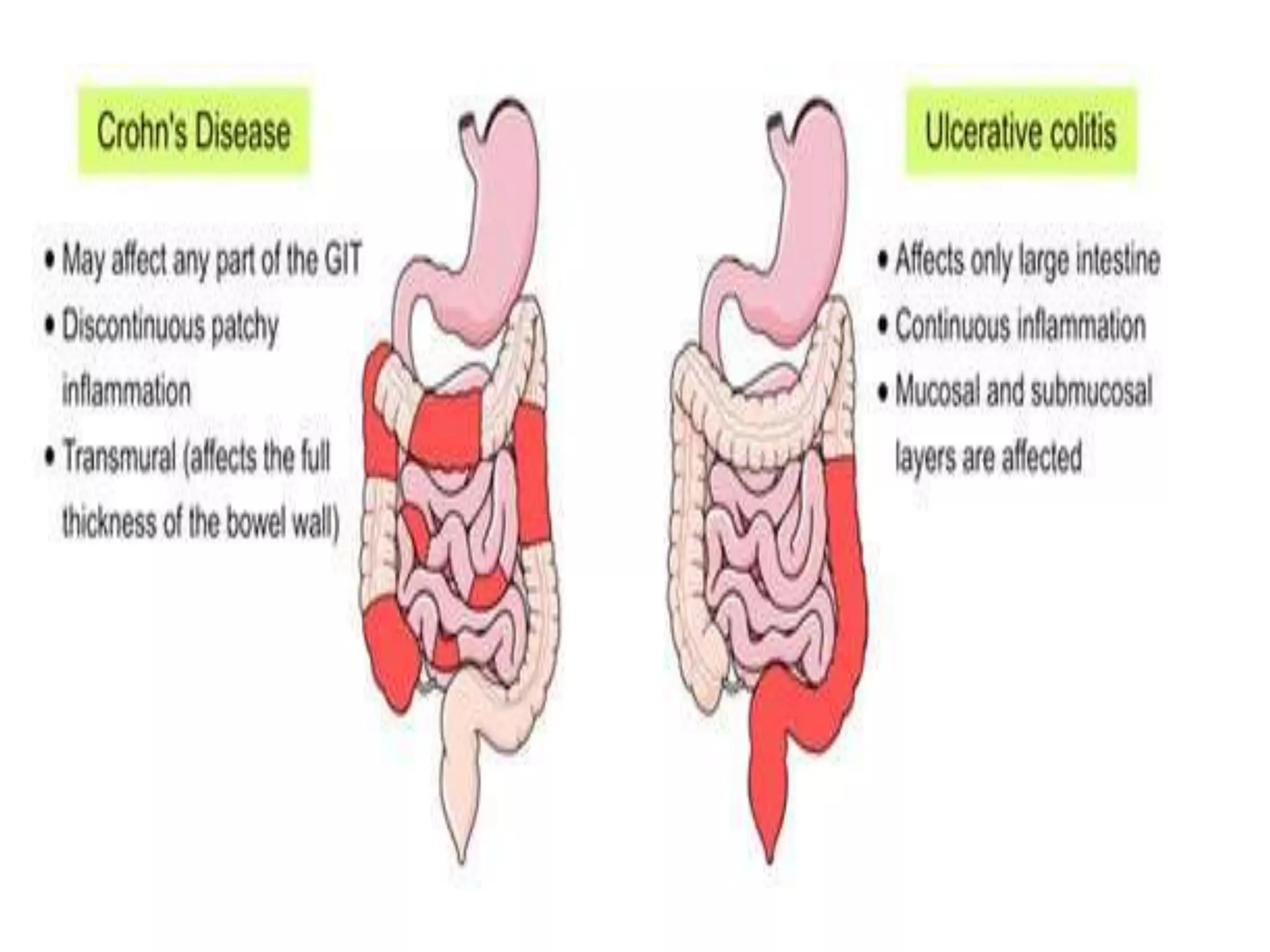
Inflammatory bowel disease
Injury to the colon or rectum
Partial or complete intestinal or
bowel blockage
Rectal or colon cancer
Wounds or fistulas in the perineum.
A fistula is an abnormal connection
between internal parts of the body,
or between an internal organ and
the skin. A woman's perineum is the
area between her anus and vulva; a
man's lies between his anus and
scrotum.
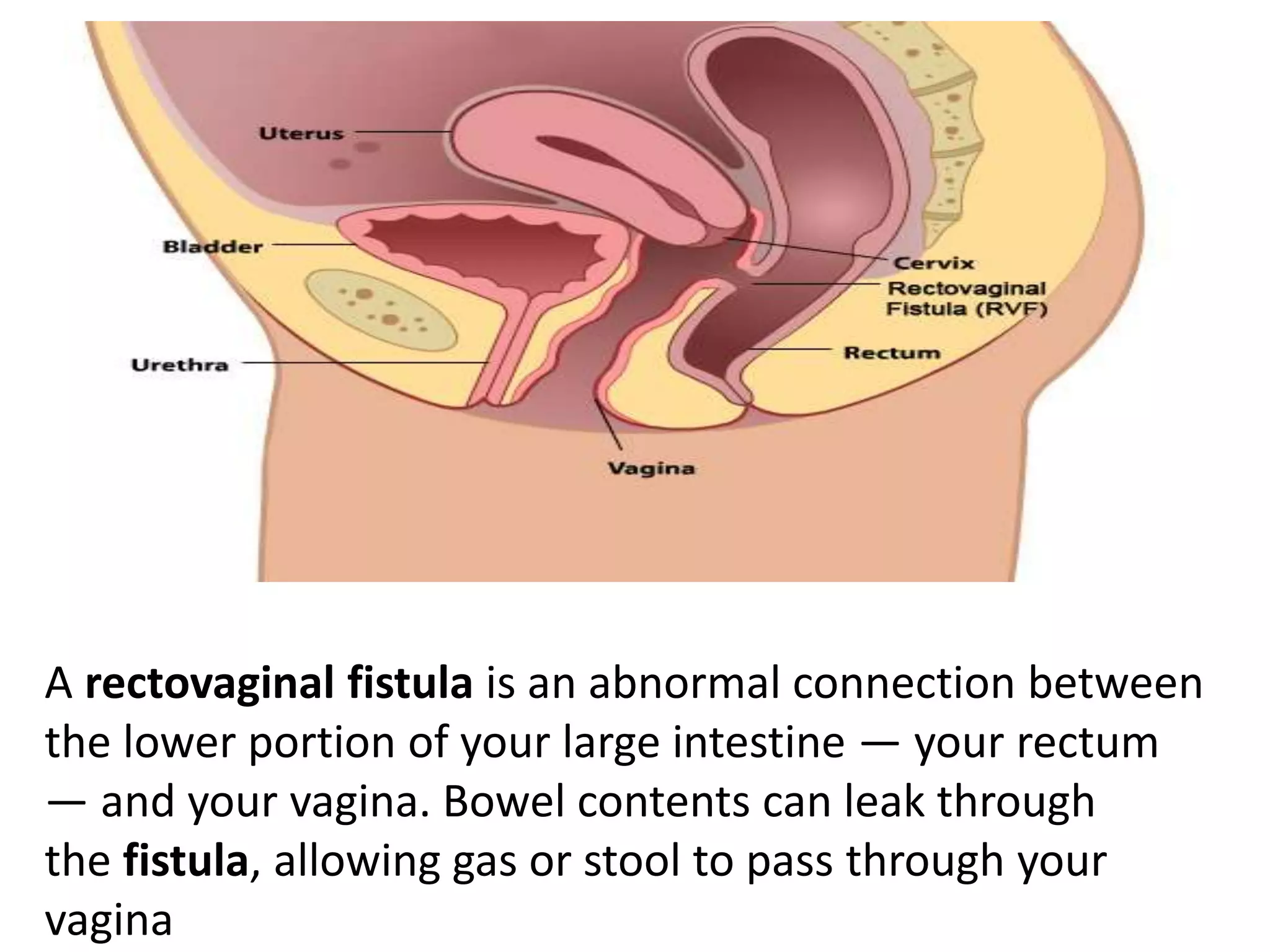
A rectovaginal fistula is an abnormal connection between
the lower portion of your large intestine — your rectum
— and your vagina. Bowel contents can leak through
the fistula, allowing gas or stool to pass through your
vagina
 Temporary- some infections or
injuries require giving the bowel a
temporary rest, then reattaching it.
Permanent colostomy- It may be
required for a more serious or
incurable problem, such as cancer
that requires removal of the rectum,
or a failure of the muscles that
control elimination.
Types of colostomies according to the location
Ascending colostomy — is made from
the ascending part of the colon. The
ascending colostomy is usually located
in the low to middle right side of the
abdomen. The output is often liquid to
semi liquid, and gas is common.
Transverse colostomy — is made from
the transverse part of the colon. The
transverse colostomy is usually located
in the center of the abdomen above the
navel. The output often is liquid to
pasty, and gas is common.
Descending colostomy — is made from
the descending part of the colon. The
descending colostomy is typically
located on the lower left-hand side of
the abdomen. The output may be pasty
to a formed consistency, and gas is
common.
Sigmoid colostomy — is made from the
sigmoid colon. The sigmoid colostomy is
usually located in the lower left-hand
side of the abdomen. The output is
usually pasty to a formed consistency,
and gas is common.
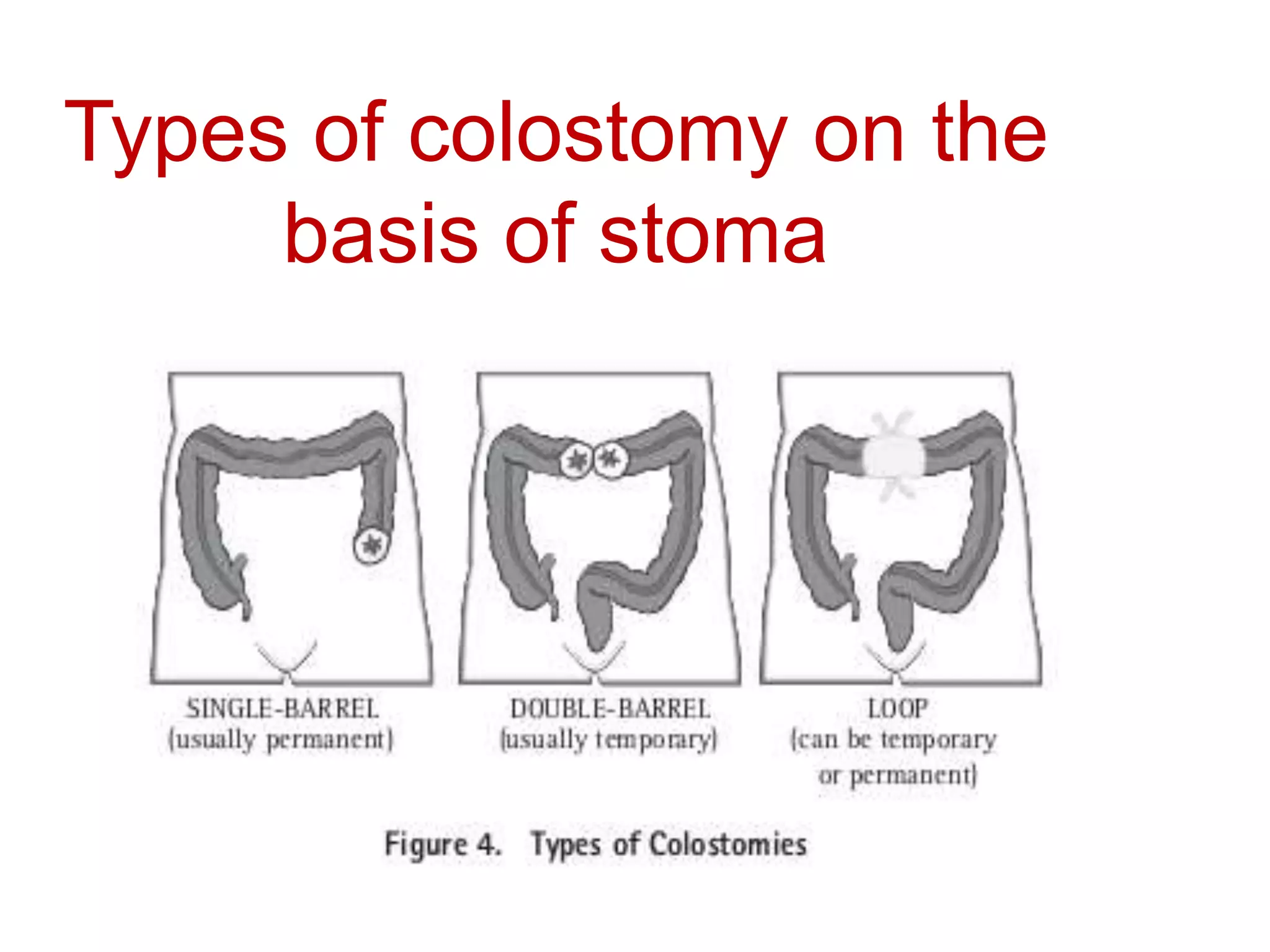
Types of colostomy on the
basis of stoma
 Single barrel colostomy: A stoma is created
from one end of the bowel. The other
portion of the bowel is either removed or
sewn shut
 Double-barrel colostomy -double
barrel transverse colostomy rarely is
performed today. In this surgery, the bowel is
completely divided resulting in two stomas
on the abdominal wall.
Both ends of the bowel are brought through
the abdomen to the skin surface as two
separate sections. The proximal stoma is
functional and expels feces while the distal
stoma passes mucus.
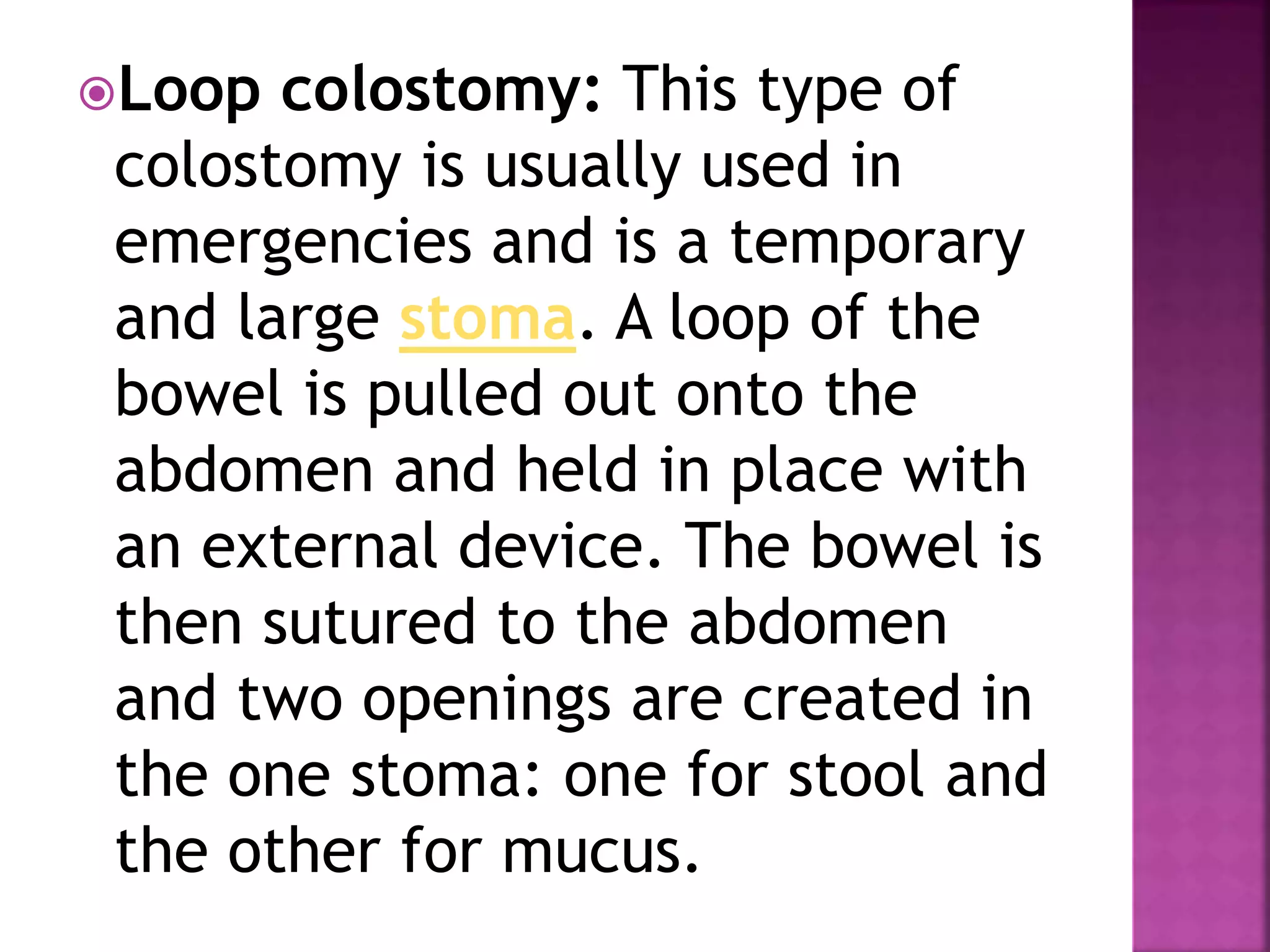
Loop colostomy: This type of
colostomy is usually used in
emergencies and is a temporary
and large stoma. A loop of the
bowel is pulled out onto the
abdomen and held in place with
an external device. The bowel is
then sutured to the abdomen
and two openings are created in
the one stoma: one for stool and
the other for mucus.
 Moist, round, beefy red, budded shape
 Appearance similar to a rose bud
 Protrusion 2-3cm (20-30mm)
 Located on smooth portion of abdomen,
away from beltlines, bony prominences,
suture lines, and umbilicus
 Lumen in center of stoma
 Adequate surface area- two to three inches
of flat surface surrounding stoma
 Location- easily seen by patient- for many
people, the best location is in the lower
quadrant.
PURPOSES
To prevent leakage
To prevent excoriation of skin and
stoma
To observe stoma and surrounding
skin
To teach patient and relatives about
care of colostomy and collecting
bag.
Articles
 A tray containing
 Water in basin
 Soap in dish
 Disposable colostomy bag with clamp
 Stoma measuring guide
 Towel
 Mackintosh
 Clean gloves
 Zinc oxide ointment
 Skin barrier
 Bed pan with cover
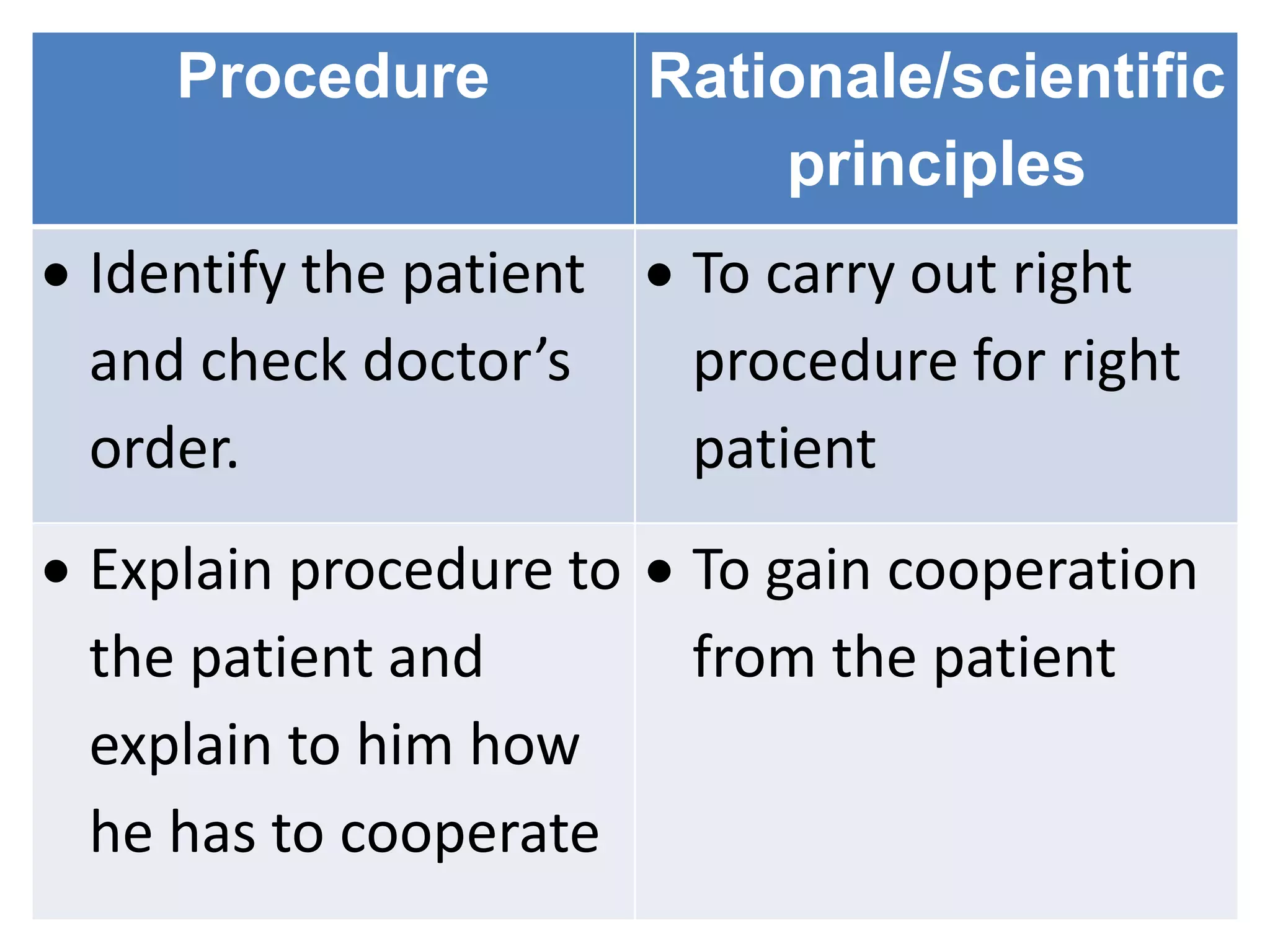
Procedure Rationale/scientific
principles
 Identify the patient
and check doctor’s
order.
 To carry out right
procedure for right
patient
 Explain procedure to
the patient and
explain to him how
he has to cooperate
 To gain cooperation
from the patient
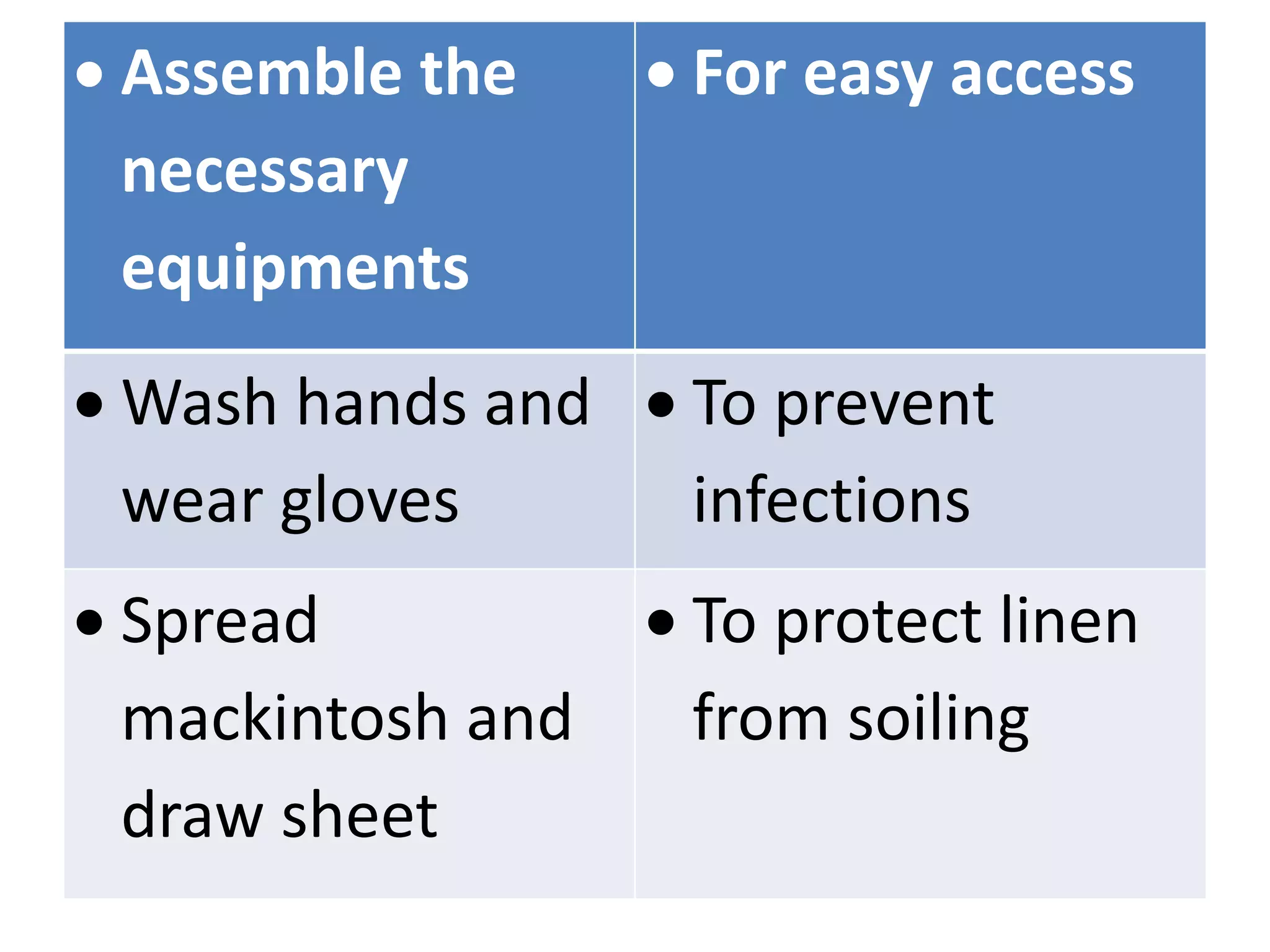
 Assemble the
necessary
equipments
 For easy access
 Wash hands and
wear gloves
 To prevent
infections
 Spread
mackintosh and
draw sheet
 To protect linen
from soiling
 Remove used pouch and
skin barrier gently by
pushing the skin away
from the barrier
 Reduces trauma, jerking
irritates skin and can
cause tear
 Remove clamp and
empty the contents into
the bed pan, rinse the
pouch with tepid water
or normal saline
 To minimize the bed odour
and growth of microbes
 Discard the disposable
pouch in paper bag
 For proper waste
management.
 Observe stoma for colour,
swelling, trauma and healing.
Stoma should be moist and
pink.
 To find out complications
 Cover the stoma with a gauze
piece
 To prevent the fecal matters
from contacting with skin.
Stoma surface is highly
vascular. Skinbarrier does not
adhere to wet skin.
 Clean peristomal region gently
with warm tap water using
gauze pad. Do not scrub the
skin, dry completely by patting
the skin with gauze.
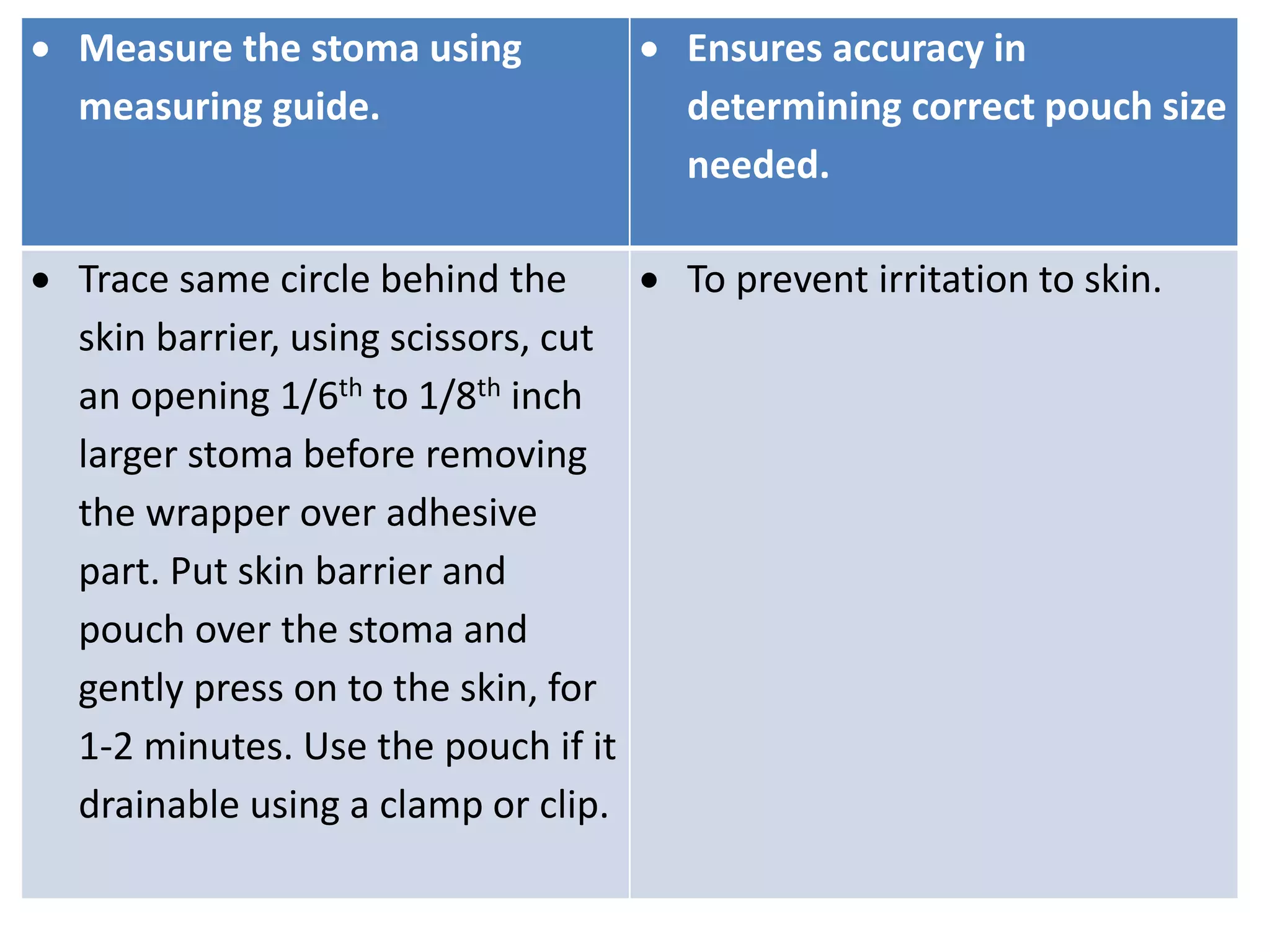
 Measure the stoma using
measuring guide.
 Ensures accuracy in
determining correct pouch size
needed.
 Trace same circle behind the
skin barrier, using scissors, cut
an opening 1/6th to 1/8th inch
larger stoma before removing
the wrapper over adhesive
part. Put skin barrier and
pouch over the stoma and
gently press on to the skin, for
1-2 minutes. Use the pouch if it
drainable using a clamp or clip.
 To prevent irritation to skin.
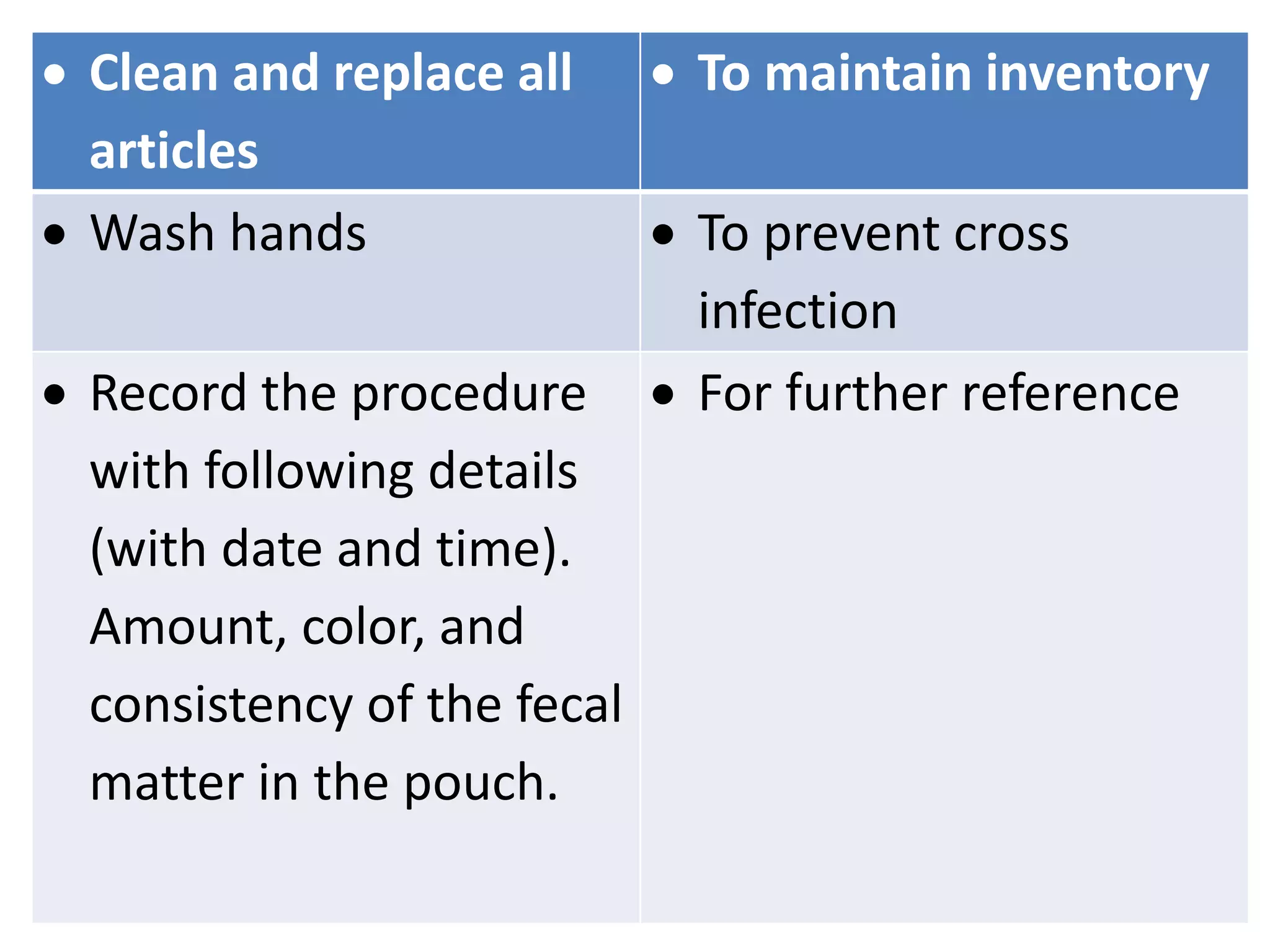
 Clean and replace all
articles
 To maintain inventory
 Wash hands  To prevent cross
infection
 Record the procedure
with following details
(with date and time).
Amount, color, and
consistency of the fecal
matter in the pouch.
 For further reference
Articles
Lubricant
Irrigation solution
Irrigation set (1000-2000 ml
container, tubing with irrigating
stoma cone,clamp)
Irrigating sleeve with adhesive or
belt
Toilet tissue to clean around stoma
Disposable sack for soiled dressing
Procedure Rationale/
scientific
principles
 Identify the
patient and check
doctor’s order
 To do right
procedure for
right patient
 Explain the
procedure to the
patient
 To provide
comfortable
position
 Wash hands  To prevent cross infection
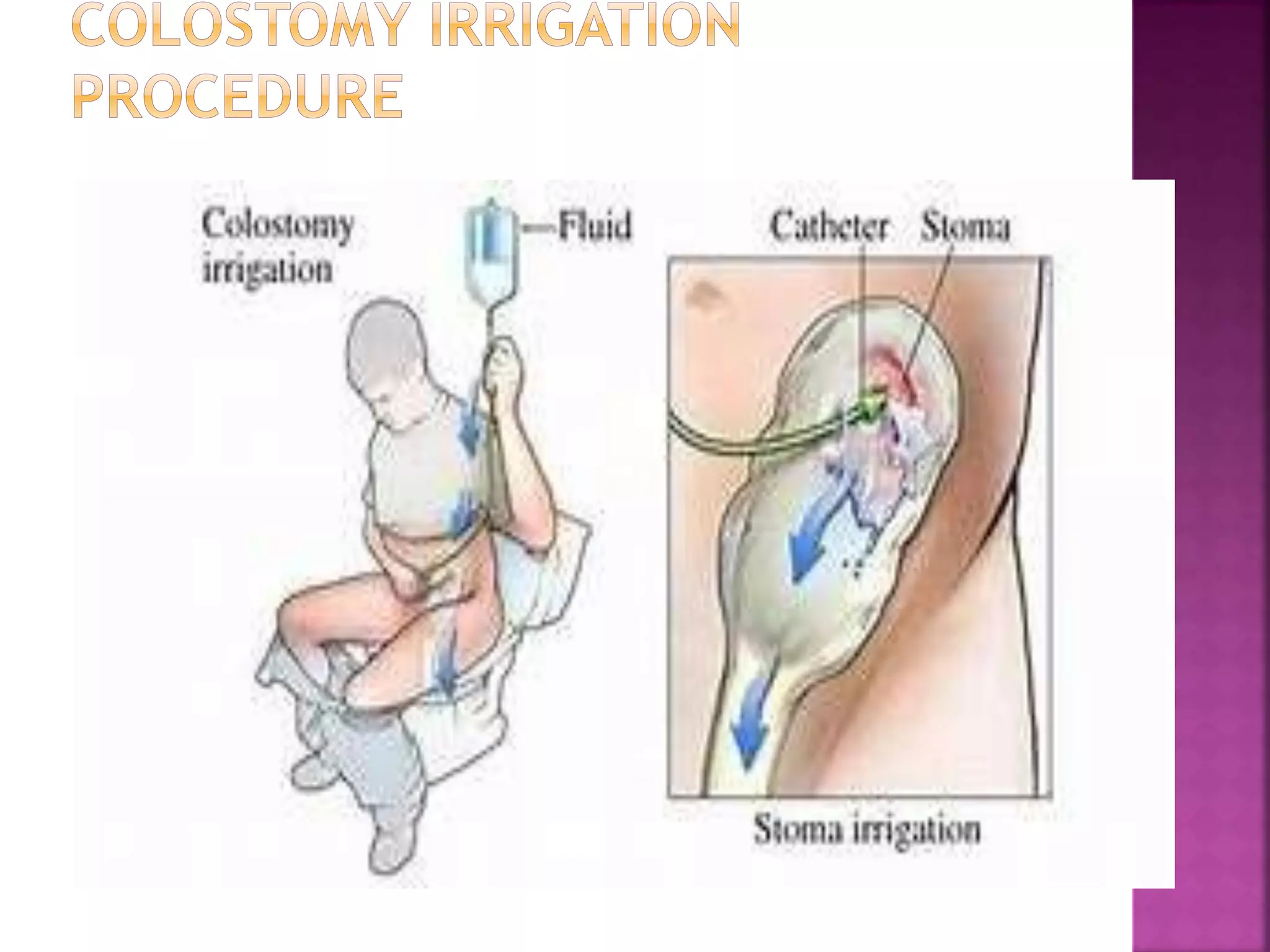
 Place 500-1000ml of luke
warm water (not exceed
40.5 degree celcious ) in
container. Hang container
on hook or IV pole (18-24
inches) above stoma
(about shoulder height).
 Rate of flow and forces of
the fluid depend upon the
height of the reservoir
 Expel the air from the
tubing and clamp. It
removes the froth if any
 Air introduced into the
colon causes discomfort to
the patient.
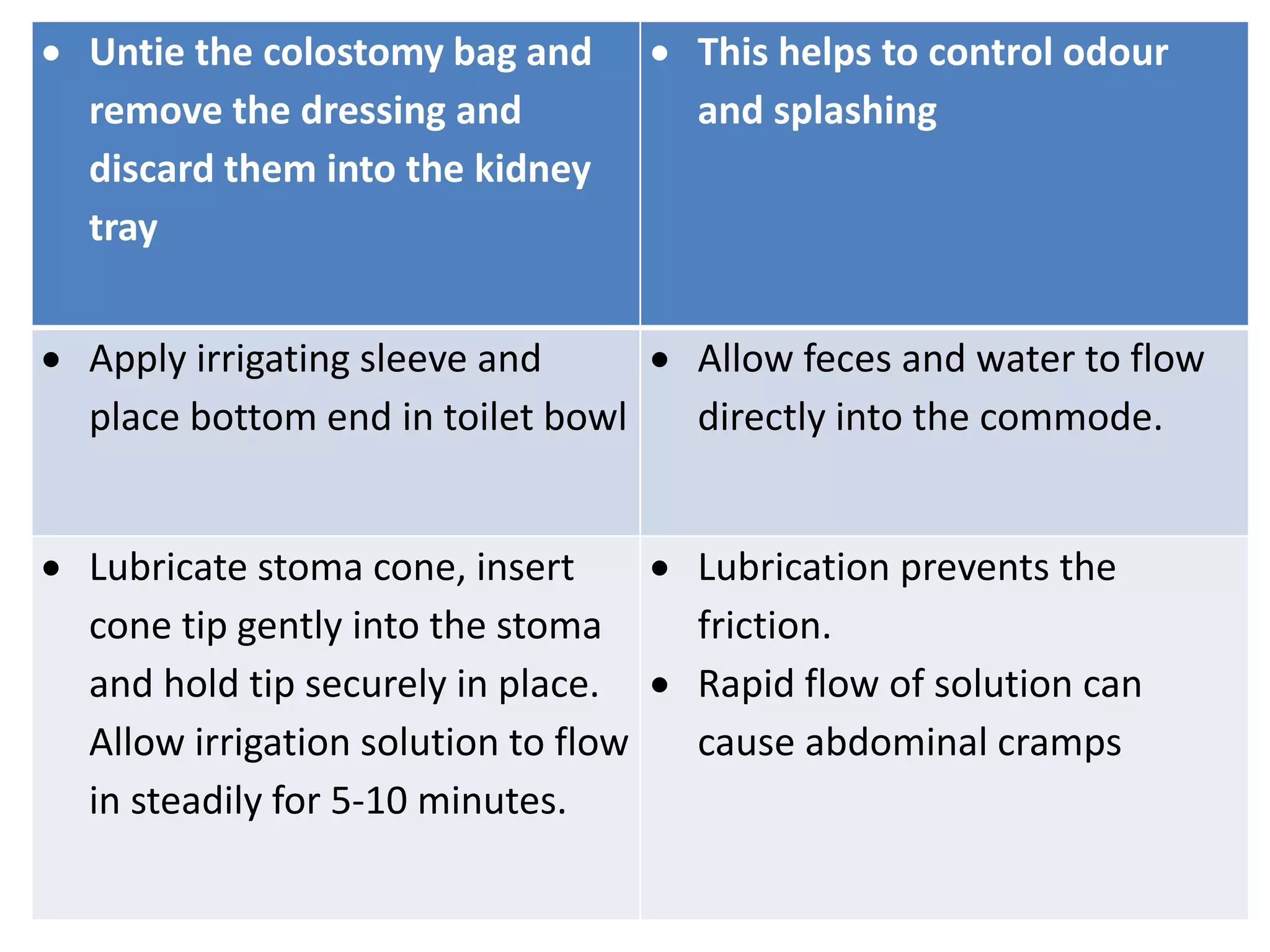
 Untie the colostomy bag and
remove the dressing and
discard them into the kidney
tray
 This helps to control odour
and splashing
 Apply irrigating sleeve and
place bottom end in toilet bowl
 Allow feces and water to flow
directly into the commode.
 Lubricate stoma cone, insert
cone tip gently into the stoma
and hold tip securely in place.
Allow irrigation solution to flow
in steadily for 5-10 minutes.
 Lubrication prevents the
friction.
 Rapid flow of solution can
cause abdominal cramps
 If cramping occurs stop flow of
solutions for a few seconds for a few
seconds, leaving the cone in place.
 Clamping prevents introduction of
air into colon. Ambulation
stimulates peristalsis.
 Clamp the tubing and remove
irrigating cone when the desired
amount of irritant has been delivered
or patient senses colonic distension.
Allow 30-40 minutes for the solution
and feces to be expelled. Initial
evacuation is usually completion 10 -
15 minutes. Close of the irrigating
sleeve at the bottom to allow
ambulation.
 Clean , rinse , and dry peristomal skin  To prevent skin irritation.
There are 2 main types of systems
available:
 One-piece pouches have both a pouch and
skin barrier attached together in the
same unit. When the pouch is removed,
the barrier also comes off.
 Two-piece systems are made up of a skin
barrier separate from a pouch. When the
pouch is taken off, the barrier stays in
place.
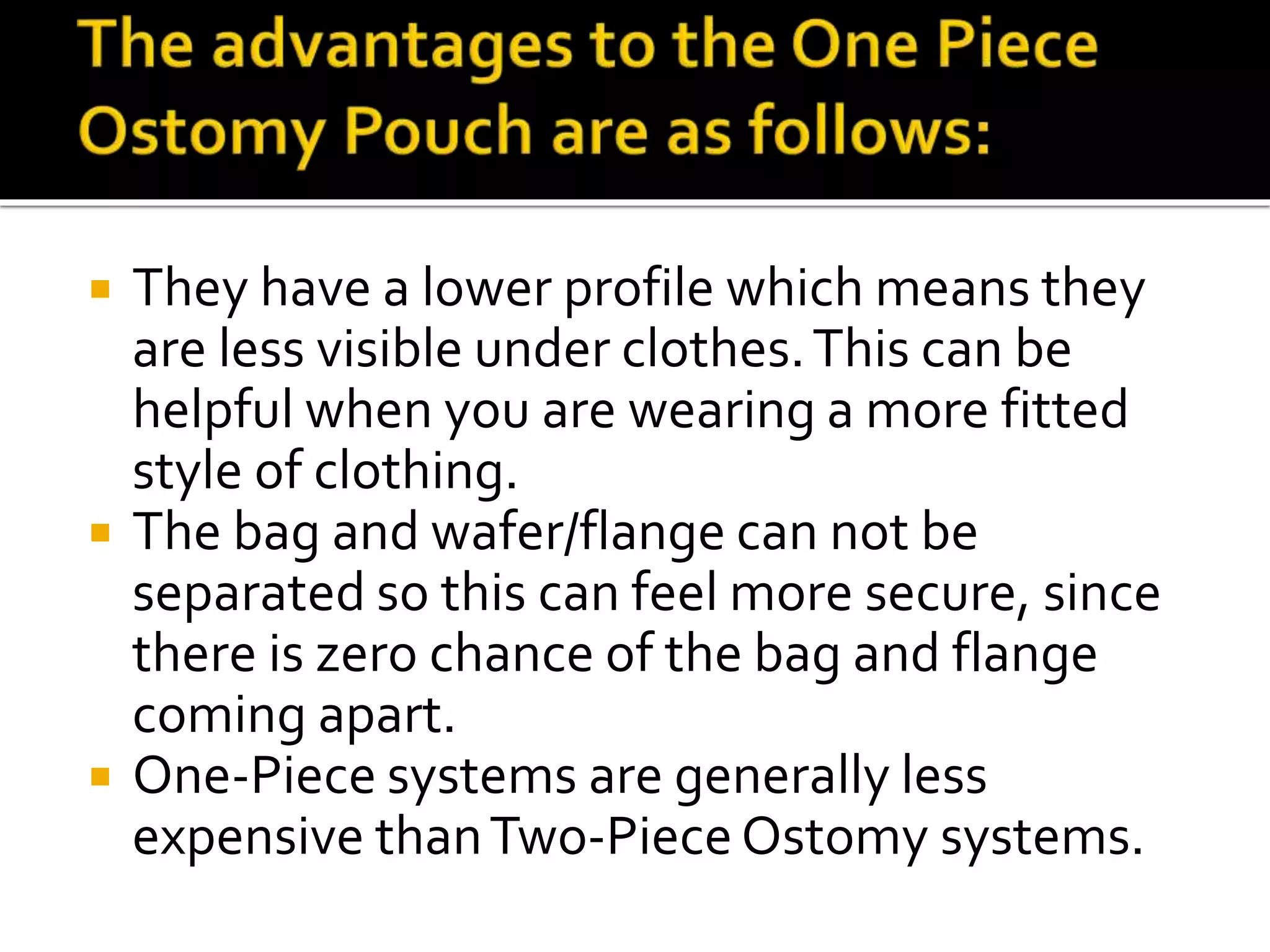
•One-piece pouches system
 They have a lower profile which means they
are less visible under clothes.This can be
helpful when you are wearing a more fitted
style of clothing.
 The bag and wafer/flange can not be
separated so this can feel more secure, since
there is zero chance of the bag and flange
coming apart.
 One-Piece systems are generally less
expensive thanTwo-Piece Ostomy systems.
 Changing the wafer or flange at every bag
change can make our skin tender and cause
some irritation.
 Anytime someone may change the bag, then
we have to get everything positioned around
our stoma right, which can take time, and be
cumbersome in a public restroom.
 We may go through skin barrier pastes,
tapes, and adhesive removers more often.
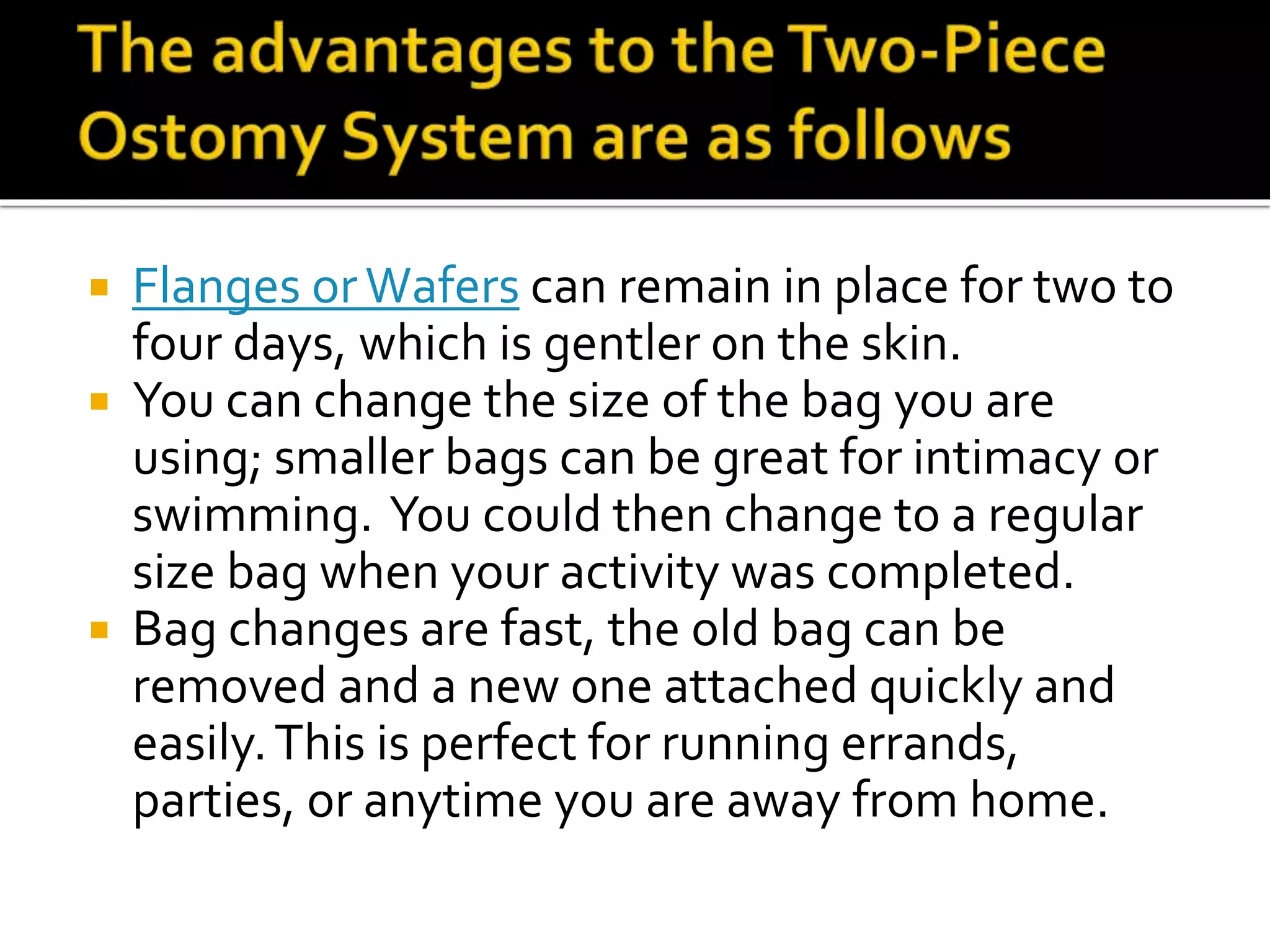
•Two-piece systems
 Flanges orWafers can remain in place for two to
four days, which is gentler on the skin.
 You can change the size of the bag you are
using; smaller bags can be great for intimacy or
swimming. You could then change to a regular
size bag when your activity was completed.
 Bag changes are fast, the old bag can be
removed and a new one attached quickly and
easily.This is perfect for running errands,
parties, or anytime you are away from home.
 Can be more bulky than a One-Piece making
it more visible under clothing.
 Bag and flange (wafer) can come apart and
cause leaks.
 If the stoma output gets behind the flange, it
can be harder to see since you are changing
the flange less often.
 Generally theTwo-Piece System is more
expensive.
 Some pouching systems can be opened at the
bottom for easy emptying. Others are closed
and are taken off when they are full. Still
others allow the adhesive skin barrier to stay
on the body while the pouch may be taken
off, washed out, and reused. Pouches are
made from odor-resistant materials and vary
in cost. They can be either clear or opaque
and come in different lengths
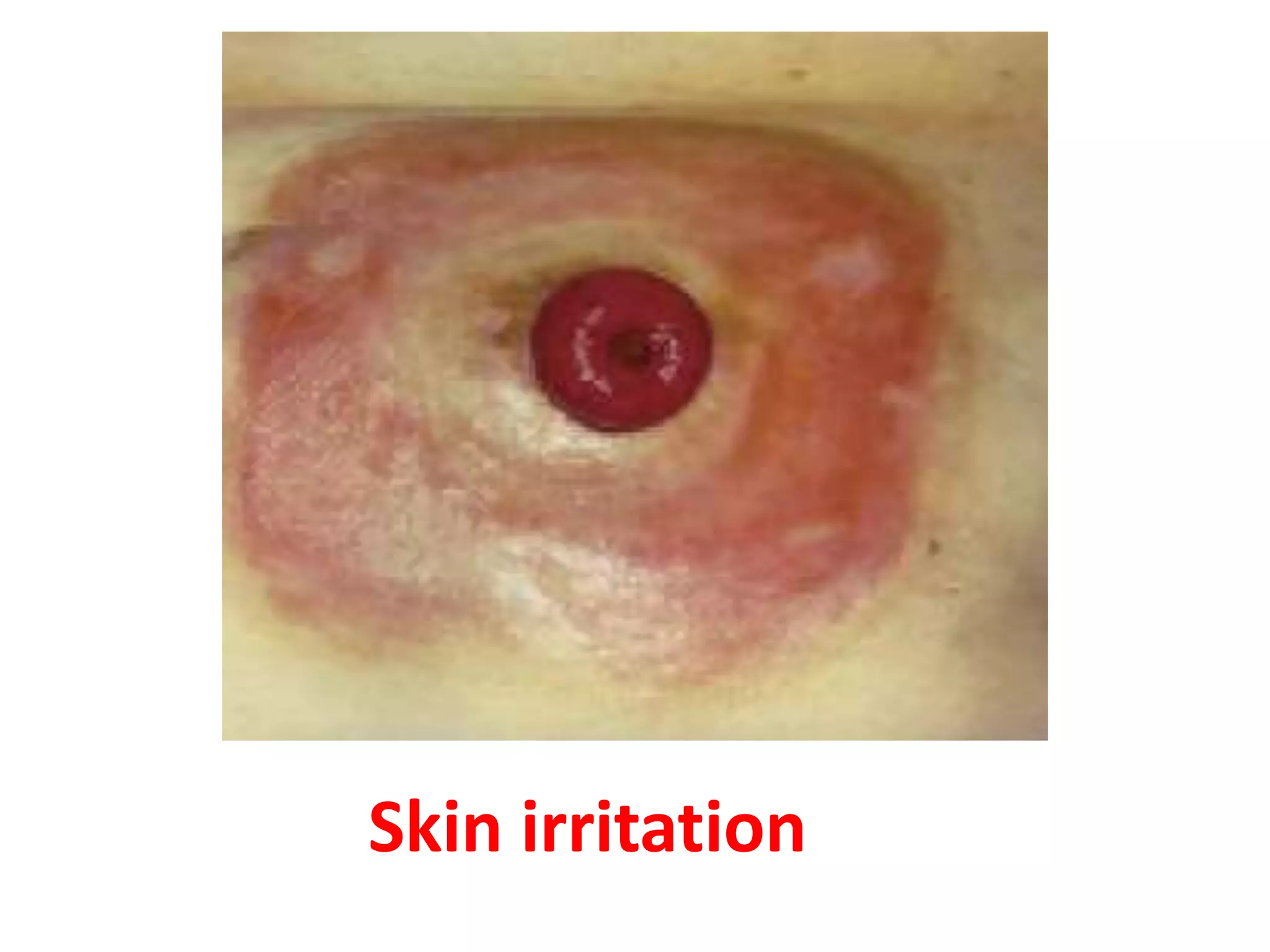
 Skin irritation. This is a common problem that’s
caused by the adhesive on ostomy appliance. Try
using a different appliance or changing the
adhesive you use.
 Dehydration. Having a lot of waste exit through
stoma can lead to dehydration. In most cases,
someone can rehydrate them self by drinking
more fluids, but in severe cases might require
hospitalization. Avoiding foods high in sugar, salt,
and fat can decrease anyone’s risk of
dehydration.
 Leakage. If stoma appliance doesn’t fit properly,
it can leak. If this happens, then probably need
a new appliance that fits better.
Skin irritation
 Bowel obstruction. If food isn’t chewed or
properly digested, it can cause a blockage in
someone’s intestines. Symptoms of a blockage
include cramps, stomach pain, and a sudden
decrease in waste. Inform doctor if someone
notices any symptoms of a blockage. While it
may clear up on its own, some blockages require
additional treatment.
 Retraction It’s possible for stoma to move
inward, usually due to weight gain, scar tissue,
or improper placement. Retraction makes it hard
to attach appliance and can also cause irritation
and leakage. Accessory products of appliance
can help, but a new stoma might be needed in
severe cases.
•Retracted stoma
Parastomal hernia. This is a frequent
complication that happens when
intestine starts to press outward
through the opening. These are very
common and often go away on their
own. However, in some cases may need
surgery to repair it.
Necrosis. Necrosis refers to tissue
death, which happens when blood flow
to stoma is reduced or cut off. When
this happens, it’s usually within the
first few days after surgery.
•Parastomal hernia
•Stomal necrosis
 Someone is vomiting and not seeing any waste in
your pouch
 the skin around stoma is turning blue, purple, or
very dark red
 and someone is becoming dizzy, lightheaded,
and always thirsty
•NURSING CARE
 Educate about what to expect (many patients are
scared), how the stoma will look (show them a
picture), and where it will be on the abdomen.
 Start teaching them about the pouching system
 MD may prescribe oral antibiotics to reduce bacteria
in the colon (which normally lives there) to prevent
post-opt infection.
 2 to 3 days before surgery soft or semi-liquid diet may
be ordered
 A cleansing solution and laxative may be ordered to
clean the colon and that the patient follows a clear
liquid diet prior to surgery (24 hours). Patient may
have to be hospitalized due to the profuse diarrhea
they will be experiencing and may need an IV solution
to maintain hydration.
 NPO day of surgery
Monitor the electrolytes, sign of
dehydration (urinary output) site
and stoma:
After surgery, stoma will be
swollen and large, but after a
couple months it will shrink to
normal size
Prior to discharge, provide written,
verbal, and psychomotor instruction on
colostomy care, pouch management,
skin care, and irrigation for the client.
Whether the colostomy is temporary or
permanent, the client will be
responsible for its management. Good
understanding of procedures and care
enhances the ability to provide self-
care, as well as self-esteem and
control.
Allow ample time for the client (and
family, if necessary) to practice
changing the pouch, either on the
client or a model. Practice of
psychomotor skills improves learning
and confidence.
The diet for a client with a colostomy
is individualized and may require no
alteration from that consumed
preoperatively. Dietary teaching
should, however, include information
on foods to be consumed..
The ostomy
diet
These guidelines need to be followed within
the first few weeks after surgery. This will
help prevent discomfort while colon heals.
 Need to eat small, frequent meals. Try to
have 6 small meals throughout the day
instead of 3 large ones.
 Need to eat slowly and chew your food well.
 Need to Drink 8 to 10 glasses of liquids every
day.
 Need to eat mostly bland, low-fiber foods.
 Eating bland foods will help someone to
avoid uncomfortable symptoms such as
diarrhea (loose or watery bowel movements),
bloating, and gas.
Milk and diary
Foods to include in your diet
 Non-fat (skim) or low-fat (1% or 2%) milk*
 Powdered milk*
 Non-dairy milks (such as soy milk and almond milk)
 Lactose-free dairy products (such as Lactaid® products)
 Yogurt*
 Cheese*
 Low-fat ice cream or sherbet
 Eggs**
Foods to limit
 High-fat milk and dairy products, such as:
 Whole milk
 Regular ice cream or sherbet
 Milk and dairy products with lactose (if someone have diarrhea after
having them)
Meats and proteins
 Foods to include in your diet
 Lean animal proteins, such as:
 Meat without visible fat
 Skinless poultry
 Fish*
 Nuts and nut butter (such as peanut butter)*
 Foods to limit
 High-fat foods, such as fried meat, poultry, or fish
 High-fiber foods, such as dried or canned legumes
(beans)
Grains
Foods to include in your diet
 Low-fiber foods, such as:
 White bread, pasta, and rice
 Bagels, rolls, and crackers made from white or refined
flour
 Cereals made from white or refined flour, such as Cream
of Wheat®, Rice Chex®, and Rice Krispies®
Foods to limit
 High-fiber foods, such as:
 Whole grains, such as whole wheat bread, brown rice,
bran cereal, quinoa, and buckwheat
vegetables
Foods to include in your diet
 Low-fiber foods, such as:
 Well-cooked vegetables without skins or seeds, such as
peeled potatoes, peeled zucchini with the seeds removed,
and peeled tomatoes with the seeds removed
 Lettuce
 Strained vegetable juice
Foods to limit
 High-fiber foods, such as raw vegetables (except lettuce)
Fruits
Foods to include in your diet
 Low-fiber foods, such as:
 Pulp-free fruit juice (except prune juice and grape juice)
 Peeled fruit (such as a peeled apple)
 Canned fruit (except pineapple)
 Fruits with thick skins. Examples include:
 Soft melons, such as watermelon and honeydew
 Orange without the membrane (the thin clear or white part around each orange section)
 Ripe banana
Foods to limit
 High-fiber foods, such as:
 Raw fruits with the skin. Examples include:
 Apples
 Strawberries
 Blueberries
 Grapes
 Prune juice
 Grape juice
Fats
Foods to include in your diet
Foods cooked with a small amount
of fat (such as olive or canola oil)
Foods to limit
High-fat foods, such as fried foods
Drinks
Drinks to include in your diet
 Water
 Decaffeinated coffee or tea
 Drinks that aren’t carbonated
 Sports drinks (such as Gatorade® and Powerade®)
Drinks to limit
 Carbonated drinks, because they may cause gas

Ppt of colostomy

  • 1.
  • 2.
    A colostomy isa surgical procedure that brings one end of the large intestine out through the abdominal wall. During this procedure, one end of the colon is diverted through an incision in the abdominal wall to create a stoma. A stoma is the opening in the skin where a pouch for collecting feces is attached. People with temporary or long-term colostomies have pouches attached to their sides where feces collect and can be easily disposed of.
  • 3.
    Colostomy is anoperation in which an artificial opening is made into the colon on the anterior abdominal wall to permit the escape of faeces and flatus.
  • 4.
    Birth defect, suchas a blocked or missing anal opening, called an imperforate anus Serious infection, such as diverticulitis, inflammation of little sacs on the colon Inflammatory bowel disease Injury to the colon or rectum
  • 7.
    Partial or completeintestinal or bowel blockage Rectal or colon cancer Wounds or fistulas in the perineum. A fistula is an abnormal connection between internal parts of the body, or between an internal organ and the skin. A woman's perineum is the area between her anus and vulva; a man's lies between his anus and scrotum.
  • 8.
    A rectovaginal fistulais an abnormal connection between the lower portion of your large intestine — your rectum — and your vagina. Bowel contents can leak through the fistula, allowing gas or stool to pass through your vagina
  • 10.
     Temporary- someinfections or injuries require giving the bowel a temporary rest, then reattaching it. Permanent colostomy- It may be required for a more serious or incurable problem, such as cancer that requires removal of the rectum, or a failure of the muscles that control elimination.
  • 11.
    Types of colostomiesaccording to the location
  • 12.
    Ascending colostomy —is made from the ascending part of the colon. The ascending colostomy is usually located in the low to middle right side of the abdomen. The output is often liquid to semi liquid, and gas is common. Transverse colostomy — is made from the transverse part of the colon. The transverse colostomy is usually located in the center of the abdomen above the navel. The output often is liquid to pasty, and gas is common.
  • 13.
    Descending colostomy —is made from the descending part of the colon. The descending colostomy is typically located on the lower left-hand side of the abdomen. The output may be pasty to a formed consistency, and gas is common. Sigmoid colostomy — is made from the sigmoid colon. The sigmoid colostomy is usually located in the lower left-hand side of the abdomen. The output is usually pasty to a formed consistency, and gas is common.
  • 14.
    Types of colostomyon the basis of stoma
  • 15.
     Single barrelcolostomy: A stoma is created from one end of the bowel. The other portion of the bowel is either removed or sewn shut  Double-barrel colostomy -double barrel transverse colostomy rarely is performed today. In this surgery, the bowel is completely divided resulting in two stomas on the abdominal wall. Both ends of the bowel are brought through the abdomen to the skin surface as two separate sections. The proximal stoma is functional and expels feces while the distal stoma passes mucus.
  • 16.
    Loop colostomy: Thistype of colostomy is usually used in emergencies and is a temporary and large stoma. A loop of the bowel is pulled out onto the abdomen and held in place with an external device. The bowel is then sutured to the abdomen and two openings are created in the one stoma: one for stool and the other for mucus.
  • 17.
     Moist, round,beefy red, budded shape  Appearance similar to a rose bud  Protrusion 2-3cm (20-30mm)  Located on smooth portion of abdomen, away from beltlines, bony prominences, suture lines, and umbilicus  Lumen in center of stoma  Adequate surface area- two to three inches of flat surface surrounding stoma  Location- easily seen by patient- for many people, the best location is in the lower quadrant.
  • 18.
    PURPOSES To prevent leakage Toprevent excoriation of skin and stoma To observe stoma and surrounding skin To teach patient and relatives about care of colostomy and collecting bag.
  • 19.
    Articles  A traycontaining  Water in basin  Soap in dish  Disposable colostomy bag with clamp  Stoma measuring guide  Towel  Mackintosh  Clean gloves  Zinc oxide ointment  Skin barrier  Bed pan with cover
  • 20.
    Procedure Rationale/scientific principles  Identifythe patient and check doctor’s order.  To carry out right procedure for right patient  Explain procedure to the patient and explain to him how he has to cooperate  To gain cooperation from the patient
  • 21.
     Assemble the necessary equipments For easy access  Wash hands and wear gloves  To prevent infections  Spread mackintosh and draw sheet  To protect linen from soiling
  • 22.
     Remove usedpouch and skin barrier gently by pushing the skin away from the barrier  Reduces trauma, jerking irritates skin and can cause tear  Remove clamp and empty the contents into the bed pan, rinse the pouch with tepid water or normal saline  To minimize the bed odour and growth of microbes  Discard the disposable pouch in paper bag  For proper waste management.
  • 23.
     Observe stomafor colour, swelling, trauma and healing. Stoma should be moist and pink.  To find out complications  Cover the stoma with a gauze piece  To prevent the fecal matters from contacting with skin. Stoma surface is highly vascular. Skinbarrier does not adhere to wet skin.  Clean peristomal region gently with warm tap water using gauze pad. Do not scrub the skin, dry completely by patting the skin with gauze.
  • 24.

     Measure thestoma using measuring guide.  Ensures accuracy in determining correct pouch size needed.  Trace same circle behind the skin barrier, using scissors, cut an opening 1/6th to 1/8th inch larger stoma before removing the wrapper over adhesive part. Put skin barrier and pouch over the stoma and gently press on to the skin, for 1-2 minutes. Use the pouch if it drainable using a clamp or clip.  To prevent irritation to skin.
  • 25.
     Clean andreplace all articles  To maintain inventory  Wash hands  To prevent cross infection  Record the procedure with following details (with date and time). Amount, color, and consistency of the fecal matter in the pouch.  For further reference
  • 27.
    Articles Lubricant Irrigation solution Irrigation set(1000-2000 ml container, tubing with irrigating stoma cone,clamp) Irrigating sleeve with adhesive or belt Toilet tissue to clean around stoma Disposable sack for soiled dressing
  • 28.
    Procedure Rationale/ scientific principles  Identifythe patient and check doctor’s order  To do right procedure for right patient  Explain the procedure to the patient  To provide comfortable position
  • 29.
     Wash hands To prevent cross infection  Place 500-1000ml of luke warm water (not exceed 40.5 degree celcious ) in container. Hang container on hook or IV pole (18-24 inches) above stoma (about shoulder height).  Rate of flow and forces of the fluid depend upon the height of the reservoir  Expel the air from the tubing and clamp. It removes the froth if any  Air introduced into the colon causes discomfort to the patient.
  • 30.
     Untie thecolostomy bag and remove the dressing and discard them into the kidney tray  This helps to control odour and splashing  Apply irrigating sleeve and place bottom end in toilet bowl  Allow feces and water to flow directly into the commode.  Lubricate stoma cone, insert cone tip gently into the stoma and hold tip securely in place. Allow irrigation solution to flow in steadily for 5-10 minutes.  Lubrication prevents the friction.  Rapid flow of solution can cause abdominal cramps
  • 31.
     If crampingoccurs stop flow of solutions for a few seconds for a few seconds, leaving the cone in place.  Clamping prevents introduction of air into colon. Ambulation stimulates peristalsis.  Clamp the tubing and remove irrigating cone when the desired amount of irritant has been delivered or patient senses colonic distension. Allow 30-40 minutes for the solution and feces to be expelled. Initial evacuation is usually completion 10 - 15 minutes. Close of the irrigating sleeve at the bottom to allow ambulation.  Clean , rinse , and dry peristomal skin  To prevent skin irritation.
  • 32.
    There are 2main types of systems available:  One-piece pouches have both a pouch and skin barrier attached together in the same unit. When the pouch is removed, the barrier also comes off.  Two-piece systems are made up of a skin barrier separate from a pouch. When the pouch is taken off, the barrier stays in place.
  • 34.
  • 35.
     They havea lower profile which means they are less visible under clothes.This can be helpful when you are wearing a more fitted style of clothing.  The bag and wafer/flange can not be separated so this can feel more secure, since there is zero chance of the bag and flange coming apart.  One-Piece systems are generally less expensive thanTwo-Piece Ostomy systems.
  • 36.
     Changing thewafer or flange at every bag change can make our skin tender and cause some irritation.  Anytime someone may change the bag, then we have to get everything positioned around our stoma right, which can take time, and be cumbersome in a public restroom.  We may go through skin barrier pastes, tapes, and adhesive removers more often.
  • 37.
  • 38.
     Flanges orWaferscan remain in place for two to four days, which is gentler on the skin.  You can change the size of the bag you are using; smaller bags can be great for intimacy or swimming. You could then change to a regular size bag when your activity was completed.  Bag changes are fast, the old bag can be removed and a new one attached quickly and easily.This is perfect for running errands, parties, or anytime you are away from home.
  • 39.
     Can bemore bulky than a One-Piece making it more visible under clothing.  Bag and flange (wafer) can come apart and cause leaks.  If the stoma output gets behind the flange, it can be harder to see since you are changing the flange less often.  Generally theTwo-Piece System is more expensive.
  • 40.
     Some pouchingsystems can be opened at the bottom for easy emptying. Others are closed and are taken off when they are full. Still others allow the adhesive skin barrier to stay on the body while the pouch may be taken off, washed out, and reused. Pouches are made from odor-resistant materials and vary in cost. They can be either clear or opaque and come in different lengths
  • 41.
     Skin irritation.This is a common problem that’s caused by the adhesive on ostomy appliance. Try using a different appliance or changing the adhesive you use.  Dehydration. Having a lot of waste exit through stoma can lead to dehydration. In most cases, someone can rehydrate them self by drinking more fluids, but in severe cases might require hospitalization. Avoiding foods high in sugar, salt, and fat can decrease anyone’s risk of dehydration.  Leakage. If stoma appliance doesn’t fit properly, it can leak. If this happens, then probably need a new appliance that fits better.
  • 42.
  • 43.
     Bowel obstruction.If food isn’t chewed or properly digested, it can cause a blockage in someone’s intestines. Symptoms of a blockage include cramps, stomach pain, and a sudden decrease in waste. Inform doctor if someone notices any symptoms of a blockage. While it may clear up on its own, some blockages require additional treatment.  Retraction It’s possible for stoma to move inward, usually due to weight gain, scar tissue, or improper placement. Retraction makes it hard to attach appliance and can also cause irritation and leakage. Accessory products of appliance can help, but a new stoma might be needed in severe cases.
  • 44.
  • 45.
    Parastomal hernia. Thisis a frequent complication that happens when intestine starts to press outward through the opening. These are very common and often go away on their own. However, in some cases may need surgery to repair it. Necrosis. Necrosis refers to tissue death, which happens when blood flow to stoma is reduced or cut off. When this happens, it’s usually within the first few days after surgery.
  • 46.
  • 47.
  • 48.
     Someone isvomiting and not seeing any waste in your pouch  the skin around stoma is turning blue, purple, or very dark red  and someone is becoming dizzy, lightheaded, and always thirsty
  • 49.
  • 50.
     Educate aboutwhat to expect (many patients are scared), how the stoma will look (show them a picture), and where it will be on the abdomen.  Start teaching them about the pouching system  MD may prescribe oral antibiotics to reduce bacteria in the colon (which normally lives there) to prevent post-opt infection.  2 to 3 days before surgery soft or semi-liquid diet may be ordered  A cleansing solution and laxative may be ordered to clean the colon and that the patient follows a clear liquid diet prior to surgery (24 hours). Patient may have to be hospitalized due to the profuse diarrhea they will be experiencing and may need an IV solution to maintain hydration.  NPO day of surgery
  • 51.
    Monitor the electrolytes,sign of dehydration (urinary output) site and stoma: After surgery, stoma will be swollen and large, but after a couple months it will shrink to normal size
  • 52.
    Prior to discharge,provide written, verbal, and psychomotor instruction on colostomy care, pouch management, skin care, and irrigation for the client. Whether the colostomy is temporary or permanent, the client will be responsible for its management. Good understanding of procedures and care enhances the ability to provide self- care, as well as self-esteem and control.
  • 53.
    Allow ample timefor the client (and family, if necessary) to practice changing the pouch, either on the client or a model. Practice of psychomotor skills improves learning and confidence. The diet for a client with a colostomy is individualized and may require no alteration from that consumed preoperatively. Dietary teaching should, however, include information on foods to be consumed..
  • 54.
  • 55.
    These guidelines needto be followed within the first few weeks after surgery. This will help prevent discomfort while colon heals.  Need to eat small, frequent meals. Try to have 6 small meals throughout the day instead of 3 large ones.  Need to eat slowly and chew your food well.  Need to Drink 8 to 10 glasses of liquids every day.  Need to eat mostly bland, low-fiber foods.
  • 56.
     Eating blandfoods will help someone to avoid uncomfortable symptoms such as diarrhea (loose or watery bowel movements), bloating, and gas.
  • 57.
    Milk and diary Foodsto include in your diet  Non-fat (skim) or low-fat (1% or 2%) milk*  Powdered milk*  Non-dairy milks (such as soy milk and almond milk)  Lactose-free dairy products (such as Lactaid® products)  Yogurt*  Cheese*  Low-fat ice cream or sherbet  Eggs** Foods to limit  High-fat milk and dairy products, such as:  Whole milk  Regular ice cream or sherbet  Milk and dairy products with lactose (if someone have diarrhea after having them)
  • 58.
    Meats and proteins Foods to include in your diet  Lean animal proteins, such as:  Meat without visible fat  Skinless poultry  Fish*  Nuts and nut butter (such as peanut butter)*  Foods to limit  High-fat foods, such as fried meat, poultry, or fish  High-fiber foods, such as dried or canned legumes (beans)
  • 59.
    Grains Foods to includein your diet  Low-fiber foods, such as:  White bread, pasta, and rice  Bagels, rolls, and crackers made from white or refined flour  Cereals made from white or refined flour, such as Cream of Wheat®, Rice Chex®, and Rice Krispies® Foods to limit  High-fiber foods, such as:  Whole grains, such as whole wheat bread, brown rice, bran cereal, quinoa, and buckwheat
  • 60.
    vegetables Foods to includein your diet  Low-fiber foods, such as:  Well-cooked vegetables without skins or seeds, such as peeled potatoes, peeled zucchini with the seeds removed, and peeled tomatoes with the seeds removed  Lettuce  Strained vegetable juice Foods to limit  High-fiber foods, such as raw vegetables (except lettuce)
  • 61.
    Fruits Foods to includein your diet  Low-fiber foods, such as:  Pulp-free fruit juice (except prune juice and grape juice)  Peeled fruit (such as a peeled apple)  Canned fruit (except pineapple)  Fruits with thick skins. Examples include:  Soft melons, such as watermelon and honeydew  Orange without the membrane (the thin clear or white part around each orange section)  Ripe banana Foods to limit  High-fiber foods, such as:  Raw fruits with the skin. Examples include:  Apples  Strawberries  Blueberries  Grapes  Prune juice  Grape juice
  • 62.
    Fats Foods to includein your diet Foods cooked with a small amount of fat (such as olive or canola oil) Foods to limit High-fat foods, such as fried foods
  • 63.
    Drinks Drinks to includein your diet  Water  Decaffeinated coffee or tea  Drinks that aren’t carbonated  Sports drinks (such as Gatorade® and Powerade®) Drinks to limit  Carbonated drinks, because they may cause gas