Airfoils Reuben, Collin, Andrew
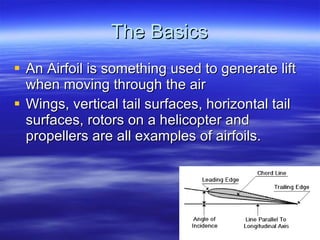
The Basics An Airfoil is something used to generate lift when moving through the air  Wings, vertical tail surfaces, horizontal tail surfaces, rotors on a helicopter and propellers are all examples of airfoils.
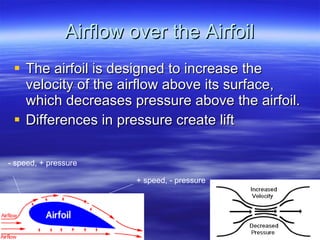
Airflow over the Airfoil The airfoil is designed to increase the velocity of the airflow above its surface, which decreases pressure above the airfoil.  Differences in pressure create lift + speed, - pressure - speed, + pressure
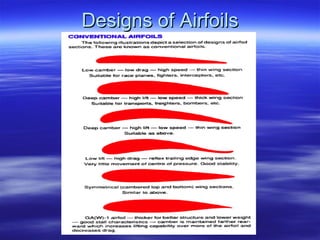
Designs of Airfoils
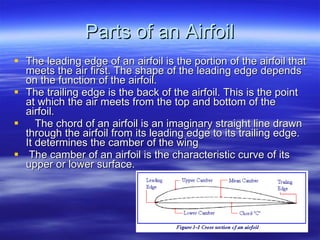
Parts of an Airfoil The leading edge of an airfoil is the portion of the airfoil that meets the air first. The shape of the leading edge depends on the function of the airfoil.  The trailing edge is the back of the airfoil. This is the point at which the air meets from the top and bottom of the airfoil.     The chord of an airfoil is an imaginary straight line drawn through the airfoil from its leading edge to its trailing edge. It determines the camber of the wing   The camber of an airfoil is the characteristic curve of its upper or lower surface.
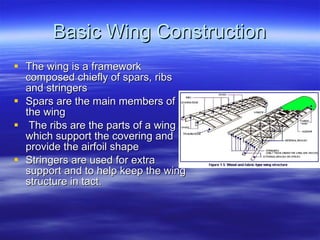
Basic Wing Construction The wing is a framework composed chiefly of spars, ribs and stringers Spars are the main members of the wing   The ribs are the parts of a wing which support the covering and provide the airfoil shape  Stringers are used for extra support and to help keep the wing structure in tact.
Wing Materials Early aircraft used wooden wings, due to its availability and cost. Many small modern aircraft use aluminum wings, due to aluminums lightness, and strength. Most modern aircraft use composite materials, such as carbon fiber and Kevlar. Composite materials are used because they are lightweight, and very strong.

Airfoils

  • 1.
  • 2.
    The Basics AnAirfoil is something used to generate lift when moving through the air Wings, vertical tail surfaces, horizontal tail surfaces, rotors on a helicopter and propellers are all examples of airfoils.
  • 3.
    Airflow over theAirfoil The airfoil is designed to increase the velocity of the airflow above its surface, which decreases pressure above the airfoil. Differences in pressure create lift + speed, - pressure - speed, + pressure
  • 4.
  • 5.
    Parts of anAirfoil The leading edge of an airfoil is the portion of the airfoil that meets the air first. The shape of the leading edge depends on the function of the airfoil. The trailing edge is the back of the airfoil. This is the point at which the air meets from the top and bottom of the airfoil.     The chord of an airfoil is an imaginary straight line drawn through the airfoil from its leading edge to its trailing edge. It determines the camber of the wing   The camber of an airfoil is the characteristic curve of its upper or lower surface.
  • 6.
    Basic Wing ConstructionThe wing is a framework composed chiefly of spars, ribs and stringers Spars are the main members of the wing   The ribs are the parts of a wing which support the covering and provide the airfoil shape Stringers are used for extra support and to help keep the wing structure in tact.
  • 7.
    Wing Materials Earlyaircraft used wooden wings, due to its availability and cost. Many small modern aircraft use aluminum wings, due to aluminums lightness, and strength. Most modern aircraft use composite materials, such as carbon fiber and Kevlar. Composite materials are used because they are lightweight, and very strong.