Basics ofBasics of
AerodynamicsAerodynamics
Presented by:
Zubayer Al Billal Khan
Consultant
zubayer_007@yahoo.com
www.zubayer.name
10/27/18 Zubayer Al Billal Khan 1
AerodynamicsAerodynamics
“A branch of dynamics that deals with the motion of air and
other gaseous fluids and with the forces acting on bodies in
motion relative to such fluids.”
Source: Merriam-Webster Online
Forces of FlightForces of Flight
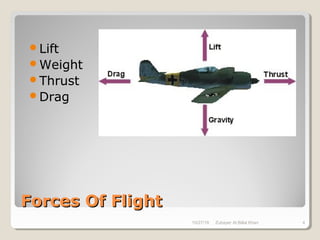
Forces Of FlightForces Of Flight
Lift
Weight
Thrust
Drag
10/27/18 Zubayer Al Billal Khan 4
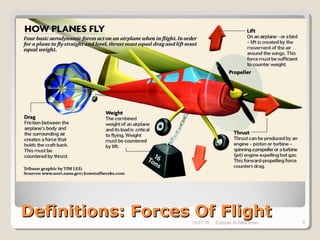
Definitions: Forces Of FlightDefinitions: Forces Of Flight10/27/18 Zubayer Al Billal Khan 5
LiftLift
LiftLift
In addition to allowing the aircraft to fly,
changing the force of lift on various parts
of the aircraft allows the aircraft to be
maneuvered in flight
◦ We will review how lift is created first
10/27/18 Zubayer Al Billal Khan 7
Physics ReviewPhysics Review
Newton’s laws summed up.
◦ 1st
- A body at rest tends to stay at rest and a
body in motion will stay in motion unless acted
on by a force.
◦ 2nd
– Force = Mass * Acceleration
◦ 3rd
– For every action there is an equal and
opposite reaction
10/27/18 Zubayer Al Billal Khan 8
Bernoulli’s Theory of LiftBernoulli’s Theory of Lift
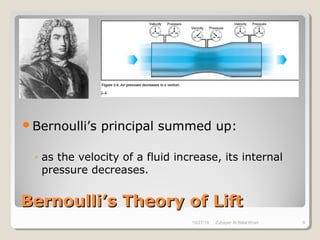
Bernoulli’s principal summed up:
◦ as the velocity of a fluid increase, its internal
pressure decreases.
10/27/18 Zubayer Al Billal Khan 9
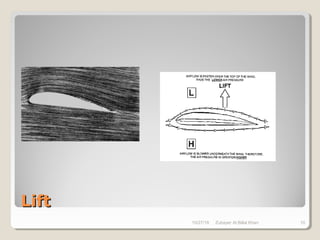
LiftLift
10/27/18 Zubayer Al Billal Khan 10
LiftLift
Changing the basic shape of the airfoil
allows for different flow patterns about the
wing changing the amount of lift created
Changing the amount of lift created by
various airfoils on the aircraft allows the
pilot to maneuver the aircraft in-flight
10/27/18 Zubayer Al Billal Khan 11
TermsTerms
TermsTerms
10/27/18 Zubayer Al Billal Khan 13
Chord LineChord Line
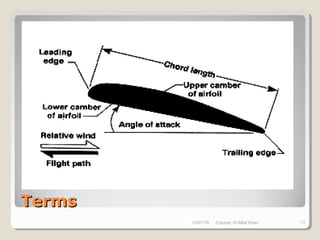
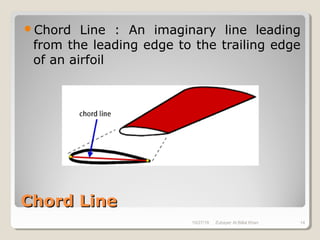
Chord Line : An imaginary line leading
from the leading edge to the trailing edge
of an airfoil
10/27/18 Zubayer Al Billal Khan 14
Angle Of AttackAngle Of Attack
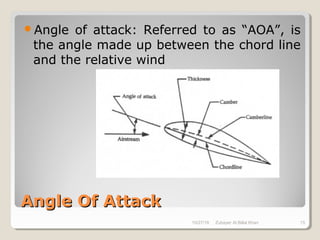
Angle of attack: Referred to as “AOA”, is
the angle made up between the chord line
and the relative wind
10/27/18 Zubayer Al Billal Khan 15
StallsStalls
Airspeed and StallsAirspeed and Stalls
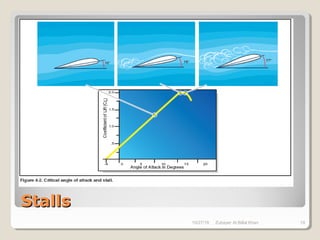
We can only increase AOA so much before
we induce an aerodynamic stall
Though airspeed is often associated with a
stall, a stall can happen at any airspeed
and in any attitude if the critical AOA is
exceeded
10/27/18 Zubayer Al Billal Khan 17
StallsStalls
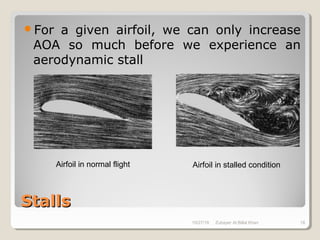
For a given airfoil, we can only increase
AOA so much before we experience an
aerodynamic stall
Airfoil in normal flight Airfoil in stalled condition
10/27/18 Zubayer Al Billal Khan 18
StallsStalls
10/27/18 Zubayer Al Billal Khan 19
Maneuvering FlightManeuvering Flight
Primary Flight ControlsPrimary Flight Controls
10/27/18 Zubayer Al Billal Khan 21
Maneuvering FlightManeuvering Flight
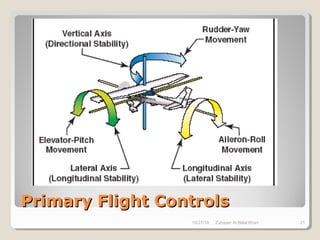
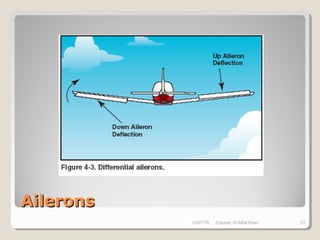
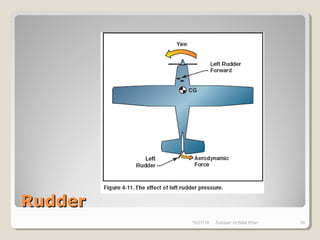
The flight controls allow pilots to
maneuver the aircraft by changing the
pressure distribution (and the amount of
lift created) on various parts of the
aircraft.
The primary flight controls do this by
changing the AOA to change the lift
created thereby allowing the aircraft to
pitch bank and yaw
10/27/18 Zubayer Al Billal Khan 22
AileronsAilerons
10/27/18 Zubayer Al Billal Khan 23
RudderRudder
10/27/18 Zubayer Al Billal Khan 24
DragDrag
DragDrag
Drag is broken into two types
◦ Parasite
◦ Induced
10/27/18 Zubayer Al Billal Khan 26
DragDrag
Parasite drag:
◦ Further broken into
 Form drag
 Skin friction drag
 Interference drag
10/27/18 Zubayer Al Billal Khan 27
DragDrag
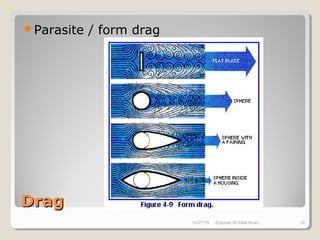
Parasite / form drag
10/27/18 Zubayer Al Billal Khan 28
DragDrag
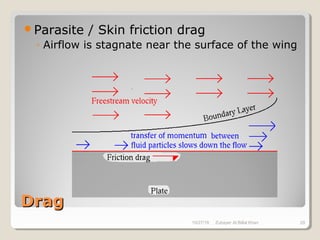
Parasite / Skin friction drag
◦ Airflow is stagnate near the surface of the wing
10/27/18 Zubayer Al Billal Khan 29
DragDrag
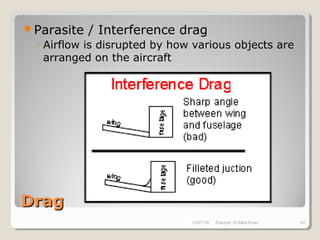
Parasite / Interference drag
◦ Airflow is disrupted by how various objects are
arranged on the aircraft
10/27/18 Zubayer Al Billal Khan 30
DragDrag
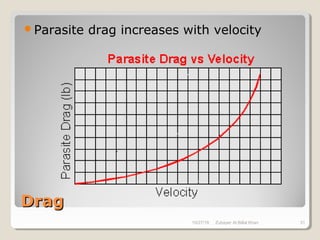
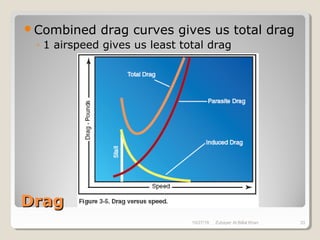
Parasite drag increases with velocity
10/27/18 Zubayer Al Billal Khan 31
DragDrag
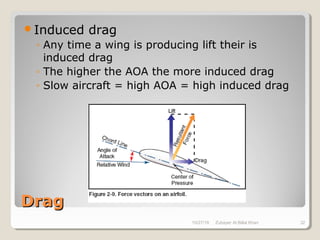
Induced drag
◦ Any time a wing is producing lift their is
induced drag
◦ The higher the AOA the more induced drag
◦ Slow aircraft = high AOA = high induced drag
10/27/18 Zubayer Al Billal Khan 32
DragDrag
Combined drag curves gives us total drag
◦ 1 airspeed gives us least total drag
10/27/18 Zubayer Al Billal Khan 33
Wake TurbulenceWake Turbulence
Wingtip VorticesWingtip Vortices
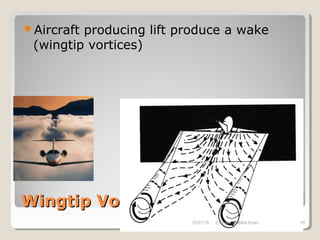
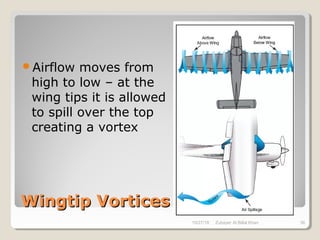
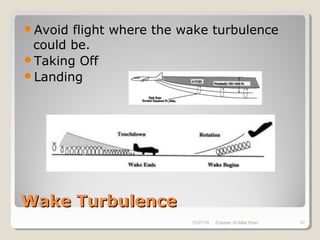
Aircraft producing lift produce a wake
(wingtip vortices)
10/27/18 Zubayer Al Billal Khan 35
Wingtip VorticesWingtip Vortices
Airflow moves from
high to low – at the
wing tips it is allowed
to spill over the top
creating a vortex
10/27/18 Zubayer Al Billal Khan 36
Wake TurbulenceWake Turbulence
Avoid flight where the wake turbulence
could be.
Taking Off
Landing
10/27/18 Zubayer Al Billal Khan 37
Secondary FlightSecondary Flight
ControlsControls
Secondary Flight ControlsSecondary Flight Controls
On most training aircraft secondary flight
controls are limited to:
◦ Flaps
◦ Trim
10/27/18 Zubayer Al Billal Khan 39
Secondary Flight ControlsSecondary Flight Controls
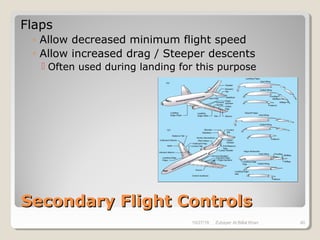
Flaps
◦ Allow decreased minimum flight speed
◦ Allow increased drag / Steeper descents
 Often used during landing for this purpose
10/27/18 Zubayer Al Billal Khan 40
Secondary Flight ControlsSecondary Flight Controls
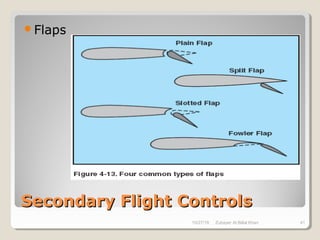
Flaps
10/27/18 Zubayer Al Billal Khan 41
TrimTrim
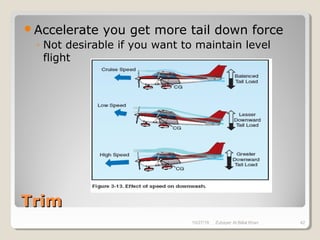
Accelerate you get more tail down force
◦ Not desirable if you want to maintain level
flight
10/27/18 Zubayer Al Billal Khan 42
Multi Rotor Flying PrincipalMulti Rotor Flying Principal
10/27/18 Zubayer Al Billal Khan 43
Weight Balance MechanismWeight Balance Mechanism
10/27/18 Zubayer Al Billal Khan 44
TrimTrim
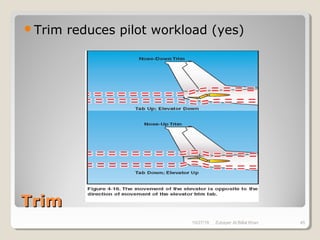
Trim reduces pilot workload (yes)
10/27/18 Zubayer Al Billal Khan 45
ConclusionConclusion
Concluding RemarksConcluding Remarks
What was not discussed
◦ Transonic flow
◦ Drag-divergence Mach number
◦ Supersonic flow
◦ Wave drag
◦ Swept wings
◦ Compressibility effects
◦ Boundary layer theory
◦ The history of aerodynamics
10/27/18 Zubayer Al Billal Khan 46
Ask your question:Ask your question:
For more information
Youtube:
https://www.youtube.com/user/imagineer
ingstudiobd
Contact with me in social media:
https://www.facebook.com/zubayer.billal.
khan/
Email: zubayer_007@yahoo.com
10/27/18 Zubayer Al Billal Khan 47

Basics of Aerodynamics