Basic Aerodynamic and Theory of Flight
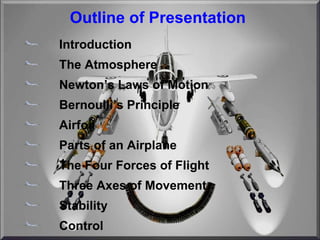
Outline of Presentation Introduction The Atmosphere Newton’s Laws of Motion Bernoulli’s Principle Airfoil Parts of an Airplane The Four Forces of Flight Three Axes of Movement Stability Control
Aerodynamics Aerodynamics is the study of objects in motion through the air and the forces that produce or change such motion. INTRODUCTION It is unnecessary that a mechanic be totally  versed  on  Aerodynamics   and  Theory  of  Flight .  However  he  must understand  the  relationships  between  the  atmosphere,  the aircraft and the forces acting on it in  flight,  in  order  to  make intelligent decisions affecting the flight safety of both  airplanes  and  helicopters.
The Atmosphere Air is a mixture of gases composed principally of  nitrogen and  oxygen.  An  aircraft  operates  in  the air,  therefore,  the properties of air that affect aircraft control and performance must be understood. Pressure   –  Atmospheric  pressure  varies  with  altitude.  The higher an object rises above sea level, the lower  the  pressure. Density  – It varies directly with the pressure and inversely with the temperature. With the same horse power, an aircraft can fly faster at high altitude because of less resistance of air at there. Humidity  – Humidity is the amount of water vapor in the air. It varies directly with temperature.
Newton's First Law of Motion According to Newton's first law of motion (inertia), an object at rest will remain at rest, or an object in motion  will  continue  in motion at the same speed and in the same  direction,  until  an outside force acts on it. For an aircraft  to  taxi  or  fly,  a  force must  be  applied  to  it.  It  would  remain  at  rest  without  an outside force. Once the aircraft is moving, another force must act on it  to  bring  it  to  a  stop.  It  would  continue  in  motion without  an  outside  force.  This  willingness  of  an  object  to remain at rest or to continue in motion is referred to as  inertia .
Newton's Second Law of Motion The second law of motion (force) states that if a object  moving with uniform speed is  acted  upon  by  an  external  force,  the change of motion (acceleration) will be directly  proportional  to the amount of force and inversely proportional to the  mass  of the object  being  moved.  The  motion  will  take  place  in  the direction in which the force acts. Simply stated, this means that an object being pushed by 10 pounds of force will travel  faster than it would if it were pushed by 5 pounds of force. A  heavier object will accelerate more slowly than a lighter object when an equal force is applied.    F = m  ×  a
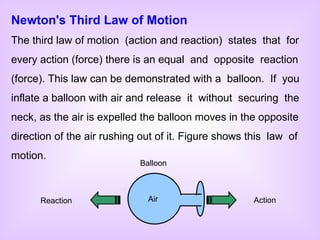
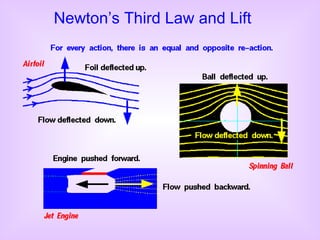
Newton's Third Law of Motion The third law of motion  (action and reaction)  states  that  for every action (force) there is an equal  and  opposite  reaction (force). This law can be demonstrated with a  balloon.  If  you inflate a balloon with air and release  it  without  securing  the neck, as the air is expelled the balloon moves in the opposite direction of the air rushing out of it. Figure shows this  law  of motion. Action Reaction Balloon Air
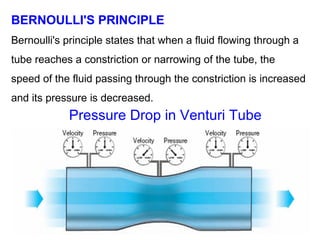
BERNOULLI'S PRINCIPLE Bernoulli's principle states that when a fluid flowing through a tube reaches a constriction or narrowing of the tube, the speed of the fluid passing through the constriction is increased and its pressure is decreased. Pressure Drop in Venturi Tube
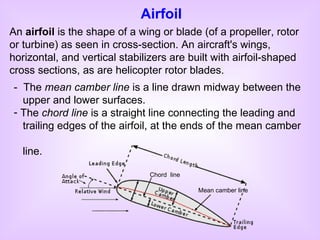
Airfoil An  airfoil  is the shape of a wing or blade (of a propeller, rotor or turbine) as seen in cross-section. An aircraft's wings, horizontal, and vertical stabilizers are built with airfoil-shaped cross sections, as are helicopter rotor blades. -  The  mean camber line  is a line drawn midway between the  upper and lower surfaces.  The  chord line  is a straight line connecting the leading and  trailing edges of the airfoil, at the ends of the mean camber  line. Mean camber line Chord  line
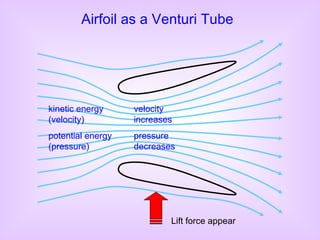
kinetic energy (velocity) potential energy (pressure) velocity increases pressure decreases Airfoil as a Venturi Tube Lift force appear
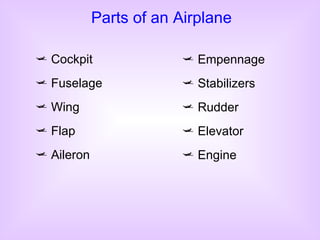
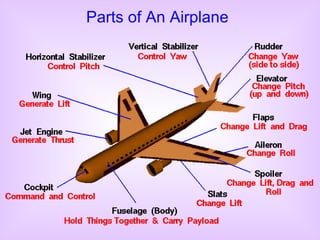
Cockpit Fuselage Wing Flap Aileron Empennage Stabilizers Rudder Elevator Engine Parts of an Airplane
Parts of An Airplane
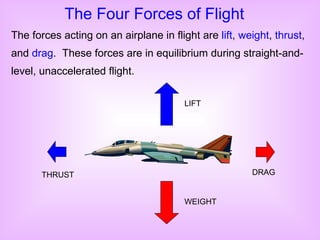
The forces acting on an airplane in flight are  lift ,  weight ,  thrust , and  drag .  These forces are in equilibrium during straight-and-level, unaccelerated flight. The Four Forces of Flight DRAG WEIGHT THRUST LIFT
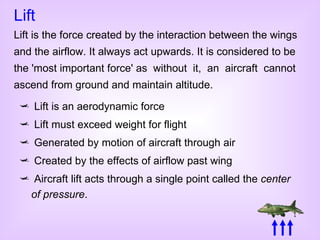
Lift is an aerodynamic force Lift must exceed weight for flight Generated by motion of aircraft through air Created by the effects of airflow past wing Aircraft lift acts through a single point called the  center of pressure . Lift Lift is the force created by the interaction between the wings and the airflow. It always act upwards. It is considered to be the 'most important force' as  without  it,  an  aircraft  cannot ascend from ground and maintain altitude.
Newton’s Third Law and Lift
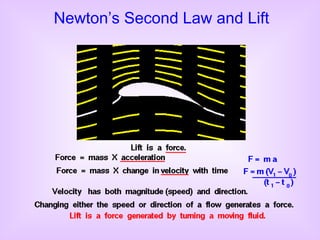
Newton’s Second Law and Lift
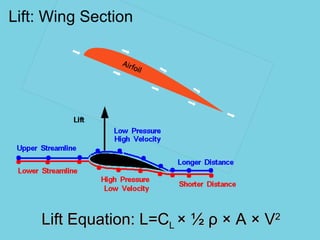
Lift: Wing Section Lift Equation: L=C L  ×   ½  ρ  × A × V 2
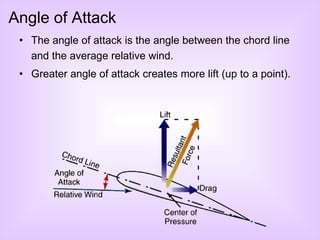
The angle of attack is the angle between the chord line and the average relative wind. Greater angle of attack creates more lift (up to a point). Angle of Attack
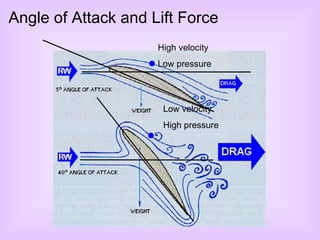
Angle of Attack and Lift Force High velocity  Low pressure Low velocity High pressure
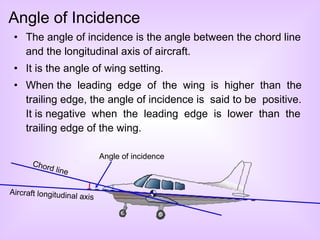
The angle of incidence is the angle between the chord line and the longitudinal axis of aircraft. It is the angle of wing setting. When the  leading  edge  of  the  wing  is  higher  than  the trailing edge, the angle of incidence is  said to be  positive. It is negative  when  the  leading  edge  is  lower  than  the trailing edge of the wing. Angle of Incidence Chord line Aircraft longitudinal axis Angle of incidence
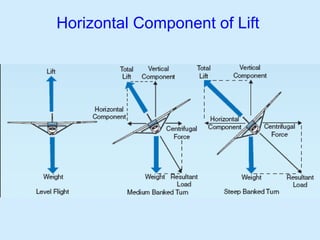
Horizontal Component of Lift
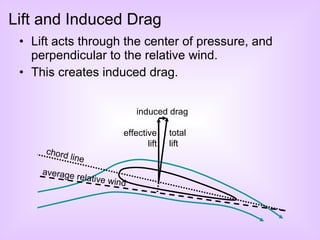
Lift acts through the center of pressure, and perpendicular to the relative wind. This creates induced drag. Lift and Induced Drag chord line average relative wind total lift effective lift induced drag
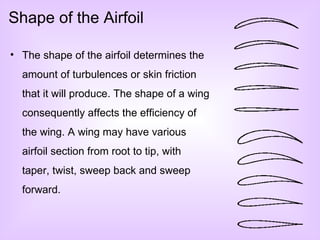
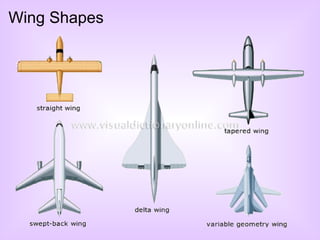
Shape of the Airfoil The shape of the airfoil determines the amount of turbulences or skin friction that it will produce. The shape of a wing consequently affects the efficiency of the wing. A wing may have various airfoil section from root to tip, with taper, twist, sweep back and sweep forward.
Wing Shapes
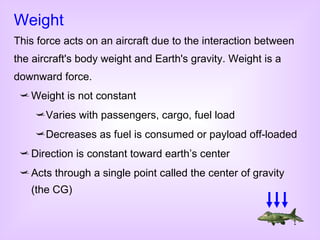
Weight is not constant Varies with passengers, cargo, fuel load Decreases as fuel is consumed or payload off-loaded Direction is constant toward earth’s center Acts through a single point called the center of gravity (the CG) Weight This force acts on an aircraft due to the interaction between the aircraft's body weight and Earth's gravity. Weight is a downward force.
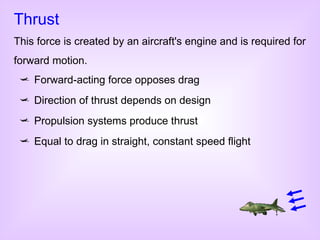
Forward-acting force opposes drag Direction of thrust depends on design Propulsion systems produce thrust Equal to drag in straight, constant speed flight Thrust This force is created by an aircraft's engine and is required for forward motion.
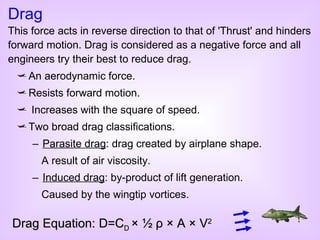
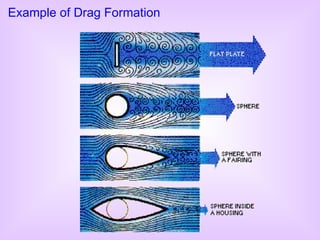
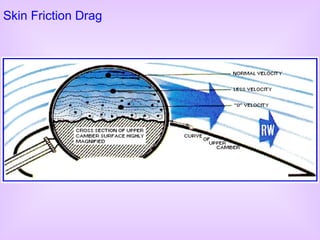
An aerodynamic force. Resists forward motion. Increases with the square of speed. Two broad drag classifications. Parasite drag : drag created by airplane shape. A result of air viscosity. Induced drag : by-product of lift generation. Caused by the wingtip vortices. Drag This force acts in reverse direction to that of 'Thrust' and hinders forward motion. Drag is considered as a negative force and all engineers try their best to reduce drag. Drag Equation: D=C D  ×   ½  ρ  × A × V 2
Example of Drag Formation
Skin Friction Drag
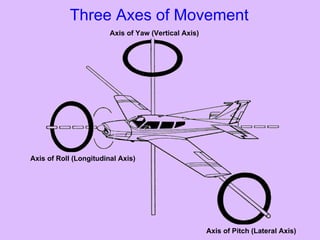
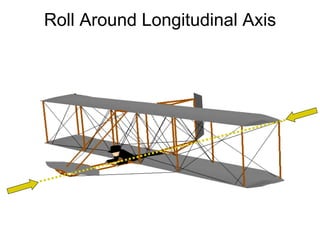
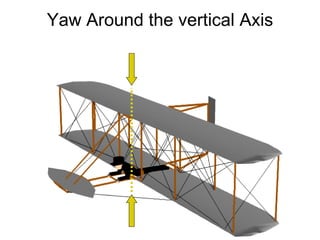
Three Axes of Movement Axis of Roll (Longitudinal Axis) Axis of Pitch (Lateral Axis) Axis of Yaw (Vertical Axis)
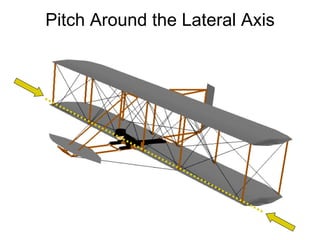
Pitch Around the Lateral Axis
Roll Around Longitudinal Axis
Yaw Around the vertical Axis
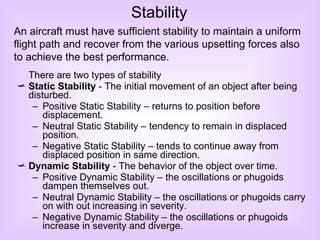
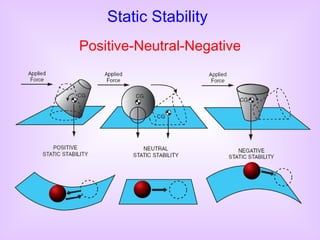
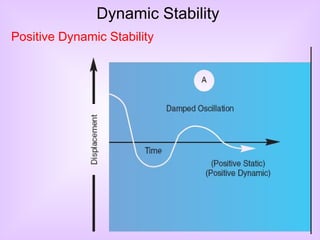
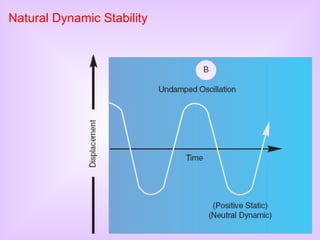
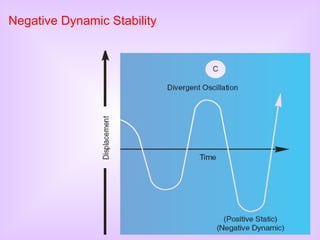
There are two types of stability Static Stability  - The initial movement of an object after being disturbed. Positive Static Stability – returns to position before displacement. Neutral Static Stability – tendency to remain in displaced position. Negative Static Stability – tends to continue away from displaced position in same direction. Dynamic Stability  - The behavior of the object over time. Positive Dynamic Stability – the oscillations or phugoids dampen themselves out. Neutral Dynamic Stability – the oscillations or phugoids carry on with out increasing in severity. Negative Dynamic Stability – the oscillations or phugoids increase in severity and diverge. Stability An aircraft must have sufficient stability to maintain a uniform flight path and recover from the various upsetting forces also to achieve the best performance.
Static Stability Positive-Neutral-Negative
Dynamic Stability Positive Dynamic Stability
Natural Dynamic Stability
Negative Dynamic Stability
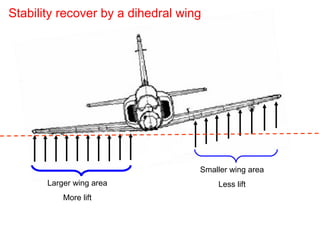
Stability recover by a dihedral wing Larger wing area More lift Smaller wing area Less lift
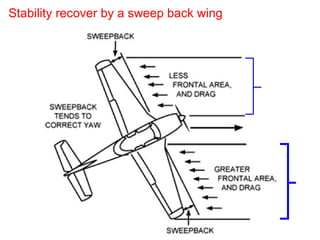
Stability recover by a sweep back wing
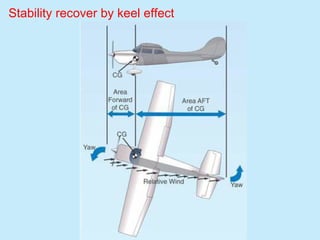
Stability recover by keel effect
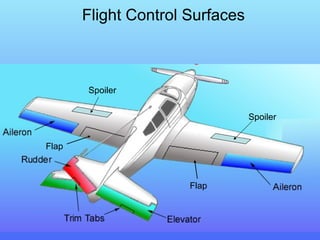
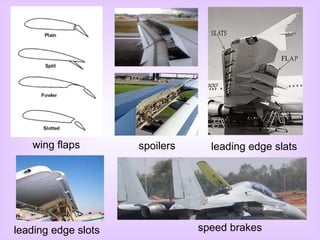
CONTROL To achieve the best performance, the aircraft must have the proper response to the movement of the controls. Control is the action taken to make the aircraft follow any desired flight path. Different Control surfaces are used to control the aircraft about each of the three axes. Flight Control Surfaces  – Hinged or moveable airfoils designed to change the attitude of the aircraft during flight. 1.  Primary group - ailerons - elevators - rudder 2.  Secondary group - trim tab,  spring tab - servo tab, balance tab 3.  Auxiliary group - wing flaps - spoilers - speed brakes - slats - leading edge flaps - slots
Flight Control Surfaces Flap Flap Spoiler Spoiler
wing flaps spoilers leading edge slats leading edge slots speed brakes
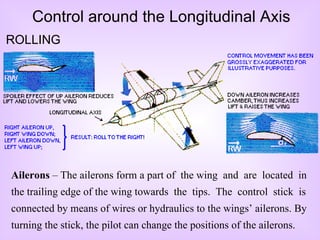
Ailerons  – The ailerons form a part of  the wing  and  are  located  in the trailing edge of the wing towards  the  tips.  The  control  stick  is connected by means of wires or hydraulics to the wings’ ailerons. By turning the stick, the pilot can change the positions of the ailerons.  ROLLING Control around the Longitudinal Axis
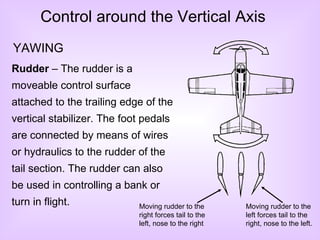
Rudder  – The rudder is a moveable control surface attached to the trailing edge of the vertical stabilizer.  The foot pedals are connected by means of wires or hydraulics to the rudder of the tail section. The rudder can also be used in controlling a bank or turn in flight. YAWING Control around the Vertical Axis Moving rudder to the right forces tail to the left, nose to the right Moving rudder to the left forces tail to the right, nose to the left.
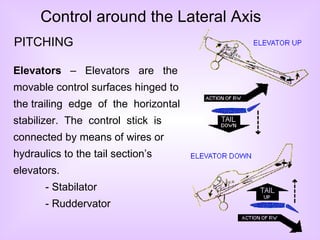
Elevators   –  Elevators  are  the movable control surfaces hinged to the trailing  edge  of  the  horizontal stabilizer.  The  control  stick  is connected by means of wires or hydraulics to the tail section’s elevators.  - Stabilator - Ruddervator PITCHING Control around the Lateral Axis
End of Presentation Thanks for your time

Basic aerodynamics

  • 1.
    Basic Aerodynamic andTheory of Flight
  • 2.
    Outline of PresentationIntroduction The Atmosphere Newton’s Laws of Motion Bernoulli’s Principle Airfoil Parts of an Airplane The Four Forces of Flight Three Axes of Movement Stability Control
  • 3.
    Aerodynamics Aerodynamics isthe study of objects in motion through the air and the forces that produce or change such motion. INTRODUCTION It is unnecessary that a mechanic be totally versed on Aerodynamics and Theory of Flight . However he must understand the relationships between the atmosphere, the aircraft and the forces acting on it in flight, in order to make intelligent decisions affecting the flight safety of both airplanes and helicopters.
  • 4.
    The Atmosphere Airis a mixture of gases composed principally of nitrogen and oxygen. An aircraft operates in the air, therefore, the properties of air that affect aircraft control and performance must be understood. Pressure – Atmospheric pressure varies with altitude. The higher an object rises above sea level, the lower the pressure. Density – It varies directly with the pressure and inversely with the temperature. With the same horse power, an aircraft can fly faster at high altitude because of less resistance of air at there. Humidity – Humidity is the amount of water vapor in the air. It varies directly with temperature.
  • 5.
    Newton's First Lawof Motion According to Newton's first law of motion (inertia), an object at rest will remain at rest, or an object in motion will continue in motion at the same speed and in the same direction, until an outside force acts on it. For an aircraft to taxi or fly, a force must be applied to it. It would remain at rest without an outside force. Once the aircraft is moving, another force must act on it to bring it to a stop. It would continue in motion without an outside force. This willingness of an object to remain at rest or to continue in motion is referred to as inertia .
  • 6.
    Newton's Second Lawof Motion The second law of motion (force) states that if a object moving with uniform speed is acted upon by an external force, the change of motion (acceleration) will be directly proportional to the amount of force and inversely proportional to the mass of the object being moved. The motion will take place in the direction in which the force acts. Simply stated, this means that an object being pushed by 10 pounds of force will travel faster than it would if it were pushed by 5 pounds of force. A heavier object will accelerate more slowly than a lighter object when an equal force is applied. F = m × a
  • 7.
    Newton's Third Lawof Motion The third law of motion (action and reaction) states that for every action (force) there is an equal and opposite reaction (force). This law can be demonstrated with a balloon. If you inflate a balloon with air and release it without securing the neck, as the air is expelled the balloon moves in the opposite direction of the air rushing out of it. Figure shows this law of motion. Action Reaction Balloon Air
  • 8.
    BERNOULLI'S PRINCIPLE Bernoulli'sprinciple states that when a fluid flowing through a tube reaches a constriction or narrowing of the tube, the speed of the fluid passing through the constriction is increased and its pressure is decreased. Pressure Drop in Venturi Tube
  • 9.
    Airfoil An airfoil is the shape of a wing or blade (of a propeller, rotor or turbine) as seen in cross-section. An aircraft's wings, horizontal, and vertical stabilizers are built with airfoil-shaped cross sections, as are helicopter rotor blades. - The mean camber line is a line drawn midway between the upper and lower surfaces. The chord line is a straight line connecting the leading and trailing edges of the airfoil, at the ends of the mean camber line. Mean camber line Chord line
  • 10.
    kinetic energy (velocity)potential energy (pressure) velocity increases pressure decreases Airfoil as a Venturi Tube Lift force appear
  • 11.
    Cockpit Fuselage WingFlap Aileron Empennage Stabilizers Rudder Elevator Engine Parts of an Airplane
  • 12.
    Parts of AnAirplane
  • 13.
    The forces actingon an airplane in flight are lift , weight , thrust , and drag . These forces are in equilibrium during straight-and-level, unaccelerated flight. The Four Forces of Flight DRAG WEIGHT THRUST LIFT
  • 14.
    Lift is anaerodynamic force Lift must exceed weight for flight Generated by motion of aircraft through air Created by the effects of airflow past wing Aircraft lift acts through a single point called the center of pressure . Lift Lift is the force created by the interaction between the wings and the airflow. It always act upwards. It is considered to be the 'most important force' as without it, an aircraft cannot ascend from ground and maintain altitude.
  • 15.
  • 16.
  • 17.
    Lift: Wing SectionLift Equation: L=C L × ½ ρ × A × V 2
  • 18.
    The angle ofattack is the angle between the chord line and the average relative wind. Greater angle of attack creates more lift (up to a point). Angle of Attack
  • 19.
    Angle of Attackand Lift Force High velocity Low pressure Low velocity High pressure
  • 20.
    The angle ofincidence is the angle between the chord line and the longitudinal axis of aircraft. It is the angle of wing setting. When the leading edge of the wing is higher than the trailing edge, the angle of incidence is said to be positive. It is negative when the leading edge is lower than the trailing edge of the wing. Angle of Incidence Chord line Aircraft longitudinal axis Angle of incidence
  • 21.
  • 22.
    Lift acts throughthe center of pressure, and perpendicular to the relative wind. This creates induced drag. Lift and Induced Drag chord line average relative wind total lift effective lift induced drag
  • 23.
    Shape of theAirfoil The shape of the airfoil determines the amount of turbulences or skin friction that it will produce. The shape of a wing consequently affects the efficiency of the wing. A wing may have various airfoil section from root to tip, with taper, twist, sweep back and sweep forward.
  • 24.
  • 25.
    Weight is notconstant Varies with passengers, cargo, fuel load Decreases as fuel is consumed or payload off-loaded Direction is constant toward earth’s center Acts through a single point called the center of gravity (the CG) Weight This force acts on an aircraft due to the interaction between the aircraft's body weight and Earth's gravity. Weight is a downward force.
  • 26.
    Forward-acting force opposesdrag Direction of thrust depends on design Propulsion systems produce thrust Equal to drag in straight, constant speed flight Thrust This force is created by an aircraft's engine and is required for forward motion.
  • 27.
    An aerodynamic force.Resists forward motion. Increases with the square of speed. Two broad drag classifications. Parasite drag : drag created by airplane shape. A result of air viscosity. Induced drag : by-product of lift generation. Caused by the wingtip vortices. Drag This force acts in reverse direction to that of 'Thrust' and hinders forward motion. Drag is considered as a negative force and all engineers try their best to reduce drag. Drag Equation: D=C D × ½ ρ × A × V 2
  • 28.
    Example of DragFormation
  • 29.
  • 30.
    Three Axes ofMovement Axis of Roll (Longitudinal Axis) Axis of Pitch (Lateral Axis) Axis of Yaw (Vertical Axis)
  • 31.
    Pitch Around theLateral Axis
  • 32.
  • 33.
    Yaw Around thevertical Axis
  • 34.
    There are twotypes of stability Static Stability - The initial movement of an object after being disturbed. Positive Static Stability – returns to position before displacement. Neutral Static Stability – tendency to remain in displaced position. Negative Static Stability – tends to continue away from displaced position in same direction. Dynamic Stability - The behavior of the object over time. Positive Dynamic Stability – the oscillations or phugoids dampen themselves out. Neutral Dynamic Stability – the oscillations or phugoids carry on with out increasing in severity. Negative Dynamic Stability – the oscillations or phugoids increase in severity and diverge. Stability An aircraft must have sufficient stability to maintain a uniform flight path and recover from the various upsetting forces also to achieve the best performance.
  • 35.
  • 36.
    Dynamic Stability PositiveDynamic Stability
  • 37.
  • 38.
  • 39.
    Stability recover bya dihedral wing Larger wing area More lift Smaller wing area Less lift
  • 40.
    Stability recover bya sweep back wing
  • 41.
  • 42.
    CONTROL To achievethe best performance, the aircraft must have the proper response to the movement of the controls. Control is the action taken to make the aircraft follow any desired flight path. Different Control surfaces are used to control the aircraft about each of the three axes. Flight Control Surfaces – Hinged or moveable airfoils designed to change the attitude of the aircraft during flight. 1. Primary group - ailerons - elevators - rudder 2. Secondary group - trim tab, spring tab - servo tab, balance tab 3. Auxiliary group - wing flaps - spoilers - speed brakes - slats - leading edge flaps - slots
  • 43.
    Flight Control SurfacesFlap Flap Spoiler Spoiler
  • 44.
    wing flaps spoilersleading edge slats leading edge slots speed brakes
  • 45.
    Ailerons –The ailerons form a part of the wing and are located in the trailing edge of the wing towards the tips. The control stick is connected by means of wires or hydraulics to the wings’ ailerons. By turning the stick, the pilot can change the positions of the ailerons. ROLLING Control around the Longitudinal Axis
  • 46.
    Rudder –The rudder is a moveable control surface attached to the trailing edge of the vertical stabilizer. The foot pedals are connected by means of wires or hydraulics to the rudder of the tail section. The rudder can also be used in controlling a bank or turn in flight. YAWING Control around the Vertical Axis Moving rudder to the right forces tail to the left, nose to the right Moving rudder to the left forces tail to the right, nose to the left.
  • 47.
    Elevators – Elevators are the movable control surfaces hinged to the trailing edge of the horizontal stabilizer. The control stick is connected by means of wires or hydraulics to the tail section’s elevators. - Stabilator - Ruddervator PITCHING Control around the Lateral Axis
  • 48.
    End of PresentationThanks for your time

Editor's Notes

  • #26 Discuss weight from lift equation POV.
  • #27 Propeller is a rotating airfoil.
  • #46 The stick is connected by means of wires or hydraulics to the wings’ ailerons. By turning the stick, the pilot can change the positions of the ailerons . When the control wheel is turned to the right, the right aileron goes up and the left aileron goes down, rolling the airplane to the right. When the control wheel is turned to the left, the right aileron goes down and the left aileron goes up, rolling the airplane to the left.
  • #47 Rudder: The foot pedals are connected by means of wires or hydraulics to the rudder of the tail section. The rudder is the vertical part of the tail that can move from side to side. When the foot pressure on the left rudder pedal moves the rudder to the left, causing the nose of the airplane to move to the left.
  • #48 The stick (joy stick) is connected by means of wires or hydraulics to the tail section’s elevators. By moving the stick, the pilot can change the position of the elevators. When the control column is pushed in, the elevators move down, pitching the tail of the airplane up an the nose down, rolling the airplane down. When pulling the control column back makes the elevators move up, pitching the tail of the airplane down and the nose up, rolling the airplane upwards. Cars go only left or right, but planes must be steered up or down as well. A plane has parts on its wings and tail called control surfaces to help it. These can be demonstrated by use of folded paper gliders and balsa gliders. Let’s start with an experiment to illustrate how a plane is controlled.