AVB 2:  Aerodynamics Instructed by CCPL G. Fleming
Objectives Identify the parts of an aerofoil shape Using a diagram define: a. Relative airflow b Angle of attack c. Centre of pressure d Centre of gravity. State in simple terms, Bernoulli’s Principle and establish its relationship t o  wing shape and the production of lift. Identify the four basic forces acting on an aircraft: State the five factors that affect aerofoil lift and their relationship.
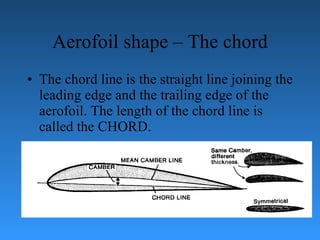
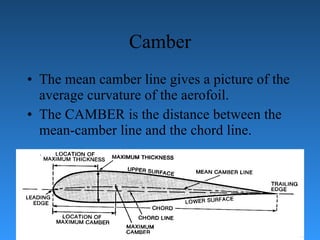
Aerofoil shape – The chord The chord line is the straight line joining the leading edge and the trailing edge   of the aerofoil. The length of the chord line is called the CHORD.
Camber The mean camber line gives a picture of the average curvature of the aerofoil. The CAMBER is the distance between the mean-camber line and the chord   line.
Leading Edge The front edge of a wing is termed the Leading edge.
The Trailing Edge The rear edge of a wing is termed the Trailing edge.
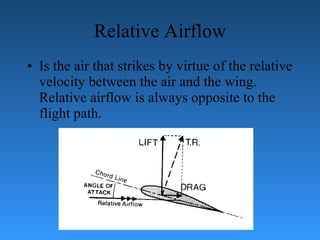
Relative Airflow Is the air that strikes by virtue of the relative velocity between the air and the   wing. Relative airflow is always opposite to the flight path.
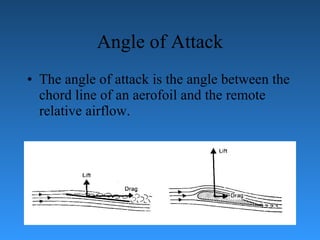
Angle Of Attack Is the angle between the chord line of an aerofoil and the relative airflow.
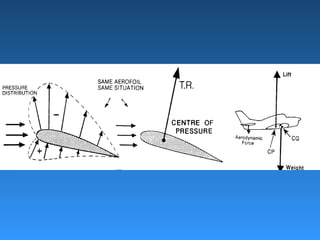
Centre Of Pressure The total reaction of the aerodynamic forces on the aerofoil can be considered   to act through the centre of pressure.  It is that point on the chord line of an aerofoil   through which total lift is said to act.
 
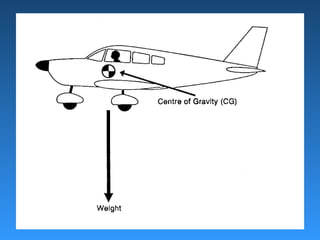
Centre Of Gravity The Centre of gravity is the balance point of the aircraft.  It is usually located   close to the longitudinal centre line of the aircraft and a fourth of the way back from   the leading edge of the wing.  The centre of gravity moves back and forth as the   aircraft has passengers or cargo loaded or unloaded.
 
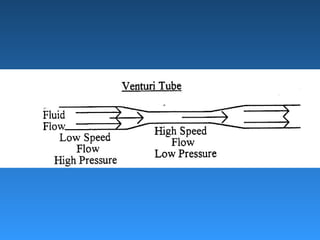
Bernoulli’s theorem The total energy in a streamline flow remains constant. Kinetic energy (motion) + Potential energy (pressure) = constant For any increase in relative velocity (kinetic energy) there is a   corresponding reduction in pressure (Potential energy).
 
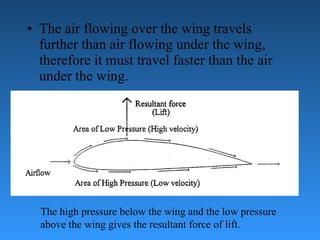
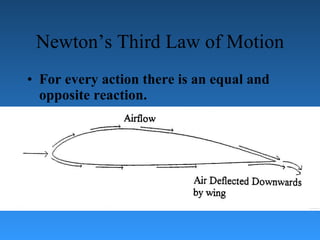
The air flowing over the wing travels further than air flowing under the wing,   therefore it must travel faster than the air under the wing. The high pressure below the wing and the low pressure above the wing gives   the resultant force of lift.
Newton’s Third Law of Motion For every action there is an equal and opposite reaction .
Lift Lift is the component of the Total Reaction at right angles to the relative   airflow.  It is varied by the shape (camber) of the wings.  Its point of application is the   centre of pressure.  Production of lift is dependant on two theories: 1) Bernoulli's and   Newton's third law of Motion.
 
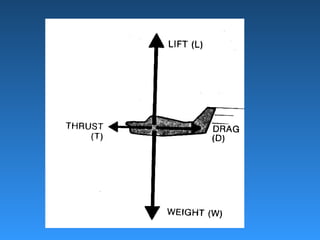
Weight Like all objects on this planet, an aeroplane has WEIGHT, which is a force   that acts vertically towards the centre of the earth through the centre of gravity of the   aeroplane.  Whilst on the ground the aeroplanes weight is supported by ground   reaction, whereas the weight of an aeroplane in the air is supported by the LIFT.
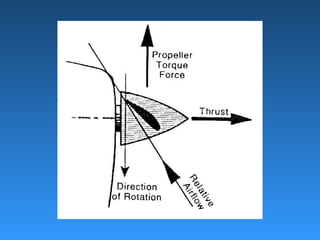
Thrust Thrust is provided by the engine acting either through a propeller or a jet and   is the force, which propels the aircraft forward.  The propeller pulls the aircraft   through the air by generating a horizontal lift force acting through the centre of   pressure of the propeller shaft.
 
Drag Drag is the force which opposes the forward movement of the aircraft. Its   point of application is also the centre of pressure.  The total drag acts parallel to the   relative airflow in the opposite direction to the aircraft's movement
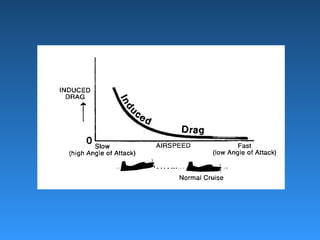
Induced Drag Induced drag is related to the angle of attack and is at its greatest at slow   speeds.  As we have learnt, to create lift we have a lower static pressure on the upper   wing surface than underneath the wing.  As the air flows rearwards, there is a spill   around the wingtip from high to low pressure.  This causes a flow of air around the   wing.  They are called  wingtip vortices  at the wing tips, and are at their greatest at   this point.
 
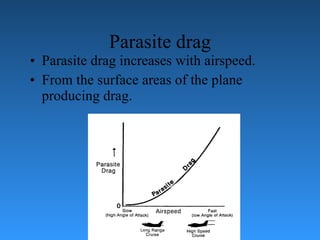
Parasite drag Parasite drag increases with airspeed. From the surface areas of the plane producing drag.
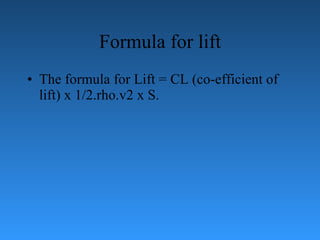
Formula for lift The formula for Lift = CL (co-efficient of lift) x 1/2.rho.v2 x S.
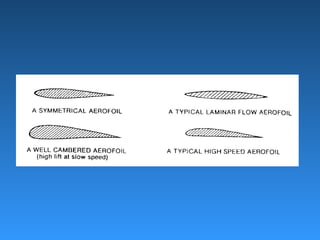
Wing shape Most wings are not shaped like a flat plate as this is not the ideal aerofoil. A   flat shape will break up the streamlined flow and cause turbulence/eddying, there   by   greatly increasing drag.  A curved aerofoil surface generates more lift, less drag and is   stronger in structural strength than a flat wing.
 
Angle of Attack The angle of attack is the angle between the chord line of an aerofoil and the   remote relative airflow.
Bernoulli's principle associates a decrease in Static Pressure with an increase   in Velocity. Therefore the shape of Aerofoil and its Angle of Attack determine the   distribution of velocity and therefore the distribution of the static pressures over the   surface.
Air Density (rho) The performance of an aircraft depends on AIR DENSITY.  Air expands when   it becomes less dense and when compressed, it becomes denser. As we ascend into   the atmosphere the pressure decreases and allows the air to expand, therefore it   becomes less dense.  The converse happens as we descend.  The more dense air we   have then the more lift (and drag) and conversely the less dense the air the less lift   (and drag).
Wing Area Wing surface area refers to the size of the wings.  The larger the surface area   the more lift and d r ag.  If the pilot wishes to vary the lift varying the angle of attack   and/or the speed (velocity) can do it.
QUESTIONS???
QUIZ What does bernoulli’s theorem state? What are the two different types of drag? What are the four basic forces acting upon an airborne aircraft?

Avb 2: Aerodynamics - CCPL G. Fleming

  • 1.
    AVB 2: Aerodynamics Instructed by CCPL G. Fleming
  • 2.
    Objectives Identify theparts of an aerofoil shape Using a diagram define: a. Relative airflow b Angle of attack c. Centre of pressure d Centre of gravity. State in simple terms, Bernoulli’s Principle and establish its relationship t o wing shape and the production of lift. Identify the four basic forces acting on an aircraft: State the five factors that affect aerofoil lift and their relationship.
  • 3.
    Aerofoil shape –The chord The chord line is the straight line joining the leading edge and the trailing edge of the aerofoil. The length of the chord line is called the CHORD.
  • 4.
    Camber The meancamber line gives a picture of the average curvature of the aerofoil. The CAMBER is the distance between the mean-camber line and the chord line.
  • 5.
    Leading Edge Thefront edge of a wing is termed the Leading edge.
  • 6.
    The Trailing EdgeThe rear edge of a wing is termed the Trailing edge.
  • 7.
    Relative Airflow Isthe air that strikes by virtue of the relative velocity between the air and the wing. Relative airflow is always opposite to the flight path.
  • 8.
    Angle Of AttackIs the angle between the chord line of an aerofoil and the relative airflow.
  • 9.
    Centre Of PressureThe total reaction of the aerodynamic forces on the aerofoil can be considered to act through the centre of pressure. It is that point on the chord line of an aerofoil through which total lift is said to act.
  • 10.
  • 11.
    Centre Of GravityThe Centre of gravity is the balance point of the aircraft. It is usually located close to the longitudinal centre line of the aircraft and a fourth of the way back from the leading edge of the wing. The centre of gravity moves back and forth as the aircraft has passengers or cargo loaded or unloaded.
  • 12.
  • 13.
    Bernoulli’s theorem Thetotal energy in a streamline flow remains constant. Kinetic energy (motion) + Potential energy (pressure) = constant For any increase in relative velocity (kinetic energy) there is a corresponding reduction in pressure (Potential energy).
  • 14.
  • 15.
    The air flowingover the wing travels further than air flowing under the wing, therefore it must travel faster than the air under the wing. The high pressure below the wing and the low pressure above the wing gives the resultant force of lift.
  • 16.
    Newton’s Third Lawof Motion For every action there is an equal and opposite reaction .
  • 17.
    Lift Lift isthe component of the Total Reaction at right angles to the relative airflow. It is varied by the shape (camber) of the wings. Its point of application is the centre of pressure. Production of lift is dependant on two theories: 1) Bernoulli's and Newton's third law of Motion.
  • 18.
  • 19.
    Weight Like allobjects on this planet, an aeroplane has WEIGHT, which is a force that acts vertically towards the centre of the earth through the centre of gravity of the aeroplane. Whilst on the ground the aeroplanes weight is supported by ground reaction, whereas the weight of an aeroplane in the air is supported by the LIFT.
  • 20.
    Thrust Thrust isprovided by the engine acting either through a propeller or a jet and is the force, which propels the aircraft forward. The propeller pulls the aircraft through the air by generating a horizontal lift force acting through the centre of pressure of the propeller shaft.
  • 21.
  • 22.
    Drag Drag isthe force which opposes the forward movement of the aircraft. Its point of application is also the centre of pressure. The total drag acts parallel to the relative airflow in the opposite direction to the aircraft's movement
  • 23.
    Induced Drag Induceddrag is related to the angle of attack and is at its greatest at slow speeds. As we have learnt, to create lift we have a lower static pressure on the upper wing surface than underneath the wing. As the air flows rearwards, there is a spill around the wingtip from high to low pressure. This causes a flow of air around the wing. They are called wingtip vortices at the wing tips, and are at their greatest at this point.
  • 24.
  • 25.
    Parasite drag Parasitedrag increases with airspeed. From the surface areas of the plane producing drag.
  • 26.
    Formula for liftThe formula for Lift = CL (co-efficient of lift) x 1/2.rho.v2 x S.
  • 27.
    Wing shape Mostwings are not shaped like a flat plate as this is not the ideal aerofoil. A flat shape will break up the streamlined flow and cause turbulence/eddying, there by greatly increasing drag. A curved aerofoil surface generates more lift, less drag and is stronger in structural strength than a flat wing.
  • 28.
  • 29.
    Angle of AttackThe angle of attack is the angle between the chord line of an aerofoil and the remote relative airflow.
  • 30.
    Bernoulli's principle associatesa decrease in Static Pressure with an increase in Velocity. Therefore the shape of Aerofoil and its Angle of Attack determine the distribution of velocity and therefore the distribution of the static pressures over the surface.
  • 31.
    Air Density (rho)The performance of an aircraft depends on AIR DENSITY. Air expands when it becomes less dense and when compressed, it becomes denser. As we ascend into the atmosphere the pressure decreases and allows the air to expand, therefore it becomes less dense. The converse happens as we descend. The more dense air we have then the more lift (and drag) and conversely the less dense the air the less lift (and drag).
  • 32.
    Wing Area Wingsurface area refers to the size of the wings. The larger the surface area the more lift and d r ag. If the pilot wishes to vary the lift varying the angle of attack and/or the speed (velocity) can do it.
  • 33.
  • 34.
    QUIZ What doesbernoulli’s theorem state? What are the two different types of drag? What are the four basic forces acting upon an airborne aircraft?