Aircraft Instrument Systems
Aircraft Instruments
โ€ข Aircraft Instruments or Flight instruments are the instruments in the cockpit of an aircraft
that provide the pilot with information about the flight situation of that aircraft, such as
altitude, speed and direction. The flight instruments are of particular use in conditions of
poor visibility, such as in clouds, when such information is not available from visual reference
outside the aircraft.
โ€ข The term is sometimes used loosely as a synonym for cockpit instruments as a whole, in
which context it can include engine instruments, navigational and communication
equipment.
โ€ข There are usually two parts to any instrument or instrument system. One part senses the
situation and the other part displays it. In analog instruments, both of these functions often
take place in a single unit or instrument (case). These are called direct-sensing instruments.
Remote-sensing requires the information to be sensed, or captured, and then sent to a
separate display unit in the cockpit. Both analog and digital instruments make use of this
method.
General Rules
โ€ข Donโ€™t open instrument
โ€“ Any internal problem, send it in for repair
โ€“ Can paint the outside
โ€“ Can make markings on the outside
โ€“ A white slippage mark must be place on glass/case
โ€“ Can repair outside wires, tubes and connectors
โ€“ Must be repaired by a certificated repair station approved for a specific class instrument
โ€ข Label inoperable instruments
โ€“ Place label on instrument
โ€“ Document with a trouble ticket
General Rules
โ€ข Markings and graduations are made according to the Aircraft
Manufacturer
โ€“ Aircraft Specification or Type Certificate Data Sheet
โ€“ Maintenance manual
โ€“ Flight manual
โ€ข Marks
โ€“ Red radial line โ€“ minimum or maximum
โ€“ Green โ€“ normal
โ€“ Yellow โ€“ caution
โ€“ Not specified by Title 14
Instrument Case
โ€ข FAA say โ€“ โ€œCases for electrically operated
instruments are made of iron or steel; these
materials provide a path for stray magnetic
force fields that would otherwise interfere
with radio and electronic devices.
โ€ข Case usually made of iron/steel
โ€“ Protect against magnetic and electrical fields
โ€ข Mounting
โ€“ Flanges
Instrument Case
โ€ข Mounting
โ€“ Flanges
โ€ข Mount from the front
โ€“ Flangeless
โ€ข Uses a expanding type of clamp secured to the rear
face of the panel
โ€“ Slide in cases
โ€ข Almost all radios
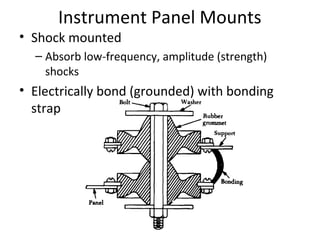
Instrument Panel Mounts
โ€ข Shock mounted
โ€“ Absorb low-frequency, amplitude (strength)
shocks
โ€ข Electrically bond (grounded) with bonding
strap
Classifying Instruments
โ€ข There are three basic kinds of instruments classified by the job they perform:
โ€ข flight instruments,
โ€ข engine instruments, and
โ€ข navigation instruments.
โ€ข There are also miscellaneous gauges and indicators that provide information that do not fall
into these classifications, especially on large complex aircraft. Flight control position, cabin
environmental systems, power, and auxiliary power units (APUs), for example, are all
monitored and controlled from the cockpit via the use of instruments systems.
โ€ข All may be regarded as position/condition instruments since they usually report the position
of a certain moveable component on the aircraft, or the condition of various aircraft
components or systems not included in the first three groups.
Flight Instruments
โ€ข The instruments used in controlling the aircraftโ€™s flight attitude are known as the flight
instruments.
โ€ข There are basic flight instruments, such as the altimeter that displays aircraft altitude; the
airspeed indicator; and the magnetic direction indicator, a form of compass. Additionally, an
artificial horizon, turn coordinator, and vertical speed indicator are flight instruments present
in most aircraft.
โ€ข Over the years, flight instruments have come to be situated similarly on the instrument
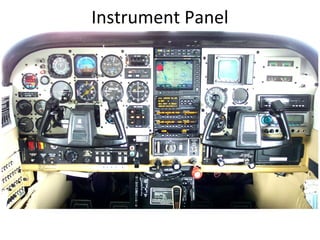
panels in most aircraft. This basic T arrangement for flight instruments is shown in figure.
โ€ข The top center position directly in front of the pilot and copilot is the basic display position
for the artificial horizon even in modern glass cockpits (those with solid-state, flat-panel
screen indicating systems).
โ€ข Original analog flight instruments are operated by air pressure and the use of gyroscopes.
This avoids the use of electricity, which could put the pilot in a dangerous situation if the
aircraft lost electrical power.
โ€ข Development of sensing and display techniques, combined with advanced aircraft electrical
systems, has made it possible for reliable primary and secondary instrument systems that are
electrically operated. Nonetheless, often a pneumatic altimeter, a gyro artificial horizon, and
a magnetic direction indicator are retained somewhere in the instrument panel for
redundancy.
The basic T arrangement of analog flight instruments. At the bottom of the T is a heading indicator that
functions as a compass but is driven by a gyroscope and not subject to the oscillations common to
magnetic direction indicators.
Engine Instruments
โ€ข Engine instruments are those designed to measure operating parameters of the aircraftโ€™s
engine(s).
โ€ข These are usually quantity, pressure, and temperature indications. They also include
measuring engine speed(s). The most common engine instruments are the
โ€ข fuel and oil quantity and
โ€ข pressure gauges,
โ€ข tachometers, and
โ€ข temperature gauges.
โ€ข Engine instrumentation is often displayed in the center of the cockpit where it is easily visible
to the pilot and copilot.
โ€ข On light aircraft requiring only one flight crewmember, this may not be the case. Multiengine
aircraft often use a single gauge for a particular engine parameter, but it displays information
for all engines through the use of multiple pointers on the same dial face.
Various engine instruments found on reciprocating and
turbine-powered aircraft.
Navigation Instruments
โ€ข Navigation instruments are those that contribute information used by the pilot to guide the
aircraft along a definite course.
โ€ข This group includes compasses of various kinds, some of which incorporate the use of radio
signals to define a specific course while flying the aircraft en route from one airport to another.
โ€ข Other navigational instruments are designed specifically to direct the pilotโ€™s approach to
landing at an airport.
โ€ข Traditional navigation instruments include a clock and a magnetic compass. Along with the
airspeed indicator and wind information, these can be used to calculate navigational progress.
โ€ข Radios and instruments sending locating information via radio waves have replaced these
manual efforts in modern aircraft. Global position systems (GPS) use satellites to pinpoint the
location of the aircraft via geometric triangulation. This technology is built into some aircraft
instrument packages for navigational purposes.
โ€ข To understand how various instruments work and can be repaired and maintained, they can be
classified according to the principle upon which they operate.
โ€ข Some use mechanical methods to measure pressure and temperature.
โ€ข Some utilize magnetism and electricity to sense and display a parameter.
โ€ข Others depend on the use of gyroscopes in their primary workings.
โ€ข Still others utilize solid state sensors and computers to process and display important
information.
โ€ข An overview of many of the engine, flight, and navigation instruments is given.
Instrument Panel
Pressure Measuring Instruments
โ€ข A number of instruments inform the pilot of the aircraftโ€™s condition and flight situations
through the measurement of pressure.
โ€ข Pressure-sensing instruments can be found in the flight group and the engine group.
โ€ข These are some of the most critical instruments on the aircraft and must accurately inform
the pilot to maintain safe operations.
โ€ข Pressure measurement involves some sort of mechanism that can sense changes in
pressure. A technique for calibration and displaying the information is then added to inform
the pilot.
โ€ข The three fundamental pressure-sensing mechanisms used in aircraft instrument systems are
the
โ€ข Bourdon tube,
โ€ข the diaphragm or bellows, and
โ€ข the solid-state sensing device.
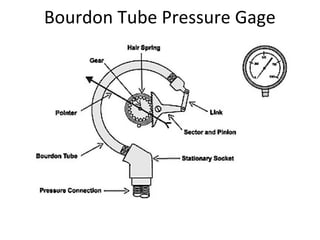
Bourdon-tube
โ€ข Anย instrumentย forย measuringย theย pressureย ofย gasesย or
ย liquids,ย consistingย ofย aย semicircularย orย coiled,ย flexibleย 
metalย tubeย attachedย toย aย gaugeย thatย recordsย theย degr
eeย toย whichย theย tubeย isย straightenedย byย theย pressureย 
ofย theย gasย orย liquidย inside.ย Aย Bourdonย tubeย isย aย wayย ofย 
measuringย pressure.ย Probablyย everyย mechanicalย dial-
typeย pressureย gaugeย youโ€™veย everย seenย isย basedย onย aย 
Bourdonย tube.
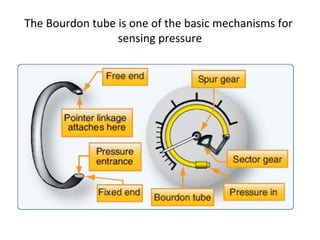
Theย Bourdonย tubeย isย oneย ofย theย basicย mechanismsย forย 
sensingย pressure
Bourdonย Tubeย Pressureย Gage
Basic Principle of Bourdon tube pressure gauge
โ€ข when an elastic transducer ( bourdon tube in this case ) is subjected to a
pressure, it defects. This deflection is proportional to the applied pressure when
calibrated.
Description of Bourdon tube Pressure Gauge:
The main parts of this instruments are as follows:
An elastic transducer, that is bourdon tube which is fixed and open at one end to
receive the pressure which is to be measured. The other end of the bourdon
tube is free and closed.
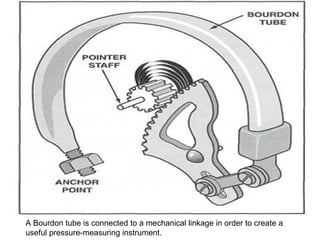
The cross-section of the bourdon tube is elliptical. The bourdon tube is in a bent
form to look like a circular arc. To the free end of the bourdon tube is attached
an adjustable link, which is in turn connected to a sector and pinion as shown in
diagram. To the shaft of the pinion is connected a pointer which sweeps over a
pressure calibrated scale.
Operation of Bourdon tube
โ€ข Theย pressureย toย beย measuredย isย connectedย toย theย fixedย openย endย ofย theย bourdonย tube.ย Theย 
appliedย pressureย actsย onย theย innerย wallsย ofย theย bourdonย tube.ย Dueย toย theย appliedย pressure,ย 
theย bourdonย tubeย tendsย toย changeย inย crossย โ€“ย sectionย fromย ellipticalย toย circular.ย Thisย tendsย toย 
straightenย theย bourdonย tubeย causingย aย displacementย ofย theย freeย endย ofย theย bourdonย tube.
Thisย displacementย ofย theย freeย closedย endย ofย theย bourdonย tubeย isย proportionalย toย theย appliedย 
pressure.ย Asย theย freeย endย ofย theย bourdonย tubeย isย connectedย toย aย linkย โ€“ย sectionย โ€“ย pinionย 
arrangement,ย theย displacementย isย amplifiedย andย convertedย toย aย rotaryย motionย ofย theย pinion.
Asย theย pinionย rotates,ย itย makesย theย pointerย toย assumeย aย newย positionย onย aย pressureย calibratedย 
scaleย toย indicateย theย appliedย pressureย directly.ย Asย theย pressureย inย theย caseย containingย theย 
bourdonย tubeย isย usuallyย atmospheric,ย theย pointerย indicatesย gaugeย pressure.
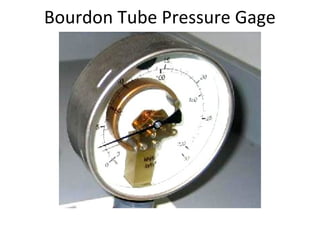
Bourdonย Tubeย Pressureย Gage
Advantages of Bourdon tube pressure gauge
โ€ข 1) These Bourdon tube pressure gauges give accurate results.
โ€ข 2) Bourdon tube cost low.
โ€ข 3) Bourdon tubes are simple in construction.
โ€ข 4) They can be modified to give electrical outputs.
โ€ข 5) They are safe even for high pressure measurement.
โ€ข 6) Accuracy is high especially at high pressures.
7) They are used to measure medium to very high pressures.
Limitations of bourdon tube pressure gauge
โ€ข 1)ย Theyย respondย slowlyย toย changesย inย pressure
โ€ข 2)ย Theyย areย subjectedย toย hysteresis.
โ€ข 3)ย Theyย areย sensitiveย toย shocksย andย vibrations.
โ€ข 4)ย Amplificationย isย aย mustย asย theย displacementย ofย theย freeย endย ofย theย bourdonย tubeย isย low.
โ€ข 5)ย Itย cannotย beย usedย forย precisionย measurement.
Theย Bourdonย tubeย mechanismย canย beย usedย toย measureย pressureย orย 
temperatureย byย recalibratingย theย pointerโ€™sย connectingย linkageย andย 
scalingย instrumentย faceย toย readย inย degreesย Celsiusย orย Fahrenheit.
Bourdonย Tubeย Pressureย Gage
โ€ข Usedย forย higherย pressures
โ€ข Oilย pressure
โ€“ Restrictorย onย inputย lineย toย limitย leaks
โ€“ Keroseneย toย improveย movement
โ€ข Keroseneย isย thinnerย thanย oil
โ€ข Hydraulicย pressure
โ€ข Oilย temperature
โ€“ ย Capillaryย tubeย sensesย temperature
โ€“ Volatileย fluidย vaporizesย atย higherย temperaturesย 
andย increasesย pressure
A Bourdon tube is connected to a mechanical linkage in order to create a
useful pressure-measuring instrument.
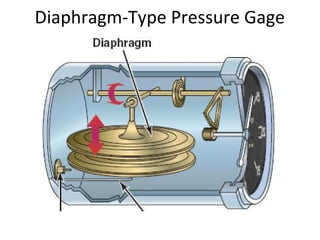
Diaphragm-Typeย Pressureย Gage
Theย diaphragmย orย bellows
โ€ข Theย diaphragmย andย bellowsย areย twoย otherย basicย sensingย mechanismsย employedย inย aircraftย 
instrumentsย forย pressureย measurement.
โ€ข Theย diaphragmย isย aย hollow,ย thin-walledย metalย disk,ย usuallyย corrugated.ย Whenย pressureย isย 
introducedย throughย anย openingย onย oneย sideย ofย theย disk,ย theย entireย diskย expands.
โ€ข Byย placingย linkageย inย contactย againstย theย otherย sideย ofย theย disk,ย theย movementย ofย theย 
pressurizedย diaphragmย canย beย transferredย toย aย pointerย thatย registersย theย movementย againstย 
scaleย onย theย instrumentย face.
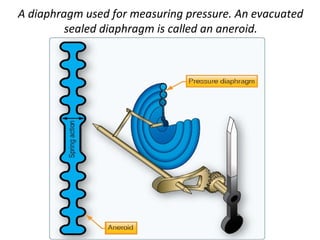
โ€ข Diaphragmsย canย alsoย beย sealed.ย Theย diaphragmย canย beย evacuatedย beforeย sealing,ย retainingย 
absolutelyย nothing.ย Whenย thisย isย done,ย theย diaphragmย isย calledย anย aneroid.ย ย Androidsย areย usedย 
inย manyย flightย instruments.ย 
โ€ข Aย diaphragmย canย alsoย beย filledย withย aย gasย toย standardย atmosphericย pressureย andย thenย sealed.
โ€ข Theย commonย factorย inย allย isย thatย theย expansionย andย contractionย ofย theย sideย wallย ofย theย 
diaphragmย isย theย movementย thatย correlatesย toย increasingย andย decreasingย pressure.
A diaphragm used for measuring pressure. An evacuated
sealed diaphragm is called an aneroid.
Bellows
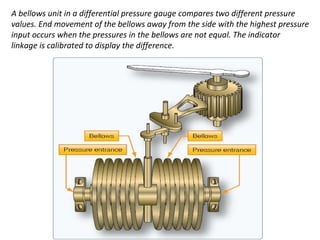
โ€ข Whenย aย numberย ofย diaphragmย chambersย areย connectedย together,ย theย deviceย isย calledย aย 
bellows.
โ€ข Thisย accordion-likeย assemblyย ofย diaphragmsย canย beย veryย usefulย whenย measuringย theย 
differenceย inย pressureย betweenย twoย gases,ย calledย differentialย pressure.
โ€ข Justย asย withย aย singleย diaphragm,ย itย isย theย movementย ofย theย sideย wallsย ofย theย bellowsย assemblyย 
thatย correlatesย withย changesย inย pressureย andย toย whichย aย pointerย linkageย andย gearingย isย 
attachedย toย informย theย pilot.
โ€ข Diaphragms,ย aneroid,ย andย bellowsย pressureย sensingย devicesย areย oftenย locatedย insideย theย 
singleย instrumentย housingย thatย containsย theย pointerย andย instrumentย dialย readย byย theย pilotย onย 
theย instrumentย panel.ย Thus,ย manyย instrumentsย thatย makeย useย ofย theseย sensitiveย andย reliableย 
mechanismsย areย directย readingย gauges.
โ€ข Examplesย ofย instrumentsย thatย useย aย diaphragmย orย bellowsย inย aย directย readingย orย remoteย 
sensingย gaugeย areย theย altimeter,ย verticalย speedย indicator,ย cabinย differentialย pressureย gaugeย (inย 
pressurizedย aircraft),ย andย manifoldย pressureย gauge.
โ€ข Solid-stateย microย technologyย pressureย sensorsย areย usedย inย modernย aircraftย toย determineย theย 
criticalย pressuresย neededย forย safeย operation.ย Manyย ofย theseย haveย digitalย outputย readyย forย 
processingย byย electronicย flightย instrumentย computersย andย otherย onboardย computers.
A bellows unit in a differential pressure gauge compares two different pressure
values. End movement of the bellows away from the side with the highest pressure
input occurs when the pressures in the bellows are not equal. The indicator
linkage is calibrated to display the difference.
PRESSURE INSTRUMENTS
โ€ข ENIGNE OIL PRESSURE
โ€ข MANIFOLD PRESSURE
โ€ข ENGINE PRESSURE RATIO (EPR)
โ€ข FUEL PRESSURE
โ€ข HYDRAULIC PRESSURE
โ€ข VACUUM PRESSURE
โ€ข PRESSURE SWITCHES
MANIFOLD PRESSURE GAUGE
โ€ข The absolute pressure inside the induction system of an engine is an important indicator of the
power the engine is developing. Although this manifold pressure is not directly proportional to
horsepower, it is related qualitatively. In a normally aspirated [non-supercharged] engine, the
maximum differen-tial between manifold pressure and atmospheric pressure will occur when
the engine is at idle. As the throttle is opened, manifold pressure rises and approaches
atmospheric pressure. When the throttle is wide open, the engine is producing maximum
manifold pressure and horsepower. The aircraft flight manual includes charts showing the
various combinations of r.p.m. and manifold pressures that produce desired engine
performance.
โ€ข For normally aspirated engines, the manifold presยญsure gauge usually has a range from 10 to
40 inches of mercury. For turbocharged engines, the range extends high enough to cover the
highest manifold pressure for which the engine is rated.
ENGINE OIL PRESSURE
โ€ข The most important instrument used by the pilot to perceive the health of an engine is the
engine oil pressure gauge.
โ€ข Oil pressure is usually indicated in psi. The normal operating range is typically represented by
a green arc on the circular gauge.
โ€ข In reciprocating and turbine engines, oil is used to lubricate and cool bearing surfaces where
parts are rotating or sliding past each other at high speeds. A loss of pressurized oil to these
areas would rapidly cause excessive friction and over temperature conditions, leading to
catastrophic engine failure.
โ€ข Often, oil pressure is grouped with other engine parameter displays on the same page or
portion of a page on the display.
โ€ข Digital instrument systems use an analog or digital remote oil pressure sensing unit that
sends output to the computer, driving the display of oil pressure value(s) on the aircraftโ€™s
cockpit display screens.
โ€ข Oil pressure may be displayed in a circular or linear gauge fashion and may even include a
numerical value on screen.
An analog oil pressure gauge is driven by a Bourdon
tube. Oil pressure is vital to engine health and must be monitored
by the pilot.
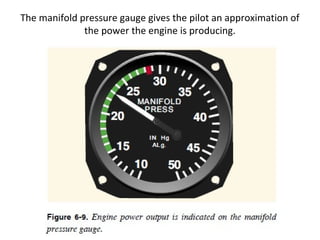
The manifold pressure gauge gives the pilot an approximation of
the power the engine is producing.
Manifold Pressure
โ€ข In reciprocating engine aircraft, the manifold pressure gauge indicates the pressure of the air
in the engineโ€™s induction manifold.
โ€ข This is an indication of power being developed by the engine.
โ€ข The higher the pressure of the fuel air mixture going into the engine, the more power it can
produce.
โ€ข Turbocharged or supercharged engines pressurize the air being mixed with the fuel, so full
power indications are above atmospheric pressure.
โ€ข Most manifold pressure gauges are calibrated in inches of mercury, although digital displays
may have the option to display in a different scale.
โ€ข When atmospheric pressure acts on the aneroid inside the gauge, the connected pointer
indicates the current air pressure. A line running from the intake manifold into the gauge
presents intake manifold air pressure to the aneroid, so the gauge indicates the absolute
pressure in the intake manifold.
โ€ข The aircraftโ€™s operating manual contains data on managing manifold pressure in relation to
fuel flow and propeller pitch and for achieving various performance profiles during different
phases of runยญup and flight.
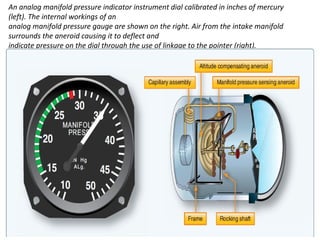
An analog manifold pressure indicator instrument dial calibrated in inches of mercury
(left). The internal workings of an
analog manifold pressure gauge are shown on the right. Air from the intake manifold
surrounds the aneroid causing it to deflect and
indicate pressure on the dial through the use of linkage to the pointer (right).
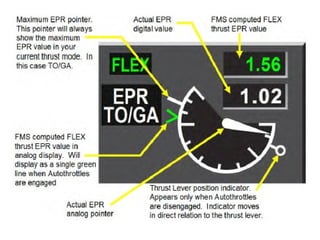
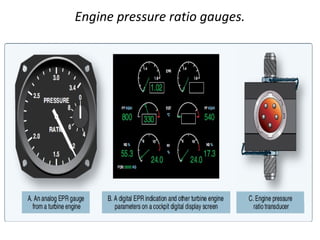
ENGINE PRESSURE RATIO INDICATOR (EPR)
โ€ข Turbine engines have their own pressure indication that relates the power being
developed by the engine. It is called the engine pressure ratio (EPR) indicator (EPR
gauge).
โ€ข This gauge compares the total exhaust pressure to the pressure of the ram air at
the inlet of the engine.
โ€ข This gauge compares the total exhaust pressure to the pressure of the ram air at
the inlet of the engine.
โ€ข Since the EPR gauge compares two pressures, it is a differential pressure gauge. It
is a remoteยญsensing instrument that receives its input from an engine pressure
ratio transmitter or, in digital instrument systems displays, from a computer.
โ€ข The pressure ratio transmitter contains the bellows arrangement that compares
the two pressures and converts the ratio into an electric signal used by the gauge
for indication.
Engine pressure ratio gauges.
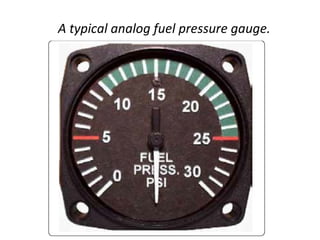
Fuel Pressure
โ€ข Fuel pressure gauges also provide critical information to the pilot.
โ€ข Typically, fuel is pumped out of various fuel tanks on the aircraft for use by the engines. A
malfunctioning fuel pump, or a tank that has been emptied beyond the point at which there
is sufficient fuel entering the pump to maintain desired output pressure, is a condition that
requires the pilotโ€™s immediate attention.
โ€ข While directยญsensing fuel pressure gauges using Bourdon tubes, diaphragms, and bellows
sensing arrangements exist, it is particularly undesirable to run a fuel line into the cockpit,
due to the potential for fire should a leak develop.
โ€ข Therefore, the preferred arrangement is to have whichever sensing mechanism that is used
be part of a transmitter device that uses electricity to send a signal to the indicator in the
cockpit.
โ€ข Sometimes, indications monitoring the fuel flow rate are used instead of fuel pressure
gauges.
A typical analog fuel pressure gauge.
Hydraulic Pressure
โ€ข Numerous other pressure monitoring gauges are used on complex aircraft to indicate the
condition of various support systems not found on simple light aircraft.
โ€ข Hydraulic systems are commonly used to raise and lower landing gear, operate flight
controls, apply brakes, and more. Sufficient pressure in the hydraulic system developed by
the hydraulic pump(s) is required for normal operation of hydraulic devices.
โ€ข Hydraulic pressure gauges are often located in the cockpit and at or near the hydraulic
system servicing point on the airframe.
โ€ข Remotely located indicators used by maintenance personnel are almost always direct reading
Bourdon tube type gauges. Cockpit gauges usually have system pressure transmitted from
sensors or computers electrically for indication.
A hydraulic pressure transmitter senses and converts
pressure into an electrical output for indication by the cockpit
gauge
or for use by a computer that analyzes and displays the pressure in
the cockpit when requested or required.
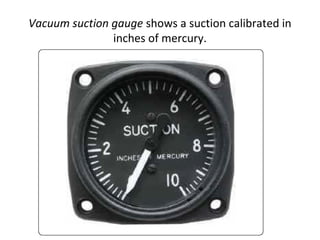
Vacuum Pressure
โ€ข Gyro pressure gauge, vacuum gauge, or suction gauge are all terms for the same gauge used
to monitor the vacuum developed in the system that actuates the air driven gyroscopic flight
instruments.
โ€ข Air is pulled through the instruments, causing the gyroscopes to spin.
โ€ข The speed at which the gyros spin needs to be within a certain range for correct operation.
This speed is directly related to the suction pressure that is developed in the system. The
suction gauge is extremely important in aircraft relying solely on vacuum operated
gyroscopic flight instruments.
โ€ข Vacuum is a differential pressure indication, meaning the pressure to be measured is
compared to atmospheric pressure through the use of a sealed diaphragm or capsule.
โ€ข The gauge is calibrated in inches of mercury.
โ€ข It shows how much less pressure exists in the system than in the atmosphere.
Vacuum suction gauge shows a suction calibrated in
inches of mercury.
Pressure Switches
โ€ข In aviation, it is often sufficient to simply monitor whether the pressure developed by a
certain operating system is too high or too low, so that an action can take place should one
of these conditions occur. This is often accomplished through the use of a pressure switch.
โ€ข A pressure switch is a simple device usually made to open or close an electric circuit when a
certain pressure is reached in a system.
โ€ข It can be manufactured so that the electric circuit is normally open and can then close when
a certain pressure is sensed, or the circuit can be closed and then opened when the
activation pressure is reached.
โ€ข Pressure switches contain a diaphragm to which the pressure being sensed is applied on one
side. The opposite side of the diaphragm is connected to a mechanical switching mechanism
for an electric circuit. Small fluctuations or a buildup of pressure against the diaphragm move
the diaphragm, but not enough to throw the switch.
โ€ข Only when pressure meets or exceeds a preset level designed into the structure of the switch
does the diaphragm move far enough for the mechanical device on the opposite side to close
the switch contacts and complete the circuit.
โ€ข Each switch is rated to close (or open) at a certain pressure, and must only be installed in the
proper location.
A pressure switch can be used in addition to, or
instead of, a pressure gauge.
โ€ข A low oil pressure indication switch is a common example of how pressure switches are
employed.
โ€ข It is installed in an engine so pressurized oil can be applied to the switchโ€™s diaphragm. Upon
starting the engine, oil pressure increases and the pressure against the diaphragm is
sufficient to hold the contacts in the switch open.
โ€ข As such, current does not flow through the circuit and no indication of low oil pressure is
given in the cockpit. Should a loss of oil pressure occur, the pressure against the diaphragm
becomes insufficient to hold the switched contacts open. When the contacts close, they
close the circuit to the low oil pressure indicator, usually a light, to warn the pilot of the
situation.
โ€ข Some sort of sensing device, appropriate for the pressure being measured or monitored, is
matched with an indicating display system.
โ€ข A normally open pressure switch positioned in an electrical circuit causes the circuit to be
open as well. The switch closes, allowing electricity to flow when pressure is applied beyond
the switchโ€™s preset activation point. Normally, closed pressure switches allow electricity to
flow through the switch in a circuit but open when pressure reaches a preset activation point,
thus opening the electrical circuit as shown in the figure in the next slight.
PITOT-STATIC SYSTEM
โ€ข Some of the most important flight instruments derive their indications from measuring air
pressure. Gathering and distributing various air pressures for flight instrumentation is the
function of the pitot-static system.
โ€ข Pitot Tubes and Static Vents
โ€ข On simple aircraft, this may consist of a pitot-static system head or pitot tube with impact
and static air pressure ports and leak-free tubing connecting these air pressure pickup points
to the instruments that require the air for their indications.
โ€ข The altimeter,
โ€ข airspeed indicator, and
โ€ข vertical
โ€ข speed indicator
โ€ข These are the three most common pitot-static instruments.
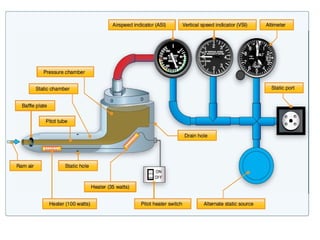
โ€ข It is open and faces into the airstream to receive the full force of the impact
โ€ข air pressure as the aircraft moves forward. This air passes through a baffled plate designed to
protect the system from moisture and dirt entering the tube. Below the baffle, a drain hole is
provided, allowing moisture to escape. The ram air is directed aft to a chamber in the shark
fin of the assembly. An upright tube, or riser, leads this pressurized air out of the pitot
assemble to the airspeed indicator.
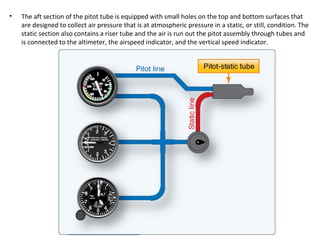
โ€ข The aft section of the pitot tube is equipped with small holes on the top and bottom surfaces that
are designed to collect air pressure that is at atmospheric pressure in a static, or still, condition. The
static section also contains a riser tube and the air is run out the pitot assembly through tubes and
is connected to the altimeter, the airspeed indicator, and the vertical speed indicator.
โ€ข Many pitot-static tube heads contain heating elements to prevent icing during flight.
โ€ข The pitot-static tube is mounted on the outside of the aircraft at a point where the air is least likely
to be turbulent.
โ€ข It is pointed in a forward direction parallel to the aircraftโ€™s line of flight.
โ€ข The location may vary.
โ€ข Some are on the nose of the fuselage and others may be located on a wing. A few may even be
found on the empennage.
โ€ข Various designs exist but the function remains the same, to capture impact air pressure and static
air pressure and direct them to the proper instruments.
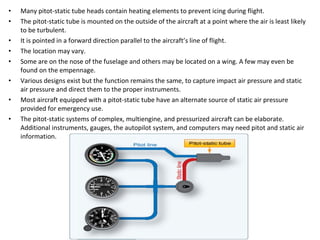
โ€ข Most aircraft equipped with a pitot-static tube have an alternate source of static air pressure
provided for emergency use.
โ€ข The pitot-static systems of complex, multiengine, and pressurized aircraft can be elaborate.
Additional instruments, gauges, the autopilot system, and computers may need pitot and static air
information.
Pitot-Static Pressure-Sensing Flight Instruments
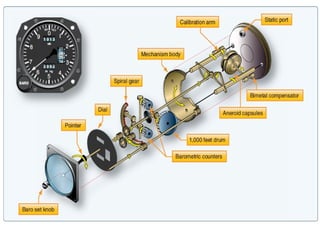
โ€ข Altimeters and Altitude
โ€ข An altimeter is an instrument that is used to indicate the height of the aircraft above a
predetermined level, such as sea level or the terrain beneath the aircraft.
โ€ข As altitude increases, air pressure decreases. The amount that it decreases is measurable and
consistent for any given altitude change. Therefore, by measuring air pressure, altitude can be
determined.
โ€ข Altimeters that measure the aircraftโ€™s altitude by measuring the pressure of the atmospheric air
are known as pressure altimeters.
โ€ข A pressure altimeter is made to measure the ambient air pressure at any given location and
altitude. In aircraft, it is connected to the static vent(s) via tubing in the pitot-static system.
โ€ข The relationship between the measured pressure and the altitude is indicated on the instrument
face, which is calibrated in feet. These devises are direct-reading instruments that measure
absolute pressure. An aneroid or aneroid bellows is at the core of the pressure altimeterโ€™s inner
workings. Attached to this sealed diaphragm are the linkages and gears that connect it to the
indicating pointer. Static air pressure enters the airtight instrument case and surrounds the
aneroid.
โ€ข At sea level, the altimeter indicates zero when this pressure is exerted by the ambient air on the
aneroid. As air pressure is reduced by moving the altimeter higher in the atmosphere, the aneroid
expands and displays altitude on the instrument by rotating the pointer. As the altimeter is
lowered in the atmosphere, the air pressure around the aneroid increases and the pointer moves
in the opposite direction.
โ€ข The face, or dial, of an analog altimeter is read similarly to a clock.
โ€ข As the longest pointer moves around the dial, it is registering the altitude in hundreds of feet.
โ€ข One complete revolution of this pointer indicates 1,000 feet of altitude.
โ€ข The second-longest point moves more slowly.
โ€ข Each time it reaches a numeral, it indicates 1,000 feet of altitude. Once around the dial for this
pointer is equal to 10,000 feet.
โ€ข When the longest pointer travels completely around the dial one time, the second-longest point
moves only the distance between two numeralsโ€”indicating 1,000 feet of altitude has been attained.
โ€ข If so equipped, a third, shortest or thinnest pointer registers altitude in 10,000 foot increments.
โ€ข Sometimes a black-and-white or red-and-white
โ€ข cross-hatched area is shown on the face on the instrument
โ€ข until the 10,000 foot level has been reached.
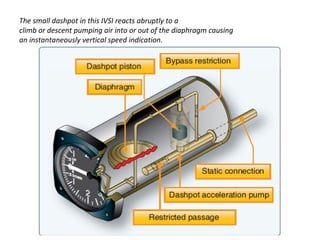
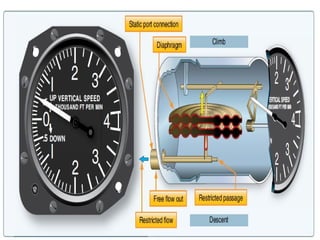
The small dashpot in this IVSI reacts abruptly to a
climb or descent pumping air into or out of the diaphragm causing
an instantaneously vertical speed indication.
Vertical Speed Indicator
โ€ข The VSI is a differential pressure gauge that compares free-flowing static air pressure in the
diaphragm with restricted
โ€ข static air pressure around the diaphragm in the instrument case.
โ€ข An analog vertical speed indicator (VSI) may also be referred to as a vertical velocity indicator (VVI),
or rate-of-climb indicator.
โ€ข It is a direct reading, differential pressure gauge that compares static pressure from the aircraftโ€™s
static system directed into a diaphragm with static pressure surrounding the diaphragm in the
instrument case.
โ€ข A pointer attached to the diaphragm indicates zero vertical speed when the pressure inside and
outside the diaphragm are the same.
โ€ข A zeroing adjustment screw, or knob, on the face of the instrument is used to center the pointer
exactly on zero while the aircraft is on the ground.
โ€ข As the aircraft climbs, the unrestricted air pressure in the diaphragm lowers as the air becomes less
dense. The case air pressure surrounding the diaphragm lowers more slowly, having to pass through
the restriction created by the orifice. This causes unequal pressure inside and outside the diaphragm,
which in turn causes the diaphragm to contract a bit and the pointer indicates a climb.
โ€ข The process works in reverse for an aircraft in a descent.
โ€ข If a steady climb or descent is maintained, a steady pressure differential is established
โ€ข between the diaphragm and case pressure surrounding it, resulting in an accurate indication of the
rate of climb via graduations on the instrument face.
Airspeed Indicators

Aircraft instrumentsystems

  • 1.
  • 2.
    Aircraft Instruments โ€ข AircraftInstruments or Flight instruments are the instruments in the cockpit of an aircraft that provide the pilot with information about the flight situation of that aircraft, such as altitude, speed and direction. The flight instruments are of particular use in conditions of poor visibility, such as in clouds, when such information is not available from visual reference outside the aircraft. โ€ข The term is sometimes used loosely as a synonym for cockpit instruments as a whole, in which context it can include engine instruments, navigational and communication equipment. โ€ข There are usually two parts to any instrument or instrument system. One part senses the situation and the other part displays it. In analog instruments, both of these functions often take place in a single unit or instrument (case). These are called direct-sensing instruments. Remote-sensing requires the information to be sensed, or captured, and then sent to a separate display unit in the cockpit. Both analog and digital instruments make use of this method.
  • 4.
    General Rules โ€ข Donโ€™topen instrument โ€“ Any internal problem, send it in for repair โ€“ Can paint the outside โ€“ Can make markings on the outside โ€“ A white slippage mark must be place on glass/case โ€“ Can repair outside wires, tubes and connectors โ€“ Must be repaired by a certificated repair station approved for a specific class instrument โ€ข Label inoperable instruments โ€“ Place label on instrument โ€“ Document with a trouble ticket
  • 5.
    General Rules โ€ข Markingsand graduations are made according to the Aircraft Manufacturer โ€“ Aircraft Specification or Type Certificate Data Sheet โ€“ Maintenance manual โ€“ Flight manual โ€ข Marks โ€“ Red radial line โ€“ minimum or maximum โ€“ Green โ€“ normal โ€“ Yellow โ€“ caution โ€“ Not specified by Title 14
  • 6.
    Instrument Case โ€ข FAAsay โ€“ โ€œCases for electrically operated instruments are made of iron or steel; these materials provide a path for stray magnetic force fields that would otherwise interfere with radio and electronic devices. โ€ข Case usually made of iron/steel โ€“ Protect against magnetic and electrical fields โ€ข Mounting โ€“ Flanges
  • 7.
    Instrument Case โ€ข Mounting โ€“Flanges โ€ข Mount from the front โ€“ Flangeless โ€ข Uses a expanding type of clamp secured to the rear face of the panel โ€“ Slide in cases โ€ข Almost all radios
  • 8.
    Instrument Panel Mounts โ€ขShock mounted โ€“ Absorb low-frequency, amplitude (strength) shocks โ€ข Electrically bond (grounded) with bonding strap
  • 9.
    Classifying Instruments โ€ข Thereare three basic kinds of instruments classified by the job they perform: โ€ข flight instruments, โ€ข engine instruments, and โ€ข navigation instruments. โ€ข There are also miscellaneous gauges and indicators that provide information that do not fall into these classifications, especially on large complex aircraft. Flight control position, cabin environmental systems, power, and auxiliary power units (APUs), for example, are all monitored and controlled from the cockpit via the use of instruments systems. โ€ข All may be regarded as position/condition instruments since they usually report the position of a certain moveable component on the aircraft, or the condition of various aircraft components or systems not included in the first three groups.
  • 10.
    Flight Instruments โ€ข Theinstruments used in controlling the aircraftโ€™s flight attitude are known as the flight instruments. โ€ข There are basic flight instruments, such as the altimeter that displays aircraft altitude; the airspeed indicator; and the magnetic direction indicator, a form of compass. Additionally, an artificial horizon, turn coordinator, and vertical speed indicator are flight instruments present in most aircraft. โ€ข Over the years, flight instruments have come to be situated similarly on the instrument panels in most aircraft. This basic T arrangement for flight instruments is shown in figure. โ€ข The top center position directly in front of the pilot and copilot is the basic display position for the artificial horizon even in modern glass cockpits (those with solid-state, flat-panel screen indicating systems). โ€ข Original analog flight instruments are operated by air pressure and the use of gyroscopes. This avoids the use of electricity, which could put the pilot in a dangerous situation if the aircraft lost electrical power. โ€ข Development of sensing and display techniques, combined with advanced aircraft electrical systems, has made it possible for reliable primary and secondary instrument systems that are electrically operated. Nonetheless, often a pneumatic altimeter, a gyro artificial horizon, and a magnetic direction indicator are retained somewhere in the instrument panel for redundancy.
  • 11.
    The basic Tarrangement of analog flight instruments. At the bottom of the T is a heading indicator that functions as a compass but is driven by a gyroscope and not subject to the oscillations common to magnetic direction indicators.
  • 12.
    Engine Instruments โ€ข Engineinstruments are those designed to measure operating parameters of the aircraftโ€™s engine(s). โ€ข These are usually quantity, pressure, and temperature indications. They also include measuring engine speed(s). The most common engine instruments are the โ€ข fuel and oil quantity and โ€ข pressure gauges, โ€ข tachometers, and โ€ข temperature gauges. โ€ข Engine instrumentation is often displayed in the center of the cockpit where it is easily visible to the pilot and copilot. โ€ข On light aircraft requiring only one flight crewmember, this may not be the case. Multiengine aircraft often use a single gauge for a particular engine parameter, but it displays information for all engines through the use of multiple pointers on the same dial face.
  • 13.
    Various engine instrumentsfound on reciprocating and turbine-powered aircraft.
  • 14.
    Navigation Instruments โ€ข Navigationinstruments are those that contribute information used by the pilot to guide the aircraft along a definite course. โ€ข This group includes compasses of various kinds, some of which incorporate the use of radio signals to define a specific course while flying the aircraft en route from one airport to another. โ€ข Other navigational instruments are designed specifically to direct the pilotโ€™s approach to landing at an airport. โ€ข Traditional navigation instruments include a clock and a magnetic compass. Along with the airspeed indicator and wind information, these can be used to calculate navigational progress. โ€ข Radios and instruments sending locating information via radio waves have replaced these manual efforts in modern aircraft. Global position systems (GPS) use satellites to pinpoint the location of the aircraft via geometric triangulation. This technology is built into some aircraft instrument packages for navigational purposes. โ€ข To understand how various instruments work and can be repaired and maintained, they can be classified according to the principle upon which they operate. โ€ข Some use mechanical methods to measure pressure and temperature. โ€ข Some utilize magnetism and electricity to sense and display a parameter. โ€ข Others depend on the use of gyroscopes in their primary workings. โ€ข Still others utilize solid state sensors and computers to process and display important information. โ€ข An overview of many of the engine, flight, and navigation instruments is given.
  • 15.
  • 16.
    Pressure Measuring Instruments โ€ขA number of instruments inform the pilot of the aircraftโ€™s condition and flight situations through the measurement of pressure. โ€ข Pressure-sensing instruments can be found in the flight group and the engine group. โ€ข These are some of the most critical instruments on the aircraft and must accurately inform the pilot to maintain safe operations. โ€ข Pressure measurement involves some sort of mechanism that can sense changes in pressure. A technique for calibration and displaying the information is then added to inform the pilot. โ€ข The three fundamental pressure-sensing mechanisms used in aircraft instrument systems are the โ€ข Bourdon tube, โ€ข the diaphragm or bellows, and โ€ข the solid-state sensing device.
  • 17.
  • 18.
  • 19.
  • 20.
    Basic Principle ofBourdon tube pressure gauge โ€ข when an elastic transducer ( bourdon tube in this case ) is subjected to a pressure, it defects. This deflection is proportional to the applied pressure when calibrated. Description of Bourdon tube Pressure Gauge: The main parts of this instruments are as follows: An elastic transducer, that is bourdon tube which is fixed and open at one end to receive the pressure which is to be measured. The other end of the bourdon tube is free and closed. The cross-section of the bourdon tube is elliptical. The bourdon tube is in a bent form to look like a circular arc. To the free end of the bourdon tube is attached an adjustable link, which is in turn connected to a sector and pinion as shown in diagram. To the shaft of the pinion is connected a pointer which sweeps over a pressure calibrated scale.
  • 21.
    Operation of Bourdontube โ€ข Theย pressureย toย beย measuredย isย connectedย toย theย fixedย openย endย ofย theย bourdonย tube.ย Theย  appliedย pressureย actsย onย theย innerย wallsย ofย theย bourdonย tube.ย Dueย toย theย appliedย pressure,ย  theย bourdonย tubeย tendsย toย changeย inย crossย โ€“ย sectionย fromย ellipticalย toย circular.ย Thisย tendsย toย  straightenย theย bourdonย tubeย causingย aย displacementย ofย theย freeย endย ofย theย bourdonย tube. Thisย displacementย ofย theย freeย closedย endย ofย theย bourdonย tubeย isย proportionalย toย theย appliedย  pressure.ย Asย theย freeย endย ofย theย bourdonย tubeย isย connectedย toย aย linkย โ€“ย sectionย โ€“ย pinionย  arrangement,ย theย displacementย isย amplifiedย andย convertedย toย aย rotaryย motionย ofย theย pinion. Asย theย pinionย rotates,ย itย makesย theย pointerย toย assumeย aย newย positionย onย aย pressureย calibratedย  scaleย toย indicateย theย appliedย pressureย directly.ย Asย theย pressureย inย theย caseย containingย theย  bourdonย tubeย isย usuallyย atmospheric,ย theย pointerย indicatesย gaugeย pressure.
  • 22.
  • 23.
    Advantages of Bourdontube pressure gauge โ€ข 1) These Bourdon tube pressure gauges give accurate results. โ€ข 2) Bourdon tube cost low. โ€ข 3) Bourdon tubes are simple in construction. โ€ข 4) They can be modified to give electrical outputs. โ€ข 5) They are safe even for high pressure measurement. โ€ข 6) Accuracy is high especially at high pressures. 7) They are used to measure medium to very high pressures.
  • 24.
    Limitations of bourdontube pressure gauge โ€ข 1)ย Theyย respondย slowlyย toย changesย inย pressure โ€ข 2)ย Theyย areย subjectedย toย hysteresis. โ€ข 3)ย Theyย areย sensitiveย toย shocksย andย vibrations. โ€ข 4)ย Amplificationย isย aย mustย asย theย displacementย ofย theย freeย endย ofย theย bourdonย tubeย isย low. โ€ข 5)ย Itย cannotย beย usedย forย precisionย measurement.
  • 25.
  • 26.
    Bourdonย Tubeย Pressureย Gage โ€ข Usedย forย higherย pressures โ€ข Oilย pressure โ€“Restrictorย onย inputย lineย toย limitย leaks โ€“ Keroseneย toย improveย movement โ€ข Keroseneย isย thinnerย thanย oil โ€ข Hydraulicย pressure โ€ข Oilย temperature โ€“ ย Capillaryย tubeย sensesย temperature โ€“ Volatileย fluidย vaporizesย atย higherย temperaturesย  andย increasesย pressure
  • 27.
    A Bourdon tubeis connected to a mechanical linkage in order to create a useful pressure-measuring instrument.
  • 28.
  • 29.
    Theย diaphragmย orย bellows โ€ข Theย diaphragmย andย bellowsย areย twoย otherย basicย sensingย mechanismsย employedย inย aircraftย  instrumentsย forย pressureย measurement. โ€ข Theย diaphragmย isย aย hollow,ย thin-walledย metalย disk,ย usuallyย corrugated.ย Whenย pressureย isย  introducedย throughย anย openingย onย oneย sideย ofย theย disk,ย theย entireย diskย expands. โ€ขByย placingย linkageย inย contactย againstย theย otherย sideย ofย theย disk,ย theย movementย ofย theย  pressurizedย diaphragmย canย beย transferredย toย aย pointerย thatย registersย theย movementย againstย  scaleย onย theย instrumentย face. โ€ข Diaphragmsย canย alsoย beย sealed.ย Theย diaphragmย canย beย evacuatedย beforeย sealing,ย retainingย  absolutelyย nothing.ย Whenย thisย isย done,ย theย diaphragmย isย calledย anย aneroid.ย ย Androidsย areย usedย  inย manyย flightย instruments.ย  โ€ข Aย diaphragmย canย alsoย beย filledย withย aย gasย toย standardย atmosphericย pressureย andย thenย sealed. โ€ข Theย commonย factorย inย allย isย thatย theย expansionย andย contractionย ofย theย sideย wallย ofย theย  diaphragmย isย theย movementย thatย correlatesย toย increasingย andย decreasingย pressure.
  • 30.
    A diaphragm usedfor measuring pressure. An evacuated sealed diaphragm is called an aneroid.
  • 31.
    Bellows โ€ข Whenย aย numberย ofย diaphragmย chambersย areย connectedย together,ย theย deviceย isย calledย aย  bellows. โ€ข Thisย accordion-likeย assemblyย ofย diaphragmsย canย beย veryย usefulย whenย measuringย theย  differenceย inย pressureย betweenย twoย gases,ย calledย differentialย pressure. โ€ขJustย asย withย aย singleย diaphragm,ย itย isย theย movementย ofย theย sideย wallsย ofย theย bellowsย assemblyย  thatย correlatesย withย changesย inย pressureย andย toย whichย aย pointerย linkageย andย gearingย isย  attachedย toย informย theย pilot. โ€ข Diaphragms,ย aneroid,ย andย bellowsย pressureย sensingย devicesย areย oftenย locatedย insideย theย  singleย instrumentย housingย thatย containsย theย pointerย andย instrumentย dialย readย byย theย pilotย onย  theย instrumentย panel.ย Thus,ย manyย instrumentsย thatย makeย useย ofย theseย sensitiveย andย reliableย  mechanismsย areย directย readingย gauges. โ€ข Examplesย ofย instrumentsย thatย useย aย diaphragmย orย bellowsย inย aย directย readingย orย remoteย  sensingย gaugeย areย theย altimeter,ย verticalย speedย indicator,ย cabinย differentialย pressureย gaugeย (inย  pressurizedย aircraft),ย andย manifoldย pressureย gauge. โ€ข Solid-stateย microย technologyย pressureย sensorsย areย usedย inย modernย aircraftย toย determineย theย  criticalย pressuresย neededย forย safeย operation.ย Manyย ofย theseย haveย digitalย outputย readyย forย  processingย byย electronicย flightย instrumentย computersย andย otherย onboardย computers.
  • 32.
    A bellows unitin a differential pressure gauge compares two different pressure values. End movement of the bellows away from the side with the highest pressure input occurs when the pressures in the bellows are not equal. The indicator linkage is calibrated to display the difference.
  • 33.
    PRESSURE INSTRUMENTS โ€ข ENIGNEOIL PRESSURE โ€ข MANIFOLD PRESSURE โ€ข ENGINE PRESSURE RATIO (EPR) โ€ข FUEL PRESSURE โ€ข HYDRAULIC PRESSURE โ€ข VACUUM PRESSURE โ€ข PRESSURE SWITCHES
  • 34.
    MANIFOLD PRESSURE GAUGE โ€ขThe absolute pressure inside the induction system of an engine is an important indicator of the power the engine is developing. Although this manifold pressure is not directly proportional to horsepower, it is related qualitatively. In a normally aspirated [non-supercharged] engine, the maximum differen-tial between manifold pressure and atmospheric pressure will occur when the engine is at idle. As the throttle is opened, manifold pressure rises and approaches atmospheric pressure. When the throttle is wide open, the engine is producing maximum manifold pressure and horsepower. The aircraft flight manual includes charts showing the various combinations of r.p.m. and manifold pressures that produce desired engine performance. โ€ข For normally aspirated engines, the manifold presยญsure gauge usually has a range from 10 to 40 inches of mercury. For turbocharged engines, the range extends high enough to cover the highest manifold pressure for which the engine is rated.
  • 35.
    ENGINE OIL PRESSURE โ€ขThe most important instrument used by the pilot to perceive the health of an engine is the engine oil pressure gauge. โ€ข Oil pressure is usually indicated in psi. The normal operating range is typically represented by a green arc on the circular gauge. โ€ข In reciprocating and turbine engines, oil is used to lubricate and cool bearing surfaces where parts are rotating or sliding past each other at high speeds. A loss of pressurized oil to these areas would rapidly cause excessive friction and over temperature conditions, leading to catastrophic engine failure. โ€ข Often, oil pressure is grouped with other engine parameter displays on the same page or portion of a page on the display. โ€ข Digital instrument systems use an analog or digital remote oil pressure sensing unit that sends output to the computer, driving the display of oil pressure value(s) on the aircraftโ€™s cockpit display screens. โ€ข Oil pressure may be displayed in a circular or linear gauge fashion and may even include a numerical value on screen.
  • 36.
    An analog oilpressure gauge is driven by a Bourdon tube. Oil pressure is vital to engine health and must be monitored by the pilot.
  • 37.
    The manifold pressuregauge gives the pilot an approximation of the power the engine is producing.
  • 38.
    Manifold Pressure โ€ข Inreciprocating engine aircraft, the manifold pressure gauge indicates the pressure of the air in the engineโ€™s induction manifold. โ€ข This is an indication of power being developed by the engine. โ€ข The higher the pressure of the fuel air mixture going into the engine, the more power it can produce. โ€ข Turbocharged or supercharged engines pressurize the air being mixed with the fuel, so full power indications are above atmospheric pressure. โ€ข Most manifold pressure gauges are calibrated in inches of mercury, although digital displays may have the option to display in a different scale. โ€ข When atmospheric pressure acts on the aneroid inside the gauge, the connected pointer indicates the current air pressure. A line running from the intake manifold into the gauge presents intake manifold air pressure to the aneroid, so the gauge indicates the absolute pressure in the intake manifold. โ€ข The aircraftโ€™s operating manual contains data on managing manifold pressure in relation to fuel flow and propeller pitch and for achieving various performance profiles during different phases of runยญup and flight.
  • 39.
    An analog manifoldpressure indicator instrument dial calibrated in inches of mercury (left). The internal workings of an analog manifold pressure gauge are shown on the right. Air from the intake manifold surrounds the aneroid causing it to deflect and indicate pressure on the dial through the use of linkage to the pointer (right).
  • 40.
    ENGINE PRESSURE RATIOINDICATOR (EPR) โ€ข Turbine engines have their own pressure indication that relates the power being developed by the engine. It is called the engine pressure ratio (EPR) indicator (EPR gauge). โ€ข This gauge compares the total exhaust pressure to the pressure of the ram air at the inlet of the engine. โ€ข This gauge compares the total exhaust pressure to the pressure of the ram air at the inlet of the engine. โ€ข Since the EPR gauge compares two pressures, it is a differential pressure gauge. It is a remoteยญsensing instrument that receives its input from an engine pressure ratio transmitter or, in digital instrument systems displays, from a computer. โ€ข The pressure ratio transmitter contains the bellows arrangement that compares the two pressures and converts the ratio into an electric signal used by the gauge for indication.
  • 42.
  • 43.
    Fuel Pressure โ€ข Fuelpressure gauges also provide critical information to the pilot. โ€ข Typically, fuel is pumped out of various fuel tanks on the aircraft for use by the engines. A malfunctioning fuel pump, or a tank that has been emptied beyond the point at which there is sufficient fuel entering the pump to maintain desired output pressure, is a condition that requires the pilotโ€™s immediate attention. โ€ข While directยญsensing fuel pressure gauges using Bourdon tubes, diaphragms, and bellows sensing arrangements exist, it is particularly undesirable to run a fuel line into the cockpit, due to the potential for fire should a leak develop. โ€ข Therefore, the preferred arrangement is to have whichever sensing mechanism that is used be part of a transmitter device that uses electricity to send a signal to the indicator in the cockpit. โ€ข Sometimes, indications monitoring the fuel flow rate are used instead of fuel pressure gauges.
  • 44.
    A typical analogfuel pressure gauge.
  • 45.
    Hydraulic Pressure โ€ข Numerousother pressure monitoring gauges are used on complex aircraft to indicate the condition of various support systems not found on simple light aircraft. โ€ข Hydraulic systems are commonly used to raise and lower landing gear, operate flight controls, apply brakes, and more. Sufficient pressure in the hydraulic system developed by the hydraulic pump(s) is required for normal operation of hydraulic devices. โ€ข Hydraulic pressure gauges are often located in the cockpit and at or near the hydraulic system servicing point on the airframe. โ€ข Remotely located indicators used by maintenance personnel are almost always direct reading Bourdon tube type gauges. Cockpit gauges usually have system pressure transmitted from sensors or computers electrically for indication.
  • 46.
    A hydraulic pressuretransmitter senses and converts pressure into an electrical output for indication by the cockpit gauge or for use by a computer that analyzes and displays the pressure in the cockpit when requested or required.
  • 47.
    Vacuum Pressure โ€ข Gyropressure gauge, vacuum gauge, or suction gauge are all terms for the same gauge used to monitor the vacuum developed in the system that actuates the air driven gyroscopic flight instruments. โ€ข Air is pulled through the instruments, causing the gyroscopes to spin. โ€ข The speed at which the gyros spin needs to be within a certain range for correct operation. This speed is directly related to the suction pressure that is developed in the system. The suction gauge is extremely important in aircraft relying solely on vacuum operated gyroscopic flight instruments. โ€ข Vacuum is a differential pressure indication, meaning the pressure to be measured is compared to atmospheric pressure through the use of a sealed diaphragm or capsule. โ€ข The gauge is calibrated in inches of mercury. โ€ข It shows how much less pressure exists in the system than in the atmosphere.
  • 48.
    Vacuum suction gaugeshows a suction calibrated in inches of mercury.
  • 49.
    Pressure Switches โ€ข Inaviation, it is often sufficient to simply monitor whether the pressure developed by a certain operating system is too high or too low, so that an action can take place should one of these conditions occur. This is often accomplished through the use of a pressure switch. โ€ข A pressure switch is a simple device usually made to open or close an electric circuit when a certain pressure is reached in a system. โ€ข It can be manufactured so that the electric circuit is normally open and can then close when a certain pressure is sensed, or the circuit can be closed and then opened when the activation pressure is reached. โ€ข Pressure switches contain a diaphragm to which the pressure being sensed is applied on one side. The opposite side of the diaphragm is connected to a mechanical switching mechanism for an electric circuit. Small fluctuations or a buildup of pressure against the diaphragm move the diaphragm, but not enough to throw the switch. โ€ข Only when pressure meets or exceeds a preset level designed into the structure of the switch does the diaphragm move far enough for the mechanical device on the opposite side to close the switch contacts and complete the circuit. โ€ข Each switch is rated to close (or open) at a certain pressure, and must only be installed in the proper location.
  • 50.
    A pressure switchcan be used in addition to, or instead of, a pressure gauge.
  • 51.
    โ€ข A lowoil pressure indication switch is a common example of how pressure switches are employed. โ€ข It is installed in an engine so pressurized oil can be applied to the switchโ€™s diaphragm. Upon starting the engine, oil pressure increases and the pressure against the diaphragm is sufficient to hold the contacts in the switch open. โ€ข As such, current does not flow through the circuit and no indication of low oil pressure is given in the cockpit. Should a loss of oil pressure occur, the pressure against the diaphragm becomes insufficient to hold the switched contacts open. When the contacts close, they close the circuit to the low oil pressure indicator, usually a light, to warn the pilot of the situation. โ€ข Some sort of sensing device, appropriate for the pressure being measured or monitored, is matched with an indicating display system. โ€ข A normally open pressure switch positioned in an electrical circuit causes the circuit to be open as well. The switch closes, allowing electricity to flow when pressure is applied beyond the switchโ€™s preset activation point. Normally, closed pressure switches allow electricity to flow through the switch in a circuit but open when pressure reaches a preset activation point, thus opening the electrical circuit as shown in the figure in the next slight.
  • 53.
    PITOT-STATIC SYSTEM โ€ข Someof the most important flight instruments derive their indications from measuring air pressure. Gathering and distributing various air pressures for flight instrumentation is the function of the pitot-static system. โ€ข Pitot Tubes and Static Vents โ€ข On simple aircraft, this may consist of a pitot-static system head or pitot tube with impact and static air pressure ports and leak-free tubing connecting these air pressure pickup points to the instruments that require the air for their indications. โ€ข The altimeter, โ€ข airspeed indicator, and โ€ข vertical โ€ข speed indicator โ€ข These are the three most common pitot-static instruments. โ€ข It is open and faces into the airstream to receive the full force of the impact โ€ข air pressure as the aircraft moves forward. This air passes through a baffled plate designed to protect the system from moisture and dirt entering the tube. Below the baffle, a drain hole is provided, allowing moisture to escape. The ram air is directed aft to a chamber in the shark fin of the assembly. An upright tube, or riser, leads this pressurized air out of the pitot assemble to the airspeed indicator.
  • 54.
    โ€ข The aftsection of the pitot tube is equipped with small holes on the top and bottom surfaces that are designed to collect air pressure that is at atmospheric pressure in a static, or still, condition. The static section also contains a riser tube and the air is run out the pitot assembly through tubes and is connected to the altimeter, the airspeed indicator, and the vertical speed indicator.
  • 55.
    โ€ข Many pitot-statictube heads contain heating elements to prevent icing during flight. โ€ข The pitot-static tube is mounted on the outside of the aircraft at a point where the air is least likely to be turbulent. โ€ข It is pointed in a forward direction parallel to the aircraftโ€™s line of flight. โ€ข The location may vary. โ€ข Some are on the nose of the fuselage and others may be located on a wing. A few may even be found on the empennage. โ€ข Various designs exist but the function remains the same, to capture impact air pressure and static air pressure and direct them to the proper instruments. โ€ข Most aircraft equipped with a pitot-static tube have an alternate source of static air pressure provided for emergency use. โ€ข The pitot-static systems of complex, multiengine, and pressurized aircraft can be elaborate. Additional instruments, gauges, the autopilot system, and computers may need pitot and static air information.
  • 57.
    Pitot-Static Pressure-Sensing FlightInstruments โ€ข Altimeters and Altitude โ€ข An altimeter is an instrument that is used to indicate the height of the aircraft above a predetermined level, such as sea level or the terrain beneath the aircraft. โ€ข As altitude increases, air pressure decreases. The amount that it decreases is measurable and consistent for any given altitude change. Therefore, by measuring air pressure, altitude can be determined. โ€ข Altimeters that measure the aircraftโ€™s altitude by measuring the pressure of the atmospheric air are known as pressure altimeters. โ€ข A pressure altimeter is made to measure the ambient air pressure at any given location and altitude. In aircraft, it is connected to the static vent(s) via tubing in the pitot-static system. โ€ข The relationship between the measured pressure and the altitude is indicated on the instrument face, which is calibrated in feet. These devises are direct-reading instruments that measure absolute pressure. An aneroid or aneroid bellows is at the core of the pressure altimeterโ€™s inner workings. Attached to this sealed diaphragm are the linkages and gears that connect it to the indicating pointer. Static air pressure enters the airtight instrument case and surrounds the aneroid. โ€ข At sea level, the altimeter indicates zero when this pressure is exerted by the ambient air on the aneroid. As air pressure is reduced by moving the altimeter higher in the atmosphere, the aneroid expands and displays altitude on the instrument by rotating the pointer. As the altimeter is lowered in the atmosphere, the air pressure around the aneroid increases and the pointer moves in the opposite direction.
  • 58.
    โ€ข The face,or dial, of an analog altimeter is read similarly to a clock. โ€ข As the longest pointer moves around the dial, it is registering the altitude in hundreds of feet. โ€ข One complete revolution of this pointer indicates 1,000 feet of altitude. โ€ข The second-longest point moves more slowly. โ€ข Each time it reaches a numeral, it indicates 1,000 feet of altitude. Once around the dial for this pointer is equal to 10,000 feet. โ€ข When the longest pointer travels completely around the dial one time, the second-longest point moves only the distance between two numeralsโ€”indicating 1,000 feet of altitude has been attained. โ€ข If so equipped, a third, shortest or thinnest pointer registers altitude in 10,000 foot increments. โ€ข Sometimes a black-and-white or red-and-white โ€ข cross-hatched area is shown on the face on the instrument โ€ข until the 10,000 foot level has been reached.
  • 61.
    The small dashpotin this IVSI reacts abruptly to a climb or descent pumping air into or out of the diaphragm causing an instantaneously vertical speed indication.
  • 62.
    Vertical Speed Indicator โ€ขThe VSI is a differential pressure gauge that compares free-flowing static air pressure in the diaphragm with restricted โ€ข static air pressure around the diaphragm in the instrument case. โ€ข An analog vertical speed indicator (VSI) may also be referred to as a vertical velocity indicator (VVI), or rate-of-climb indicator. โ€ข It is a direct reading, differential pressure gauge that compares static pressure from the aircraftโ€™s static system directed into a diaphragm with static pressure surrounding the diaphragm in the instrument case. โ€ข A pointer attached to the diaphragm indicates zero vertical speed when the pressure inside and outside the diaphragm are the same. โ€ข A zeroing adjustment screw, or knob, on the face of the instrument is used to center the pointer exactly on zero while the aircraft is on the ground. โ€ข As the aircraft climbs, the unrestricted air pressure in the diaphragm lowers as the air becomes less dense. The case air pressure surrounding the diaphragm lowers more slowly, having to pass through the restriction created by the orifice. This causes unequal pressure inside and outside the diaphragm, which in turn causes the diaphragm to contract a bit and the pointer indicates a climb. โ€ข The process works in reverse for an aircraft in a descent. โ€ข If a steady climb or descent is maintained, a steady pressure differential is established โ€ข between the diaphragm and case pressure surrounding it, resulting in an accurate indication of the rate of climb via graduations on the instrument face.
  • 64.