WINGS -
RESEARCH &
AERODYNAMICS
Types of Wings & Configurations
Pros & Cons
Parts of Wings
High lift devices
Airfoil & its types
Dimensioning of Wing parameters
Aerodynamics of Wing
Content
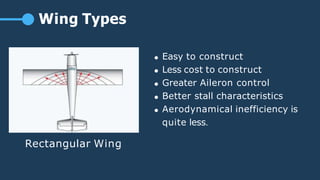
Wing Types
Easy to construct
Less cost to construct
Greater Aileron control
Better stall characteristics
Aerodynamical inefficiency is
quite less.
Rectangular Wing
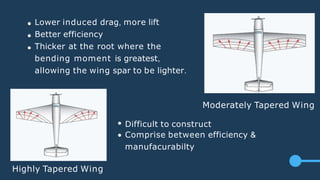
Lower induced drag, more lift
Better efficiency
Thicker at the root where the
bending moment is greatest,
allowing the wing spar to be lighter.
Moderately Tapered Wing
Difficult to construct
Comprise between efficiency &
manufacurabilty
Highly Tapered Wing
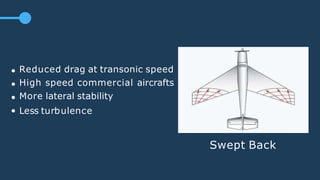
Swept Back
Reduced drag at transonic speed
High speed commercial aircrafts
More lateral stability
Less turbulence
Elliptical Wing Delta/Pointed Wing
Most efficient
Minimum drag
Poor manufacurability
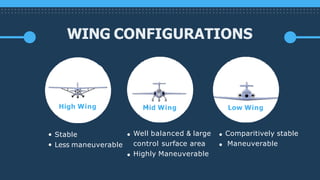
WING CONFIGURATIONS
Mid Wing
High Wing Low Wing
Stable
Less maneuverable
Well balanced & large
control surface area
Highly Maneuverable
Comparitively stable
Maneuverable
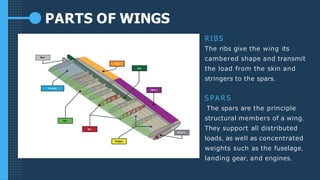
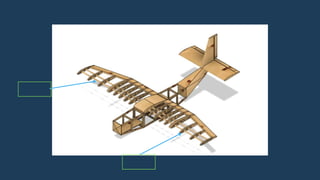
PARTS OF WINGS
RIBS
The ribs give the wing its
cambered shape and transmit
the load from the skin and
stringers to the spars.
S P A R S
The spars are the principle
structural members of a wing.
They support all distributed
loads, as well as concentrated
weights such as the fuselage,
landing gear, and engines.
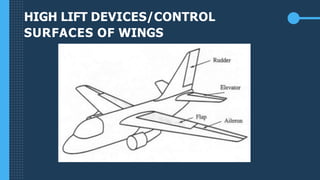
HIGH LIFT DEVICES/CONTROL
SURFACES OF WINGS
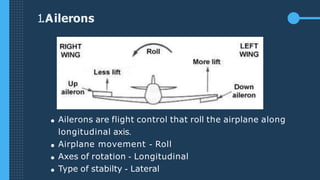
1.Ailerons
Ailerons are flight control that roll the airplane along
longitudinal axis.
Airplane movement - Roll
Axes of rotation - Longitudinal
Type of stabilty - Lateral
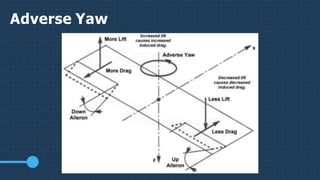
Adverse Yaw
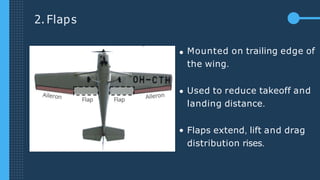
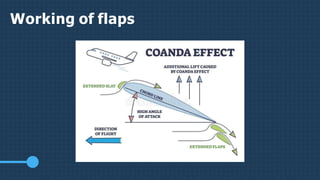
2. Flaps
Mounted on trailing edge of
the wing.
Used to reduce takeoff and
landing distance.
Flaps extend, lift and drag
distribution rises.
Working of flaps
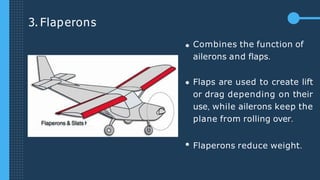
3. Flaperons
Combines the function of
ailerons and flaps.
Flaps are used to create lift
or drag depending on their
use, while ailerons keep the
plane from rolling over.
Flaperons reduce weight.
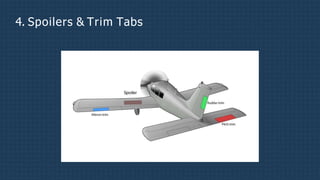
4. Spoilers & Trim Tabs
Spoiler
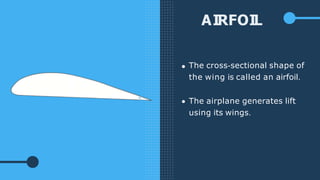
AIRFOIL
The cross-sectional shape of
the wing is called an airfoil.
The airplane generates lift
using its wings.
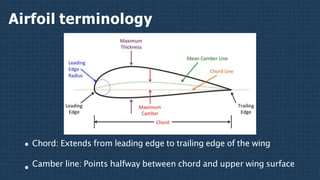
Airfoil terminology
Chord: Extends from leading edge to trailing edge of the wing
Camber line: Points halfway between chord and upper wing surface
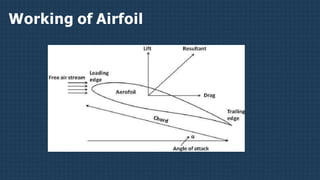
Working of Airfoil
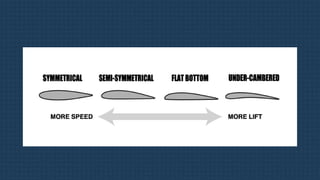
S Y M M E T R I C A L
AIRFOIL
TYPES
FLAT B O TT O M E D
SEMI
S Y M M E T R I C A L
U N D E R C A M B E R E D
WING DIMENSIONING
PARAMETERS
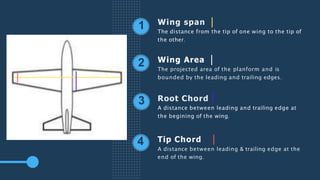
Wing span
The distance from the tip of one wing to the tip of
the other.
Wing Area
The projected area of the planform and is
bounded by the leading and trailing edges.
Root Chord
A distance between leading and trailing edge at
the begining of the wing.
Tip Chord
A distance between leading & trailing edge at the
end of the wing.
1
2
3
4
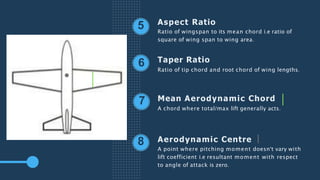
Aspect Ratio
Ratio of wingspan to its mean chord i.e ratio of
square of wing span to wing area.
Taper Ratio
Ratio of tip chord and root chord of wing lengths.
Mean Aerodynamic Chord
A chord where total/max lift generally acts.
Aerodynamic Centre
A point where pitching moment doesn't vary with
lift coefficient i.e resultant moment with respect
to angle of attack is zero.
5
6
7
8
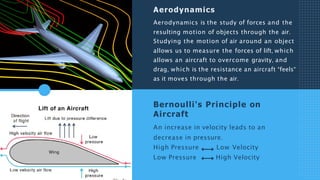
Aerodynamics
Aerodynamics is the study of forces and the
resulting motion of objects through the air.
Studying the motion of air around an object
allows us to measure the forces of lift, which
allows an aircraft to overcome gravity, and
drag, which is the resistance an aircraft “feels”
as it moves through the air.
Bernoulli's Principle on
Aircraft
An increase in velocity leads to an
decrease in pressure.
High Pressure
Low Pressure
Low Velocity
High Velocity
Recap
TY P E S O F W IN G S
WING C O N F I G U R AT I O N S
PA RT S OF W I N G S
C O N TR O L S U R FA C E S
TY P E S OF AIRFOILS
W IN G P A R A M E TE R S &
B E R N O U LLI'S
Until next time
THA NK
YOU
N E X T - A E R O D Y N A M I C S & S O F T W A R E

Aeronix Session- Wing aeronix wing .pptx

  • 1.
  • 2.
    Types of Wings& Configurations Pros & Cons Parts of Wings High lift devices Airfoil & its types Dimensioning of Wing parameters Aerodynamics of Wing Content
  • 3.
    Wing Types Easy toconstruct Less cost to construct Greater Aileron control Better stall characteristics Aerodynamical inefficiency is quite less. Rectangular Wing
  • 4.
    Lower induced drag,more lift Better efficiency Thicker at the root where the bending moment is greatest, allowing the wing spar to be lighter. Moderately Tapered Wing Difficult to construct Comprise between efficiency & manufacurabilty Highly Tapered Wing
  • 5.
    Swept Back Reduced dragat transonic speed High speed commercial aircrafts More lateral stability Less turbulence
  • 6.
    Elliptical Wing Delta/PointedWing Most efficient Minimum drag Poor manufacurability
  • 7.
    WING CONFIGURATIONS Mid Wing HighWing Low Wing Stable Less maneuverable Well balanced & large control surface area Highly Maneuverable Comparitively stable Maneuverable
  • 8.
    PARTS OF WINGS RIBS Theribs give the wing its cambered shape and transmit the load from the skin and stringers to the spars. S P A R S The spars are the principle structural members of a wing. They support all distributed loads, as well as concentrated weights such as the fuselage, landing gear, and engines.
  • 10.
  • 11.
    1.Ailerons Ailerons are flightcontrol that roll the airplane along longitudinal axis. Airplane movement - Roll Axes of rotation - Longitudinal Type of stabilty - Lateral
  • 12.
  • 13.
    2. Flaps Mounted ontrailing edge of the wing. Used to reduce takeoff and landing distance. Flaps extend, lift and drag distribution rises.
  • 14.
  • 15.
    3. Flaperons Combines thefunction of ailerons and flaps. Flaps are used to create lift or drag depending on their use, while ailerons keep the plane from rolling over. Flaperons reduce weight.
  • 16.
    4. Spoilers &Trim Tabs Spoiler
  • 17.
    AIRFOIL The cross-sectional shapeof the wing is called an airfoil. The airplane generates lift using its wings.
  • 18.
    Airfoil terminology Chord: Extendsfrom leading edge to trailing edge of the wing Camber line: Points halfway between chord and upper wing surface
  • 19.
  • 20.
    S Y MM E T R I C A L AIRFOIL TYPES FLAT B O TT O M E D SEMI S Y M M E T R I C A L U N D E R C A M B E R E D
  • 22.
  • 23.
    Wing span The distancefrom the tip of one wing to the tip of the other. Wing Area The projected area of the planform and is bounded by the leading and trailing edges. Root Chord A distance between leading and trailing edge at the begining of the wing. Tip Chord A distance between leading & trailing edge at the end of the wing. 1 2 3 4
  • 24.
    Aspect Ratio Ratio ofwingspan to its mean chord i.e ratio of square of wing span to wing area. Taper Ratio Ratio of tip chord and root chord of wing lengths. Mean Aerodynamic Chord A chord where total/max lift generally acts. Aerodynamic Centre A point where pitching moment doesn't vary with lift coefficient i.e resultant moment with respect to angle of attack is zero. 5 6 7 8
  • 25.
    Aerodynamics Aerodynamics is thestudy of forces and the resulting motion of objects through the air. Studying the motion of air around an object allows us to measure the forces of lift, which allows an aircraft to overcome gravity, and drag, which is the resistance an aircraft “feels” as it moves through the air. Bernoulli's Principle on Aircraft An increase in velocity leads to an decrease in pressure. High Pressure Low Pressure Low Velocity High Velocity
  • 26.
    Recap TY P ES O F W IN G S WING C O N F I G U R AT I O N S PA RT S OF W I N G S C O N TR O L S U R FA C E S TY P E S OF AIRFOILS W IN G P A R A M E TE R S & B E R N O U LLI'S
  • 27.
    Until next time THANK YOU N E X T - A E R O D Y N A M I C S & S O F T W A R E