
Assignment
Lahore School of Aviation
The University of Lahore
TOPIC: Airfoils
 Program: BS Aviation Management Semester: 01
 Course: Principles of Flights Date:1-Jan-2017
 Instructor: Imtiaz Hussain Batch: 06
 Term: FALL 2016 Section: A
Presented By
 H M Noshairwan (BAM02163111)
 INTRODUCTION
 DEFINITION
 PARTS
 TYPES
 NACA 4 DIGITS
 NACA 5 DIGITS
AIRFOILS
Introduction
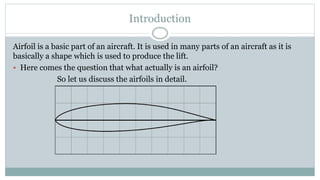
Airfoil is a basic part of an aircraft. It is used in many parts of an aircraft as it is
basically a shape which is used to produce the lift.
 Here comes the question that what actually is an airfoil?
So let us discuss the airfoils in detail.
Airfoil:
“ it is actually the shape of the wing or blade which is used in propeller,
wings, fuselage, vertical and horizontal stabilizer in order to produce the
lift.
Shape:
 It’s shape is just like the shape of the fish as it was made by getting the
inspiration of a fish swimming against the heavy flow of water.
Parts:
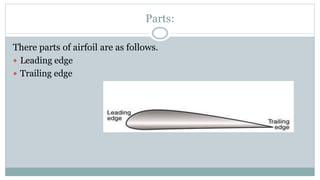
There parts of airfoil are as follows.
 Leading edge
 Trailing edge
Leading edge:
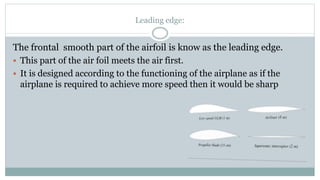
The frontal smooth part of the airfoil is know as the leading edge.
 This part of the air foil meets the air first.
 It is designed according to the functioning of the airplane as if the
airplane is required to achieve more speed then it would be sharp
Trailing edge:
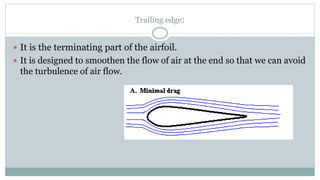
 It is the terminating part of the airfoil.
 It is designed to smoothen the flow of air at the end so that we can avoid
the turbulence of air flow.
Basic terminologies of an airfoil:
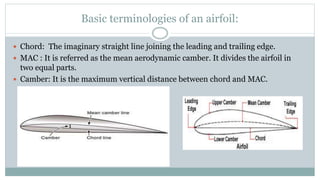
 Chord: The imaginary straight line joining the leading and trailing edge.
 MAC : It is referred as the mean aerodynamic camber. It divides the airfoil in
two equal parts.
 Camber: It is the maximum vertical distance between chord and MAC.
Types:
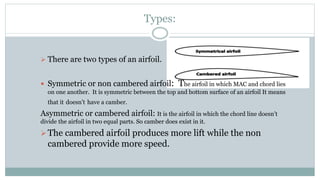
 There are two types of an airfoil.
 Symmetric or non cambered airfoil: The airfoil in which MAC and chord lies
on one another. It is symmetric between the top and bottom surface of an airfoil It means
that it doesn’t have a camber.
Asymmetric or cambered airfoil: It is the airfoil in which the chord line doesn’t
divide the airfoil in two equal parts. So camber does exist in it.
The cambered airfoil produces more lift while the non
cambered provide more speed.
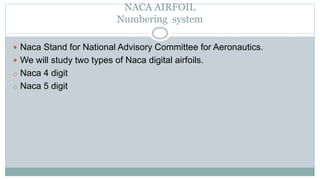
NACA AIRFOIL
Numbering system
 Naca Stand for National Advisory Committee for Aeronautics.
 We will study two types of Naca digital airfoils.
o Naca 4 digit
o Naca 5 digit
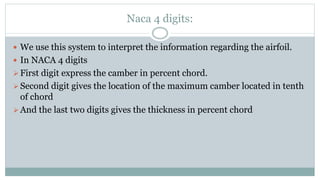
Naca 4 digits:
 We use this system to interpret the information regarding the airfoil.
 In NACA 4 digits
First digit express the camber in percent chord.
Second digit gives the location of the maximum camber located in tenth
of chord
And the last two digits gives the thickness in percent chord
NACA 4 Digits
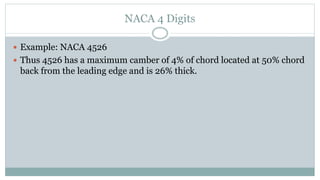
 Example: NACA 4526
 Thus 4526 has a maximum camber of 4% of chord located at 50% chord
back from the leading edge and is 26% thick.
Naca 5-digits airfoil
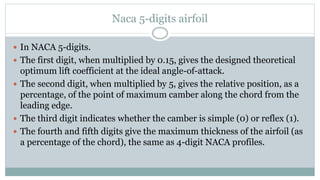
 In NACA 5-digits.
 The first digit, when multiplied by 0.15, gives the designed theoretical
optimum lift coefficient at the ideal angle-of-attack.
 The second digit, when multiplied by 5, gives the relative position, as a
percentage, of the point of maximum camber along the chord from the
leading edge.
 The third digit indicates whether the camber is simple (0) or reflex (1).
 The fourth and fifth digits give the maximum thickness of the airfoil (as
a percentage of the chord), the same as 4-digit NACA profiles.

Airfoil

  • 1.
    Assignment Lahore School ofAviation The University of Lahore TOPIC: Airfoils  Program: BS Aviation Management Semester: 01  Course: Principles of Flights Date:1-Jan-2017  Instructor: Imtiaz Hussain Batch: 06  Term: FALL 2016 Section: A
  • 2.
    Presented By  HM Noshairwan (BAM02163111)
  • 3.
     INTRODUCTION  DEFINITION PARTS  TYPES  NACA 4 DIGITS  NACA 5 DIGITS AIRFOILS
  • 4.
    Introduction Airfoil is abasic part of an aircraft. It is used in many parts of an aircraft as it is basically a shape which is used to produce the lift.  Here comes the question that what actually is an airfoil? So let us discuss the airfoils in detail.
  • 5.
    Airfoil: “ it isactually the shape of the wing or blade which is used in propeller, wings, fuselage, vertical and horizontal stabilizer in order to produce the lift.
  • 6.
    Shape:  It’s shapeis just like the shape of the fish as it was made by getting the inspiration of a fish swimming against the heavy flow of water.
  • 7.
    Parts: There parts ofairfoil are as follows.  Leading edge  Trailing edge
  • 8.
    Leading edge: The frontalsmooth part of the airfoil is know as the leading edge.  This part of the air foil meets the air first.  It is designed according to the functioning of the airplane as if the airplane is required to achieve more speed then it would be sharp
  • 9.
    Trailing edge:  Itis the terminating part of the airfoil.  It is designed to smoothen the flow of air at the end so that we can avoid the turbulence of air flow.
  • 10.
    Basic terminologies ofan airfoil:  Chord: The imaginary straight line joining the leading and trailing edge.  MAC : It is referred as the mean aerodynamic camber. It divides the airfoil in two equal parts.  Camber: It is the maximum vertical distance between chord and MAC.
  • 11.
    Types:  There aretwo types of an airfoil.  Symmetric or non cambered airfoil: The airfoil in which MAC and chord lies on one another. It is symmetric between the top and bottom surface of an airfoil It means that it doesn’t have a camber. Asymmetric or cambered airfoil: It is the airfoil in which the chord line doesn’t divide the airfoil in two equal parts. So camber does exist in it. The cambered airfoil produces more lift while the non cambered provide more speed.
  • 12.
    NACA AIRFOIL Numbering system Naca Stand for National Advisory Committee for Aeronautics.  We will study two types of Naca digital airfoils. o Naca 4 digit o Naca 5 digit
  • 13.
    Naca 4 digits: We use this system to interpret the information regarding the airfoil.  In NACA 4 digits First digit express the camber in percent chord. Second digit gives the location of the maximum camber located in tenth of chord And the last two digits gives the thickness in percent chord
  • 14.
    NACA 4 Digits Example: NACA 4526  Thus 4526 has a maximum camber of 4% of chord located at 50% chord back from the leading edge and is 26% thick.
  • 15.
    Naca 5-digits airfoil In NACA 5-digits.  The first digit, when multiplied by 0.15, gives the designed theoretical optimum lift coefficient at the ideal angle-of-attack.  The second digit, when multiplied by 5, gives the relative position, as a percentage, of the point of maximum camber along the chord from the leading edge.  The third digit indicates whether the camber is simple (0) or reflex (1).  The fourth and fifth digits give the maximum thickness of the airfoil (as a percentage of the chord), the same as 4-digit NACA profiles.