Content….
• What is air pollution?
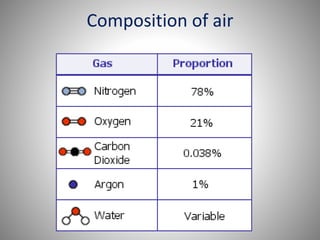
• Composition of air
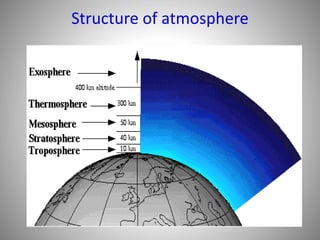
• Structure of atmosphere
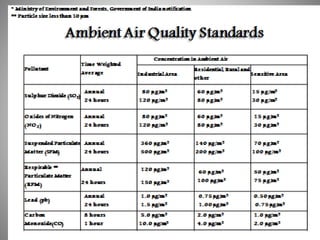
• Ambient Air Quality Standards
• Classification of air pollutants
• Sources of common air pollutants like PM, SO2,
NOX, Natural & Anthropogenic Sources
• Effects of common air pollutants
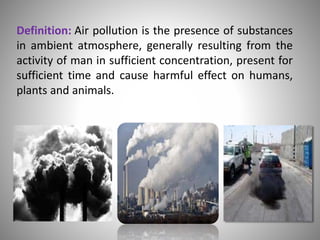
Definition: Air pollution is the presence of substances
in ambient atmosphere, generally resulting from the
activity of man in sufficient concentration, present for
sufficient time and cause harmful effect on humans,
plants and animals.
Composition of air
Composition of air
Structure of atmosphere
Classification of air pollutants
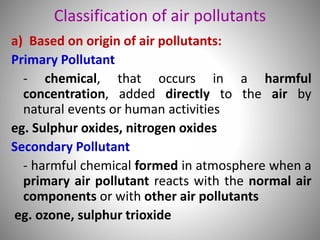
a) Based on origin of air pollutants:
Primary Pollutant
- chemical, that occurs in a harmful
concentration, added directly to the air by
natural events or human activities
eg. Sulphur oxides, nitrogen oxides
Secondary Pollutant
- harmful chemical formed in atmosphere when a
primary air pollutant reacts with the normal air
components or with other air pollutants
eg. ozone, sulphur trioxide
Classification of air pollutants
Primary Pollutants
Most hydrocarbons
Most suspended particles
CO2CO
SO2 NO2NO
Most NO3
– and SO4
2– salts
Secondary Pollutants
PANs
SO3
H2SO4HNO3
O3H2O2
Stationary
Mobile
NaturalSources
Based on state of matter, air pollutants:
• Gaseous pollutants:
Pollutants are gaseous in state at normal
temperature and pressure.
eg. Common gas pollutants like CO, CO2, NOX,
SOX .
• Particulate air pollutants:
Suspended droplets, solid particles or their
mixtures in the atmosphere, commonly
referred as particulates.
eg. Dust, smoke, aerosols.
Sources of Air pollution
• Natural:
• Pollen grains
• Volcanoes
• Forest fire
• Salt spray from oceans
• Dust storms
• Marshy land
• Bacteria and other microorganisms
• Spores
• Photochemical reactions
Sources of Air pollution
• Man made:
• Industrial unit
• Thermal power plants
• Automobile exhaust
• Fossil fuel burning
• Agricultural activities
• Mining
• Air crafts
• Nuclear explosion
• Domestic burning of woods
Sources of Air pollution
• Man made:
• Point or Stationary sources - those that are fixed
in location.
• point sources e.g. smoke stacks, 14% air pollution
from plants generating electricity
• Line or Mobile sources - those that move while
polluting, e.g. trucks, cars, busses etc. 60% of air
pollution from motor vehicles.
• area sources: town or cities add smoke and gases
over wide areas called area sources of air pollution.
Point or Stationary sources Line or Mobile sources
Sources of common air pollutants
• Particulate matter:
• Small, solid particles and liquid droplets present
in atmosphere.
• Size: 0.02µm to 500µm.
• Particulate pollutants categorized according to
size, source and physical state.
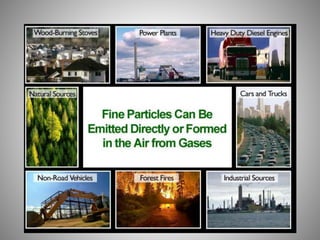
Particulate Matter
•particles of different sizes and
structures that are released into the
atmosphere
•present in many sources including
fossil fuels, dust, smoke, fog, etc.
•can build up in respiratory system
• cause heart and lung disease;
increases risk of respiratory infection
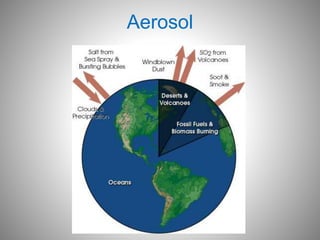
Aerosol
• Aerosol – a dispersion of solid and liquid
particles suspended in gas (air).
• Aerosol particles larger than about 1 micrometer
in size are produced by windblown dust and sea
salt from sea spray.
• After formation, the aerosols are mixed and
transported by atmospheric motions.
• Examples: dust, smoke, mist, fumes.
Aerosol
Dust:
• Small solid particles.
• Size: 1 to 200 µm.
• Formed by breaking up of larger masses of
rock and soil either by disintegration or by
mechanical process.
• Remain suspended in air temporarily but
ultimately settle under the influence of
gravity.
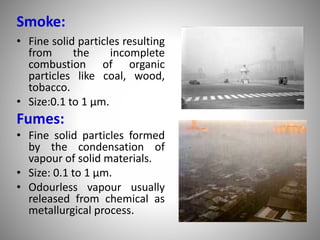
Smoke:
• Fine solid particles resulting
from the incomplete
combustion of organic
particles like coal, wood,
tobacco.
• Size:0.1 to 1 µm.
Fumes:
• Fine solid particles formed
by the condensation of
vapour of solid materials.
• Size: 0.1 to 1 µm.
• Odourless vapour usually
released from chemical as
metallurgical process.
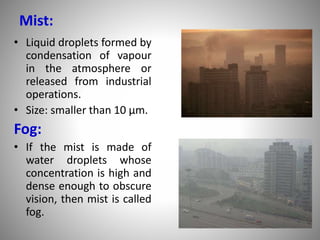
Mist:
• Liquid droplets formed by
condensation of vapour
in the atmosphere or
released from industrial
operations.
• Size: smaller than 10 µm.
Fog:
• If the mist is made of
water droplets whose
concentration is high and
dense enough to obscure
vision, then mist is called
fog.
Flyash:
• Finely divided non
combustible particles
present in the gases arising
from fuel combustion.
• Contain inorganic metallic or
mineral substances released
when organic part of coal is
burnt.
Soot:
• Incomplete combustion of
carbon containing materials
release carbon particles.
Gas pollutants - SO2
• Properties
– SO2 is a colorless gas having pungent and
suffocating odour.
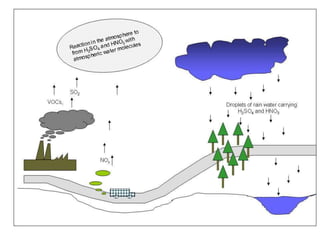
– Reacts with H2O and forms sulfurous acid
(H2SO3), which oxidizes to sulfuric acid (H2SO4)
– Chemical transformation of other pollutants
– Responsible for acid rain effect
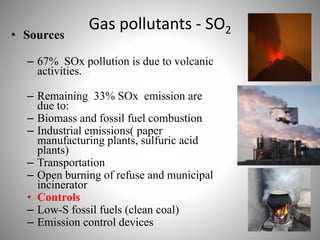
Gas pollutants - SO2• Sources
– 67% SOx pollution is due to volcanic
activities.
– Remaining 33% SOx emission are
due to:
– Biomass and fossil fuel combustion
– Industrial emissions( paper
manufacturing plants, sulfuric acid
plants)
– Transportation
– Open burning of refuse and municipal
incinerator
• Controls
– Low-S fossil fuels (clean coal)
– Emission control devices
Gas pollutants - SO2
• Effects:
₋ Irritation of mucous membranes of the respiratory
tract.
₋ High concentration may cause bronchitis.
₋ Marbles and mortar statues are affected.
₋ Plants are sensitive to high concentration of SO2 ,
result in chlorosis, metabolic inhibition, plasmolysis
and even death.
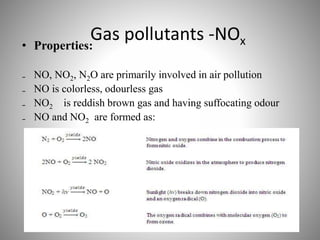
Gas pollutants -NOx• Properties:
₋ NO, NO2, N2O are primarily involved in air pollution
₋ NO is colorless, odourless gas
₋ NO2 is reddish brown gas and having suffocating odour
₋ NO and NO2 are formed as:
Gas pollutants -NOx
• Sources
– Fuel combustion in automobiles and industries
– Lightening
– Forest fire
– Bacterial decomposition of organic matters
Gas pollutants -NOx
• Effects :
– Deep lung irritant
– Nitric oxide can combine with hemoglobin and
reduce oxygen carrying capacity of blood.
– NO is moderately toxic.
– NO2 is more toxic, it irritate alveoli of lungs and
high concentration may cause acute bronchitis.
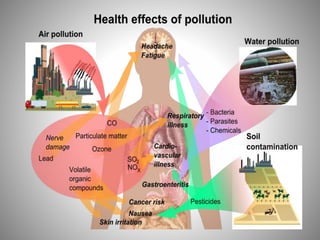
Effects of air pollution
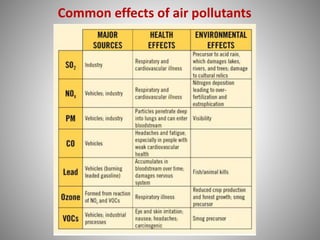
Common effects of air pollutants
EFFECTS OF AIR POLLUTION ON
HUMAN HEALTH
• Human Health
– ACUTE: short duration
exposure and/or immediate
effects
Examples:
irritation of eyes, nose and
throat
upper respiratory infections
(bronchitis, pneumonia)
headaches
nausea
allergic reactions, etc.
EFFECTS OF AIR POLLUTION ON
HUMAN HEALTH
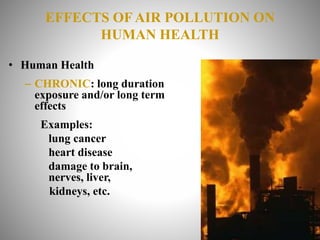
• Human Health
– CHRONIC: long duration
exposure and/or long term
effects
Examples:
lung cancer
heart disease
damage to brain,
nerves, liver,
kidneys, etc.
EFFECTS OF AIR POLLUTION ON
HUMAN HEALTH
• Reduced lung functioning
• Irritation of eyes, nose, mouth and throat
• Asthma attacks
• Respiratory symptoms such as coughing and wheezing
• Increased respiratory disease such as bronchitis
• Reduced energy levels
• Headaches and dizziness
• Neuro -behavioural disorders
• Cardiovascular problems
• Cancer
Nasal
Cavity
Nose
Mouth
Bronchus
Bronchiole
Alveolus
Diaphragm
Throat
(pharynx)
Windpipe
(Trachea)
Left lungs
Ribs
Effects of CO:
Reacts with hemoglobin in blood
• –Forms carboxyhemoglobin (HbCO) rather
than oxyhemoglobin (HbO2)
• –Prevents oxygen transfer
• Effect of O3:
• Cause: atmospheric photochemical reaction
• Acute Health effects
– Severe ear/nose/throat irritation
– Interferes with lung functions
• Coughing at 2 ppm ozone
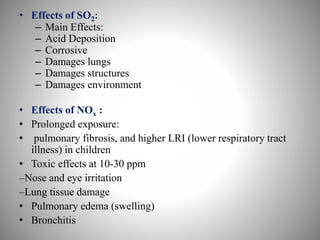
• Effects of SO2:
– Main Effects:
– Acid Deposition
– Corrosive
– Damages lungs
– Damages structures
– Damages environment
• Effects of NOx :
• Prolonged exposure:
• pulmonary fibrosis, and higher LRI (lower respiratory tract
illness) in children
• Toxic effects at 10-30 ppm
–Nose and eye irritation
–Lung tissue damage
• Pulmonary edema (swelling)
• Bronchitis
Effects of air pollution on plants
• Have an adverse effect on plants
• Cause a widespread damage to natural
vegetation and economic crops
• Many species are susceptible to damage even
at low concentrations
• Gaseous pollutants are actively metabolized
by some plants and these plants are employed
as indicators of air pollutants
Effects of air pollution on plants
Pollutant Effects on plants
SO2 Bleaching of leaves, necrosis(killing of tissues)
NO2 Suppressed growth, bleaching
O3 Suppressed growth, bleaching, necrosis, collapse of leaf
Fluorides Necrosis at leaf tip
PAN Suppressed growth, silvering of lower leaf surface
Necrotic lesions on
lower surface of potato
leaves
Chlorosis and necrosis of
white pine needles
Necrosis of
watermelon leaf
Effects of air pollution on plants
• Forms of damages to leaves:
 Necrosis: killing or collapse of tissue
 Chlorosis: loss or reduction of chlorophyll resulting in fading of
the leaf’s green color to yellowish or pale green.
 Abscission: dropping of leaves
 Epinasty: downward curvature of leaf due to the higher rate of
growth on the upper surface
 Acute injury: short-time to high concentration occur under
fumigation conditions. Effects are noted within few hours to few
days- make visible markings on the leaves
 Chronic injury: long-term to low concentrations
Effect of Ozone on plants
Effects of air pollution on material/property
• Damage to property
Effects of dry deposition of sulfur dioxide, which causes
the formation of gypsum. Gypsum traps particulate
matter to form heavy, black incrustation.
Effects of air pollution on material/property
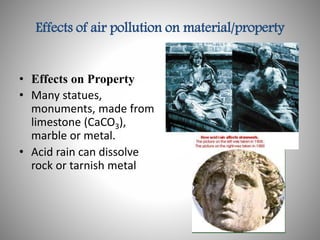
• Effects on Property
• Many statues,
monuments, made from
limestone (CaCO3),
marble or metal.
• Acid rain can dissolve
rock or tarnish metal
Effects of air pollution on material/property
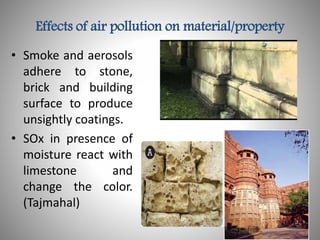
• Smoke and aerosols
adhere to stone,
brick and building
surface to produce
unsightly coatings.
• SOx in presence of
moisture react with
limestone and
change the color.
(Tajmahal)
Effects of air pollution on material/property
On paints:
• Areas high pollution require frequent painting.
• H2S cause darkening of surfaces covered with
paint containing white lead.
On textiles:
• SO2 causes deterioration of natural and
synthetic textile fibers.
• Fading of textile dyes by oxides of nitrogen,
ozone.
Effects of air pollution on climate/environment
When gas pollutants e.g. sulfur dioxide,
nitrogen dioxidedissolve in rain water,
various acids are formed
– CO2 + H2O  H2CO3 (carbonic acid)
– SO2 + H2O  H2SO4 (sulfuric acid)
– NO2 + H2O  HNO2 (nitrous acid) +
HNO3 (nitric acid)
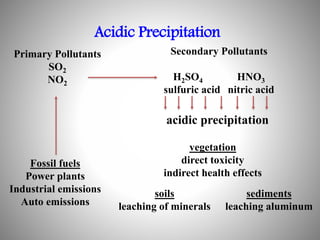
Acidic Precipitation
Fossil fuels
Power plants
Industrial emissions
Auto emissions
Primary Pollutants
SO2
NO2
Secondary Pollutants
H2SO4 HNO3
sulfuric acid nitric acid
soils
leaching of minerals
vegetation
direct toxicity
indirect health effects
sediments
leaching aluminum
acidic precipitation
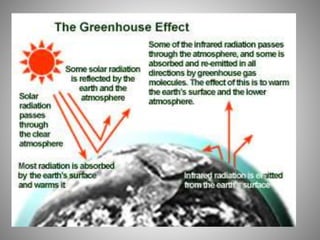
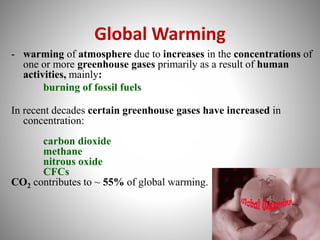
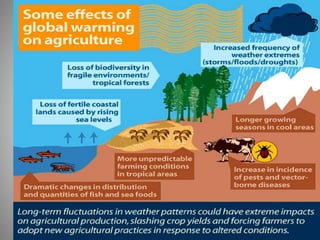
Global Warming
- warming of atmosphere due to increases in the concentrations of
one or more greenhouse gases primarily as a result of human
activities, mainly:
burning of fossil fuels
In recent decades certain greenhouse gases have increased in
concentration:
carbon dioxide
methane
nitrous oxide
CFCs
CO2 contributes to ~ 55% of global warming.
Melting of Glacier
Ozone Depletion
- The ozone layer is a layer of gaseous ozone
located in the stratosphere
- The stratosphere contains O3 “good ozone”
- The ozone layer prevents 99% of harmful
ultraviolet radiation from reaching Earth’s
surface
- It is being depleted by CFCs, halons and other
chemicals
Thank You

air pollution

  • 2.
    Content…. • What isair pollution? • Composition of air • Structure of atmosphere • Ambient Air Quality Standards • Classification of air pollutants • Sources of common air pollutants like PM, SO2, NOX, Natural & Anthropogenic Sources • Effects of common air pollutants
  • 3.
    Definition: Air pollutionis the presence of substances in ambient atmosphere, generally resulting from the activity of man in sufficient concentration, present for sufficient time and cause harmful effect on humans, plants and animals.
  • 4.
  • 5.
  • 6.
  • 7.
    Classification of airpollutants a) Based on origin of air pollutants: Primary Pollutant - chemical, that occurs in a harmful concentration, added directly to the air by natural events or human activities eg. Sulphur oxides, nitrogen oxides Secondary Pollutant - harmful chemical formed in atmosphere when a primary air pollutant reacts with the normal air components or with other air pollutants eg. ozone, sulphur trioxide
  • 8.
    Classification of airpollutants Primary Pollutants Most hydrocarbons Most suspended particles CO2CO SO2 NO2NO Most NO3 – and SO4 2– salts Secondary Pollutants PANs SO3 H2SO4HNO3 O3H2O2 Stationary Mobile NaturalSources
  • 9.
    Based on stateof matter, air pollutants: • Gaseous pollutants: Pollutants are gaseous in state at normal temperature and pressure. eg. Common gas pollutants like CO, CO2, NOX, SOX . • Particulate air pollutants: Suspended droplets, solid particles or their mixtures in the atmosphere, commonly referred as particulates. eg. Dust, smoke, aerosols.
  • 10.
    Sources of Airpollution • Natural: • Pollen grains • Volcanoes • Forest fire • Salt spray from oceans • Dust storms • Marshy land • Bacteria and other microorganisms • Spores • Photochemical reactions
  • 11.
    Sources of Airpollution • Man made: • Industrial unit • Thermal power plants • Automobile exhaust • Fossil fuel burning • Agricultural activities • Mining • Air crafts • Nuclear explosion • Domestic burning of woods
  • 12.
    Sources of Airpollution • Man made: • Point or Stationary sources - those that are fixed in location. • point sources e.g. smoke stacks, 14% air pollution from plants generating electricity • Line or Mobile sources - those that move while polluting, e.g. trucks, cars, busses etc. 60% of air pollution from motor vehicles. • area sources: town or cities add smoke and gases over wide areas called area sources of air pollution.
  • 13.
    Point or Stationarysources Line or Mobile sources
  • 14.
    Sources of commonair pollutants • Particulate matter: • Small, solid particles and liquid droplets present in atmosphere. • Size: 0.02µm to 500µm. • Particulate pollutants categorized according to size, source and physical state.
  • 16.
    Particulate Matter •particles ofdifferent sizes and structures that are released into the atmosphere •present in many sources including fossil fuels, dust, smoke, fog, etc. •can build up in respiratory system • cause heart and lung disease; increases risk of respiratory infection
  • 17.
    Aerosol • Aerosol –a dispersion of solid and liquid particles suspended in gas (air). • Aerosol particles larger than about 1 micrometer in size are produced by windblown dust and sea salt from sea spray. • After formation, the aerosols are mixed and transported by atmospheric motions. • Examples: dust, smoke, mist, fumes.
  • 18.
  • 19.
    Dust: • Small solidparticles. • Size: 1 to 200 µm. • Formed by breaking up of larger masses of rock and soil either by disintegration or by mechanical process. • Remain suspended in air temporarily but ultimately settle under the influence of gravity.
  • 20.
    Smoke: • Fine solidparticles resulting from the incomplete combustion of organic particles like coal, wood, tobacco. • Size:0.1 to 1 µm. Fumes: • Fine solid particles formed by the condensation of vapour of solid materials. • Size: 0.1 to 1 µm. • Odourless vapour usually released from chemical as metallurgical process.
  • 21.
    Mist: • Liquid dropletsformed by condensation of vapour in the atmosphere or released from industrial operations. • Size: smaller than 10 µm. Fog: • If the mist is made of water droplets whose concentration is high and dense enough to obscure vision, then mist is called fog.
  • 22.
    Flyash: • Finely dividednon combustible particles present in the gases arising from fuel combustion. • Contain inorganic metallic or mineral substances released when organic part of coal is burnt. Soot: • Incomplete combustion of carbon containing materials release carbon particles.
  • 23.
    Gas pollutants -SO2 • Properties – SO2 is a colorless gas having pungent and suffocating odour. – Reacts with H2O and forms sulfurous acid (H2SO3), which oxidizes to sulfuric acid (H2SO4) – Chemical transformation of other pollutants – Responsible for acid rain effect
  • 24.
    Gas pollutants -SO2• Sources – 67% SOx pollution is due to volcanic activities. – Remaining 33% SOx emission are due to: – Biomass and fossil fuel combustion – Industrial emissions( paper manufacturing plants, sulfuric acid plants) – Transportation – Open burning of refuse and municipal incinerator • Controls – Low-S fossil fuels (clean coal) – Emission control devices
  • 25.
    Gas pollutants -SO2 • Effects: ₋ Irritation of mucous membranes of the respiratory tract. ₋ High concentration may cause bronchitis. ₋ Marbles and mortar statues are affected. ₋ Plants are sensitive to high concentration of SO2 , result in chlorosis, metabolic inhibition, plasmolysis and even death.
  • 27.
    Gas pollutants -NOx•Properties: ₋ NO, NO2, N2O are primarily involved in air pollution ₋ NO is colorless, odourless gas ₋ NO2 is reddish brown gas and having suffocating odour ₋ NO and NO2 are formed as:
  • 28.
    Gas pollutants -NOx •Sources – Fuel combustion in automobiles and industries – Lightening – Forest fire – Bacterial decomposition of organic matters
  • 29.
    Gas pollutants -NOx •Effects : – Deep lung irritant – Nitric oxide can combine with hemoglobin and reduce oxygen carrying capacity of blood. – NO is moderately toxic. – NO2 is more toxic, it irritate alveoli of lungs and high concentration may cause acute bronchitis.
  • 30.
    Effects of airpollution
  • 31.
    Common effects ofair pollutants
  • 33.
    EFFECTS OF AIRPOLLUTION ON HUMAN HEALTH • Human Health – ACUTE: short duration exposure and/or immediate effects Examples: irritation of eyes, nose and throat upper respiratory infections (bronchitis, pneumonia) headaches nausea allergic reactions, etc.
  • 34.
    EFFECTS OF AIRPOLLUTION ON HUMAN HEALTH • Human Health – CHRONIC: long duration exposure and/or long term effects Examples: lung cancer heart disease damage to brain, nerves, liver, kidneys, etc.
  • 35.
    EFFECTS OF AIRPOLLUTION ON HUMAN HEALTH • Reduced lung functioning • Irritation of eyes, nose, mouth and throat • Asthma attacks • Respiratory symptoms such as coughing and wheezing • Increased respiratory disease such as bronchitis • Reduced energy levels • Headaches and dizziness • Neuro -behavioural disorders • Cardiovascular problems • Cancer
  • 36.
  • 37.
    Effects of CO: Reactswith hemoglobin in blood • –Forms carboxyhemoglobin (HbCO) rather than oxyhemoglobin (HbO2) • –Prevents oxygen transfer • Effect of O3: • Cause: atmospheric photochemical reaction • Acute Health effects – Severe ear/nose/throat irritation – Interferes with lung functions • Coughing at 2 ppm ozone
  • 38.
    • Effects ofSO2: – Main Effects: – Acid Deposition – Corrosive – Damages lungs – Damages structures – Damages environment • Effects of NOx : • Prolonged exposure: • pulmonary fibrosis, and higher LRI (lower respiratory tract illness) in children • Toxic effects at 10-30 ppm –Nose and eye irritation –Lung tissue damage • Pulmonary edema (swelling) • Bronchitis
  • 39.
    Effects of airpollution on plants • Have an adverse effect on plants • Cause a widespread damage to natural vegetation and economic crops • Many species are susceptible to damage even at low concentrations • Gaseous pollutants are actively metabolized by some plants and these plants are employed as indicators of air pollutants
  • 40.
    Effects of airpollution on plants Pollutant Effects on plants SO2 Bleaching of leaves, necrosis(killing of tissues) NO2 Suppressed growth, bleaching O3 Suppressed growth, bleaching, necrosis, collapse of leaf Fluorides Necrosis at leaf tip PAN Suppressed growth, silvering of lower leaf surface Necrotic lesions on lower surface of potato leaves Chlorosis and necrosis of white pine needles Necrosis of watermelon leaf
  • 41.
    Effects of airpollution on plants • Forms of damages to leaves:  Necrosis: killing or collapse of tissue  Chlorosis: loss or reduction of chlorophyll resulting in fading of the leaf’s green color to yellowish or pale green.  Abscission: dropping of leaves  Epinasty: downward curvature of leaf due to the higher rate of growth on the upper surface  Acute injury: short-time to high concentration occur under fumigation conditions. Effects are noted within few hours to few days- make visible markings on the leaves  Chronic injury: long-term to low concentrations
  • 42.
    Effect of Ozoneon plants
  • 43.
    Effects of airpollution on material/property • Damage to property Effects of dry deposition of sulfur dioxide, which causes the formation of gypsum. Gypsum traps particulate matter to form heavy, black incrustation.
  • 44.
    Effects of airpollution on material/property • Effects on Property • Many statues, monuments, made from limestone (CaCO3), marble or metal. • Acid rain can dissolve rock or tarnish metal
  • 45.
    Effects of airpollution on material/property • Smoke and aerosols adhere to stone, brick and building surface to produce unsightly coatings. • SOx in presence of moisture react with limestone and change the color. (Tajmahal)
  • 46.
    Effects of airpollution on material/property On paints: • Areas high pollution require frequent painting. • H2S cause darkening of surfaces covered with paint containing white lead. On textiles: • SO2 causes deterioration of natural and synthetic textile fibers. • Fading of textile dyes by oxides of nitrogen, ozone.
  • 47.
    Effects of airpollution on climate/environment When gas pollutants e.g. sulfur dioxide, nitrogen dioxidedissolve in rain water, various acids are formed – CO2 + H2O  H2CO3 (carbonic acid) – SO2 + H2O  H2SO4 (sulfuric acid) – NO2 + H2O  HNO2 (nitrous acid) + HNO3 (nitric acid)
  • 48.
    Acidic Precipitation Fossil fuels Powerplants Industrial emissions Auto emissions Primary Pollutants SO2 NO2 Secondary Pollutants H2SO4 HNO3 sulfuric acid nitric acid soils leaching of minerals vegetation direct toxicity indirect health effects sediments leaching aluminum acidic precipitation
  • 51.
    Global Warming - warmingof atmosphere due to increases in the concentrations of one or more greenhouse gases primarily as a result of human activities, mainly: burning of fossil fuels In recent decades certain greenhouse gases have increased in concentration: carbon dioxide methane nitrous oxide CFCs CO2 contributes to ~ 55% of global warming.
  • 53.
  • 54.
    Ozone Depletion - Theozone layer is a layer of gaseous ozone located in the stratosphere - The stratosphere contains O3 “good ozone” - The ozone layer prevents 99% of harmful ultraviolet radiation from reaching Earth’s surface - It is being depleted by CFCs, halons and other chemicals
  • 56.