Air pollution
BY:- ANAS HARUNA INDABAWA
CONTENT
 Definition
 Air pollutants
 Classification
 Primary Air Pollution
 Secondary air Pollution
Source of air pollution
 Gases
 Particles
Effect of Air pollution
 On human health
 On Animals
 On plants
 On Materials
 On Climates
Control of Air pollution
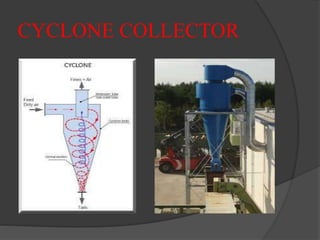
 Cyclone collector
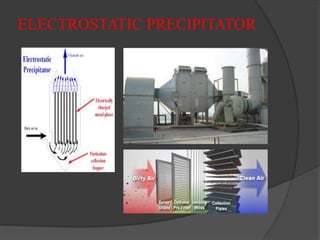
 Electrostatic precipitator
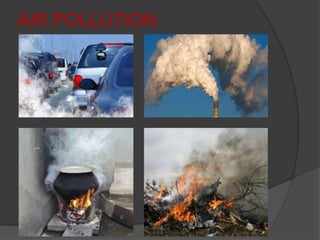
AIR POLLUTION
DEFINATION
Air pollution is basically the presence of
foreign substances in air in excessive
concentration which adversely affect the well
being of the individual or causes damage to
property.
According to World Health Organization,
air pollution is defined as “substances put into
air by activity of mankind into concentration
sufficient to cause harmful effect to his health,
vegetables, property, or interfere with the
enjoyment of of his property.”
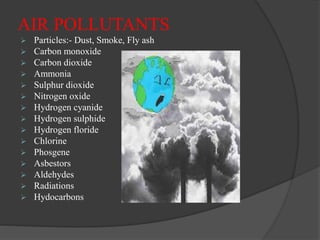
AIR POLLUTANTS
 Particles:- Dust, Smoke, Fly ash
 Carbon monoxide
 Carbon dioxide
 Ammonia
 Sulphur dioxide
 Nitrogen oxide
 Hydrogen cyanide
 Hydrogen sulphide
 Hydrogen floride
 Chlorine
 Phosgene
 Asbestors
 Aldehydes
 Radiations
 Hydocarbons
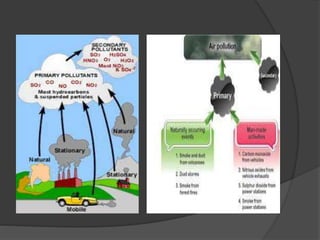
CLASSIFICATION
 PRIMARY AIR POLLUTION
The poisonous gases and
undesirable chemical which cause air
pollution. They are emitted directly
to the atmosphere.
 Carbon monoxide (CO)
 Sulphur dioxide (SO2)
 Nitrogen dioxide (NO2)
 Hydocarbons (HCs)
 Radio active compounds
 Particles of metals
 Pollens
 Bacteria, etc.
 SECONDARY AIR POLLUTION
Those which are produced in
the air by the interaction among two
or more primary air pollution.
 Ozone (O3)
 Peroxyacetyl nitrrate (PAN)
 Formaldehyte
 Formation of acid rain
 Smog
 Nitrogen oxide, etc.
SOUCE OF AIR POLLUTION
 NATURAL
 Natural Contaminants
(fungi, spores, cysts,
bacteria, methane, dust,
etc.)
 Carbon monoxide from
methane gas
 Volcanic Eruptions
 Forest fire
 Electric storms & solar
flares
 Salt spray from ocean
Dust storms
 Hydrogen sulphite
 Cosmic dust
MAN-MADE SOURCE
 Emission from vehicle
 Rapid industrialization
 Agricultural activities
 War fares
 Automobile revolution
 Deforestation, etc.
 Burning of fossils fuel
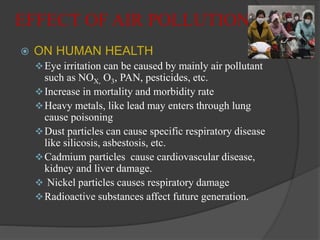
EFFECT OF AIR POLLUTION
 ON HUMAN HEALTH
Eye irritation can be caused by mainly air pollutant
such as NOX, O3, PAN, pesticides, etc.
Increase in mortality and morbidity rate
Heavy metals, like lead may enters through lung
cause poisoning
Dust particles can cause specific respiratory disease
like silicosis, asbestosis, etc.
Cadmium particles cause cardiovascular disease,
kidney and liver damage.
 Nickel particles causes respiratory damage
Radioactive substances affect future generation.
Effect of Air pollution Contd…
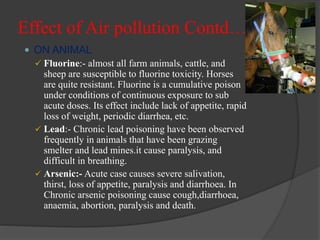
 ON ANIMAL
 Fluorine:- almost all farm animals, cattle, and
sheep are susceptible to fluorine toxicity. Horses
are quite resistant. Fluorine is a cumulative poison
under conditions of continuous exposure to sub
acute doses. Its effect include lack of appetite, rapid
loss of weight, periodic diarrhea, etc.
 Lead:- Chronic lead poisoning have been observed
frequently in animals that have been grazing
smelter and lead mines.it cause paralysis, and
difficult in breathing.
 Arsenic:- Acute case causes severe salivation,
thirst, loss of appetite, paralysis and diarrhoea. In
Chronic arsenic poisoning cause cough,diarrhoea,
anaemia, abortion, paralysis and death.
Effect of Air pollution Contd…
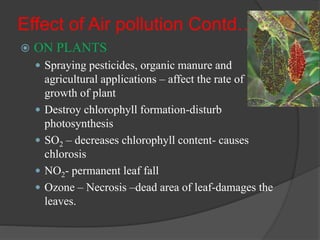
 ON PLANTS
 Spraying pesticides, organic manure and
agricultural applications – affect the rate of
growth of plant
 Destroy chlorophyll formation-disturb
photosynthesis
 SO2 – decreases chlorophyll content- causes
chlorosis
 NO2- permanent leaf fall
 Ozone – Necrosis –dead area of leaf-damages the
leaves.
Effect of Air pollution Contd…
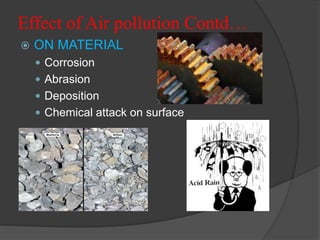
 ON MATERIAL
 Corrosion
 Abrasion
 Deposition
 Chemical attack on surface
Effect of Air pollution Contd…
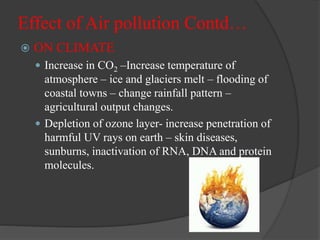
 ON CLIMATE
 Increase in CO2 –Increase temperature of
atmosphere – ice and glaciers melt – flooding of
coastal towns – change rainfall pattern –
agricultural output changes.
 Depletion of ozone layer- increase penetration of
harmful UV rays on earth – skin diseases,
sunburns, inactivation of RNA, DNA and protein
molecules.
CONTROL OF AIR
POLLUTION
 Planting more trees
 Reducing vehicle exhausts
 Using less polluting fuels
 Using mass transport
 Removal of particulate matter using
electrostatic precipitator, cyclone filter, etc.
 Industrial area should be cited far away from
residential area.
 Suitable chemical methods applied to remove
hydrocarbons
 Multi stage combustion process – suggested to
remove oxides of nirogen
Control of Air Pollution Contd…
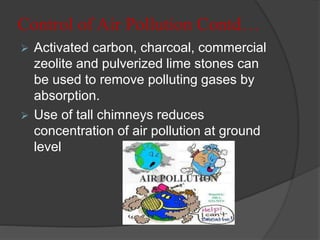
 Activated carbon, charcoal, commercial
zeolite and pulverized lime stones can
be used to remove polluting gases by
absorption.
 Use of tall chimneys reduces
concentration of air pollution at ground
level
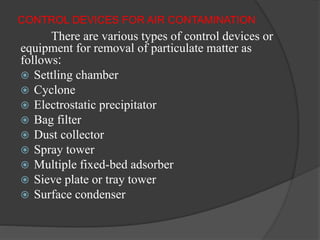
CONTROL DEVICES FOR AIR CONTAMINATION
There are various types of control devices or
equipment for removal of particulate matter as
follows:
 Settling chamber
 Cyclone
 Electrostatic precipitator
 Bag filter
 Dust collector
 Spray tower
 Multiple fixed-bed adsorber
 Sieve plate or tray tower
 Surface condenser
CYCLONE COLLECTOR
ELECTROSTATIC PRECIPITATOR
REFERENCE
 S. Deswal, A. Deswal; “A basic course in
Environmental studies” Second revised edition,
Reprint:(2013) New delhi. Dhanpat Rai & CO. (P)
LTD. Education and technical publioshers. Page
5.2-5.3
 Health effects of outdoor air pollution. Committee
of the Environmental and Occupational Health
Assembly of the American Thoracic Society.
(1996). [Comparative Study Review]. American
journal of respiratory and critical care medicine,
153(1), 3-50.
Say No
to
pollution

Air pollution: source, effect and cont

  • 1.
    Air pollution BY:- ANASHARUNA INDABAWA
  • 2.
    CONTENT  Definition  Airpollutants  Classification  Primary Air Pollution  Secondary air Pollution Source of air pollution  Gases  Particles Effect of Air pollution  On human health  On Animals  On plants  On Materials  On Climates Control of Air pollution  Cyclone collector  Electrostatic precipitator
  • 3.
  • 4.
    DEFINATION Air pollution isbasically the presence of foreign substances in air in excessive concentration which adversely affect the well being of the individual or causes damage to property. According to World Health Organization, air pollution is defined as “substances put into air by activity of mankind into concentration sufficient to cause harmful effect to his health, vegetables, property, or interfere with the enjoyment of of his property.”
  • 5.
    AIR POLLUTANTS  Particles:-Dust, Smoke, Fly ash  Carbon monoxide  Carbon dioxide  Ammonia  Sulphur dioxide  Nitrogen oxide  Hydrogen cyanide  Hydrogen sulphide  Hydrogen floride  Chlorine  Phosgene  Asbestors  Aldehydes  Radiations  Hydocarbons
  • 6.
    CLASSIFICATION  PRIMARY AIRPOLLUTION The poisonous gases and undesirable chemical which cause air pollution. They are emitted directly to the atmosphere.  Carbon monoxide (CO)  Sulphur dioxide (SO2)  Nitrogen dioxide (NO2)  Hydocarbons (HCs)  Radio active compounds  Particles of metals  Pollens  Bacteria, etc.  SECONDARY AIR POLLUTION Those which are produced in the air by the interaction among two or more primary air pollution.  Ozone (O3)  Peroxyacetyl nitrrate (PAN)  Formaldehyte  Formation of acid rain  Smog  Nitrogen oxide, etc.
  • 8.
    SOUCE OF AIRPOLLUTION  NATURAL  Natural Contaminants (fungi, spores, cysts, bacteria, methane, dust, etc.)  Carbon monoxide from methane gas  Volcanic Eruptions  Forest fire  Electric storms & solar flares  Salt spray from ocean Dust storms  Hydrogen sulphite  Cosmic dust MAN-MADE SOURCE  Emission from vehicle  Rapid industrialization  Agricultural activities  War fares  Automobile revolution  Deforestation, etc.  Burning of fossils fuel
  • 9.
    EFFECT OF AIRPOLLUTION  ON HUMAN HEALTH Eye irritation can be caused by mainly air pollutant such as NOX, O3, PAN, pesticides, etc. Increase in mortality and morbidity rate Heavy metals, like lead may enters through lung cause poisoning Dust particles can cause specific respiratory disease like silicosis, asbestosis, etc. Cadmium particles cause cardiovascular disease, kidney and liver damage.  Nickel particles causes respiratory damage Radioactive substances affect future generation.
  • 10.
    Effect of Airpollution Contd…  ON ANIMAL  Fluorine:- almost all farm animals, cattle, and sheep are susceptible to fluorine toxicity. Horses are quite resistant. Fluorine is a cumulative poison under conditions of continuous exposure to sub acute doses. Its effect include lack of appetite, rapid loss of weight, periodic diarrhea, etc.  Lead:- Chronic lead poisoning have been observed frequently in animals that have been grazing smelter and lead mines.it cause paralysis, and difficult in breathing.  Arsenic:- Acute case causes severe salivation, thirst, loss of appetite, paralysis and diarrhoea. In Chronic arsenic poisoning cause cough,diarrhoea, anaemia, abortion, paralysis and death.
  • 11.
    Effect of Airpollution Contd…  ON PLANTS  Spraying pesticides, organic manure and agricultural applications – affect the rate of growth of plant  Destroy chlorophyll formation-disturb photosynthesis  SO2 – decreases chlorophyll content- causes chlorosis  NO2- permanent leaf fall  Ozone – Necrosis –dead area of leaf-damages the leaves.
  • 12.
    Effect of Airpollution Contd…  ON MATERIAL  Corrosion  Abrasion  Deposition  Chemical attack on surface
  • 13.
    Effect of Airpollution Contd…  ON CLIMATE  Increase in CO2 –Increase temperature of atmosphere – ice and glaciers melt – flooding of coastal towns – change rainfall pattern – agricultural output changes.  Depletion of ozone layer- increase penetration of harmful UV rays on earth – skin diseases, sunburns, inactivation of RNA, DNA and protein molecules.
  • 14.
    CONTROL OF AIR POLLUTION Planting more trees  Reducing vehicle exhausts  Using less polluting fuels  Using mass transport  Removal of particulate matter using electrostatic precipitator, cyclone filter, etc.  Industrial area should be cited far away from residential area.  Suitable chemical methods applied to remove hydrocarbons  Multi stage combustion process – suggested to remove oxides of nirogen
  • 15.
    Control of AirPollution Contd…  Activated carbon, charcoal, commercial zeolite and pulverized lime stones can be used to remove polluting gases by absorption.  Use of tall chimneys reduces concentration of air pollution at ground level
  • 16.
    CONTROL DEVICES FORAIR CONTAMINATION There are various types of control devices or equipment for removal of particulate matter as follows:  Settling chamber  Cyclone  Electrostatic precipitator  Bag filter  Dust collector  Spray tower  Multiple fixed-bed adsorber  Sieve plate or tray tower  Surface condenser
  • 17.
  • 18.
  • 19.
    REFERENCE  S. Deswal,A. Deswal; “A basic course in Environmental studies” Second revised edition, Reprint:(2013) New delhi. Dhanpat Rai & CO. (P) LTD. Education and technical publioshers. Page 5.2-5.3  Health effects of outdoor air pollution. Committee of the Environmental and Occupational Health Assembly of the American Thoracic Society. (1996). [Comparative Study Review]. American journal of respiratory and critical care medicine, 153(1), 3-50.
  • 20.