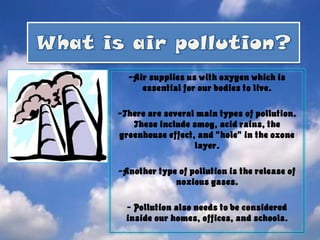
°°ThEPoLLuTiOnOf ThEAiR…°°
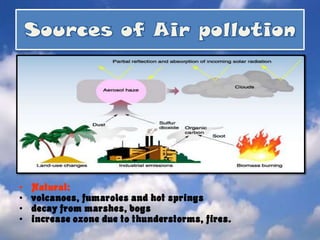
What is air pollution?-Air supplies us with oxygenwhich is essential for our bodies to live.-There are several main typesof pollution. These include smog, acid rains, the greenhouse effect, and "hole" in the ozone layer. Another type of pollution is the release of noxious gases.
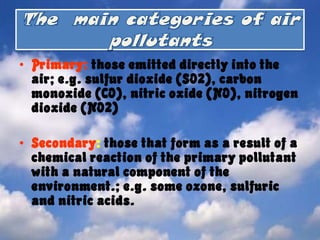
 Pollution also needs to be considered insideour homes, offices, and schools.Sources of Air pollutionNatural: volcanoes, fumaroles and hot springs decay from marshes, bogs increase ozone due to thunderstorms, fires.
The  main categories of air pollutantsPrimary: those emitted directly into the air; e.g. sulfur dioxide (SO2), carbon monoxide (CO), nitric oxide (NO), nitrogen dioxide (NO2) Secondary: those that form as a result of a chemical reaction of the primary pollutant with a natural component of the environment.; e.g. some ozone, sulfuric and nitric acids.
Types of pollutantsPrimary pollutantsPollutants that areemitted directly from identifiable sources –produced by both natural events or human activitiesEg. Dust storms, emission from vehiclesSecondary pollutantsWhen certain chemical reactions take place among the primary pollutants Eg. Sulphuric acid
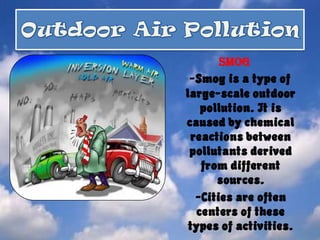
Outdoor Air PollutionSmog-Smog is a type of large-scale outdoor pollution. It is caused by chemical reactions between pollutants derived from different sources.    -Cities are often centers of these types of activities.
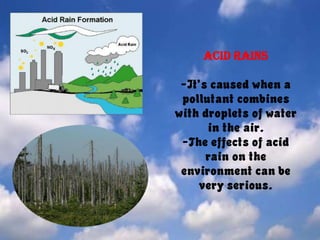
Acid rains-It’s caused when a pollutant combines with droplets of water in the air.-The effects of acid rain on the environment can be very serious.
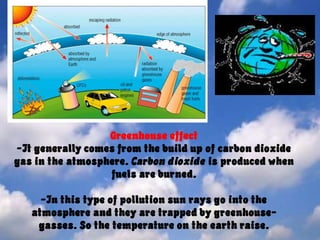
Greenhouse effect-It generally comes from the build up of carbon dioxide gas in the atmosphere. Carbon dioxide is produced when fuels are burned. -In this type of pollution sun rays go into the atmosphere and they are trapped by greenhouse-gasses. So the temperature on the earth raise.
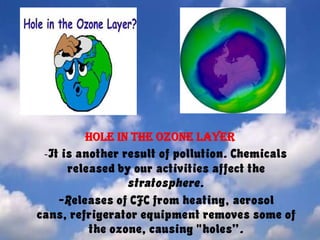
Hole in the ozonelayer    -It is another result of pollution. Chemicals released by our activities affect the stratosphere.     -Releases of CFC from heating, aerosol cans, refrigerator equipment removes some of the ozone, causing "holes”.
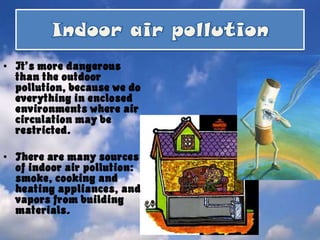
Indoorair pollutionIt’s more dangerous than the outdoor pollution, because we do everything in enclosed environments where air circulation may be restricted. There are many sources of indoor air pollution: smoke, cooking and heating appliances, and vapors from building materials.
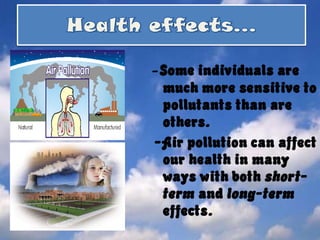
Healtheffects…-Some individuals are much more sensitive to pollutants than are others.  -Air pollution can affect our health in many ways with both short-term and long-term effects.
General solutionsswitch from coal to cleaner fuels - use natural gas reduce energy use, improve energy efficiency burn less coal, use lower sulfur coals. Coal gasification After burning the SO2 can be cleaned out by scrubbing
General solutions to indoor air pollution:source removal: no smoking source modification: more efficient stove design. pollutant removal: filters education
discourage auto use, reduce number of cars require electric cars improve public transport mandatory carpools industrial & household controls reduce emissions- burn less fuel, be energy efficient Do not smokePrevention
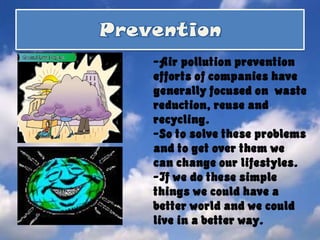
Prevention-Air pollution prevention efforts of companies have generally focused on  waste reduction, reuse and recycling. -So to solve these problems and to get over them we can change our lifestyles.-If we do these simple things we could have a better world and we could live in a better way.
MUNISVARI A/P RAJAMANIKAMKDC5Thank You

Air pollution

  • 1.
  • 2.
    What is airpollution?-Air supplies us with oxygenwhich is essential for our bodies to live.-There are several main typesof pollution. These include smog, acid rains, the greenhouse effect, and "hole" in the ozone layer. Another type of pollution is the release of noxious gases.
  • 3.
    Pollution alsoneeds to be considered insideour homes, offices, and schools.Sources of Air pollutionNatural: volcanoes, fumaroles and hot springs decay from marshes, bogs increase ozone due to thunderstorms, fires.
  • 4.
    The maincategories of air pollutantsPrimary: those emitted directly into the air; e.g. sulfur dioxide (SO2), carbon monoxide (CO), nitric oxide (NO), nitrogen dioxide (NO2) Secondary: those that form as a result of a chemical reaction of the primary pollutant with a natural component of the environment.; e.g. some ozone, sulfuric and nitric acids.
  • 5.
    Types of pollutantsPrimarypollutantsPollutants that areemitted directly from identifiable sources –produced by both natural events or human activitiesEg. Dust storms, emission from vehiclesSecondary pollutantsWhen certain chemical reactions take place among the primary pollutants Eg. Sulphuric acid
  • 6.
    Outdoor Air PollutionSmog-Smogis a type of large-scale outdoor pollution. It is caused by chemical reactions between pollutants derived from different sources. -Cities are often centers of these types of activities.
  • 7.
    Acid rains-It’s causedwhen a pollutant combines with droplets of water in the air.-The effects of acid rain on the environment can be very serious.
  • 8.
    Greenhouse effect-It generallycomes from the build up of carbon dioxide gas in the atmosphere. Carbon dioxide is produced when fuels are burned. -In this type of pollution sun rays go into the atmosphere and they are trapped by greenhouse-gasses. So the temperature on the earth raise.
  • 9.
    Hole in theozonelayer -It is another result of pollution. Chemicals released by our activities affect the stratosphere. -Releases of CFC from heating, aerosol cans, refrigerator equipment removes some of the ozone, causing "holes”.
  • 10.
    Indoorair pollutionIt’s moredangerous than the outdoor pollution, because we do everything in enclosed environments where air circulation may be restricted. There are many sources of indoor air pollution: smoke, cooking and heating appliances, and vapors from building materials.
  • 11.
    Healtheffects…-Some individuals aremuch more sensitive to pollutants than are others. -Air pollution can affect our health in many ways with both short-term and long-term effects.
  • 12.
    General solutionsswitch fromcoal to cleaner fuels - use natural gas reduce energy use, improve energy efficiency burn less coal, use lower sulfur coals. Coal gasification After burning the SO2 can be cleaned out by scrubbing
  • 13.
    General solutions toindoor air pollution:source removal: no smoking source modification: more efficient stove design. pollutant removal: filters education
  • 14.
    discourage auto use,reduce number of cars require electric cars improve public transport mandatory carpools industrial & household controls reduce emissions- burn less fuel, be energy efficient Do not smokePrevention
  • 15.
    Prevention-Air pollution preventionefforts of companies have generally focused on waste reduction, reuse and recycling. -So to solve these problems and to get over them we can change our lifestyles.-If we do these simple things we could have a better world and we could live in a better way.
  • 16.