Air Microbiology
Saad Farooqi
Department of Environmental Sciences
University of Swat
Saad.luck57@gmail.com
Air Microbiology
• Aerobiology is defined as the study of life present in the
air.
• Aeromicrobiology relates to the study of
environmentally relevant microorganisms.
• Microorganisms exist within 300-1000 feet of earth’s
surface that have become attached to fragments of dried
leaves, straw or dust particles light enough to be blown
by wind.
• In dry whether the microbial load of air is high while in
wet weather the rain washes the microorganisms from the
air.
• Air is a poor medium for
microbial growth – too dry and
no nutrients
• Spore forming and Gram-
positive bacteria are resistant to
drying
• Dust, water droplets in air carry
microbial populations from one
place to another
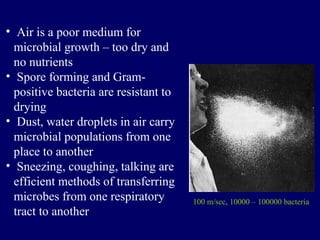
• Sneezing, coughing, talking are
efficient methods of transferring
microbes from one respiratory
tract to another
100 m/sec, 10000 – 100000 bacteria
• Liquid and dust particles settle in the respiratory tract
depending on their velocity and size
• Microorganisms colonize specific locations in the
respiratory tract
Streptococcal diseases
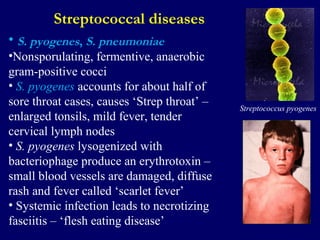
• S. pyogenes, S. pneumoniae
•Nonsporulating, fermentive, anaerobic
gram-positive cocci
• S. pyogenes accounts for about half of
sore throat cases, causes ‘Strep throat’ –
enlarged tonsils, mild fever, tender
cervical lymph nodes
• S. pyogenes lysogenized with
bacteriophage produce an erythrotoxin –
small blood vessels are damaged, diffuse
rash and fever called ‘scarlet fever’
• Systemic infection leads to necrotizing
fasciitis – ‘flesh eating disease’
Streptococcus pyogenes
Hemolysis of blood agar
• Diagnosis of S. pyogenes
infection from throat swab
includes fluorescent Ab
staining, or culturing on
blood agar for hemolysis
• S. pneumoniae causes
difficult lung infections
(pneumonia) due to the
bacterial capsule
• Infection can spread to inner
ear,, heart with mortality rate
around 10%
• Vaccination is possible with
capsule polysaccharide,
treatment with antibiotics
Diptheria
• Childhood respiratory illness caused by
Cornyebacterium diptheriae infection.
• Gram-positive non-motile aerobic rods
• Spread via fluid droplets entering the lung
• Bacterial enzyme called neuraminidase
interacts with epithelial glycoproteins for
successful invasion
• Inflammatory response in throat tissues
causes characteristic ‘pseudomembrane’ of
damaged host cells, leukocytes and C.
diptheriae.
• Death can occur from obstructed breathing
and the effects of the diptheria exotoxin
pseudomembrane
• Treatment includes antibiotic therapy in conjunction with
diptheria antitoxin – neutralizing antibodies against the
toxin
• Diptheria toxoid (formalin treated exotoxin) is part of the
Whooping cough (pertussis)
• Infection by Bordetella pertussis
•Small, gram-negative, aerobic coccobacillus
• Attaches to epithelial cells of upper
respiratory tract using an adherence protein
called filamentous hemagglutinin antigen
•Produces an exotoxin that induces cAMP
production, and an endotoxin that may
induce the cough
•Recurring spasmodic coughing that lasts up
to 6 weeks
• Nasopharyngeal aspirate is plated on blood-
glycerol-potato extract agar to diagnose
• Vaccine consists of killed whole cells or purified proteins
derived from Bortedella pertussis
• Rise in the incidence of whooping cough. Why?
Tuberculosis (consumption)
Lung tubercles
• Infection by gram-positive bacillus
Mycobacterium tuberculosis
• Extremely contagious by respiration
• Primary infection usually occurs by
inhalation – bacteria are usually
engulfed but survive within
activated macrophages of the lung –
structures called tubercles
• Primary infection is diagnosed
using the tuberculin test, and
usually provides cell-based
immunity
• Secondary
infection or
reactivation of
dormant bacteria
can cause extensive
lung tissue damage
• Pathology most
often occurs in very
young, elderly,
malnourished,
immune-
compromised
people
1.5 million deaths annually
Treatment includes streptomycin antibiotic, as well
as the growth factor analog isoniazid
Isoniazid is an analogue of nicotinimide, required
For mycolic acid synthesis in Mycobacterium
Leprosy (Hansen’s disease)
lepromatous lesion
tubercular lesion
• Infection by Mycobacterium leprae, can
not be cultured in the lab
• Intracellular parasite grows in
macrophages
• Folded, bulblike lesions on the body
containing a billion bacteria/gram of
tissue
• Severe form is lepromatous leprosy
which can also affect peripheral nerves
and motor function
• Milder form is tubercular leprosy, in
which fewer bacteria can be recovered
• As, many as 12 million cases
Meningitis and meningococcemia
• Infection by Neisseria meningitidis
• Gram-negative, aerobic encapsulated
• Infection starts via the airborne route,
spreads to blood and can cause
1) meningococcemia – sepsis,
coagulation, shock, 17% mortality
2) meningitis – inflammation of
membranes lining the central nervous
system, sudden headache, vomiting,
stiff neck
• Treated by penicillin G or
chloramphenicol
Measles, Mumps, Rubella
• Measles caused by a paramyxovirus,
nasal discharge, sore throat, fever,
characteristic rash. Now occurs in
isolated outbreaks
• Mumps caused by a different
paramyxovirus, inflammation of salivary
glands, can spread through bloodstream
to testis and brain
• Rubella caused by a togavirus, generally
milder than measles but can be transmitted
congenitally
• All three are effectively managed by the
MMR vaccine
Chickenpox and shingles
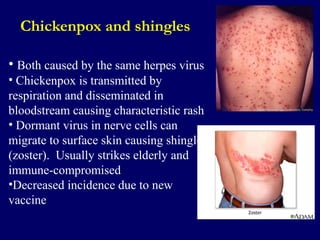
• Both caused by the same herpes virus
• Chickenpox is transmitted by
respiration and disseminated in
bloodstream causing characteristic rash
• Dormant virus in nerve cells can
migrate to surface skin causing shingles
(zoster). Usually strikes elderly and
immune-compromised
•Decreased incidence due to new
vaccine
Common cold
rhinovirus
adenovirus
• 85% caused by ssRNA viruses, especially
rhinovirus and coronavirus, 15% caused
by DNA viruses such as adenovirus
• Average person gets 3/year
• Nasal inflammation and obstruction,
general malaise but no fever
• Aerosol transmission
• Vaccination is extremely unlikely. Why?
• Specific anti-rhinoviral drugs are under
development: Block viral coat protein to
prevent virus-cell recognition
Influenza
• ssRNA orhomyxovirus, types
A,B,C
• Low grade fever, chills, fatigue,
headache
• Segmented RNA genome –
infection by more than one strain
leads to gene reassortment called
antigenic shift
• Mutations in important genes
encoding the haemagglutinin and
neuraminidase result in antigenic
drift
• Immunity generally comes from
IgA to Ha and Neu antigens
• Severe localized epidemics occur every 2-3 years due to
antigenic drift
• Worldwide pandemics occur every 10-40 years due to
antigenic shift
• Vaccines are created using mixed population of strains
from the previous year
Staphylococcus infections
• gram-positive and nonsporulating, but
resistant to drying. Therefore found on
skin and mucus membranes
• Infection often occurs at wound sites –
especially nosocomial (hospital)
infections
• S. aureus produces a hemolysin
exotoxin – lyses red blood cells, an
enterotoxin - causing food poisoning,
coagulase – blood clots around bacteria
mask it from immune system,
leukocydin – kills white blood cells
• Toxic shock syndrome can be caused by
inadequate feminine hygiene
Gastric ulcers and cancers
• Infection by Helicobacter pylori in the
non acid secreting mucosa of stomach
• gram-negative motile, polar flagella
• 80% of gastric ulcer patients are
infected
• Perhaps transmitted from contaminated
food or water, or person-to person
contact in unknown fashion
• Mucosal layer protects from stomach
acid, how it causes ulcers is unknown
• Treated with a combination of
antibiotics
Hepatitis
• Infection of hepatocytes (liver cells)
leading to inflammation, cirrhosis and
sometimes cancer
• Jaundice, hepatomegaly
• Caused by a number of unrelated viruses:
• A – person to person, vaccine
• B – parenteral, vaccine, fatal, vaccine
• D – defective virus requires B coat
• C – parenteral, chronic
• E – enteric, acute
• G - perhaps asymptomatic
• Universal precaution against blood-borne
and sexually transmitted infections
Sexually transmitted infections
• Fallacy – there is a technological solution to every
problem
• “The sex drive in some individuals is so strong that it
will suppress the fear of disease, even AIDS”
Acquired immunodeficiency syndrome
(AIDS)
• Suite of disorders as a
secondary consequence to
infection by human
immunodeficiency virus (HIV)
• First recognized in 1981, now
50 million infected
• HIV is a ssRNA retrovirus:
reverse transcriptase enzyme
generates a cDNA that
integrates into host cell genome
• HIV infects macrophages and
TH cells
• An individual has AIDS if:
1) Tests positive for HIV
AND
2) Has a drastically reduced number of TH cells
OR
3) At least one unusual opportunistic infection or cancer
such as Pneumocystis carinii pneumonia, toxoplasmosis,
or Kaposi’s sarcoma (cancer of blood vessel
• HIV first infects macrophages
expressing CD4 and CCR5
coreceptors
• HIV next infects T cells
expressing CD4 and CXCR4
coreceptors
• HIV can exist in latent state as
a provirus for long periods
• Infected T cells express gp120
on their surface and fuse with
uninfected T cells
• Death of CD4 T cells leads to
complete loss of cytokine
production, cellular and
humoral immunity is destroyed
• Typical course of a poor-prognosis HIV infection
• Presence of HIV in the blood is routinely done by
screening for anti-HIV antibodies
• More sensitive technique is reverse-transcription PCR
(RTPCR)
• Blood products are screened using enzyme-linked
immunosorbent assay (ELISA)
• Pharmaceutical therapy for
AIDS:
• 1) Nucleoside analogs such
as AZT inhibit reverse
transcription
• 2) Non-nucleoside Rt
inhibitors
• 3) Protease inhibitors
specifically inhibit
maturation of HIV proteins
• Intensive vaccination
research
• Majority of HIV infections are in people who can not
afford treatment
• Is this an ethical problem?
Bacteria Disease
Streptococcus pyogenes Sore throat
Corynebacterium diphtheriae Diphtheria
Mycobacterium tuberculosis Tuberculosis
Streptococcus pneumoniae Pneumococcal pneumonia
Klebsiella pneumoniae atypical pneumonia
Neisseria meningitidis Meningococcal meningitis
Yersinia pestis Bubonic plaque
Bordetella pertussis Whooping cough
Haemophilus influenzae Influenza
Nocardia asteroids Nocardiosis
Air-borne human diseases of importance and their
causative agent
Virus Disease
Influenza virus Influenza
Hantavirus Pulmonary syndrome
Hepatitis virus Hepatitis
Herpes virus Chicken pox
Picorna virus Common cold
Flavivirus Dengue fever
Rubella virus Rubella
Measles virus Measles
Influenza virus Influenza
Hantavirus pulmonary syndrome
Fungi Disease
Aspergillus fumigatus Aspergillosis
Blastomyces dermatiridi Blastomycosis
Coccidioides immitis Coccidioidomyosis
Cryptococcus neoformans Cryptococcosis
Histoplasma capsulatum Histoplasmosis
Pneumocystis carinii Pneumocystitis

Air Microbiology

  • 1.
    Air Microbiology Saad Farooqi Departmentof Environmental Sciences University of Swat Saad.luck57@gmail.com
  • 2.
    Air Microbiology • Aerobiologyis defined as the study of life present in the air. • Aeromicrobiology relates to the study of environmentally relevant microorganisms. • Microorganisms exist within 300-1000 feet of earth’s surface that have become attached to fragments of dried leaves, straw or dust particles light enough to be blown by wind. • In dry whether the microbial load of air is high while in wet weather the rain washes the microorganisms from the air.
  • 3.
    • Air isa poor medium for microbial growth – too dry and no nutrients • Spore forming and Gram- positive bacteria are resistant to drying • Dust, water droplets in air carry microbial populations from one place to another • Sneezing, coughing, talking are efficient methods of transferring microbes from one respiratory tract to another 100 m/sec, 10000 – 100000 bacteria
  • 4.
    • Liquid anddust particles settle in the respiratory tract depending on their velocity and size • Microorganisms colonize specific locations in the respiratory tract
  • 5.
    Streptococcal diseases • S.pyogenes, S. pneumoniae •Nonsporulating, fermentive, anaerobic gram-positive cocci • S. pyogenes accounts for about half of sore throat cases, causes ‘Strep throat’ – enlarged tonsils, mild fever, tender cervical lymph nodes • S. pyogenes lysogenized with bacteriophage produce an erythrotoxin – small blood vessels are damaged, diffuse rash and fever called ‘scarlet fever’ • Systemic infection leads to necrotizing fasciitis – ‘flesh eating disease’ Streptococcus pyogenes
  • 6.
    Hemolysis of bloodagar • Diagnosis of S. pyogenes infection from throat swab includes fluorescent Ab staining, or culturing on blood agar for hemolysis • S. pneumoniae causes difficult lung infections (pneumonia) due to the bacterial capsule • Infection can spread to inner ear,, heart with mortality rate around 10% • Vaccination is possible with capsule polysaccharide, treatment with antibiotics
  • 7.
    Diptheria • Childhood respiratoryillness caused by Cornyebacterium diptheriae infection. • Gram-positive non-motile aerobic rods • Spread via fluid droplets entering the lung • Bacterial enzyme called neuraminidase interacts with epithelial glycoproteins for successful invasion • Inflammatory response in throat tissues causes characteristic ‘pseudomembrane’ of damaged host cells, leukocytes and C. diptheriae. • Death can occur from obstructed breathing and the effects of the diptheria exotoxin pseudomembrane
  • 8.
    • Treatment includesantibiotic therapy in conjunction with diptheria antitoxin – neutralizing antibodies against the toxin • Diptheria toxoid (formalin treated exotoxin) is part of the
  • 9.
    Whooping cough (pertussis) •Infection by Bordetella pertussis •Small, gram-negative, aerobic coccobacillus • Attaches to epithelial cells of upper respiratory tract using an adherence protein called filamentous hemagglutinin antigen •Produces an exotoxin that induces cAMP production, and an endotoxin that may induce the cough •Recurring spasmodic coughing that lasts up to 6 weeks • Nasopharyngeal aspirate is plated on blood- glycerol-potato extract agar to diagnose
  • 10.
    • Vaccine consistsof killed whole cells or purified proteins derived from Bortedella pertussis • Rise in the incidence of whooping cough. Why?
  • 11.
    Tuberculosis (consumption) Lung tubercles •Infection by gram-positive bacillus Mycobacterium tuberculosis • Extremely contagious by respiration • Primary infection usually occurs by inhalation – bacteria are usually engulfed but survive within activated macrophages of the lung – structures called tubercles • Primary infection is diagnosed using the tuberculin test, and usually provides cell-based immunity
  • 12.
    • Secondary infection or reactivationof dormant bacteria can cause extensive lung tissue damage • Pathology most often occurs in very young, elderly, malnourished, immune- compromised people 1.5 million deaths annually Treatment includes streptomycin antibiotic, as well as the growth factor analog isoniazid Isoniazid is an analogue of nicotinimide, required For mycolic acid synthesis in Mycobacterium
  • 13.
    Leprosy (Hansen’s disease) lepromatouslesion tubercular lesion • Infection by Mycobacterium leprae, can not be cultured in the lab • Intracellular parasite grows in macrophages • Folded, bulblike lesions on the body containing a billion bacteria/gram of tissue • Severe form is lepromatous leprosy which can also affect peripheral nerves and motor function • Milder form is tubercular leprosy, in which fewer bacteria can be recovered • As, many as 12 million cases
  • 14.
    Meningitis and meningococcemia •Infection by Neisseria meningitidis • Gram-negative, aerobic encapsulated • Infection starts via the airborne route, spreads to blood and can cause 1) meningococcemia – sepsis, coagulation, shock, 17% mortality 2) meningitis – inflammation of membranes lining the central nervous system, sudden headache, vomiting, stiff neck • Treated by penicillin G or chloramphenicol
  • 15.
    Measles, Mumps, Rubella •Measles caused by a paramyxovirus, nasal discharge, sore throat, fever, characteristic rash. Now occurs in isolated outbreaks • Mumps caused by a different paramyxovirus, inflammation of salivary glands, can spread through bloodstream to testis and brain • Rubella caused by a togavirus, generally milder than measles but can be transmitted congenitally • All three are effectively managed by the MMR vaccine
  • 16.
    Chickenpox and shingles •Both caused by the same herpes virus • Chickenpox is transmitted by respiration and disseminated in bloodstream causing characteristic rash • Dormant virus in nerve cells can migrate to surface skin causing shingles (zoster). Usually strikes elderly and immune-compromised •Decreased incidence due to new vaccine
  • 17.
    Common cold rhinovirus adenovirus • 85%caused by ssRNA viruses, especially rhinovirus and coronavirus, 15% caused by DNA viruses such as adenovirus • Average person gets 3/year • Nasal inflammation and obstruction, general malaise but no fever • Aerosol transmission • Vaccination is extremely unlikely. Why? • Specific anti-rhinoviral drugs are under development: Block viral coat protein to prevent virus-cell recognition
  • 18.
    Influenza • ssRNA orhomyxovirus,types A,B,C • Low grade fever, chills, fatigue, headache • Segmented RNA genome – infection by more than one strain leads to gene reassortment called antigenic shift • Mutations in important genes encoding the haemagglutinin and neuraminidase result in antigenic drift • Immunity generally comes from IgA to Ha and Neu antigens
  • 19.
    • Severe localizedepidemics occur every 2-3 years due to antigenic drift • Worldwide pandemics occur every 10-40 years due to antigenic shift • Vaccines are created using mixed population of strains from the previous year
  • 20.
    Staphylococcus infections • gram-positiveand nonsporulating, but resistant to drying. Therefore found on skin and mucus membranes • Infection often occurs at wound sites – especially nosocomial (hospital) infections • S. aureus produces a hemolysin exotoxin – lyses red blood cells, an enterotoxin - causing food poisoning, coagulase – blood clots around bacteria mask it from immune system, leukocydin – kills white blood cells • Toxic shock syndrome can be caused by inadequate feminine hygiene
  • 21.
    Gastric ulcers andcancers • Infection by Helicobacter pylori in the non acid secreting mucosa of stomach • gram-negative motile, polar flagella • 80% of gastric ulcer patients are infected • Perhaps transmitted from contaminated food or water, or person-to person contact in unknown fashion • Mucosal layer protects from stomach acid, how it causes ulcers is unknown • Treated with a combination of antibiotics
  • 22.
    Hepatitis • Infection ofhepatocytes (liver cells) leading to inflammation, cirrhosis and sometimes cancer • Jaundice, hepatomegaly • Caused by a number of unrelated viruses: • A – person to person, vaccine • B – parenteral, vaccine, fatal, vaccine • D – defective virus requires B coat • C – parenteral, chronic • E – enteric, acute • G - perhaps asymptomatic • Universal precaution against blood-borne and sexually transmitted infections
  • 23.
    Sexually transmitted infections •Fallacy – there is a technological solution to every problem • “The sex drive in some individuals is so strong that it will suppress the fear of disease, even AIDS”
  • 24.
    Acquired immunodeficiency syndrome (AIDS) •Suite of disorders as a secondary consequence to infection by human immunodeficiency virus (HIV) • First recognized in 1981, now 50 million infected • HIV is a ssRNA retrovirus: reverse transcriptase enzyme generates a cDNA that integrates into host cell genome • HIV infects macrophages and TH cells
  • 25.
    • An individualhas AIDS if: 1) Tests positive for HIV AND 2) Has a drastically reduced number of TH cells OR 3) At least one unusual opportunistic infection or cancer such as Pneumocystis carinii pneumonia, toxoplasmosis, or Kaposi’s sarcoma (cancer of blood vessel
  • 26.
    • HIV firstinfects macrophages expressing CD4 and CCR5 coreceptors • HIV next infects T cells expressing CD4 and CXCR4 coreceptors • HIV can exist in latent state as a provirus for long periods • Infected T cells express gp120 on their surface and fuse with uninfected T cells • Death of CD4 T cells leads to complete loss of cytokine production, cellular and humoral immunity is destroyed
  • 27.
    • Typical courseof a poor-prognosis HIV infection • Presence of HIV in the blood is routinely done by screening for anti-HIV antibodies • More sensitive technique is reverse-transcription PCR (RTPCR) • Blood products are screened using enzyme-linked immunosorbent assay (ELISA)
  • 28.
    • Pharmaceutical therapyfor AIDS: • 1) Nucleoside analogs such as AZT inhibit reverse transcription • 2) Non-nucleoside Rt inhibitors • 3) Protease inhibitors specifically inhibit maturation of HIV proteins • Intensive vaccination research
  • 29.
    • Majority ofHIV infections are in people who can not afford treatment • Is this an ethical problem?
  • 30.
    Bacteria Disease Streptococcus pyogenesSore throat Corynebacterium diphtheriae Diphtheria Mycobacterium tuberculosis Tuberculosis Streptococcus pneumoniae Pneumococcal pneumonia Klebsiella pneumoniae atypical pneumonia Neisseria meningitidis Meningococcal meningitis Yersinia pestis Bubonic plaque Bordetella pertussis Whooping cough Haemophilus influenzae Influenza Nocardia asteroids Nocardiosis Air-borne human diseases of importance and their causative agent
  • 31.
    Virus Disease Influenza virusInfluenza Hantavirus Pulmonary syndrome Hepatitis virus Hepatitis Herpes virus Chicken pox Picorna virus Common cold Flavivirus Dengue fever Rubella virus Rubella Measles virus Measles Influenza virus Influenza Hantavirus pulmonary syndrome
  • 32.
    Fungi Disease Aspergillus fumigatusAspergillosis Blastomyces dermatiridi Blastomycosis Coccidioides immitis Coccidioidomyosis Cryptococcus neoformans Cryptococcosis Histoplasma capsulatum Histoplasmosis Pneumocystis carinii Pneumocystitis