Water
   By Lisa, Genesis and Kathy
A
D I M I N ISHI   NG


RESOURCE
video
http://www.youtube.com/watch?v=BkNY78B2Jio&feature=related
“The human right to water entitles everyone to
sufficient, safe, acceptable, physically accessible
  Title
and affordable water for personal and domestic
   uses. An adequate amount of safe water is
 necessary to prevent death from dehydration,
  reduce the risk of water-related disease and
provide for consumption, cooking, personal and
        domestic hygienic requirements”.
        (General Comment 15, CESCR, 2002)
Global Facts
                         …the reality is…

•more than one out of six people lack access to safe drinking water;
1.1 billion people
•more than two out of six lack adequate sanitation;
2.6 billion people
•3900 children die every day from water-borne diseases
•Up to half of humanity has one of these six main diseases
        1. diarrhea
        2. schistosomiasis
        3.trachoma
        4. infestation with ascaris
        5. infestation with guinea worm
        6. infestation with hookworm
Social Consequences Globally
• China, with 1.26 billion people, "the water table is dropping one
  meter per year due to over-pumping, and the Chinese admit that 300
  cities are running short.
• In India, home to 1.002 billion people, key aquifers are being over-
  pumped, and the soil is growing saltier through contamination with
  irrigation water
• Israel (population 6.2 million), invented many water-conserving
  technologies, but water withdrawals still exceed resupply.
• Egypt (population of 68 million), is irrigated by seasonal floods from
  the Nile River, and from water stored behind the Aswan High Dam.
  Any interference with water flow by Sudan or Ethiopia could starve
  Egypt.
• Mexico City (home to 20 million people) is sinking because the city
  sucks out underground water faster than the aquifer can be refilled.
Social Consequences (cont.)
• More and more areas are becoming unstable
  with regards to their water resources

• More and more people are dying from thirst
  and water-borne contaminants
•The 1950s drought severely impacted a 1.1millionkm2 area in the central US.
This drought, along with the famous 1930s drought, was among the most severe
of the 20th century for large areas and is the drought of record for water supply
planning in Texas.

•The total annual dependable water supply in Texas is approximately 16.3
million acre-feet.

•Texas has had an abundance of natural resources, although it has had some
cases of really severe drought.

• 95% of the united states fresh water is underground, and farmers in the Texas
High Plains pump groundwater faster than rain fills it, and the water tables are
dropping.
•Over 50 percent of all water projects fail and less than 5 percent of
projects are revisited and far less than one percent are monitored.
•New approaches to long-term water planning and management
that incorporate principles of sustainability and equity are required
and are now being explored by national and international water
experts and organizations.
•Politicians have proposed many different methods to this major
topic, among these principles are guaranteed access to a basic
amount of water necessary to maintain human health and to
sustain ecosystems, basic protections for the renewability of water
resources, and institutional recommendations for planning,
management, and conflict resolution
Political Consequences (cont.)

•W
          A
                           R
•For each one dollar invested in the World Health Organization
it is estimated that $3-$34 of services are possible in developing
countries depending on the region and technology.
Economic Consequences of
       diminishing water resources
• Higher food prices at the supermarket

• Loss of businesses (old and new)

• Higher cost for water on your utility bill
•Us humans of course no water, no life! The more population the less
water. As mentioned, about 1.1 billion people lack access to clean
water, and 2.6 billion do not have access to improved sanitation
facilities
•Destruction of aquatic ecosystems and extinction of species
•Growing risks of regional and international conflicts over scarce or
shared water supplies
•Businesses- (cost of water); both surface water and groundwater in
response to high market prices
Who Suffers ?

•   Millions of people worldwide
•   Agriculture
•   Ranchers
•   Businesses
•   Wildlife
•   YOU !!
•Government and politicians

•Less supply more demands which includes a high price in
markets
Who Benefits from Clean Water?

• EVERYONE !!
• If ever there was something that people
  actually “can’t live without”, it is water.
• Not just any water, but clean, drinkable water.
What Conditions Help To Promote The
             Problem ?
• “Can’t happen here” mentality; denial that
  there is a problem
• Population growth- coupled with
  industrialization and urbanization
• Climate change
• Lack of environmental concern; pollution
• Lack of conservation; misuse
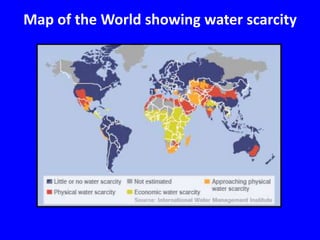
Map of the World showing water scarcity
Top 10 largest cities by population that have the greatest chance
    of running out of water
1. Los Angeles-major water supply Colorado River Basin
2. Houston- Jasper Aquifer, Lake Houston, Lake Conroe
3. Phoenix- Colorado River Basin
4. San Antonio, TX- Various groundwater sources
5. San Francisco bay areas- Various, including Lake Hetch
    Hetchy
6. Fortworth, TX- Multiple water supplies
7. Las Vegas- Lake Mead/Colorado River
8. Tucson, AZ- Local groundwater
9. Atlanta- Lake Lanier
10. Orlando, FL- Florida Aquifer
Local Perspective
• A Brief History of Water in San Antonio.
• Edwards Aquifer Authority Established
• Tom Gallier, Bx. Mets Interim Gen. Mngr. said,
  “There is no single land issue that is more
  critical than water.”
• Top 200 water users in June 2011
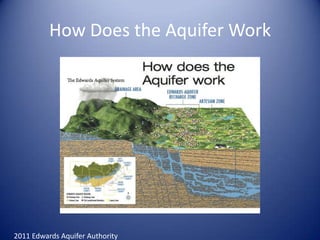
How Does the Aquifer Work


2011 Edwards Aquifer Authority
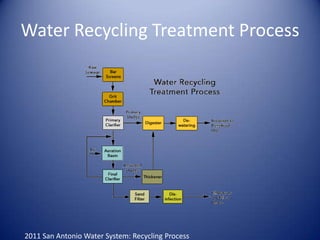
Water Recycling Treatment Process


2011 San Antonio Water System: Recycling Process
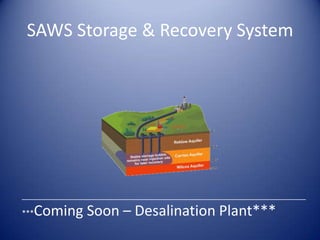
SAWS Storage & Recovery System


_______________________________________________________________________

***   Coming Soon – Desalination Plant***
Possible Solutions
• 1st step to any solution is in getting people to
  understand that there is a problem

• Need to work to keep the water we do have
  clean; reduce contaminants
•Water conservation methods such as replacing existing toilets with
low-flow toilets

•The use of grey water (all the waste water that drains out of your
washing machine and sinks), it can be easily treated and recycled.
Still more possible solutions:
1. Hard path
     - building of dams, pipelines & environmentally-destructive
     infrastructure
     - government run and owned with no personal ownership
2. Soft path
     - Reuse of wastewater ~ storm runoff, gray water & reclaimed
     wastewater are well-suited to irrigate landscaping
     - water agency or company personnel to interact closely with water
     users & to engage community groups in water management.
     - governments, companies, & individuals to meet the needs of
     peoples & businesses, instead of just supplying water
3. Privately funded companies
4. Desalination - the removal of salt from salt water -- would be the
     ultimate solution to water woes -- if it can be done cheaply enough
CONSERVE
     TO
  PRESERVE
Individual Actions Matter
References


Anderson, T. L. (1983). Water crisis: Ending the policy drought. Retrieved from
            http://www.osti.gov/energycitations/product.biblio.jsp?osti_id=5044922
BBC News. World Water Crisis . Retrieved from
            http://news.bbc.co.uk/hi/english/static/in_depth/world/2000/world_water
            _crisis/default.stm
Burchett., Rettman., & Boning. (1986). Edwards aquifer. Retrieved from
            http://libweb.lib.utsa.edu/login?url=http://search.proquest.com/docview/1
            9075288?accountid=7122
Griffin, R., & Boadu, F. (1992). Water marketing in texas: Opportunities for reform.
            Retrieved from
            http://heinonline.org/HOL/LandingPage?collection=journals&handle=hein.j
            ournals/narj32&div=23&id=&page
Linscomb, Steve. (2011, Sept. 21). SAWS pouring millions into desalination plant.
            Retrieved from http://www.woai.com/news/local/story/saws-pouring-
            millions-into-desalination-plant/9...
References (cont.)


Maclay, RW. (1995). Geology and hydrology of the Edwards aquifer in the San Antonio
area, Texas. Retrieved from google scholar website:
           http://md1.csa.com/partners/viewrecord.pho?requester=gs&collection=EN
           V&recid=3857...
Martinez, M. (2011). San Antonio Water Rights and Usage. Retrieved from
           http://sanantonio.about.com/od/historyandlandmarks/a/waterrights.htm=1
McDonald, Colin. (2011). A green lawn at any price. Retrieved from
           http://www.mysanantonio.com/news/environment/article/A-GREEN-LAWN-
           AT-ANY-P...
McDonald, Colin. (2011). BexarMet bets on getting water rights: Record drought could
           choke utility. San Antonio Express-News, pp. A1, A12.
Pacific Institute. (2009). Global Water Crisis. Retrieved from
           http://www.pacinst.org/topics/water_and_sustainability/global_water_crisi
s/
References (cont.)


Postel, S. (2011, July 14). Conservation in San Antonio is Saving more than Water.
           National Geographic Daily News. Retrieved from
           http://newswatch.nationalgeographic.com/2011/07/14/conservation-in-
           san-antonio-is-savi...
SAWS.org. (2011). Twin Oaks Aquifer Storage & Recovery. Retrieved from
           http://www.saws.org/our_water/waterresources/projects/asr.shtml
SAWS.org. (2011). Water Recycling Treatment Process. Retrieved from
           http://www.saws.org/our_water/recycling/centers/treatment.shtml
Schaefer, M. (2008). Water technologies and the environment: Ramping up by scaling
           down. (Vol. 30, pp. 3-4). UK: Elsevier Science, The Boulevard Langford Lane
           Kidlington Oxford OX51GB UK. Retrieved from
           http://search.proquest.com.libweb.lib.utsa.edu/waterresources/docview/20
           235078/132A3A6AA15173A2506/8?accountid-7122
Stockdale, C., Sauter, M., & McIntire, D. (2010, November 1). The ten biggest american
           cities that are running out of water. Retrieved from
           http://finance.yahoo.com/real-estate/article/111186/the-ten-biggest-
           american-cities-that-are-running-out-of-water
References (cont.)


Tlc what is grey water. (2011, october 24). Retrieved from
          http://tlc.howstuffworks.com/home/grey-water.htm
United Nations Human Rights. (2011). International Human Rights Law. Retrieved from
          http://www.ohchr.org/EN/ProfessionalInterest/Pages/InternationalLaw.aspx
Water Woes. (2001, APR 26). Where’s the water? Retrieved from
          http://whyfiles.org/131fresh_water/index.html
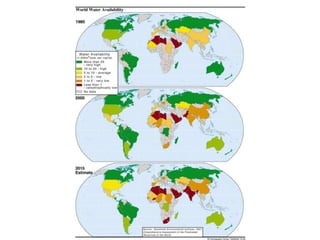
World Water Availability. Retrieved from
          http://www.lib.utexas.edu/maps/world_maps/water_availability_1980_201
          5.jpg
World Water Council. (2010). The Right to Water, a human right. Retrieved from
          http://www.worldwatercouncil.org/index.php?id=1748
Questions
• What would you suggest as a possible solution
  for the equitable distribution of the world’s
  water resources?
• What things can you as an individual do to
  help preserve our world’s water supplies?

Water presentation final ppt

  • 1.
    Water By Lisa, Genesis and Kathy
  • 2.
    A D I MI N ISHI NG RESOURCE
  • 3.
  • 4.
    “The human rightto water entitles everyone to sufficient, safe, acceptable, physically accessible Title and affordable water for personal and domestic uses. An adequate amount of safe water is necessary to prevent death from dehydration, reduce the risk of water-related disease and provide for consumption, cooking, personal and domestic hygienic requirements”. (General Comment 15, CESCR, 2002)
  • 5.
    Global Facts …the reality is… •more than one out of six people lack access to safe drinking water; 1.1 billion people •more than two out of six lack adequate sanitation; 2.6 billion people •3900 children die every day from water-borne diseases •Up to half of humanity has one of these six main diseases 1. diarrhea 2. schistosomiasis 3.trachoma 4. infestation with ascaris 5. infestation with guinea worm 6. infestation with hookworm
  • 6.
    Social Consequences Globally •China, with 1.26 billion people, "the water table is dropping one meter per year due to over-pumping, and the Chinese admit that 300 cities are running short. • In India, home to 1.002 billion people, key aquifers are being over- pumped, and the soil is growing saltier through contamination with irrigation water • Israel (population 6.2 million), invented many water-conserving technologies, but water withdrawals still exceed resupply. • Egypt (population of 68 million), is irrigated by seasonal floods from the Nile River, and from water stored behind the Aswan High Dam. Any interference with water flow by Sudan or Ethiopia could starve Egypt. • Mexico City (home to 20 million people) is sinking because the city sucks out underground water faster than the aquifer can be refilled.
  • 7.
    Social Consequences (cont.) •More and more areas are becoming unstable with regards to their water resources • More and more people are dying from thirst and water-borne contaminants
  • 8.
    •The 1950s droughtseverely impacted a 1.1millionkm2 area in the central US. This drought, along with the famous 1930s drought, was among the most severe of the 20th century for large areas and is the drought of record for water supply planning in Texas. •The total annual dependable water supply in Texas is approximately 16.3 million acre-feet. •Texas has had an abundance of natural resources, although it has had some cases of really severe drought. • 95% of the united states fresh water is underground, and farmers in the Texas High Plains pump groundwater faster than rain fills it, and the water tables are dropping.
  • 9.
    •Over 50 percentof all water projects fail and less than 5 percent of projects are revisited and far less than one percent are monitored. •New approaches to long-term water planning and management that incorporate principles of sustainability and equity are required and are now being explored by national and international water experts and organizations. •Politicians have proposed many different methods to this major topic, among these principles are guaranteed access to a basic amount of water necessary to maintain human health and to sustain ecosystems, basic protections for the renewability of water resources, and institutional recommendations for planning, management, and conflict resolution
  • 10.
  • 11.
    •For each onedollar invested in the World Health Organization it is estimated that $3-$34 of services are possible in developing countries depending on the region and technology.
  • 12.
    Economic Consequences of diminishing water resources • Higher food prices at the supermarket • Loss of businesses (old and new) • Higher cost for water on your utility bill
  • 13.
    •Us humans ofcourse no water, no life! The more population the less water. As mentioned, about 1.1 billion people lack access to clean water, and 2.6 billion do not have access to improved sanitation facilities •Destruction of aquatic ecosystems and extinction of species •Growing risks of regional and international conflicts over scarce or shared water supplies •Businesses- (cost of water); both surface water and groundwater in response to high market prices
  • 14.
    Who Suffers ? • Millions of people worldwide • Agriculture • Ranchers • Businesses • Wildlife • YOU !!
  • 15.
    •Government and politicians •Lesssupply more demands which includes a high price in markets
  • 16.
    Who Benefits fromClean Water? • EVERYONE !! • If ever there was something that people actually “can’t live without”, it is water. • Not just any water, but clean, drinkable water.
  • 17.
    What Conditions HelpTo Promote The Problem ? • “Can’t happen here” mentality; denial that there is a problem • Population growth- coupled with industrialization and urbanization • Climate change • Lack of environmental concern; pollution • Lack of conservation; misuse
  • 18.
    Map of theWorld showing water scarcity
  • 20.
    Top 10 largestcities by population that have the greatest chance of running out of water 1. Los Angeles-major water supply Colorado River Basin 2. Houston- Jasper Aquifer, Lake Houston, Lake Conroe 3. Phoenix- Colorado River Basin 4. San Antonio, TX- Various groundwater sources 5. San Francisco bay areas- Various, including Lake Hetch Hetchy 6. Fortworth, TX- Multiple water supplies 7. Las Vegas- Lake Mead/Colorado River 8. Tucson, AZ- Local groundwater 9. Atlanta- Lake Lanier 10. Orlando, FL- Florida Aquifer
  • 21.
    Local Perspective • ABrief History of Water in San Antonio. • Edwards Aquifer Authority Established • Tom Gallier, Bx. Mets Interim Gen. Mngr. said, “There is no single land issue that is more critical than water.” • Top 200 water users in June 2011
  • 22.
    How Does theAquifer Work 2011 Edwards Aquifer Authority
  • 23.
    Water Recycling TreatmentProcess 2011 San Antonio Water System: Recycling Process
  • 24.
    SAWS Storage &Recovery System _______________________________________________________________________ *** Coming Soon – Desalination Plant***
  • 25.
    Possible Solutions • 1ststep to any solution is in getting people to understand that there is a problem • Need to work to keep the water we do have clean; reduce contaminants
  • 26.
    •Water conservation methodssuch as replacing existing toilets with low-flow toilets •The use of grey water (all the waste water that drains out of your washing machine and sinks), it can be easily treated and recycled.
  • 27.
    Still more possiblesolutions: 1. Hard path - building of dams, pipelines & environmentally-destructive infrastructure - government run and owned with no personal ownership 2. Soft path - Reuse of wastewater ~ storm runoff, gray water & reclaimed wastewater are well-suited to irrigate landscaping - water agency or company personnel to interact closely with water users & to engage community groups in water management. - governments, companies, & individuals to meet the needs of peoples & businesses, instead of just supplying water 3. Privately funded companies 4. Desalination - the removal of salt from salt water -- would be the ultimate solution to water woes -- if it can be done cheaply enough
  • 28.
    CONSERVE TO PRESERVE Individual Actions Matter
  • 29.
    References Anderson, T. L.(1983). Water crisis: Ending the policy drought. Retrieved from http://www.osti.gov/energycitations/product.biblio.jsp?osti_id=5044922 BBC News. World Water Crisis . Retrieved from http://news.bbc.co.uk/hi/english/static/in_depth/world/2000/world_water _crisis/default.stm Burchett., Rettman., & Boning. (1986). Edwards aquifer. Retrieved from http://libweb.lib.utsa.edu/login?url=http://search.proquest.com/docview/1 9075288?accountid=7122 Griffin, R., & Boadu, F. (1992). Water marketing in texas: Opportunities for reform. Retrieved from http://heinonline.org/HOL/LandingPage?collection=journals&handle=hein.j ournals/narj32&div=23&id=&page Linscomb, Steve. (2011, Sept. 21). SAWS pouring millions into desalination plant. Retrieved from http://www.woai.com/news/local/story/saws-pouring- millions-into-desalination-plant/9...
  • 30.
    References (cont.) Maclay, RW.(1995). Geology and hydrology of the Edwards aquifer in the San Antonio area, Texas. Retrieved from google scholar website: http://md1.csa.com/partners/viewrecord.pho?requester=gs&collection=EN V&recid=3857... Martinez, M. (2011). San Antonio Water Rights and Usage. Retrieved from http://sanantonio.about.com/od/historyandlandmarks/a/waterrights.htm=1 McDonald, Colin. (2011). A green lawn at any price. Retrieved from http://www.mysanantonio.com/news/environment/article/A-GREEN-LAWN- AT-ANY-P... McDonald, Colin. (2011). BexarMet bets on getting water rights: Record drought could choke utility. San Antonio Express-News, pp. A1, A12. Pacific Institute. (2009). Global Water Crisis. Retrieved from http://www.pacinst.org/topics/water_and_sustainability/global_water_crisi s/
  • 31.
    References (cont.) Postel, S.(2011, July 14). Conservation in San Antonio is Saving more than Water. National Geographic Daily News. Retrieved from http://newswatch.nationalgeographic.com/2011/07/14/conservation-in- san-antonio-is-savi... SAWS.org. (2011). Twin Oaks Aquifer Storage & Recovery. Retrieved from http://www.saws.org/our_water/waterresources/projects/asr.shtml SAWS.org. (2011). Water Recycling Treatment Process. Retrieved from http://www.saws.org/our_water/recycling/centers/treatment.shtml Schaefer, M. (2008). Water technologies and the environment: Ramping up by scaling down. (Vol. 30, pp. 3-4). UK: Elsevier Science, The Boulevard Langford Lane Kidlington Oxford OX51GB UK. Retrieved from http://search.proquest.com.libweb.lib.utsa.edu/waterresources/docview/20 235078/132A3A6AA15173A2506/8?accountid-7122 Stockdale, C., Sauter, M., & McIntire, D. (2010, November 1). The ten biggest american cities that are running out of water. Retrieved from http://finance.yahoo.com/real-estate/article/111186/the-ten-biggest- american-cities-that-are-running-out-of-water
  • 32.
    References (cont.) Tlc whatis grey water. (2011, october 24). Retrieved from http://tlc.howstuffworks.com/home/grey-water.htm United Nations Human Rights. (2011). International Human Rights Law. Retrieved from http://www.ohchr.org/EN/ProfessionalInterest/Pages/InternationalLaw.aspx Water Woes. (2001, APR 26). Where’s the water? Retrieved from http://whyfiles.org/131fresh_water/index.html World Water Availability. Retrieved from http://www.lib.utexas.edu/maps/world_maps/water_availability_1980_201 5.jpg World Water Council. (2010). The Right to Water, a human right. Retrieved from http://www.worldwatercouncil.org/index.php?id=1748
  • 33.
    Questions • What wouldyou suggest as a possible solution for the equitable distribution of the world’s water resources? • What things can you as an individual do to help preserve our world’s water supplies?