1/30/20161
Urban Land Pollution & Usage
Presented by :
Saad Farooqi, C# 01
Bs semester: 6th
Department of Environmental &
Conservation Sciences
University of Swat
Land Usage
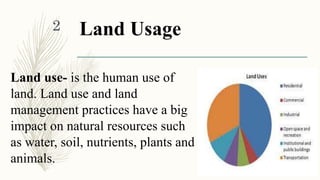
Land use- is the human use of
land. Land use and land
management practices have a big
impact on natural resources such
as water, soil, nutrients, plants and
animals.
1/30/2016
2
Land Pollution
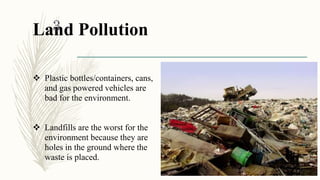
 Plastic bottles/containers, cans,
and gas powered vehicles are
bad for the environment.
 Landfills are the worst for the
environment because they are
holes in the ground where the
waste is placed.
1/30/2016
3
Primary Land-Use
1/30/2016
4
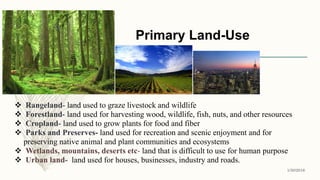
 Rangeland- land used to graze livestock and wildlife
 Forestland- land used for harvesting wood, wildlife, fish, nuts, and other resources
 Cropland- land used to grow plants for food and fiber
 Parks and Preserves- land used for recreation and scenic enjoyment and for
preserving native animal and plant communities and ecosystems
 Wetlands, mountains, deserts etc- land that is difficult to use for human purpose
 Urban land- land used for houses, businesses, industry and roads.
How Do We Use Our Land Today?
We use our land today for several things such as:
Farming, Mining, Recreation, Highways, Building Cities.
When land is being used for houses, industries, roads, and businesses
it is known as urban land.
Rural land is an area of few people and large open spaces of land.
When land is being used for graze livestock and wildlife, it is known
as range land. 1/30/2016
5
Con….
- We use land in three major ways; woods in forests, crops in farm, and mineral resources!
Weather people live in rural or urban cities, we all depend on resources that are being produced
in the rural areas.
-Resources being produced by natural and
artificial ecosystems is known as ecosystem
services.
-Ecosystem Services:
-aesthetic beauty - purification of water & air
-regulation of climate -prevention of flood/drought
-movement and cycling of nutrients
-maintenance of biodiversity -detox wastes
-decompose wastes 1/30/2016
6
What is land pollution?
 Land pollution is when left over wasted is thrown away and piles up
in land fills
 Trash is also being thrown away into rivers and into forests as well
 Sometimes the waste in burned for fuel or energy
 This is a problem because the products thrown away might have oils
or chemicals in them or on them.
 In a average day in the United States, people throw out up to 200,000
tons of edible food and 1 million bushels of litter out of their
automobiles.
1/30/2016
7
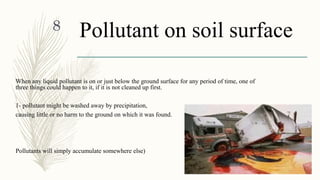
Pollutant on soil surface
When any liquid pollutant is on or just below the ground surface for any period of time, one of
three things could happen to it, if it is not cleaned up first.
1- pollutant might be washed away by precipitation,
causing little or no harm to the ground on which it was found.
Pollutants will simply accumulate somewhere else)
1/30/2016
8
Con…
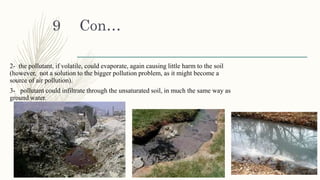
2- the pollutant, if volatile, could evaporate, again causing little harm to the soil
(however, not a solution to the bigger pollution problem, as it might become a
source of air pollution).
3- pollutant could infiltrate through the unsaturated soil, in much the same way as
ground water.
1/30/2016
9
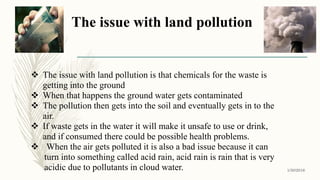
The issue with land pollution
 The issue with land pollution is that chemicals for the waste is
getting into the ground
 When that happens the ground water gets contaminated
 The pollution then gets into the soil and eventually gets in to the
air.
 If waste gets in the water it will make it unsafe to use or drink,
and if consumed there could be possible health problems.
 When the air gets polluted it is also a bad issue because it can
turn into something called acid rain, acid rain is rain that is very
acidic due to pollutants in cloud water. 1/30/2016
10
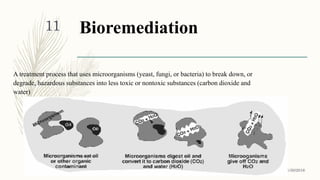
Bioremediation
A treatment process that uses microorganisms (yeast, fungi, or bacteria) to break down, or
degrade, hazardous substances into less toxic or nontoxic substances (carbon dioxide and
water)
1/30/2016
11
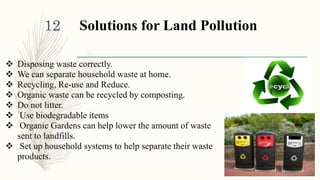
Solutions for Land Pollution
 Disposing waste correctly.
 We can separate household waste at home.
 Recycling, Re-use and Reduce.
 Organic waste can be recycled by composting.
 Do not litter.
 Use biodegradable items
 Organic Gardens can help lower the amount of waste
sent to landfills.
 Set up household systems to help separate their waste
products.
1/30/2016
12
thank
you
1/30/2016
13

Urban land pollution and usage

  • 1.
    1/30/20161 Urban Land Pollution& Usage Presented by : Saad Farooqi, C# 01 Bs semester: 6th Department of Environmental & Conservation Sciences University of Swat
  • 2.
    Land Usage Land use-is the human use of land. Land use and land management practices have a big impact on natural resources such as water, soil, nutrients, plants and animals. 1/30/2016 2
  • 3.
    Land Pollution  Plasticbottles/containers, cans, and gas powered vehicles are bad for the environment.  Landfills are the worst for the environment because they are holes in the ground where the waste is placed. 1/30/2016 3
  • 4.
    Primary Land-Use 1/30/2016 4  Rangeland-land used to graze livestock and wildlife  Forestland- land used for harvesting wood, wildlife, fish, nuts, and other resources  Cropland- land used to grow plants for food and fiber  Parks and Preserves- land used for recreation and scenic enjoyment and for preserving native animal and plant communities and ecosystems  Wetlands, mountains, deserts etc- land that is difficult to use for human purpose  Urban land- land used for houses, businesses, industry and roads.
  • 5.
    How Do WeUse Our Land Today? We use our land today for several things such as: Farming, Mining, Recreation, Highways, Building Cities. When land is being used for houses, industries, roads, and businesses it is known as urban land. Rural land is an area of few people and large open spaces of land. When land is being used for graze livestock and wildlife, it is known as range land. 1/30/2016 5
  • 6.
    Con…. - We useland in three major ways; woods in forests, crops in farm, and mineral resources! Weather people live in rural or urban cities, we all depend on resources that are being produced in the rural areas. -Resources being produced by natural and artificial ecosystems is known as ecosystem services. -Ecosystem Services: -aesthetic beauty - purification of water & air -regulation of climate -prevention of flood/drought -movement and cycling of nutrients -maintenance of biodiversity -detox wastes -decompose wastes 1/30/2016 6
  • 7.
    What is landpollution?  Land pollution is when left over wasted is thrown away and piles up in land fills  Trash is also being thrown away into rivers and into forests as well  Sometimes the waste in burned for fuel or energy  This is a problem because the products thrown away might have oils or chemicals in them or on them.  In a average day in the United States, people throw out up to 200,000 tons of edible food and 1 million bushels of litter out of their automobiles. 1/30/2016 7
  • 8.
    Pollutant on soilsurface When any liquid pollutant is on or just below the ground surface for any period of time, one of three things could happen to it, if it is not cleaned up first. 1- pollutant might be washed away by precipitation, causing little or no harm to the ground on which it was found. Pollutants will simply accumulate somewhere else) 1/30/2016 8
  • 9.
    Con… 2- the pollutant,if volatile, could evaporate, again causing little harm to the soil (however, not a solution to the bigger pollution problem, as it might become a source of air pollution). 3- pollutant could infiltrate through the unsaturated soil, in much the same way as ground water. 1/30/2016 9
  • 10.
    The issue withland pollution  The issue with land pollution is that chemicals for the waste is getting into the ground  When that happens the ground water gets contaminated  The pollution then gets into the soil and eventually gets in to the air.  If waste gets in the water it will make it unsafe to use or drink, and if consumed there could be possible health problems.  When the air gets polluted it is also a bad issue because it can turn into something called acid rain, acid rain is rain that is very acidic due to pollutants in cloud water. 1/30/2016 10
  • 11.
    Bioremediation A treatment processthat uses microorganisms (yeast, fungi, or bacteria) to break down, or degrade, hazardous substances into less toxic or nontoxic substances (carbon dioxide and water) 1/30/2016 11
  • 12.
    Solutions for LandPollution  Disposing waste correctly.  We can separate household waste at home.  Recycling, Re-use and Reduce.  Organic waste can be recycled by composting.  Do not litter.  Use biodegradable items  Organic Gardens can help lower the amount of waste sent to landfills.  Set up household systems to help separate their waste products. 1/30/2016 12
  • 13.