KUVEMPU UNIVERSITY
SAHYADRI SCIENCE COLLEGE
DEPARTMENT OF BIOTECHNOLOGY
Topic : Airborne diseases
SUBMITTED BY UNDER THE GUIDANCE OF
Syeda Nimra Ms Syeda Misba Fathima
I MSc I sem Sahyadri science college,
Sahyadri science College, Shimoga
Shimoga
INTRODUCTION
HISTORY
FACTS ON AIRBORNE DISEASES
CLASSIFICATION ON AIRBORNE DISEASE
TUBERCULOSIS
DIPHTHERIA
MENINGITIS
PREVENTIONS OF AIRBORNE DISEASE
CONCLUSION
REFERENCE
Introduction:
 Airborne disease are capable of becoming suspended in the air, typically
when an infected individual coughs or sneezes.

 They can then be inhaled by unsuspecting individuals resulting in new
infections.
 The relevant pathogens may be viruses, bacteria, or fungi. Airborne
viruses can affect both animals and humans.
 It spread through breathing, talking, coughing, sneezing, raising of dust,
spraying of liquids, flushing toilets, or any activities which
generate aerosol particles or droplets.
History:
■ Robert Koch identified and described the bacillus causing
tuberculosis, M. tuberculosis, on 24 March 1882.
■ Koch announced a glycerine extract of the tubercle bacilli as
a "remedy" for tuberculosis in 1890, calling it "tuberculin".
■ Albert Calmette and Camille Guérin achieved the first
genuine success in immunization against tuberculosis in
1906, using attenuated bovine-strain tuberculosis. It was
called bacille Calmette–Guérin (BCG).
■ 6th century: First observations of diphtheria epidemics by
the Greek physician Aetius.
■ Late 19th century: The bacteria responsible for diphtheria
are identified by the German scientists Edwin Klebs and
Friedrich Loffler.
Facts on airborne disease
■ These illnesses, including colds, are transmitted through air.
■ Many airborne diseases are common and can have mild or severe symptoms.
■ Prevention tips include good ventilation to swap indoor and outdoor air.
■ Ventilation methods, such as opening a window or using fans, help to exchange
dirty air.
■ Treatment for less serious airborne diseases includes rest and fluids.
Classification of Airborne Disease:
 Obligate airborne infections, are only through aerosols and the most common example
of this category is tuberculosis.
 Preferential airborne infections, such as chicken pox, can be obtained through
different routes, but mainly by aerosols.
 Opportunistic airborne infections, typically transmit through other routes, however
under favourable conditions, aerosol transmission can occur. An example of an
opportunistic airborne infection includes influenza.
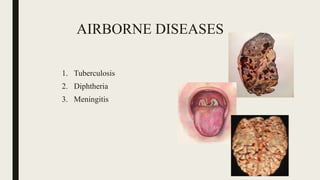
AIRBORNE DISEASES
1. Tuberculosis
2. Diphtheria
3. Meningitis
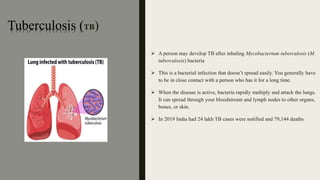
Tuberculosis (TB)
 A person may develop TB after inhaling Mycobacterium tuberculosis (M.
tuberculosis) bacteria
 This is a bacterial infection that doesn’t spread easily. You generally have
to be in close contact with a person who has it for a long time.
 When the disease is active, bacteria rapidly multiply and attack the lungs.
It can spread through your bloodstream and lymph nodes to other organs,
bones, or skin.
 In 2019 India had 24 lakh TB cases were notified and 79,144 deaths
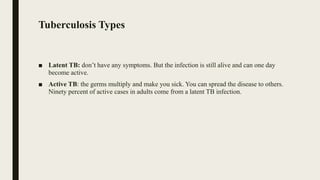
Tuberculosis Types
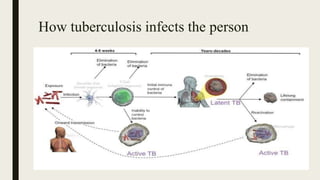
■ Latent TB: don’t have any symptoms. But the infection is still alive and can one day
become active.
■ Active TB: the germs multiply and make you sick. You can spread the disease to others.
Ninety percent of active cases in adults come from a latent TB infection.
How tuberculosis infects the person
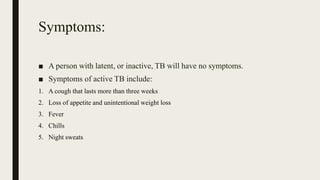
Symptoms:
■ A person with latent, or inactive, TB will have no symptoms.
■ Symptoms of active TB include:
1. A cough that lasts more than three weeks
2. Loss of appetite and unintentional weight loss
3. Fever
4. Chills
5. Night sweats
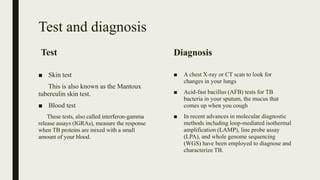
Test and diagnosis
Test
■ Skin test
This is also known as the Mantoux
tuberculin skin test.
■ Blood test
These tests, also called interferon-gamma
release assays (IGRAs), measure the response
when TB proteins are mixed with a small
amount of your blood.
Diagnosis
■ A chest X-ray or CT scan to look for
changes in your lungs
■ Acid-fast bacillus (AFB) tests for TB
bacteria in your sputum, the mucus that
comes up when you cough
■ In recent advances in molecular diagnostic
methods including loop-mediated isothermal
amplification (LAMP), line probe assay
(LPA), and whole genome sequencing
(WGS) have been employed to diagnose and
characterize TB.
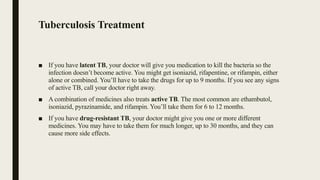
Tuberculosis Treatment
■ If you have latent TB, your doctor will give you medication to kill the bacteria so the
infection doesn’t become active. You might get isoniazid, rifapentine, or rifampin, either
alone or combined. You’ll have to take the drugs for up to 9 months. If you see any signs
of active TB, call your doctor right away.
■ A combination of medicines also treats active TB. The most common are ethambutol,
isoniazid, pyrazinamide, and rifampin. You’ll take them for 6 to 12 months.
■ If you have drug-resistant TB, your doctor might give you one or more different
medicines. You may have to take them for much longer, up to 30 months, and they can
cause more side effects.
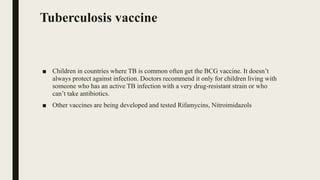
Tuberculosis vaccine
■ Children in countries where TB is common often get the BCG vaccine. It doesn’t
always protect against infection. Doctors recommend it only for children living with
someone who has an active TB infection with a very drug-resistant strain or who
can’t take antibiotics.
■ Other vaccines are being developed and tested Rifamycins, Nitroimidazols
Tuberculosis Medication Side Effects
• Numbness and tingling in your hands and feet
• Upset stomach, nausea, and vomiting
• Loss of appetite, Diarrhea
• Weakness, chills, painful or swollen joints, headache, confusion
• Lack of energy
• Skin rash
Tuberculosis complications:
Tuberculosis infection can cause complications such as:
• Joint damage
• Lung damage
• Infection or damage of your bones, spinal cord, brain, or lymph nodes
• Liver or kidney problems
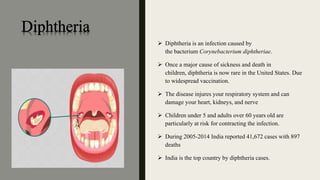
 Diphtheria is an infection caused by
the bacterium Corynebacterium diphtheriae.
 Once a major cause of sickness and death in
children, diphtheria is now rare in the United States. Due
to widespread vaccination.
 The disease injures your respiratory system and can
damage your heart, kidneys, and nerve
 Children under 5 and adults over 60 years old are
particularly at risk for contracting the infection.
 During 2005-2014 India reported 41,672 cases with 897
deaths
 India is the top country by diphtheria cases.
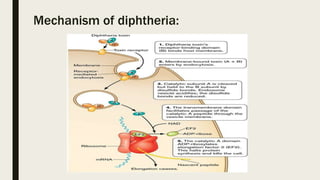
Mechanism of diphtheria:
Transmission
■ Human-to-human transmission of diphtheria typically occurs through the air when an
infected individual coughs or sneezes.
■ Contact with any lesions on the skin can also lead to transmission of diphtheria, but this
is uncommon.
■ If an infected individual touches a surface or object, the bacteria can be left behind and
remain viable.
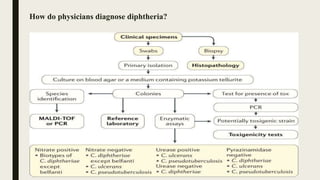
How do physicians diagnose diphtheria?
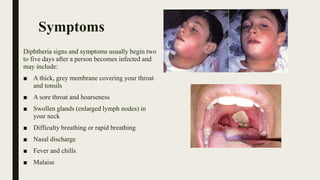
Symptoms
Diphtheria signs and symptoms usually begin two
to five days after a person becomes infected and
may include:
■ A thick, grey membrane covering your throat
and tonsils
■ A sore throat and hoarseness
■ Swollen glands (enlarged lymph nodes) in
your neck
■ Difficulty breathing or rapid breathing
■ Nasal discharge
■ Fever and chills
■ Malaise
Treatment
■ Antibiotics
Antibiotics, such as penicillin or erythromycin, help kill bacteria in the body,
clearing up infections. Antibiotics cut the time that someone with diphtheria is contagious.
■ An antitoxin
If a doctor suspects diphtheria, he or she will request a medication that
counteracts the diphtheria toxin in the body from the Centers for Disease Control and
Prevention. Called an antitoxin, this drug is injected into a vein or muscle.
■ Children and adults who have diphtheria often need to be in the hospital for treatment.
They may be isolated in an intensive care unit because diphtheria can spread easily to
anyone not immunized against the disease.
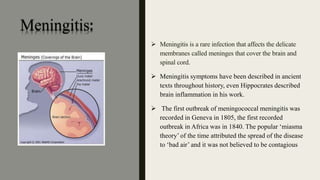
Meningitis:
 Meningitis is a rare infection that affects the delicate
membranes called meninges that cover the brain and
spinal cord.
 Meningitis symptoms have been described in ancient
texts throughout history, even Hippocrates described
brain inflammation in his work.
 The first outbreak of meningococcal meningitis was
recorded in Geneva in 1805, the first recorded
outbreak in Africa was in 1840. The popular ‘miasma
theory’ of the time attributed the spread of the disease
to ‘bad air’ and it was not believed to be contagious
Types of Meningitis
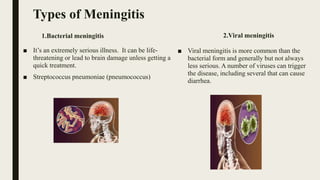
■ It’s an extremely serious illness. It can be life-
threatening or lead to brain damage unless getting a
quick treatment.
■ Streptococcus pneumoniae (pneumococcus)
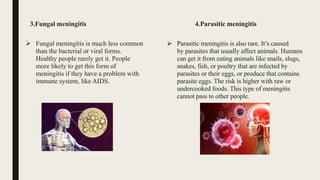
1.Bacterial meningitis 2.Viral meningitis
■ Viral meningitis is more common than the
bacterial form and generally but not always
less serious. A number of viruses can trigger
the disease, including several that can cause
diarrhea.
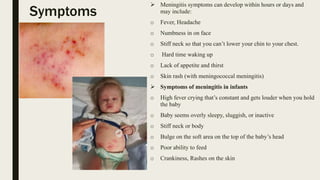
3.Fungal meningitis
 Fungal meningitis is much less common
than the bacterial or viral forms.
Healthy people rarely get it. People
more likely to get this form of
meningitis if they have a problem with
immune system, like AIDS.
4.Parasitic meningitis
 Parasitic meningitis is also rare. It’s caused
by parasites that usually affect animals. Humans
can get it from eating animals like snails, slugs,
snakes, fish, or poultry that are infected by
parasites or their eggs, or produce that contains
parasite eggs. The risk is higher with raw or
undercooked foods. This type of meningitis
cannot pass to other people.
Symptoms
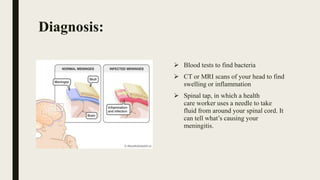
 Meningitis symptoms can develop within hours or days and
may include:
o Fever, Headache
o Numbness in on face
o Stiff neck so that you can’t lower your chin to your chest.
o Hard time waking up
o Lack of appetite and thirst
o Skin rash (with meningococcal meningitis)
 Symptoms of meningitis in infants
o High fever crying that’s constant and gets louder when you hold
the baby
o Baby seems overly sleepy, sluggish, or inactive
o Stiff neck or body
o Bulge on the soft area on the top of the baby’s head
o Poor ability to feed
o Crankiness, Rashes on the skin
Diagnosis:
 Blood tests to find bacteria
 CT or MRI scans of your head to find
swelling or inflammation
 Spinal tap, in which a health
care worker uses a needle to take
fluid from around your spinal cord. It
can tell what’s causing your
meningitis.
Treatment
■ Bacterial meningitis needs treatment with antibiotics
■ Viral meningitis usually goes away on its own without treatment. Your doctor might tell you to stay in bed,
drink plenty of fluids, and take over-the-counter pain medicines if you have a fever or aches.
■ Antifungal medications can treat fungal meningitis.
Complications of Meningitis
Meningitis can cause severe complications in adults and children, especially if you delay treatment. Possible
complications include:
• Seizures
• Brain damage
• Loss of hearing
• Memory problems, Learning problems
• A hard time walking
• Kidney failure
• Shock, Death
Prevention for airborne disease:
 Avoid close contact with people who have active symptoms of disease.
 Stay home when you’re sick. Don’t let vulnerable people come in close contact with you.
 If you must be around others, wear a face mask to prevent spreading or breathing in germs.
 Cover your mouth when you cough or sneeze. Use a tissue or your elbow to cut down on the possibility of transmitting
germs on your hands.
 Wash your hands thoroughly (at least 20 seconds) and often, especially after sneezing or coughing.
 Avoid touching your face or other people with unwashed hands.
 Take all of your medicines as they’re prescribed, until your doctor takes you off them.
 Always cover your mouth with a tissue when you cough or sneeze. Seal the tissue in a plastic bag, then throw it away.
 Stay home from work, school, or other public places.
 Use a fan or open windows to move around fresh air.
 Don’t use public transportation.
Conclusion:
To conclude, airborne transmission of infectious disease is a major public health
concern. If we are infected by any transmitted disease make sure to be away from children
and adults because they have maximum possibilities of getting infected faster. Maintain
hygiene and prevention.
Reference
 Medically reviewed by Deborah Weatherspoon, Ph.D., R.N., CRNA — Written by Ann
Pietrangelo on March 19, 2020
 Minesh Khatri, MD. WebMD, LLC. On, June 27, 2020
 Tuberculosis (TB)”. World Health Organization(WHO). 16 February 2018. Retrieved 15
September 2018
 Mayo Foundation for Medical Education and Research
Airborne diseases

Airborne diseases

  • 1.
    KUVEMPU UNIVERSITY SAHYADRI SCIENCECOLLEGE DEPARTMENT OF BIOTECHNOLOGY Topic : Airborne diseases SUBMITTED BY UNDER THE GUIDANCE OF Syeda Nimra Ms Syeda Misba Fathima I MSc I sem Sahyadri science college, Sahyadri science College, Shimoga Shimoga
  • 2.
    INTRODUCTION HISTORY FACTS ON AIRBORNEDISEASES CLASSIFICATION ON AIRBORNE DISEASE TUBERCULOSIS DIPHTHERIA MENINGITIS PREVENTIONS OF AIRBORNE DISEASE CONCLUSION REFERENCE
  • 3.
    Introduction:  Airborne diseaseare capable of becoming suspended in the air, typically when an infected individual coughs or sneezes.  They can then be inhaled by unsuspecting individuals resulting in new infections.  The relevant pathogens may be viruses, bacteria, or fungi. Airborne viruses can affect both animals and humans.  It spread through breathing, talking, coughing, sneezing, raising of dust, spraying of liquids, flushing toilets, or any activities which generate aerosol particles or droplets.
  • 4.
    History: ■ Robert Kochidentified and described the bacillus causing tuberculosis, M. tuberculosis, on 24 March 1882. ■ Koch announced a glycerine extract of the tubercle bacilli as a "remedy" for tuberculosis in 1890, calling it "tuberculin". ■ Albert Calmette and Camille Guérin achieved the first genuine success in immunization against tuberculosis in 1906, using attenuated bovine-strain tuberculosis. It was called bacille Calmette–Guérin (BCG). ■ 6th century: First observations of diphtheria epidemics by the Greek physician Aetius. ■ Late 19th century: The bacteria responsible for diphtheria are identified by the German scientists Edwin Klebs and Friedrich Loffler.
  • 5.
    Facts on airbornedisease ■ These illnesses, including colds, are transmitted through air. ■ Many airborne diseases are common and can have mild or severe symptoms. ■ Prevention tips include good ventilation to swap indoor and outdoor air. ■ Ventilation methods, such as opening a window or using fans, help to exchange dirty air. ■ Treatment for less serious airborne diseases includes rest and fluids.
  • 6.
    Classification of AirborneDisease:  Obligate airborne infections, are only through aerosols and the most common example of this category is tuberculosis.  Preferential airborne infections, such as chicken pox, can be obtained through different routes, but mainly by aerosols.  Opportunistic airborne infections, typically transmit through other routes, however under favourable conditions, aerosol transmission can occur. An example of an opportunistic airborne infection includes influenza.
  • 7.
    AIRBORNE DISEASES 1. Tuberculosis 2.Diphtheria 3. Meningitis
  • 8.
    Tuberculosis (TB)  Aperson may develop TB after inhaling Mycobacterium tuberculosis (M. tuberculosis) bacteria  This is a bacterial infection that doesn’t spread easily. You generally have to be in close contact with a person who has it for a long time.  When the disease is active, bacteria rapidly multiply and attack the lungs. It can spread through your bloodstream and lymph nodes to other organs, bones, or skin.  In 2019 India had 24 lakh TB cases were notified and 79,144 deaths
  • 9.
    Tuberculosis Types ■ LatentTB: don’t have any symptoms. But the infection is still alive and can one day become active. ■ Active TB: the germs multiply and make you sick. You can spread the disease to others. Ninety percent of active cases in adults come from a latent TB infection.
  • 10.
  • 11.
    Symptoms: ■ A personwith latent, or inactive, TB will have no symptoms. ■ Symptoms of active TB include: 1. A cough that lasts more than three weeks 2. Loss of appetite and unintentional weight loss 3. Fever 4. Chills 5. Night sweats
  • 12.
    Test and diagnosis Test ■Skin test This is also known as the Mantoux tuberculin skin test. ■ Blood test These tests, also called interferon-gamma release assays (IGRAs), measure the response when TB proteins are mixed with a small amount of your blood. Diagnosis ■ A chest X-ray or CT scan to look for changes in your lungs ■ Acid-fast bacillus (AFB) tests for TB bacteria in your sputum, the mucus that comes up when you cough ■ In recent advances in molecular diagnostic methods including loop-mediated isothermal amplification (LAMP), line probe assay (LPA), and whole genome sequencing (WGS) have been employed to diagnose and characterize TB.
  • 13.
    Tuberculosis Treatment ■ Ifyou have latent TB, your doctor will give you medication to kill the bacteria so the infection doesn’t become active. You might get isoniazid, rifapentine, or rifampin, either alone or combined. You’ll have to take the drugs for up to 9 months. If you see any signs of active TB, call your doctor right away. ■ A combination of medicines also treats active TB. The most common are ethambutol, isoniazid, pyrazinamide, and rifampin. You’ll take them for 6 to 12 months. ■ If you have drug-resistant TB, your doctor might give you one or more different medicines. You may have to take them for much longer, up to 30 months, and they can cause more side effects.
  • 14.
    Tuberculosis vaccine ■ Childrenin countries where TB is common often get the BCG vaccine. It doesn’t always protect against infection. Doctors recommend it only for children living with someone who has an active TB infection with a very drug-resistant strain or who can’t take antibiotics. ■ Other vaccines are being developed and tested Rifamycins, Nitroimidazols
  • 15.
    Tuberculosis Medication SideEffects • Numbness and tingling in your hands and feet • Upset stomach, nausea, and vomiting • Loss of appetite, Diarrhea • Weakness, chills, painful or swollen joints, headache, confusion • Lack of energy • Skin rash Tuberculosis complications: Tuberculosis infection can cause complications such as: • Joint damage • Lung damage • Infection or damage of your bones, spinal cord, brain, or lymph nodes • Liver or kidney problems
  • 16.
     Diphtheria isan infection caused by the bacterium Corynebacterium diphtheriae.  Once a major cause of sickness and death in children, diphtheria is now rare in the United States. Due to widespread vaccination.  The disease injures your respiratory system and can damage your heart, kidneys, and nerve  Children under 5 and adults over 60 years old are particularly at risk for contracting the infection.  During 2005-2014 India reported 41,672 cases with 897 deaths  India is the top country by diphtheria cases.
  • 17.
  • 18.
    Transmission ■ Human-to-human transmissionof diphtheria typically occurs through the air when an infected individual coughs or sneezes. ■ Contact with any lesions on the skin can also lead to transmission of diphtheria, but this is uncommon. ■ If an infected individual touches a surface or object, the bacteria can be left behind and remain viable.
  • 19.
    How do physiciansdiagnose diphtheria?
  • 20.
    Symptoms Diphtheria signs andsymptoms usually begin two to five days after a person becomes infected and may include: ■ A thick, grey membrane covering your throat and tonsils ■ A sore throat and hoarseness ■ Swollen glands (enlarged lymph nodes) in your neck ■ Difficulty breathing or rapid breathing ■ Nasal discharge ■ Fever and chills ■ Malaise
  • 21.
    Treatment ■ Antibiotics Antibiotics, suchas penicillin or erythromycin, help kill bacteria in the body, clearing up infections. Antibiotics cut the time that someone with diphtheria is contagious. ■ An antitoxin If a doctor suspects diphtheria, he or she will request a medication that counteracts the diphtheria toxin in the body from the Centers for Disease Control and Prevention. Called an antitoxin, this drug is injected into a vein or muscle. ■ Children and adults who have diphtheria often need to be in the hospital for treatment. They may be isolated in an intensive care unit because diphtheria can spread easily to anyone not immunized against the disease.
  • 22.
    Meningitis:  Meningitis isa rare infection that affects the delicate membranes called meninges that cover the brain and spinal cord.  Meningitis symptoms have been described in ancient texts throughout history, even Hippocrates described brain inflammation in his work.  The first outbreak of meningococcal meningitis was recorded in Geneva in 1805, the first recorded outbreak in Africa was in 1840. The popular ‘miasma theory’ of the time attributed the spread of the disease to ‘bad air’ and it was not believed to be contagious
  • 23.
    Types of Meningitis ■It’s an extremely serious illness. It can be life- threatening or lead to brain damage unless getting a quick treatment. ■ Streptococcus pneumoniae (pneumococcus) 1.Bacterial meningitis 2.Viral meningitis ■ Viral meningitis is more common than the bacterial form and generally but not always less serious. A number of viruses can trigger the disease, including several that can cause diarrhea.
  • 24.
    3.Fungal meningitis  Fungalmeningitis is much less common than the bacterial or viral forms. Healthy people rarely get it. People more likely to get this form of meningitis if they have a problem with immune system, like AIDS. 4.Parasitic meningitis  Parasitic meningitis is also rare. It’s caused by parasites that usually affect animals. Humans can get it from eating animals like snails, slugs, snakes, fish, or poultry that are infected by parasites or their eggs, or produce that contains parasite eggs. The risk is higher with raw or undercooked foods. This type of meningitis cannot pass to other people.
  • 25.
    Symptoms  Meningitis symptomscan develop within hours or days and may include: o Fever, Headache o Numbness in on face o Stiff neck so that you can’t lower your chin to your chest. o Hard time waking up o Lack of appetite and thirst o Skin rash (with meningococcal meningitis)  Symptoms of meningitis in infants o High fever crying that’s constant and gets louder when you hold the baby o Baby seems overly sleepy, sluggish, or inactive o Stiff neck or body o Bulge on the soft area on the top of the baby’s head o Poor ability to feed o Crankiness, Rashes on the skin
  • 26.
    Diagnosis:  Blood teststo find bacteria  CT or MRI scans of your head to find swelling or inflammation  Spinal tap, in which a health care worker uses a needle to take fluid from around your spinal cord. It can tell what’s causing your meningitis.
  • 27.
    Treatment ■ Bacterial meningitisneeds treatment with antibiotics ■ Viral meningitis usually goes away on its own without treatment. Your doctor might tell you to stay in bed, drink plenty of fluids, and take over-the-counter pain medicines if you have a fever or aches. ■ Antifungal medications can treat fungal meningitis. Complications of Meningitis Meningitis can cause severe complications in adults and children, especially if you delay treatment. Possible complications include: • Seizures • Brain damage • Loss of hearing • Memory problems, Learning problems • A hard time walking • Kidney failure • Shock, Death
  • 28.
    Prevention for airbornedisease:  Avoid close contact with people who have active symptoms of disease.  Stay home when you’re sick. Don’t let vulnerable people come in close contact with you.  If you must be around others, wear a face mask to prevent spreading or breathing in germs.  Cover your mouth when you cough or sneeze. Use a tissue or your elbow to cut down on the possibility of transmitting germs on your hands.  Wash your hands thoroughly (at least 20 seconds) and often, especially after sneezing or coughing.  Avoid touching your face or other people with unwashed hands.  Take all of your medicines as they’re prescribed, until your doctor takes you off them.  Always cover your mouth with a tissue when you cough or sneeze. Seal the tissue in a plastic bag, then throw it away.  Stay home from work, school, or other public places.  Use a fan or open windows to move around fresh air.  Don’t use public transportation.
  • 29.
    Conclusion: To conclude, airbornetransmission of infectious disease is a major public health concern. If we are infected by any transmitted disease make sure to be away from children and adults because they have maximum possibilities of getting infected faster. Maintain hygiene and prevention.
  • 30.
    Reference  Medically reviewedby Deborah Weatherspoon, Ph.D., R.N., CRNA — Written by Ann Pietrangelo on March 19, 2020  Minesh Khatri, MD. WebMD, LLC. On, June 27, 2020  Tuberculosis (TB)”. World Health Organization(WHO). 16 February 2018. Retrieved 15 September 2018  Mayo Foundation for Medical Education and Research