MICROFLORA OF
SOIL, WATER AND
AIR
Soil consists of mineral particles, air, water, soil organic matter, plant
roots and living soil organisms. In terms of mass and volume, the living
organisms constitute by far the smallest part of the soil.
Typically, 50% of a soil volume will be mineral particles, 25% air filled
pores and 25% water filled pores, although this will vary.
The soil organic matter constitutes 0.5-5% of the solid fraction by
weight, except in peat soils where it is much higher.
 Soil biota can be grouped according to size in micro-, meso- and
macrobiota.
are less than 0.2mm and consist of
bacteria, actinomycetes, fungi, algae and protozoa.
range from 0.2 to 10mm in size and consist of
nematodes, enchytraeids, collembola or springtails, mites, rotifers
and small insects (arthropods).
are organisms larger than 10mm and consist of
earthworms, mollusks and larger arthropods.
REASONS OF INVESTIGATION
 Epidemiological investigation
 Definition of transmission routes of diseases and
resistance of their causative agents
 Pollution of soil waters, rivers, lakes etc.
 Definition of sanitary conditions of soil
Investigation of soil microbiota
 Investigation of microflora is difficult
because of presence of many different species of microbes that
can need totally different conditions for their isolation and
identification: temperature, respiration, nutrition etc.
 Because of that problem mostly are used indicating bacteria
which show sanitary conditions of environment
 Indicating bacteria for soil: E.coli, Streptococcus
feacalis, Clostridium perfringens, bacteria of genus Proteus.
 In addition can be checked special pathogenic bacteria especially
for epidemiological reasons: Salmonellas, Shigellas, Clostridium
botulinum and tetani etc.
Obtaining of samples
 Take samples from area close to possible pollution and on some
distance from it
 Take samples from 5 points by “envelope” type
 Samples must be close to 300 g to save moisture during
transportation
 Transportation must be not more then 24 hours in temperature +4-
5 C
 In laboratory soil primary must be cleared from stones, roots, leaves
etc.
Obtaining of samples
 Should be performed in aseptic conditions with sterile
instruments
 Several probes of soil are multiplied in aseptic conditions and
mixed with sterile water to make 10-1 dilution. (30g of soil with
270 ml of water)
 Such suspension is used for preparation of other dilutions
according to method of investigation and approximate bacterial
population
Microbial number
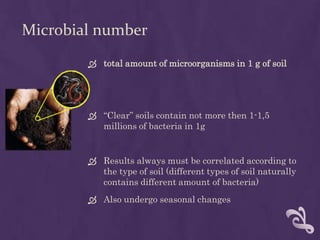
 total amount of microorganisms in 1 g of soil
 “Clear” soils contain not more then 1-1,5
millions of bacteria in 1g
 Results always must be correlated according to
the type of soil (different types of soil naturally
contains different amount of bacteria)
 Also undergo seasonal changes
Microbial number
 Often dilutions: 10-3 to 10-5
 Not less then 2 dilutions must be used
 Mix solutions before seeding
 Each solution seed not less then 2 Petri dishes
 1 ml of solution is taken, placed on a button of Petri dish
 Add 7-10 ml of boiled and cooled to 45 C MPA
 Mix MPA with suspension by soft rocking of Petri dish
 Mark dilution, data about investigation on Petri dish
Microbial number
 Incubation for 24 hours with temperature of 28-30 C
 For facility of cultivation better to take dilutions in which on
dishes are formed from 50 to 150 colonies
 Protocols of calculation include such data:
1. Area of investigation
2. Amount of colonies obtained from several Petri dished according
to dilutions
3. Average amount of colonies
4. Microbial number
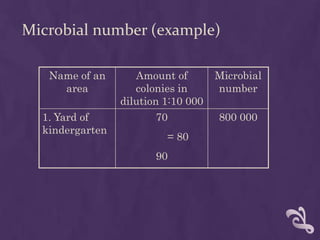
Microbial number (example)
Name of an
area
Amount of
colonies in
dilution 1:10 000
Microbial
number
1. Yard of
kindergarten
70
= 80
90
800 000
Coli-titre and Coli-index
 Coli-titre – smallest amount of
soil where present 1 E.coli
 Coli-index – amount of E.coli in 1
g of soil
 For calculation of coli-index into
coli-titre: 1000 divide by coli-index
Titration method
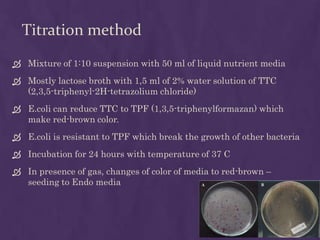
 Mixture of 1:10 suspension with 50 ml of liquid nutrient media
 Mostly lactose broth with 1,5 ml of 2% water solution of TTC
(2,3,5-triphenyl-2H-tetrazolium chloride)
 E.coli can reduce TTC to TPF (1,3,5-triphenylformazan) which
make red-brown color.
 E.coli is resistant to TPF which break the growth of other bacteria
 Incubation for 24 hours with temperature of 37 C
 In presence of gas, changes of color of media to red-brown –
seeding to Endo media
Titration method
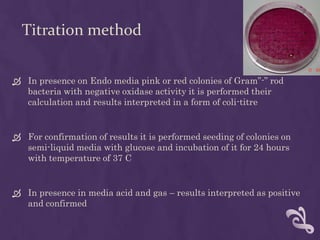
 In presence on Endo media pink or red colonies of Gram”-” rod
bacteria with negative oxidase activity it is performed their
calculation and results interpreted in a form of coli-titre
 For confirmation of results it is performed seeding of colonies on
semi-liquid media with glucose and incubation of it for 24 hours
with temperature of 37 C
 In presence in media acid and gas – results interpreted as positive
and confirmed
Titration method (other variant)
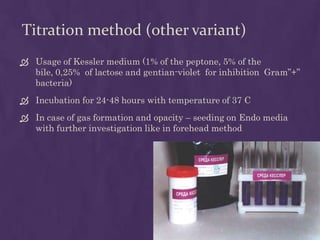
 Usage of Kessler medium (1% of the peptone, 5% of the
bile, 0,25% of lactose and gentian-violet for inhibition Gram”+”
bacteria)
 Incubation for 24-48 hours with temperature of 37 C
 In case of gas formation and opacity – seeding on Endo media
with further investigation like in forehead method
Membrane filter method
 Can reduce time of analysis by 2 days because of exclusion of stage
of cultivation on liquid medium
 For analysis of soil in small dilutions on membrane filter can be
placed plankton filter
 Calculation is performed on filters with 30-50 colonies
 After that performed calculations according to dilutions and number
of colonies
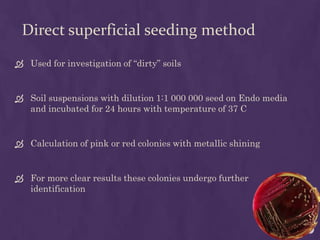
Direct superficial seeding method
 Used for investigation of “dirty” soils
 Soil suspensions with dilution 1:1 000 000 seed on Endo media
and incubated for 24 hours with temperature of 37 C
 Calculation of pink or red colonies with metallic shining
 For more clear results these colonies undergo further
identification
Detection of Clostridium perfringens
 Soil dilutions (1:100 000) are placed by 1 ml into 2 rows of test
tubes
 1 row is heated 15 min with 80 C or 10 min with 90 C
 In all test tubes put 10 ml of boiled and cooled to 45 C Wilson-
Blair medium (Bismuth Sulfite Agar)
 Typical Composition (g/liter):
Meat extract 5.0; peptone from meat 10.0; D(+)glucose 5.0; di-
sodium hydrogen phosphate 4.0; iron(III) sulfate 0.3; brilliant
green 0.025; bismuth sulfite indicator 8.0; agar-agar 15.0
 Spreading of suspension on medium and quick cooling in cold
water for removal of air
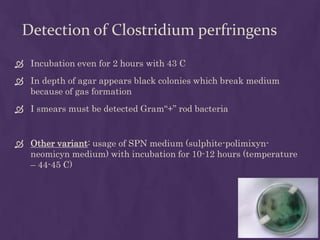
Detection of Clostridium perfringens
 Incubation even for 2 hours with 43 C
 In depth of agar appears black colonies which break medium
because of gas formation
 I smears must be detected Gram“+” rod bacteria
 Other variant: usage of SPN medium (sulphite-polimixyn-
neomicyn medium) with incubation for 10-12 hours (temperature
– 44-45 C)
Detection of Shigella and Salmonella
1. Coagulation and centrifugation by Ficker
 From 30-50 g of soil prepare dilution 1:10 in sterile water
 For concentration of bacteria to 500 ml of suspension add 2 ml of
10% solution of NaHCO3 and after that 1,7 ml of 10% solution of
Fe2SO4
 Mix suspension and leave it for 1 hour in temperature of 4 C
 Flakes of precipitation undergo centrifugation for 5 min and
titration with 25% tartaric potassium up to dilution of
sedimentation
Detection of Shigella and Salmonella
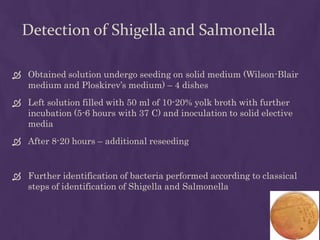
 Obtained solution undergo seeding on solid medium (Wilson-Blair
medium and Ploskirev’s medium) – 4 dishes
 Left solution filled with 50 ml of 10-20% yolk broth with further
incubation (5-6 hours with 37 C) and inoculation to solid elective
media
 After 8-20 hours – additional reseeding
 Further identification of bacteria performed according to classical
steps of identification of Shigella and Salmonella
Detection of Clostridium tetani
 Obtained 20-30 g of soil multiplies by sterile instruments, 3-5 g
of it mix with 10-15 ml of 0,9% solution of sodium chloride
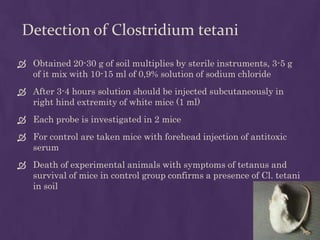
 After 3-4 hours solution should be injected subcutaneously in
right hind extremity of white mice (1 ml)
 Each probe is investigated in 2 mice
 For control are taken mice with forehead injection of antitoxic
serum
 Death of experimental animals with symptoms of tetanus and
survival of mice in control group confirms a presence of Cl. tetani
in soil
Detection of Clostridium botulinum
 20-30 g of multiplied soil place in 80-100 ml of Kitt-Tarozzi
medium
 1 flask heat with 80 C during 30 min for killing of non-spore-
forming bacteria
 Both flask incubate for 8-14 days (temperature – 37 C)
 Seed obtained material on sugar agar with further investigation
according biological and antigenic properties of Cl. botulinum
OBTAINING OF SAMPLES
 Samples from open water take from depth of 10-15 cm from
surface but not less then 10-15 cm from button
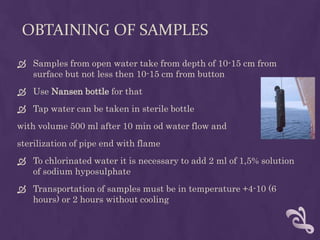
 Use Nansen bottle for that
 Tap water can be taken in sterile bottle
with volume 500 ml after 10 min od water flow and
sterilization of pipe end with flame
 To chlorinated water it is necessary to add 2 ml of 1,5% solution
of sodium hyposulphate
 Transportation of samples must be in temperature +4-10 (6
hours) or 2 hours without cooling
REASONS OF INVESTIGATION
 Sanitary control
 By epidemiological reason for detection
pathogenic intestinal bacteria
(Salmonella, Shigella etc.), Enteroviruses …
 Detection of new fecal pollutions
 Choice of water source
 Checking of quality and level of clearness of
sewage water
Microbial number
 Investigation of total number of mesophilic aerobic and
facultative anaerobic bacteria in 1 ml of water that can in 24
hours incubation in a temperature of 37 C cam form colonies on
MPA which can be visible with eyes or 2-5 times zoom
 Depending on clearness of water prepare dilutions from 1:10 for
clear water to 1:10 000 for very dirty sources
 For investigation of tap water use 1 ml without dilution
 Seed material on boiled and cooled to 45 C MPA or wort agar for
fungi
 Incubate MPA for 24 hours (temperature 37 C), wort agar – 2-3
days with temperature of 27 C
Microbial number
 Calculation performed with magnification on dishes with not
more then 300 colonies. If more – use other dilutions.
 Microbial number of tap water must be not more then 100 CFU
(colony forming units) in 1 ml
Detection of E. coli: two phase fermentative
test
 This method differs from given in book!!!
 Correspond to Governmental Standard 18963-73
 3x3 volumes of 10 ml, 1 ml and 0,1 ml – for 10 ml use flasks with
lactose-peptonic medium, other – test tubes with 5 ml of medium
 For tap water – 3x3 volumes of 100 ml, 10 ml and 1 ml – for 100 ml
use concentrated glucose-peptonic medium, for 10 ml and 1 ml –
diluted one
 Cultivation for 24 hours, T – 38 C
 In case of absence of gas formation and precipitation – result is
negative
Two phase fermentative test
 In case of presence of gas formation and precipitation – material
seed on sectors of Endo medium for isolation of colonies
 If on Endo medium there is a growth of dark-red colonies with
metallic shining – perform oxidase test
 In presence of Gram”-” rod bacteria without oxidase – test
recognized as positive and interpreted in coli-index (number of
E.coli in 1 l of water) according to a table
Detection of new fecal pollution
 From 3 volumes of lactose-peptonic medium where after
incubation was found gas formation with a loop seed bacteria to
lactose medium with boric acid
 Cultivation for 24 hours (T = 43 C)
 Presence of gas and opacity shows new fecal pollution
 Only opacity – result negative
Membrane filter method
 Filtration of water in volume 100, 10 and 1 ml for clear water and 0,1;
0,01 ml for dirty water. Investigation stert from bigger dilutions
 For seeding volumes 1 ml and less primary mix it with 10 ml of sterile
water
 After filtration filters are taken with sterile forceps and placed on Endo
medium (filtering surface on top): 1 dish – 3-4 membrane filters
 Incubation: 18-24 hours, T=37 C
 For calculation used filters with number of colonies from 10 to 50
 For calculation of coli-index number of colonies multiplied by 1000 and
divided to a volume of investigated water
 Method detect more bacteria then two phase fermentative test!!!
Detection of Enterococci (Streptococcus
faecalis etc.)
 Index of Enterococci is defined according to cultivation in liquid
alkaline polimixyn medium with 10-times dilutions depending on
clearness of water (from 100 to 0,01 ml)
 100 ml and 10 ml seed on double concentration of medium, rest –
ordinary concentration
 Incubation: 24 hours, T=37 C
 Positive result – change of color, opacity
 For control from positive flasks and test tubes bacteria seed on
dishes with milk-inhibitor medium. Streptococcus faecalis form
there black colonies with metallic shining
Detection of pathogenic bacteria
1. Salmonella
Primary seeding on accumulation media (magnesium, selenitic
medium). Further investigation goes according classical for
Salmonellas method
2. Shigella
Performed on tap water in cases of accidents with sewage system.
For accumulation media is used wort media (400 ml of water mix
with 100 ml of wort medium)
After incubation for 24 hours (T=37 C) material seed on Ploskirev’s or
Levin’s media with further classical identification
REASONS OF INVESTIGATION
 Definition of bacterial pollution of air with
microbes from nosopharynx of humans
 Direct investigation of presence of pathogenic and
conditionally pathogenic bacteria as causative
agents of nosocomial infections
 On factories: investigation of presence in air
microbes that are used for industrial reasons
Koch’s Method
(sedimentation method)
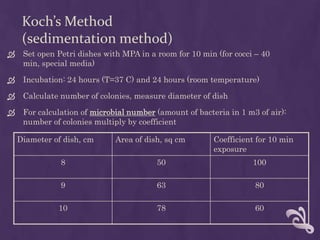
 Set open Petri dishes with MPA in a room for 10 min (for cocci – 40
min, special media)
 Incubation: 24 hours (T=37 C) and 24 hours (room temperature)
 Calculate number of colonies, measure diameter of dish
 For calculation of microbial number (amount of bacteria in 1 m3 of air):
number of colonies multiply by coefficient
Diameter of dish, cm Area of dish, sq cm Coefficient for 10 min
exposure
8 50 100
9 63 80
10 78 60
Krotov's method (aspiration method)
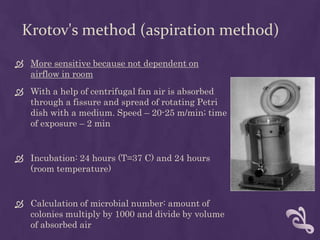
 More sensitive because not dependent on
airflow in room
 With a help of centrifugal fan air is absorbed
through a fissure and spread of rotating Petri
dish with a medium. Speed – 20-25 m/min; time
of exposure – 2 min
 Incubation: 24 hours (T=37 C) and 24 hours
(room temperature)
 Calculation of microbial number: amount of
colonies multiply by 1000 and divide by volume
of absorbed air
Krotov's method (aspiration method)
1. Detection of Staphylococci
250 dm3 of air absorb by Krotov’s apparatus on 203 dishes with milk-
yolk-salt agar and blood agar
Incubation: 37 C , 48 hours.
2. Detection of Streptococci
200-250 dm3 of air absorb by Krotov’s apparatus on 203 dishes with
Garro medium and blood agar
Incubation: 37 C , 18-24 hours, after that 48 hours in room
temperature
Microflora of soil, water and air

Microflora of soil, water and air

  • 1.
  • 3.
    Soil consists ofmineral particles, air, water, soil organic matter, plant roots and living soil organisms. In terms of mass and volume, the living organisms constitute by far the smallest part of the soil. Typically, 50% of a soil volume will be mineral particles, 25% air filled pores and 25% water filled pores, although this will vary. The soil organic matter constitutes 0.5-5% of the solid fraction by weight, except in peat soils where it is much higher.  Soil biota can be grouped according to size in micro-, meso- and macrobiota. are less than 0.2mm and consist of bacteria, actinomycetes, fungi, algae and protozoa. range from 0.2 to 10mm in size and consist of nematodes, enchytraeids, collembola or springtails, mites, rotifers and small insects (arthropods). are organisms larger than 10mm and consist of earthworms, mollusks and larger arthropods.
  • 4.
    REASONS OF INVESTIGATION Epidemiological investigation  Definition of transmission routes of diseases and resistance of their causative agents  Pollution of soil waters, rivers, lakes etc.  Definition of sanitary conditions of soil
  • 5.
    Investigation of soilmicrobiota  Investigation of microflora is difficult because of presence of many different species of microbes that can need totally different conditions for their isolation and identification: temperature, respiration, nutrition etc.  Because of that problem mostly are used indicating bacteria which show sanitary conditions of environment  Indicating bacteria for soil: E.coli, Streptococcus feacalis, Clostridium perfringens, bacteria of genus Proteus.  In addition can be checked special pathogenic bacteria especially for epidemiological reasons: Salmonellas, Shigellas, Clostridium botulinum and tetani etc.
  • 6.
    Obtaining of samples Take samples from area close to possible pollution and on some distance from it  Take samples from 5 points by “envelope” type  Samples must be close to 300 g to save moisture during transportation  Transportation must be not more then 24 hours in temperature +4- 5 C  In laboratory soil primary must be cleared from stones, roots, leaves etc.
  • 7.
    Obtaining of samples Should be performed in aseptic conditions with sterile instruments  Several probes of soil are multiplied in aseptic conditions and mixed with sterile water to make 10-1 dilution. (30g of soil with 270 ml of water)  Such suspension is used for preparation of other dilutions according to method of investigation and approximate bacterial population
  • 8.
    Microbial number  totalamount of microorganisms in 1 g of soil  “Clear” soils contain not more then 1-1,5 millions of bacteria in 1g  Results always must be correlated according to the type of soil (different types of soil naturally contains different amount of bacteria)  Also undergo seasonal changes
  • 9.
    Microbial number  Oftendilutions: 10-3 to 10-5  Not less then 2 dilutions must be used  Mix solutions before seeding  Each solution seed not less then 2 Petri dishes  1 ml of solution is taken, placed on a button of Petri dish  Add 7-10 ml of boiled and cooled to 45 C MPA  Mix MPA with suspension by soft rocking of Petri dish  Mark dilution, data about investigation on Petri dish
  • 10.
    Microbial number  Incubationfor 24 hours with temperature of 28-30 C  For facility of cultivation better to take dilutions in which on dishes are formed from 50 to 150 colonies  Protocols of calculation include such data: 1. Area of investigation 2. Amount of colonies obtained from several Petri dished according to dilutions 3. Average amount of colonies 4. Microbial number
  • 11.
    Microbial number (example) Nameof an area Amount of colonies in dilution 1:10 000 Microbial number 1. Yard of kindergarten 70 = 80 90 800 000
  • 12.
    Coli-titre and Coli-index Coli-titre – smallest amount of soil where present 1 E.coli  Coli-index – amount of E.coli in 1 g of soil  For calculation of coli-index into coli-titre: 1000 divide by coli-index
  • 13.
    Titration method  Mixtureof 1:10 suspension with 50 ml of liquid nutrient media  Mostly lactose broth with 1,5 ml of 2% water solution of TTC (2,3,5-triphenyl-2H-tetrazolium chloride)  E.coli can reduce TTC to TPF (1,3,5-triphenylformazan) which make red-brown color.  E.coli is resistant to TPF which break the growth of other bacteria  Incubation for 24 hours with temperature of 37 C  In presence of gas, changes of color of media to red-brown – seeding to Endo media
  • 14.
    Titration method  Inpresence on Endo media pink or red colonies of Gram”-” rod bacteria with negative oxidase activity it is performed their calculation and results interpreted in a form of coli-titre  For confirmation of results it is performed seeding of colonies on semi-liquid media with glucose and incubation of it for 24 hours with temperature of 37 C  In presence in media acid and gas – results interpreted as positive and confirmed
  • 15.
    Titration method (othervariant)  Usage of Kessler medium (1% of the peptone, 5% of the bile, 0,25% of lactose and gentian-violet for inhibition Gram”+” bacteria)  Incubation for 24-48 hours with temperature of 37 C  In case of gas formation and opacity – seeding on Endo media with further investigation like in forehead method
  • 16.
    Membrane filter method Can reduce time of analysis by 2 days because of exclusion of stage of cultivation on liquid medium  For analysis of soil in small dilutions on membrane filter can be placed plankton filter  Calculation is performed on filters with 30-50 colonies  After that performed calculations according to dilutions and number of colonies
  • 17.
    Direct superficial seedingmethod  Used for investigation of “dirty” soils  Soil suspensions with dilution 1:1 000 000 seed on Endo media and incubated for 24 hours with temperature of 37 C  Calculation of pink or red colonies with metallic shining  For more clear results these colonies undergo further identification
  • 18.
    Detection of Clostridiumperfringens  Soil dilutions (1:100 000) are placed by 1 ml into 2 rows of test tubes  1 row is heated 15 min with 80 C or 10 min with 90 C  In all test tubes put 10 ml of boiled and cooled to 45 C Wilson- Blair medium (Bismuth Sulfite Agar)  Typical Composition (g/liter): Meat extract 5.0; peptone from meat 10.0; D(+)glucose 5.0; di- sodium hydrogen phosphate 4.0; iron(III) sulfate 0.3; brilliant green 0.025; bismuth sulfite indicator 8.0; agar-agar 15.0  Spreading of suspension on medium and quick cooling in cold water for removal of air
  • 19.
    Detection of Clostridiumperfringens  Incubation even for 2 hours with 43 C  In depth of agar appears black colonies which break medium because of gas formation  I smears must be detected Gram“+” rod bacteria  Other variant: usage of SPN medium (sulphite-polimixyn- neomicyn medium) with incubation for 10-12 hours (temperature – 44-45 C)
  • 20.
    Detection of Shigellaand Salmonella 1. Coagulation and centrifugation by Ficker  From 30-50 g of soil prepare dilution 1:10 in sterile water  For concentration of bacteria to 500 ml of suspension add 2 ml of 10% solution of NaHCO3 and after that 1,7 ml of 10% solution of Fe2SO4  Mix suspension and leave it for 1 hour in temperature of 4 C  Flakes of precipitation undergo centrifugation for 5 min and titration with 25% tartaric potassium up to dilution of sedimentation
  • 21.
    Detection of Shigellaand Salmonella  Obtained solution undergo seeding on solid medium (Wilson-Blair medium and Ploskirev’s medium) – 4 dishes  Left solution filled with 50 ml of 10-20% yolk broth with further incubation (5-6 hours with 37 C) and inoculation to solid elective media  After 8-20 hours – additional reseeding  Further identification of bacteria performed according to classical steps of identification of Shigella and Salmonella
  • 22.
    Detection of Clostridiumtetani  Obtained 20-30 g of soil multiplies by sterile instruments, 3-5 g of it mix with 10-15 ml of 0,9% solution of sodium chloride  After 3-4 hours solution should be injected subcutaneously in right hind extremity of white mice (1 ml)  Each probe is investigated in 2 mice  For control are taken mice with forehead injection of antitoxic serum  Death of experimental animals with symptoms of tetanus and survival of mice in control group confirms a presence of Cl. tetani in soil
  • 23.
    Detection of Clostridiumbotulinum  20-30 g of multiplied soil place in 80-100 ml of Kitt-Tarozzi medium  1 flask heat with 80 C during 30 min for killing of non-spore- forming bacteria  Both flask incubate for 8-14 days (temperature – 37 C)  Seed obtained material on sugar agar with further investigation according biological and antigenic properties of Cl. botulinum
  • 25.
    OBTAINING OF SAMPLES Samples from open water take from depth of 10-15 cm from surface but not less then 10-15 cm from button  Use Nansen bottle for that  Tap water can be taken in sterile bottle with volume 500 ml after 10 min od water flow and sterilization of pipe end with flame  To chlorinated water it is necessary to add 2 ml of 1,5% solution of sodium hyposulphate  Transportation of samples must be in temperature +4-10 (6 hours) or 2 hours without cooling
  • 26.
    REASONS OF INVESTIGATION Sanitary control  By epidemiological reason for detection pathogenic intestinal bacteria (Salmonella, Shigella etc.), Enteroviruses …  Detection of new fecal pollutions  Choice of water source  Checking of quality and level of clearness of sewage water
  • 27.
    Microbial number  Investigationof total number of mesophilic aerobic and facultative anaerobic bacteria in 1 ml of water that can in 24 hours incubation in a temperature of 37 C cam form colonies on MPA which can be visible with eyes or 2-5 times zoom  Depending on clearness of water prepare dilutions from 1:10 for clear water to 1:10 000 for very dirty sources  For investigation of tap water use 1 ml without dilution  Seed material on boiled and cooled to 45 C MPA or wort agar for fungi  Incubate MPA for 24 hours (temperature 37 C), wort agar – 2-3 days with temperature of 27 C
  • 28.
    Microbial number  Calculationperformed with magnification on dishes with not more then 300 colonies. If more – use other dilutions.  Microbial number of tap water must be not more then 100 CFU (colony forming units) in 1 ml
  • 29.
    Detection of E.coli: two phase fermentative test  This method differs from given in book!!!  Correspond to Governmental Standard 18963-73  3x3 volumes of 10 ml, 1 ml and 0,1 ml – for 10 ml use flasks with lactose-peptonic medium, other – test tubes with 5 ml of medium  For tap water – 3x3 volumes of 100 ml, 10 ml and 1 ml – for 100 ml use concentrated glucose-peptonic medium, for 10 ml and 1 ml – diluted one  Cultivation for 24 hours, T – 38 C  In case of absence of gas formation and precipitation – result is negative
  • 30.
    Two phase fermentativetest  In case of presence of gas formation and precipitation – material seed on sectors of Endo medium for isolation of colonies  If on Endo medium there is a growth of dark-red colonies with metallic shining – perform oxidase test  In presence of Gram”-” rod bacteria without oxidase – test recognized as positive and interpreted in coli-index (number of E.coli in 1 l of water) according to a table
  • 31.
    Detection of newfecal pollution  From 3 volumes of lactose-peptonic medium where after incubation was found gas formation with a loop seed bacteria to lactose medium with boric acid  Cultivation for 24 hours (T = 43 C)  Presence of gas and opacity shows new fecal pollution  Only opacity – result negative
  • 32.
    Membrane filter method Filtration of water in volume 100, 10 and 1 ml for clear water and 0,1; 0,01 ml for dirty water. Investigation stert from bigger dilutions  For seeding volumes 1 ml and less primary mix it with 10 ml of sterile water  After filtration filters are taken with sterile forceps and placed on Endo medium (filtering surface on top): 1 dish – 3-4 membrane filters  Incubation: 18-24 hours, T=37 C  For calculation used filters with number of colonies from 10 to 50  For calculation of coli-index number of colonies multiplied by 1000 and divided to a volume of investigated water  Method detect more bacteria then two phase fermentative test!!!
  • 33.
    Detection of Enterococci(Streptococcus faecalis etc.)  Index of Enterococci is defined according to cultivation in liquid alkaline polimixyn medium with 10-times dilutions depending on clearness of water (from 100 to 0,01 ml)  100 ml and 10 ml seed on double concentration of medium, rest – ordinary concentration  Incubation: 24 hours, T=37 C  Positive result – change of color, opacity  For control from positive flasks and test tubes bacteria seed on dishes with milk-inhibitor medium. Streptococcus faecalis form there black colonies with metallic shining
  • 34.
    Detection of pathogenicbacteria 1. Salmonella Primary seeding on accumulation media (magnesium, selenitic medium). Further investigation goes according classical for Salmonellas method 2. Shigella Performed on tap water in cases of accidents with sewage system. For accumulation media is used wort media (400 ml of water mix with 100 ml of wort medium) After incubation for 24 hours (T=37 C) material seed on Ploskirev’s or Levin’s media with further classical identification
  • 36.
    REASONS OF INVESTIGATION Definition of bacterial pollution of air with microbes from nosopharynx of humans  Direct investigation of presence of pathogenic and conditionally pathogenic bacteria as causative agents of nosocomial infections  On factories: investigation of presence in air microbes that are used for industrial reasons
  • 37.
    Koch’s Method (sedimentation method) Set open Petri dishes with MPA in a room for 10 min (for cocci – 40 min, special media)  Incubation: 24 hours (T=37 C) and 24 hours (room temperature)  Calculate number of colonies, measure diameter of dish  For calculation of microbial number (amount of bacteria in 1 m3 of air): number of colonies multiply by coefficient Diameter of dish, cm Area of dish, sq cm Coefficient for 10 min exposure 8 50 100 9 63 80 10 78 60
  • 38.
    Krotov's method (aspirationmethod)  More sensitive because not dependent on airflow in room  With a help of centrifugal fan air is absorbed through a fissure and spread of rotating Petri dish with a medium. Speed – 20-25 m/min; time of exposure – 2 min  Incubation: 24 hours (T=37 C) and 24 hours (room temperature)  Calculation of microbial number: amount of colonies multiply by 1000 and divide by volume of absorbed air
  • 39.
    Krotov's method (aspirationmethod) 1. Detection of Staphylococci 250 dm3 of air absorb by Krotov’s apparatus on 203 dishes with milk- yolk-salt agar and blood agar Incubation: 37 C , 48 hours. 2. Detection of Streptococci 200-250 dm3 of air absorb by Krotov’s apparatus on 203 dishes with Garro medium and blood agar Incubation: 37 C , 18-24 hours, after that 48 hours in room temperature