Dr C R Meera
Assistant Professor & HOD
Department of Microbiology
St. Mary’s College, Thrissur-20,
Kerala, India
Atmospheric Layers
&
Microorganisms in Air
Atmospheric Layers and Microorganisms in Air; Dr C R Meera, St.Mary’s College,
Composition of air
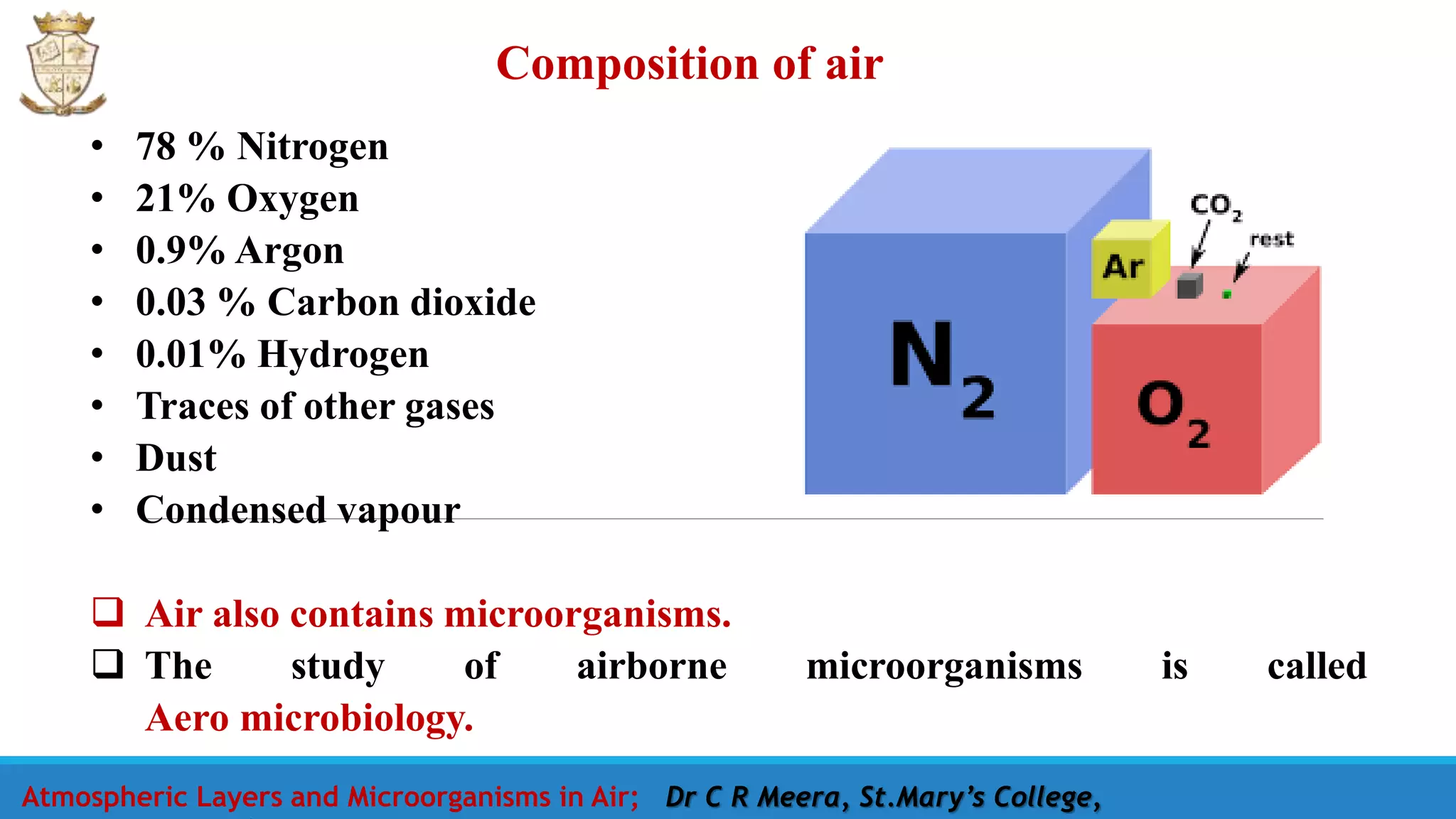
• 78 % Nitrogen
• 21% Oxygen
• 0.9% Argon
• 0.03 % Carbon dioxide
• 0.01% Hydrogen
• Traces of other gases
• Dust
• Condensed vapour
 Air also contains microorganisms.
 The study of airborne microorganisms is called
Aero microbiology.
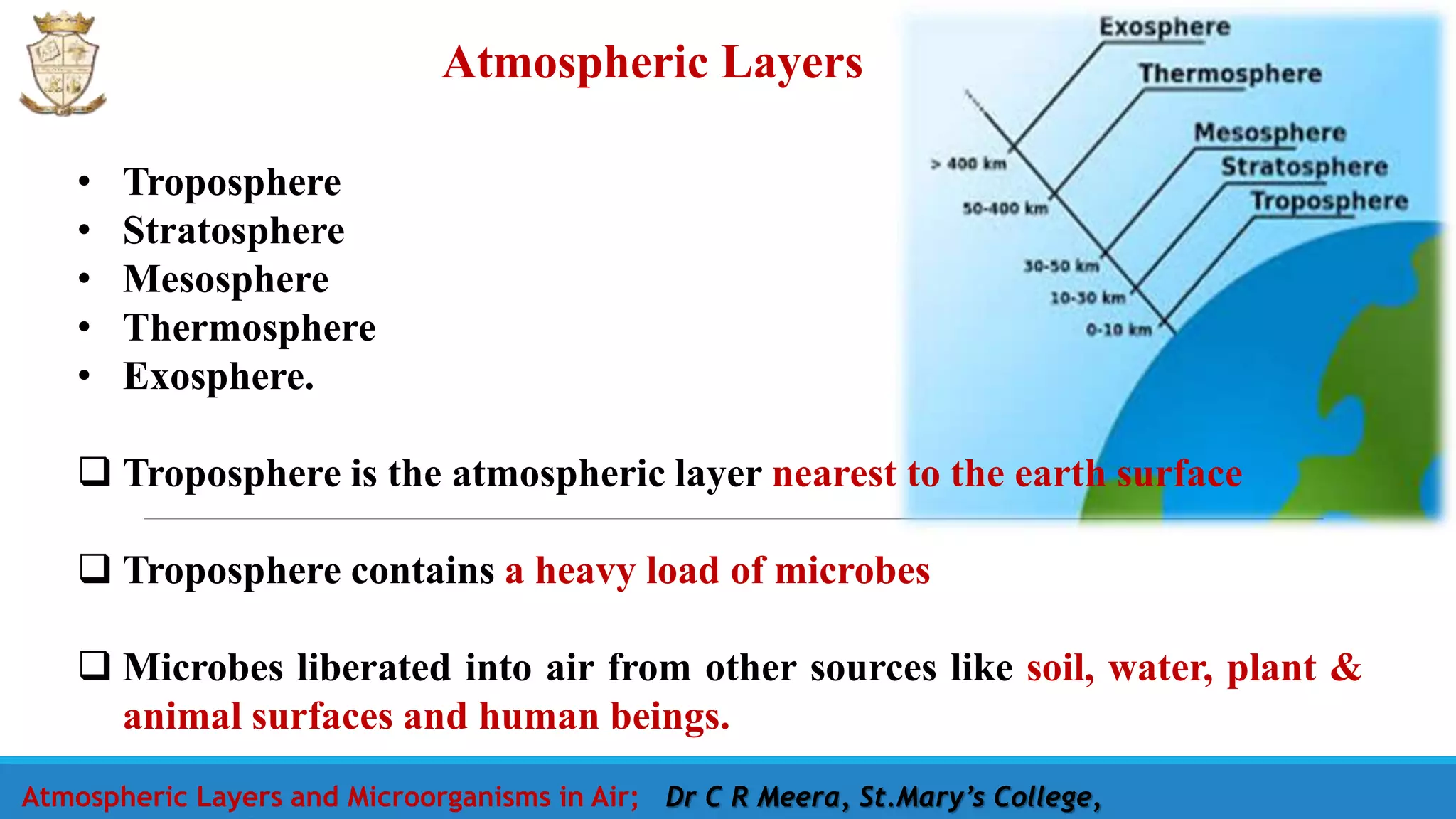
Atmospheric Layers
• Troposphere
• Stratosphere
• Mesosphere
• Thermosphere
• Exosphere.
 Troposphere is the atmospheric layer nearest to the earth surface
 Troposphere contains a heavy load of microbes
 Microbes liberated into air from other sources like soil, water, plant &
animal surfaces and human beings.
Atmospheric Layers and Microorganisms in Air; Dr C R Meera, St.Mary’s College,
Factors affecting distribution of microbes in Troposphere
 Decrease in temperature with increase in height
• Top layers of the troposphere - 43 to - 83 degree Celsius
 Reduction in atmospheric pressure
 Reduction in concentration of oxygen
 Decreased water availability
 High intensity of light radiation and UV radiation
• Cause lethal mutation and death of microorganisms.
 Low concentration of organic carbon which will affect the growth of heterotrophs.
 High altitude limit even the existence of autotrophs.
Atmospheric Layers and Microorganisms in Air; Dr C R Meera, St.Mary’s College,
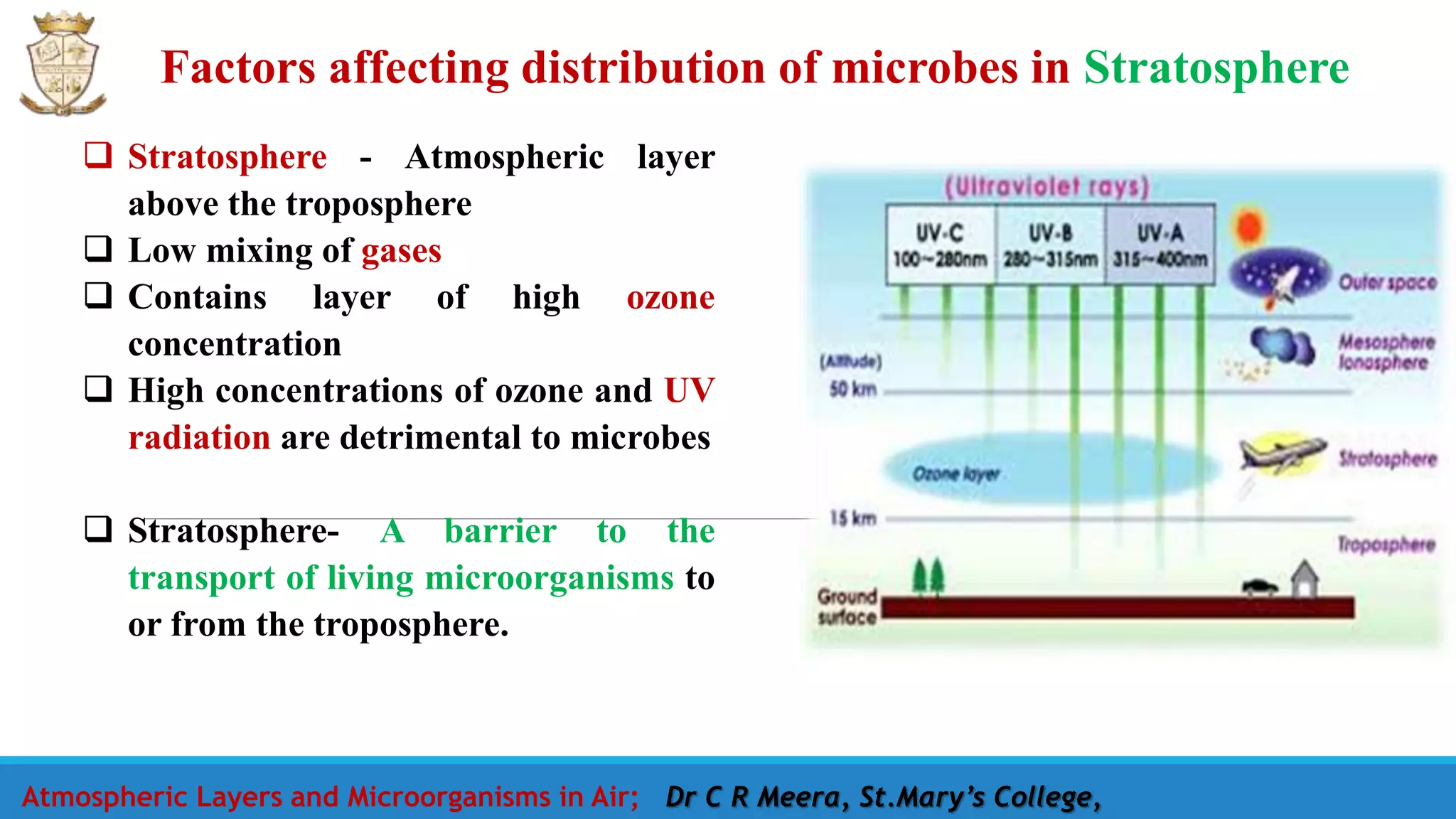
Factors affecting distribution of microbes in Stratosphere
 Stratosphere - Atmospheric layer
above the troposphere
 Low mixing of gases
 Contains layer of high ozone
concentration
 High concentrations of ozone and UV
radiation are detrimental to microbes
 Stratosphere- A barrier to the
transport of living microorganisms to
or from the troposphere.
Atmospheric Layers and Microorganisms in Air; Dr C R Meera, St.Mary’s College,
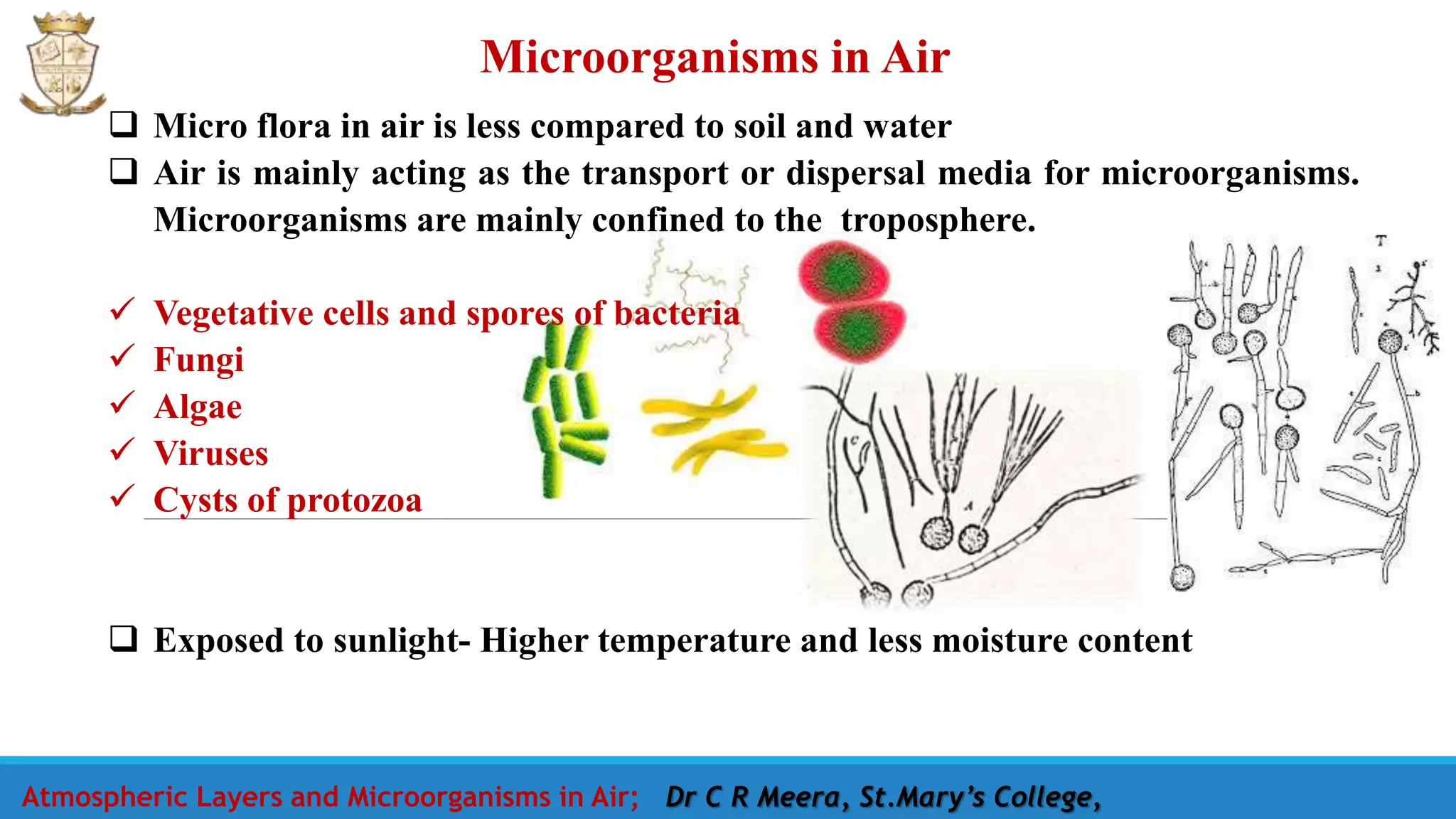
 Micro flora in air is less compared to soil and water
 Air is mainly acting as the transport or dispersal media for microorganisms.
Microorganisms are mainly confined to the troposphere.
 Vegetative cells and spores of bacteria
 Fungi
 Algae
 Viruses
 Cysts of protozoa
 Exposed to sunlight- Higher temperature and less moisture content
Microorganisms in Air
Atmospheric Layers and Microorganisms in Air; Dr C R Meera, St.Mary’s College,
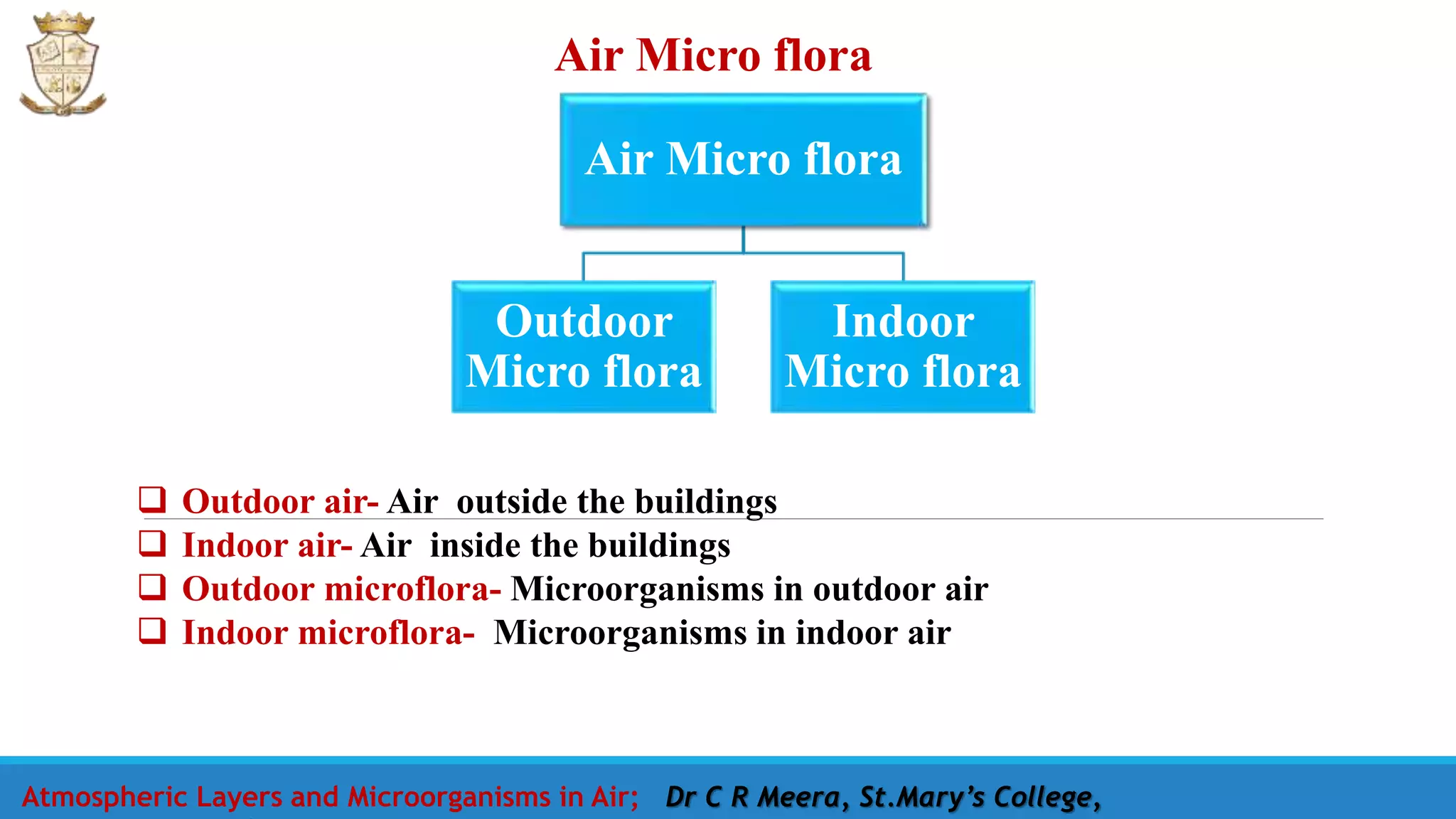
 Outdoor air- Air outside the buildings
 Indoor air- Air inside the buildings
 Outdoor microflora- Microorganisms in outdoor air
 Indoor microflora- Microorganisms in indoor air
Air Micro flora
Air Micro flora
Outdoor
Micro flora
Indoor
Micro flora
Atmospheric Layers and Microorganisms in Air; Dr C R Meera, St.Mary’s College,
Outdoor Micro flora
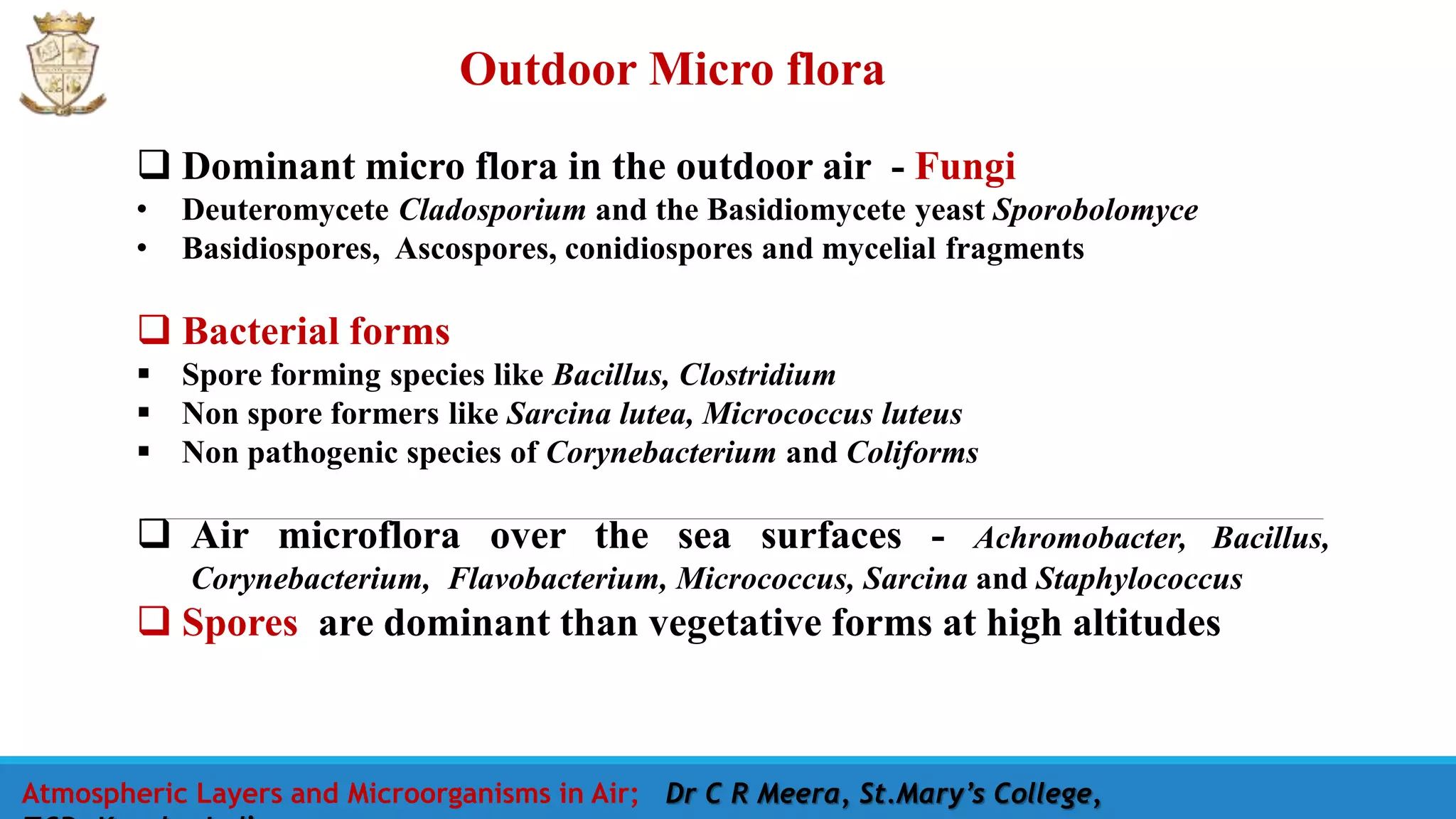
 Dominant micro flora in the outdoor air - Fungi
• Deuteromycete Cladosporium and the Basidiomycete yeast Sporobolomyce
• Basidiospores, Ascospores, conidiospores and mycelial fragments
 Bacterial forms
 Spore forming species like Bacillus, Clostridium
 Non spore formers like Sarcina lutea, Micrococcus luteus
 Non pathogenic species of Corynebacterium and Coliforms
 Air microflora over the sea surfaces - Achromobacter, Bacillus,
Corynebacterium, Flavobacterium, Micrococcus, Sarcina and Staphylococcus
 Spores are dominant than vegetative forms at high altitudes
Atmospheric Layers and Microorganisms in Air; Dr C R Meera, St.Mary’s College,
Factors Affecting Outdoor Micro flora
 As altitude increases- low temperature, UV radiation and desiccation
 Human population densities
• More microbes are found in crowded areas
• Microbes more in air over terrestrial surfaces then over the sea
 Variations in the spore densities in outdoor air occur on an annual and
daily basis
 Diurnal fluctuation in spore liberation also affects outdoor microflora
 Eg: Colorless basidiospores- liberated usually during night
 Sporangia of Phytophthora - liberated in the morning
 Spores of Erysiphe - liberated in midday
Atmospheric Layers and Microorganisms in Air; Dr C R Meera, St.Mary’s College,
Indoor Microflora &
Factors Affecting Indoor Micro flora
Atmospheric Layers and Microorganisms in Air; Dr C R Meera, St.Mary’s College,
 Affected by air circulation through doors, windows and by
turbulence caused by moving people
 Dominant micro flora in the Indoor air- Fungi
 Penicillium and Aspergillus
 Bacteria in indoor air - ventilation and the number of occupants in
the room
 Common bacterial forms
 Bacillus, Staphylococci and Clostridium perfringens
 Indoor bacteria is mainly from human skin and respiratory tracts
 Pathogenic bacteria or viruses - from infected occupants
Atmospheric Layers and Microorganisms in Air; Dr C R Meera, St.Mary’s College,

Atmospheric layers & microbes in air

  • 1.
    Dr C RMeera Assistant Professor & HOD Department of Microbiology St. Mary’s College, Thrissur-20, Kerala, India Atmospheric Layers & Microorganisms in Air
  • 2.
    Atmospheric Layers andMicroorganisms in Air; Dr C R Meera, St.Mary’s College, Composition of air • 78 % Nitrogen • 21% Oxygen • 0.9% Argon • 0.03 % Carbon dioxide • 0.01% Hydrogen • Traces of other gases • Dust • Condensed vapour  Air also contains microorganisms.  The study of airborne microorganisms is called Aero microbiology.
  • 3.
    Atmospheric Layers • Troposphere •Stratosphere • Mesosphere • Thermosphere • Exosphere.  Troposphere is the atmospheric layer nearest to the earth surface  Troposphere contains a heavy load of microbes  Microbes liberated into air from other sources like soil, water, plant & animal surfaces and human beings. Atmospheric Layers and Microorganisms in Air; Dr C R Meera, St.Mary’s College,
  • 4.
    Factors affecting distributionof microbes in Troposphere  Decrease in temperature with increase in height • Top layers of the troposphere - 43 to - 83 degree Celsius  Reduction in atmospheric pressure  Reduction in concentration of oxygen  Decreased water availability  High intensity of light radiation and UV radiation • Cause lethal mutation and death of microorganisms.  Low concentration of organic carbon which will affect the growth of heterotrophs.  High altitude limit even the existence of autotrophs. Atmospheric Layers and Microorganisms in Air; Dr C R Meera, St.Mary’s College,
  • 5.
    Factors affecting distributionof microbes in Stratosphere  Stratosphere - Atmospheric layer above the troposphere  Low mixing of gases  Contains layer of high ozone concentration  High concentrations of ozone and UV radiation are detrimental to microbes  Stratosphere- A barrier to the transport of living microorganisms to or from the troposphere. Atmospheric Layers and Microorganisms in Air; Dr C R Meera, St.Mary’s College,
  • 6.
     Micro florain air is less compared to soil and water  Air is mainly acting as the transport or dispersal media for microorganisms. Microorganisms are mainly confined to the troposphere.  Vegetative cells and spores of bacteria  Fungi  Algae  Viruses  Cysts of protozoa  Exposed to sunlight- Higher temperature and less moisture content Microorganisms in Air Atmospheric Layers and Microorganisms in Air; Dr C R Meera, St.Mary’s College,
  • 7.
     Outdoor air-Air outside the buildings  Indoor air- Air inside the buildings  Outdoor microflora- Microorganisms in outdoor air  Indoor microflora- Microorganisms in indoor air Air Micro flora Air Micro flora Outdoor Micro flora Indoor Micro flora Atmospheric Layers and Microorganisms in Air; Dr C R Meera, St.Mary’s College,
  • 8.
    Outdoor Micro flora Dominant micro flora in the outdoor air - Fungi • Deuteromycete Cladosporium and the Basidiomycete yeast Sporobolomyce • Basidiospores, Ascospores, conidiospores and mycelial fragments  Bacterial forms  Spore forming species like Bacillus, Clostridium  Non spore formers like Sarcina lutea, Micrococcus luteus  Non pathogenic species of Corynebacterium and Coliforms  Air microflora over the sea surfaces - Achromobacter, Bacillus, Corynebacterium, Flavobacterium, Micrococcus, Sarcina and Staphylococcus  Spores are dominant than vegetative forms at high altitudes Atmospheric Layers and Microorganisms in Air; Dr C R Meera, St.Mary’s College,
  • 9.
    Factors Affecting OutdoorMicro flora  As altitude increases- low temperature, UV radiation and desiccation  Human population densities • More microbes are found in crowded areas • Microbes more in air over terrestrial surfaces then over the sea  Variations in the spore densities in outdoor air occur on an annual and daily basis  Diurnal fluctuation in spore liberation also affects outdoor microflora  Eg: Colorless basidiospores- liberated usually during night  Sporangia of Phytophthora - liberated in the morning  Spores of Erysiphe - liberated in midday Atmospheric Layers and Microorganisms in Air; Dr C R Meera, St.Mary’s College,
  • 10.
    Indoor Microflora & FactorsAffecting Indoor Micro flora Atmospheric Layers and Microorganisms in Air; Dr C R Meera, St.Mary’s College,  Affected by air circulation through doors, windows and by turbulence caused by moving people  Dominant micro flora in the Indoor air- Fungi  Penicillium and Aspergillus  Bacteria in indoor air - ventilation and the number of occupants in the room  Common bacterial forms  Bacillus, Staphylococci and Clostridium perfringens  Indoor bacteria is mainly from human skin and respiratory tracts  Pathogenic bacteria or viruses - from infected occupants
  • 11.
    Atmospheric Layers andMicroorganisms in Air; Dr C R Meera, St.Mary’s College,