URBAN LANDSCAPE
Presented by :
Saad Farooqi, C# 01
Abdur Rahman, C# 02
BS 6th
semester,
Department Of Environmental & Conservation
Sciences
University Of Swat
1
05/22/15
URBAN
 Urban is derived from Latin word “Urbis” which means city.
 Anything related to city.
 It can formed from natural population growth and migration.
2
Landscape
 All the visible features of an area of land,
 Landscape is the way in which humanity has changed the physical appearance of the
environment - both present and past.
 It was first recognized in the 20th century.
 Approaches from other disciplines including archaeology,
 architecture,
 ecology,
 aerial photography,
 local history and historical geography.
3
Types of Landscape
4
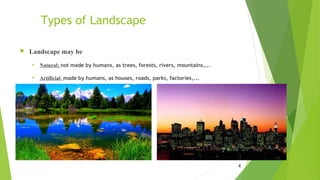
 Landscape may be
 Natural: not made by humans, as trees, forests, rivers, mountains,...
 Artificial: made by humans, as houses, roads, parks, factories,...
URBAN LANDSCAPE
5
 Urban landscape is the way which changed the physical appearance of the urban
environment.
 An integral part of modern urban construction.
 Urban landscape include urban parks, gardens, small public gardens, national and
people’s parks.
   They help to create a favorable and healthful environment.
Cont..
6
FEATURES
 Urban landscapes focus on preserving natural resources.
 This is especially important in this time of global change.
 Urban landscapes must be designed to meet the needs of today and the growth of
tomorrow.
 Urban landscape features include the preservation, restoration and the creation of:
 Parks
 Nature centers
 Recreational areas
7
Cont..
 Urban landscapes are also concerned with maintaining and increasing watershed health
and viability,
 Sustaining forested and agricultural lands and promoting safer drinking water.
 By incorporating nature into urban areas, we not only beautify our surroundings, but
also benefit wildlife and provide a healthier atmosphere for generations to come.
8
THEORY
 “Landscape Urbanism” is a theory of urban land scape.
 The phrase 'Landscape Urbanism' first appeared in the mid 1990s.
 The best way to organize cities is through the design of the city's landscape.
 From the late 1990s, the phrase 'landscape urbanism' was used by landscape
architects in the United States.
 The first major event to do with 'landscape urbanism' was the Landscape Urbanism
conference held in Chicago in April 1997.
9
Examples
 Columbus Circle:
 Columbus Circle, named after Christopher Columbus.
10
Cont..
 Zero-Energy housing complex
 Mette Kirk is a landscape designer and architect. This innovative design focuses on
creating sustainable and energy saving space.
11
12

Urban Landscape

  • 1.
    URBAN LANDSCAPE Presented by: Saad Farooqi, C# 01 Abdur Rahman, C# 02 BS 6th semester, Department Of Environmental & Conservation Sciences University Of Swat 1 05/22/15
  • 2.
    URBAN  Urban isderived from Latin word “Urbis” which means city.  Anything related to city.  It can formed from natural population growth and migration. 2
  • 3.
    Landscape  All thevisible features of an area of land,  Landscape is the way in which humanity has changed the physical appearance of the environment - both present and past.  It was first recognized in the 20th century.  Approaches from other disciplines including archaeology,  architecture,  ecology,  aerial photography,  local history and historical geography. 3
  • 4.
    Types of Landscape 4 Landscape may be  Natural: not made by humans, as trees, forests, rivers, mountains,...  Artificial: made by humans, as houses, roads, parks, factories,...
  • 5.
    URBAN LANDSCAPE 5  Urbanlandscape is the way which changed the physical appearance of the urban environment.  An integral part of modern urban construction.  Urban landscape include urban parks, gardens, small public gardens, national and people’s parks.    They help to create a favorable and healthful environment.
  • 6.
  • 7.
    FEATURES  Urban landscapesfocus on preserving natural resources.  This is especially important in this time of global change.  Urban landscapes must be designed to meet the needs of today and the growth of tomorrow.  Urban landscape features include the preservation, restoration and the creation of:  Parks  Nature centers  Recreational areas 7
  • 8.
    Cont..  Urban landscapesare also concerned with maintaining and increasing watershed health and viability,  Sustaining forested and agricultural lands and promoting safer drinking water.  By incorporating nature into urban areas, we not only beautify our surroundings, but also benefit wildlife and provide a healthier atmosphere for generations to come. 8
  • 9.
    THEORY  “Landscape Urbanism”is a theory of urban land scape.  The phrase 'Landscape Urbanism' first appeared in the mid 1990s.  The best way to organize cities is through the design of the city's landscape.  From the late 1990s, the phrase 'landscape urbanism' was used by landscape architects in the United States.  The first major event to do with 'landscape urbanism' was the Landscape Urbanism conference held in Chicago in April 1997. 9
  • 10.
    Examples  Columbus Circle: Columbus Circle, named after Christopher Columbus. 10
  • 11.
    Cont..  Zero-Energy housingcomplex  Mette Kirk is a landscape designer and architect. This innovative design focuses on creating sustainable and energy saving space. 11
  • 12.