Bacterial Infections
GRAM-POSITIVE BACTERIAL INFECTIONS :
Staphylococcal Infections:
 Staphylococcus aureus : are pyogenic, nonmotile,
  Gram-positive cocci that form grapelike clusters.
   cause skin lesions (boils, carbuncles, impetigo, and
   scalded skin) and also cause osteomyelitis, pneumonia,
   endocarditis, food poisoning, and toxic shock syndrome .
 Staphylococcus epidermidis : causes opportunistic
  infections in catheterized patients, patients with
  prosthetic cardiac valves, and drug addicts.
 Staphylococcus saprophyticus : causes urinary tract
  infections in young women.
Pathogenesis:
S. aureus and other virulent staphylococci possess
a multitude of virulence factors, which include:
 surface proteins involved in adherence.
secreted enzymes that degrade proteins.
 secreted toxins that damage host cells.
Morphology:
Whether the lesion is located in
skin, lungs, bones, or heart valves, S. aureus causes
pyogenic inflammation that is distinctive for its local
destructiveness.
Streptococcal Infections:
 Streptococci are facultative or obligate anaerobic Gram
 positive cocci that grow in pairs or chains :
 β-hemolytic streptococci : are typed according to their
  surface carbohydrate (Lancefield) antigens.
• Streptococcus pyogenes (group A) : causes pharyngitis,
  scarlet fever, erysipelas, impetigo, rheumatic fever,
  toxic shock syndrome, and glomerulonephritis.
• Streptococcus agalactiae (group B) : colonizes female
  genital tract and causes sepsis and meningitis in
  neonates and chorioamnionitis in pregnancy.
 α-hemolytic streptococcus :
• Streptococcus pneumoniae : cause community-acquired
  pneumonia and meningitis in adults.
• Streptococcus viridans : normal oral flora but also cause
  endocarditis.
• Streptococcus mutans : cause dental caries.
Pathogenesis:
 different species of streptococci produce many
  virulence factors and toxins.
 Many streptococci, including S. pyogenes and
  S. pneumoniae have capsules that resist phagocytosis.
 S. pyogenes also expresses M protein, a surface protein
  that prevents bacteria from being phagocytosed.
 Poststreptococcal acute rheumatic fever is autoimmune
  disease caused by anti streptococcal M protein
  antibodies that cross-react with cardiac myosin.
Morphology:
  Streptococcal infections are characterized by
   diffuse interstitial neutrophilic infiltrates with
   minimal destruction of host tissues.
Diphtheria:
 Diphtheria is caused by a slender Gram-positive rod with
  clubbed ends, Corynebacterium diphtheriae, which is
  passed from person to person through aerosols or
  skin shedding.
 C. diphtheriae causes a range of illnesses:
  asymptomatic carriage ; skin lesions in neglected
  wounds; and a life-threatening syndrome that includes
  formation of a tough pharyngeal pseudomembrane ;
  and toxin-mediated damage to heart, nerves, and other
  organs.
 C. diphtheriae has only one toxin which blocks host cell
  protein synthesis.
Morphology:
 Inhaled C. diphtheriae proliferate at site of
  attachment on mucosa of nasopharynx, oropharynx,
  larynx, or trachea.
 Release of exotoxin causes necrosis of epithelium,
  accompanied by an outpouring of a dense
  fibrino suppurative exudate.
 The coagulation of this exudate on ulcerated
  necrotic surface creates a tough, dirty gray to black,
  superficial pseudomembrane.
 Neutrophilic infiltration in underlying tissues is
  intense and is accompanied by marked vascular
  congestion, interstitial edema, and fibrin exudation.
Anthrax :
 Bacillus anthracis is a large, spore-forming Gram-positive
  rod-shaped bacterium.
 acquired through exposure to animals or animal
  products.
 three major anthrax syndromes: cutaneous, inhalational,
  and gastrointestinal.
 Cutaneous anthrax:
• painless, pruritic papule that develops into a vesicle
  within 2 days, and regional lymphadenopathy.
• After vesicle ruptures, the remaining ulcer becomes
  covered with a characteristic black scar.
• Bacteremia is rare with cutaneous anthrax.
 Inhalational anthrax:
• occurs when spores are inhaled, causes hemorrhagic
  mediastinitis.
• Frequently, anthrax meningitis develops due to
  bacteremia.
• Inhalational anthrax rapidly leads to shock and
  frequently death within 1 to 2 days.
 Gastrointestinal anthrax:
• Uncommon, caused by eating undercooked meat
  contaminated with B. anthracis.
• Initially nausea, abdominal pain, and vomiting.
• Severe bloody diarrhea rapidly develops, and
  mortality is over 50%.
Pathogenesis:
 B. anthracis produces potent toxins and
 a polyglutamyl capsule that is antiphagocytic.
Morphology:
 Anthrax lesions at any site are typified by
  necrosis and exudative inflammation with
  infiltration of neutrophils and macrophages.
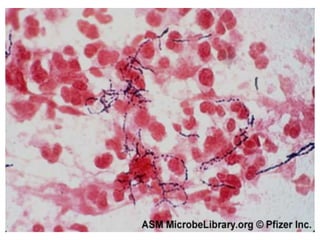
 The presence of large, boxcar-shaped
  Gram-positive extracellular bacteria in chains,
  seen histopathologically or recovered in culture,
  should suggest the diagnosis.
Nocardia:
 aerobic Gram-positive bacteria that grow in distinctive
  branched chains.
 In culture, Nocardia form aerial structures with terminal
  spores, resembling hyphae.
 Nocardia are found in soil and cause opportunistic
  infections in immunocompromised people.
 Nocardia asteroides : causes respiratory infections.
 Nocardia brasiliensis : infect skin.
 A fifth of N. asteroides infections involve CNS,
  presumably after dissemination from lungs.
Morphology:
 The diagnosis of nocardiosis depends on
  identification of slender Gram-positive organisms
  arranged in branching filaments .
 Nocardia stain with modified acid fast stains
  (Fite-Faraco stain).
 At any site of infection, Nocardia elicit
  a suppurative response with central liquefaction
  and surrounding granulation and fibrosis.
 Granulomas do not form.
GRAM-NEGATIVE BACTERIAL INFECTIONS:
Neisserial Infections :
 Neisseria are Gram-negative diplococci that are
  flattened on adjoining sides, giving the pair the shape
  of a coffee bean.
 These aerobic bacteria grow best on enriched media
  such as lysed sheep's blood agar ("chocolate" agar).
 The two clinically significant Neisseria are : Neisseria
  meningitidis and Neisseria gonorrhoeae.
 N. meningitidis : cause bacterial meningitis, particularly
  among people between 5 and 19 years old.
 N. gonorrhoeae : cause sexually transmitted disease,
  gonorrhoea.
Pathogenesis:
 Both species of Neisseria use antigenic variation
  to escape the immune response.
Whooping Cough:
 caused by Gram-negative coccobacillus Bordetella
  pertussis.
 is an acute, highly communicable illness characterized
  by paroxysms of violent coughing followed by a loud
  inspiratory "whoop."
 B. pertussis vaccination has been effective in preventing
  whooping cough.
Pathogenesis :
 B. pertussis colonizes the brush border of bronchial
  epithelium and also invades macrophages.
 Pertussis toxin is an exotoxin composed of five distinct
  peptides.
Morphology:
 Bordetella bacteria cause
  laryngotracheobronchitis that in severe cases
  features bronchial mucosal erosion, hyperemia,
  and copious mucopurulent exudate .
 a striking peripheral lymphocytosis (up to 90%)
  with hypercellularity and enlargement of mucosal
  lymph follicles and peribronchial lymph nodes.
Pseudomonas Infection:
 Pseudomonas aeruginosa is an opportunistic aerobic
  Gram-negative bacillus that is a deadly pathogen
  of patients with cystic fibrosis, severe burns, or
  neutropenia.
 Most patients with cystic fibrosis die of pulmonary
  failure secondary to chronic infection with
  P. aeruginosa.
 P. aeruginosa also causes corneal keratitis in wearers
  of contact lenses; endocarditis and osteomyelitis in
  intravenous drug abusers; external otitis (swimmer's
  ear) in healthy individuals, and severe external otitis
  in diabetics.
Pathogenesis:
 P. aeruginosa has pili and adherence proteins
  that bind to epithelial cells and lung mucin.
 as well as an endotoxin that causes symptoms
  and signs of Gram-negative sepsis.
 The organisms also secrete an exotoxin and
  several other virulence factors.
Morphology:
 Pseudomonas pneumonia: necrotizing
  inflammation distributing through the
  terminal airways , with striking whitish
  necrotic centers and red hemorrhagic
  peripheral areas.
 Gram-negative vasculitis accompanied by
  thrombosis and hemorrhage, although not
  pathognomonic, is highly suggestive of
  P. aeruginosa infection.
Plague:
 Yersinia pestis is a Gram-negative facultative
  intracellular bacterium that is transmitted by
  fleabites or aerosols.
 causes a highly invasive fatal systemic infection
  called plague, also named Black Death.
 Y. enterocolitica and Y. pseudotuberculosis :
  are genetically similar to Y. pestis ; these bacteria
  cause fecal-orally transmitted ileitis and
  mesenteric lymphadenitis.
Morphology:
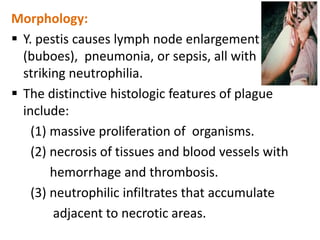
 Y. pestis causes lymph node enlargement
  (buboes), pneumonia, or sepsis, all with
  striking neutrophilia.
 The distinctive histologic features of plague
  include:
    (1) massive proliferation of organisms.
    (2) necrosis of tissues and blood vessels with
        hemorrhage and thrombosis.
    (3) neutrophilic infiltrates that accumulate
        adjacent to necrotic areas.
Chancroid (Soft Chancre):
acute, sexually transmitted, ulcerative infection
caused by Hemophilus ducreyi.
Morphology:
Grossly:
 tender, erythematous papule involving external
  genitalia.
 primary lesion erodes to produce an irregular ulcer .
 In contrast to primary chancre of syphilis, the ulcer
  of chancroid is not indurated.
 The regional lymph nodes enlarged and tender in about
  50% of cases
Microscopically :
• the ulcer of chancroid contains a superficial zone
  of neutrophilic debris and fibrin.
• underlying zone of granulation tissue containing
  areas of necrosis and thrombosed vessels.
• A dense, lymphoplasmacytic inflammatory
  infiltrate is present beneath the layer of
  granulation tissue.
• Coccobacillary organisms are sometimes
  demonstrable in Gram or silver stains.
Granuloma Inguinale:
Granuloma inguinale or donovanosis, is a chronic
inflammatory disease caused by Calymmatobacterium
donovani( a minute, encapsulated, coccobacillus ).
The organism is sexually transmitted.
Morphology:
Grossly:
 a raised, papular lesion involving genitalia.
 eventually ulceration, and abundant granulation tissue
   manifested grossly as soft, painless mass.
 Disfiguring scars in untreated cases.
 Regional lymph nodes are spared or show only
   nonspecific reactive changes, in contrast to chancroid.
Microscopically:
 marked epithelial hyperplasia
  (pseudoepitheliomatous hyperplasia).
 A mixture of neutrophils and mononuclear
  inflammatory cells at the base of ulcer and
  beneath the surrounding epithelium.
 The organisms are demonstrable in
  Giemsa-stained smears of exudate as
  minute encapsulated coccobacilli (Donovan
  bodies) in macrophages.
 Silver stains (e.g., Warthin-Starry stain) may also
  be used.
Typical histological pattern showing epithelial proliferation - pseudoepitheliomatous
hyperplasia.
THANK YOU

Infectious disease p2

  • 1.
    Bacterial Infections GRAM-POSITIVE BACTERIALINFECTIONS : Staphylococcal Infections:  Staphylococcus aureus : are pyogenic, nonmotile, Gram-positive cocci that form grapelike clusters. cause skin lesions (boils, carbuncles, impetigo, and scalded skin) and also cause osteomyelitis, pneumonia, endocarditis, food poisoning, and toxic shock syndrome .  Staphylococcus epidermidis : causes opportunistic infections in catheterized patients, patients with prosthetic cardiac valves, and drug addicts.  Staphylococcus saprophyticus : causes urinary tract infections in young women.
  • 2.
    Pathogenesis: S. aureus andother virulent staphylococci possess a multitude of virulence factors, which include:  surface proteins involved in adherence. secreted enzymes that degrade proteins.  secreted toxins that damage host cells. Morphology: Whether the lesion is located in skin, lungs, bones, or heart valves, S. aureus causes pyogenic inflammation that is distinctive for its local destructiveness.
  • 4.
    Streptococcal Infections: Streptococciare facultative or obligate anaerobic Gram positive cocci that grow in pairs or chains :  β-hemolytic streptococci : are typed according to their surface carbohydrate (Lancefield) antigens. • Streptococcus pyogenes (group A) : causes pharyngitis, scarlet fever, erysipelas, impetigo, rheumatic fever, toxic shock syndrome, and glomerulonephritis. • Streptococcus agalactiae (group B) : colonizes female genital tract and causes sepsis and meningitis in neonates and chorioamnionitis in pregnancy.
  • 5.
     α-hemolytic streptococcus: • Streptococcus pneumoniae : cause community-acquired pneumonia and meningitis in adults. • Streptococcus viridans : normal oral flora but also cause endocarditis. • Streptococcus mutans : cause dental caries. Pathogenesis:  different species of streptococci produce many virulence factors and toxins.  Many streptococci, including S. pyogenes and S. pneumoniae have capsules that resist phagocytosis.
  • 6.
     S. pyogenesalso expresses M protein, a surface protein that prevents bacteria from being phagocytosed.  Poststreptococcal acute rheumatic fever is autoimmune disease caused by anti streptococcal M protein antibodies that cross-react with cardiac myosin. Morphology: Streptococcal infections are characterized by diffuse interstitial neutrophilic infiltrates with minimal destruction of host tissues.
  • 7.
    Diphtheria:  Diphtheria iscaused by a slender Gram-positive rod with clubbed ends, Corynebacterium diphtheriae, which is passed from person to person through aerosols or skin shedding.  C. diphtheriae causes a range of illnesses: asymptomatic carriage ; skin lesions in neglected wounds; and a life-threatening syndrome that includes formation of a tough pharyngeal pseudomembrane ; and toxin-mediated damage to heart, nerves, and other organs.  C. diphtheriae has only one toxin which blocks host cell protein synthesis.
  • 8.
    Morphology:  Inhaled C.diphtheriae proliferate at site of attachment on mucosa of nasopharynx, oropharynx, larynx, or trachea.  Release of exotoxin causes necrosis of epithelium, accompanied by an outpouring of a dense fibrino suppurative exudate.  The coagulation of this exudate on ulcerated necrotic surface creates a tough, dirty gray to black, superficial pseudomembrane.  Neutrophilic infiltration in underlying tissues is intense and is accompanied by marked vascular congestion, interstitial edema, and fibrin exudation.
  • 10.
    Anthrax :  Bacillusanthracis is a large, spore-forming Gram-positive rod-shaped bacterium.  acquired through exposure to animals or animal products.  three major anthrax syndromes: cutaneous, inhalational, and gastrointestinal.  Cutaneous anthrax: • painless, pruritic papule that develops into a vesicle within 2 days, and regional lymphadenopathy. • After vesicle ruptures, the remaining ulcer becomes covered with a characteristic black scar. • Bacteremia is rare with cutaneous anthrax.
  • 11.
     Inhalational anthrax: •occurs when spores are inhaled, causes hemorrhagic mediastinitis. • Frequently, anthrax meningitis develops due to bacteremia. • Inhalational anthrax rapidly leads to shock and frequently death within 1 to 2 days.  Gastrointestinal anthrax: • Uncommon, caused by eating undercooked meat contaminated with B. anthracis. • Initially nausea, abdominal pain, and vomiting. • Severe bloody diarrhea rapidly develops, and mortality is over 50%.
  • 12.
    Pathogenesis: B. anthracisproduces potent toxins and a polyglutamyl capsule that is antiphagocytic. Morphology:  Anthrax lesions at any site are typified by necrosis and exudative inflammation with infiltration of neutrophils and macrophages.  The presence of large, boxcar-shaped Gram-positive extracellular bacteria in chains, seen histopathologically or recovered in culture, should suggest the diagnosis.
  • 14.
    Nocardia:  aerobic Gram-positivebacteria that grow in distinctive branched chains.  In culture, Nocardia form aerial structures with terminal spores, resembling hyphae.  Nocardia are found in soil and cause opportunistic infections in immunocompromised people.  Nocardia asteroides : causes respiratory infections.  Nocardia brasiliensis : infect skin.  A fifth of N. asteroides infections involve CNS, presumably after dissemination from lungs.
  • 15.
    Morphology:  The diagnosisof nocardiosis depends on identification of slender Gram-positive organisms arranged in branching filaments .  Nocardia stain with modified acid fast stains (Fite-Faraco stain).  At any site of infection, Nocardia elicit a suppurative response with central liquefaction and surrounding granulation and fibrosis.  Granulomas do not form.
  • 17.
    GRAM-NEGATIVE BACTERIAL INFECTIONS: NeisserialInfections :  Neisseria are Gram-negative diplococci that are flattened on adjoining sides, giving the pair the shape of a coffee bean.  These aerobic bacteria grow best on enriched media such as lysed sheep's blood agar ("chocolate" agar).  The two clinically significant Neisseria are : Neisseria meningitidis and Neisseria gonorrhoeae.  N. meningitidis : cause bacterial meningitis, particularly among people between 5 and 19 years old.  N. gonorrhoeae : cause sexually transmitted disease, gonorrhoea.
  • 18.
    Pathogenesis:  Both speciesof Neisseria use antigenic variation to escape the immune response.
  • 19.
    Whooping Cough:  causedby Gram-negative coccobacillus Bordetella pertussis.  is an acute, highly communicable illness characterized by paroxysms of violent coughing followed by a loud inspiratory "whoop."  B. pertussis vaccination has been effective in preventing whooping cough. Pathogenesis :  B. pertussis colonizes the brush border of bronchial epithelium and also invades macrophages.  Pertussis toxin is an exotoxin composed of five distinct peptides.
  • 20.
    Morphology:  Bordetella bacteriacause laryngotracheobronchitis that in severe cases features bronchial mucosal erosion, hyperemia, and copious mucopurulent exudate .  a striking peripheral lymphocytosis (up to 90%) with hypercellularity and enlargement of mucosal lymph follicles and peribronchial lymph nodes.
  • 22.
    Pseudomonas Infection:  Pseudomonasaeruginosa is an opportunistic aerobic Gram-negative bacillus that is a deadly pathogen of patients with cystic fibrosis, severe burns, or neutropenia.  Most patients with cystic fibrosis die of pulmonary failure secondary to chronic infection with P. aeruginosa.  P. aeruginosa also causes corneal keratitis in wearers of contact lenses; endocarditis and osteomyelitis in intravenous drug abusers; external otitis (swimmer's ear) in healthy individuals, and severe external otitis in diabetics.
  • 23.
    Pathogenesis:  P. aeruginosahas pili and adherence proteins that bind to epithelial cells and lung mucin.  as well as an endotoxin that causes symptoms and signs of Gram-negative sepsis.  The organisms also secrete an exotoxin and several other virulence factors.
  • 24.
    Morphology:  Pseudomonas pneumonia:necrotizing inflammation distributing through the terminal airways , with striking whitish necrotic centers and red hemorrhagic peripheral areas.  Gram-negative vasculitis accompanied by thrombosis and hemorrhage, although not pathognomonic, is highly suggestive of P. aeruginosa infection.
  • 26.
    Plague:  Yersinia pestisis a Gram-negative facultative intracellular bacterium that is transmitted by fleabites or aerosols.  causes a highly invasive fatal systemic infection called plague, also named Black Death.  Y. enterocolitica and Y. pseudotuberculosis : are genetically similar to Y. pestis ; these bacteria cause fecal-orally transmitted ileitis and mesenteric lymphadenitis.
  • 27.
    Morphology:  Y. pestiscauses lymph node enlargement (buboes), pneumonia, or sepsis, all with striking neutrophilia.  The distinctive histologic features of plague include: (1) massive proliferation of organisms. (2) necrosis of tissues and blood vessels with hemorrhage and thrombosis. (3) neutrophilic infiltrates that accumulate adjacent to necrotic areas.
  • 28.
    Chancroid (Soft Chancre): acute,sexually transmitted, ulcerative infection caused by Hemophilus ducreyi. Morphology: Grossly:  tender, erythematous papule involving external genitalia.  primary lesion erodes to produce an irregular ulcer .  In contrast to primary chancre of syphilis, the ulcer of chancroid is not indurated.  The regional lymph nodes enlarged and tender in about 50% of cases
  • 29.
    Microscopically : • theulcer of chancroid contains a superficial zone of neutrophilic debris and fibrin. • underlying zone of granulation tissue containing areas of necrosis and thrombosed vessels. • A dense, lymphoplasmacytic inflammatory infiltrate is present beneath the layer of granulation tissue. • Coccobacillary organisms are sometimes demonstrable in Gram or silver stains.
  • 30.
    Granuloma Inguinale: Granuloma inguinaleor donovanosis, is a chronic inflammatory disease caused by Calymmatobacterium donovani( a minute, encapsulated, coccobacillus ). The organism is sexually transmitted. Morphology: Grossly:  a raised, papular lesion involving genitalia.  eventually ulceration, and abundant granulation tissue manifested grossly as soft, painless mass.  Disfiguring scars in untreated cases.  Regional lymph nodes are spared or show only nonspecific reactive changes, in contrast to chancroid.
  • 31.
    Microscopically:  marked epithelialhyperplasia (pseudoepitheliomatous hyperplasia).  A mixture of neutrophils and mononuclear inflammatory cells at the base of ulcer and beneath the surrounding epithelium.  The organisms are demonstrable in Giemsa-stained smears of exudate as minute encapsulated coccobacilli (Donovan bodies) in macrophages.  Silver stains (e.g., Warthin-Starry stain) may also be used.
  • 32.
    Typical histological patternshowing epithelial proliferation - pseudoepitheliomatous hyperplasia.
  • 34.