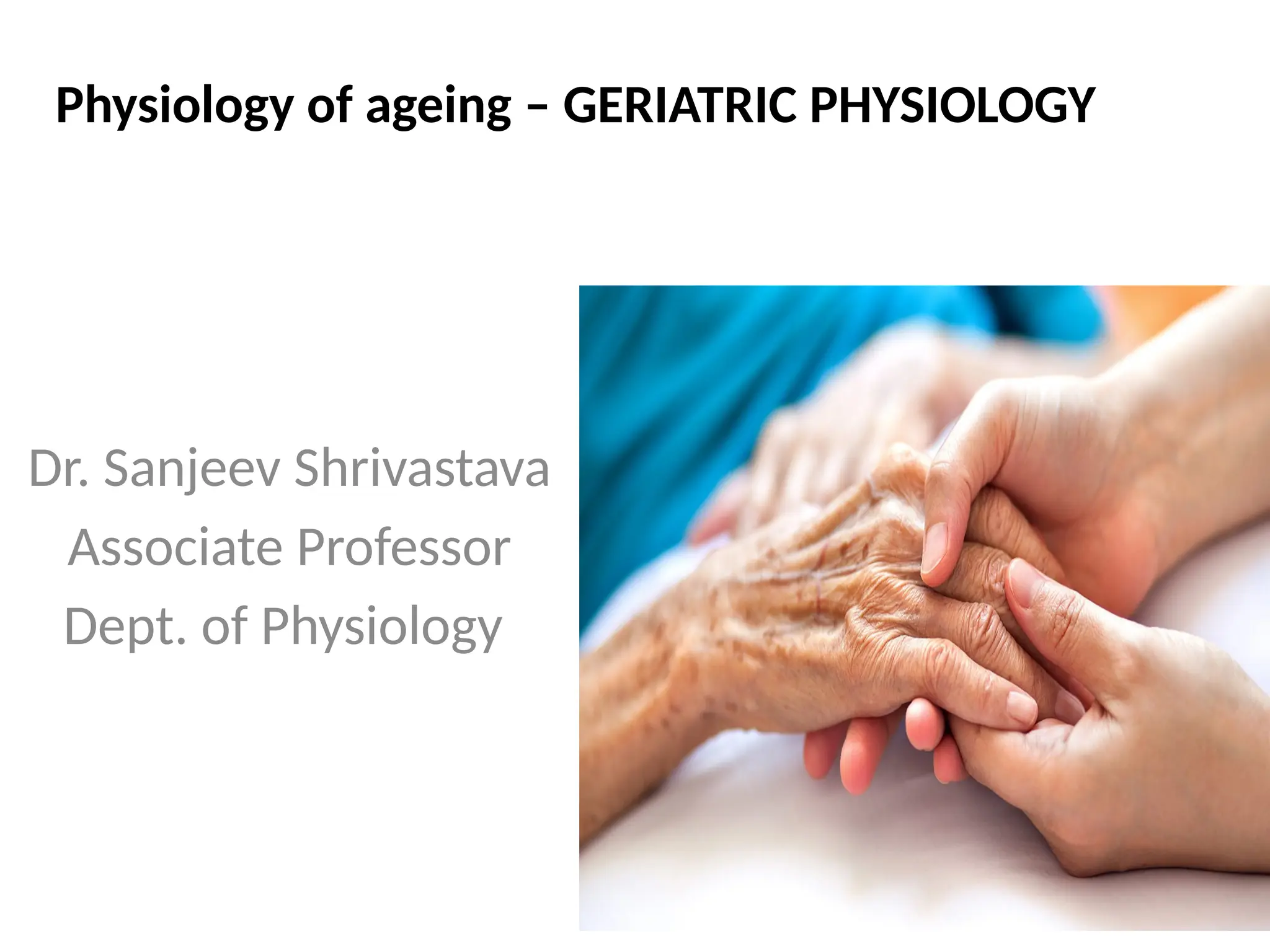
Physiology of ageing – GERIATRIC PHYSIOLOGY
Dr. Sanjeev Shrivastava
Associate Professor
Dept. of Physiology
Learning objectives
• Introduction.
• Concepts in aging
• Theories of aging
• Aging of human physiological systems
• Aging slowly
• AGE : length of time the individual has existed
• AGING / SENESENCE : it’s a natural process.
• Time related deterioration of the physiological
functions necessary for survival and fertility.
• Aging is influenced by diet, environment
genetics as well as by personal habits.
Physiological Point….BASIC CAUSE ????
• It is a progressive constriction of the
homeostatic reserve of every organ system
• Decline of homeostatic reserve –
homeostenosis – gradual and progressive
• Science of aging : Gerontology
• Scientist - Gerontologists
• Branch : Geriatric medicine
Age - associated diseases
• Diseases that do not cause morbidity or mortality
until advanced ages
• Primary ageing : intrinsic changes occuring with age,
unrelated to disease or environmental influences
• Secondary ageing : changes caused by interaction of
primary ageing with environmental influences or
disease processes
Theories of aging
• A- Genetic theories-
1- Mutation Theory
2- Pleotropic Antagonigm
3- Ecological theory
• B- Random damage
theories-
1- Free radical theory
2- Cell replication theory
3- Cross linking theory
AGING IS AN EVOLVED TRAIT
• 1. Mutation – accumulation mechanism
Deleterious mutations in gametes – defective
progeny – natural selection will remove such
genes from population
Few mutations which do not have deleterious
effect till advanced age – will not be
eliminated by natural selection
2.Antagonistic pleiotropy
• Genes that have deleterious effect in late
ages , increases evolutionary fitness in adult
age so natural selection favors such alleles
because they have negative impact only after
reproduction……………..
3. Ecological theory
• The ecological theory applies to the ecological
conditions where external hazards are less.
•
• In such favorable environments, the mutation is such
that the aging process is retarded to allow the animal
to reproduce and protect the off springs.
•Random Damage Theories
•The random damage theories explain that the aging is due to
the loss of balance between ongoing damage and repair.
•The continuous tissue damage in the body occurs due to
constant production of free radicals.
•Especially after the age of 40 years, capacity to repair cells,
tissues, and organs decline.
• Due to the arrest of the cell cycles at the G1/S phase. This
is the phase in cell cycle at which synthesis of DNA starts. Thus,
DNA synthesis is impaired.
REACTIVE OXYGEN SPECIES
• Hydrogen peroxide
• Hydroxyl radical – most reactive
• Superoxide anion radical
Imbalance between production and removal of
reactive oxygen species is the major cause of
ageing
Role of Free Radicals and Oxidative Stress
Due to metabolism, free radicals like peroxide and hydroxyl radicals
are continuously produced in the body.
These radicals damage the cells and tissues by the process of
oxidation.
The free radicals damage DNA and proteins and cause peroxidation of
lipids in the membranes. This is called oxidative stress.
Simultaneously a scavenging system of antioxidants also exists in the
body that neutralizes the toxic effects of free radicals.
Antioxidants include vitamin E, vitamin A, and vitamin C.
Enzymatic defense : SODs, catalase and glutathione, peroxidase
Oxidative stress becomes more when production of oxidants is more
than the generation of antioxidants.
 Oxidative stress promotes aging.
1. Limitations in cell division
 Hayflick limit : fibroblast can divide only for
limited number of times
Concept of telomeres
• Role of Cell Replication
• In recent times, the length of telomeric DNA has also
been associated to cell replication. Telomeric DNA is
present at the ends of chromosomes. Telomeric DNA
has following important functions:
1. Prevents chromosomal instability.
2. Slows chromosomal fragmentation and
rearrangement
3. Anchors chromosomes to nuclear matrix.
4. Acts as a buffer between coding regions of DNA
and the ends of the chromosomes.
5. It is also necessary for cell divisions
GLYCATION HYPOTHESIS OF AGEING
Schiff base – Melanoidins – pentosidine and
carboxymethyllysine
AGE associated long term complications of
diabetes, lens proteins in eyes – opacification,
stiffness of collagen in connective tissue, DNA
repair damage – aging
Mitochondrial theory of ageing
• Damage to mtDNA reduces ability of
mitochondria to generate ATP, LOSS OF CELL
FUNCTION & hence ageing
DNA damage theory of ageing
• DNA damage due to radiations, oxidative
damage
• Accumulated damaged DNA interferes with
normal DNA replication and transcription –
impairs cells ability to function – ageing
2. Protein turn-over
• Changes in primary and secondary structure of
protein – causes aggregation and
fragmentation of protein molecule – interferes
with protein function
• Protecting the organism from this degradation
is called protein turn over
• This decreases with age – causes ageing
3. MEMBRANE DETERIORATION
• In phospholipid bilayer – high amount of PUFA
is present – oxidative process generates lipid
peroxides from it and damage membrane
• Cell rapidly replaces it with membrane lipids
which alter its structure and interferes with
barrier function, signaling and transport
processes ……….
Ageing of human physiological systems
• Ageing people loose height and lean body
mass but gain and redistribute fat……
• Loose height ??? – compression of
cartilagenous disc - 2.5 to 5 %
• Fat free mass = body mass – adipose tissue fat
mass
• Lean body mass = fat free – bone & non
adipose tissue mass
• Decreased arterial compliance : atherosclerosis
• Mismatched V/P ratio : COPD
• Increased SBP
• Decreased DBP
• Wide PP
• Postural hypotension
• Atelactasis
• VO2 max : decreases with age
• Exercise capacity reduces
• GFR declines with age
• Frequency of micturition : increased , reduces bladder
compliance
• Liver mass and hepatic blood flow decreases ,
difficulty in regeneration if damage occurs
• Insulin resistance
• Increased LDL
• Peak concentrations of hormones decreases
• DHEA activity decreases , cortisol and
aldosterone well preserved
• Parathyroid level increases
• Menopause and andropause
SKELETAL MUSCLES
• Sarcopenia
• Muscle fibres
• Innervation ratio – recruitment
BONE & JOINTS
• Disbalance between osteoblastic and clastic
activity
• Bone mineral density index
• Osteoporosis
• More in women
• Ageing of articular cartilage – stiffening –
osteoarthritis
Sensory functions
• Deterioration with age
• Touch , vibrations, 2 point discrimination,
proprioception , pressure, thermoregulation :
decreases with age
• Hearing loss – high frequency
• Presbyobia – weaking of lens
• Reduced taste and olfaction
Motor functions
• Slowing of reaction time
• Delayed central processing
Cognitive functions
• Intelligence : does not decline
• Capacity to use knowledge does not decline in
healthy elderly
• Solve new problems, where r car keys ,
learning is slowed
AGEING SLOWLY ……………
Food restriction
• Restriction of specific component
( C,P,F ) ?????
• Reduces oxidative stress , reduce glycation
and glyco-oxidation, reductions in plasma level
of insulin and IGF-1
• Food restriction – Decrease oxidative stress &
stimulate maintenance and repair – retard
ageing
Role of Calorie Intake
•Increased calorie intake after 40 yrs has been proved to facilitate aging.
•The calorie restriction by about 20-30% of the total calorie intake has been
documented to have following effects:
1. Increase in average life expectancy and maximum life span.
2. Delay in onset of age-associated diseases.
3. Decrease in deterioration of physiologic processes like immune
responsiveness, glucose metabolism, muscle atrophy, etc.
4. Influence on gene expression, protein turnover, and crosslinking.
5. Calorie restriction must be supplemented with vitamins and antioxidants
to prevent aging.
EXERCISE
• There is still no conclusive evidence to document
that exercise prevents ageing or not.
• Exercise improves work capacity as assessed
from maximum oxygen uptake.
• Physical exercise improves cardiac performance
and reduces musculoskeletal disability.
• Physical exercise is reported to prevent age-
related decline in resting metabolic rate.
• Interventions to slow aging and extend human
life are controversial
• Exercise , diet , magic bullets ( anti-oxidants
and hormones )
• Recombinant GH ??????????????????????
Physiology of Ageing – GERIATRIC PHYSIOLOGY.pptx

Physiology of Ageing – GERIATRIC PHYSIOLOGY.pptx

  • 1.
    Physiology of ageing– GERIATRIC PHYSIOLOGY Dr. Sanjeev Shrivastava Associate Professor Dept. of Physiology
  • 2.
    Learning objectives • Introduction. •Concepts in aging • Theories of aging • Aging of human physiological systems • Aging slowly
  • 3.
    • AGE :length of time the individual has existed • AGING / SENESENCE : it’s a natural process. • Time related deterioration of the physiological functions necessary for survival and fertility. • Aging is influenced by diet, environment genetics as well as by personal habits.
  • 4.
    Physiological Point….BASIC CAUSE???? • It is a progressive constriction of the homeostatic reserve of every organ system • Decline of homeostatic reserve – homeostenosis – gradual and progressive
  • 7.
    • Science ofaging : Gerontology • Scientist - Gerontologists • Branch : Geriatric medicine
  • 8.
    Age - associateddiseases • Diseases that do not cause morbidity or mortality until advanced ages • Primary ageing : intrinsic changes occuring with age, unrelated to disease or environmental influences • Secondary ageing : changes caused by interaction of primary ageing with environmental influences or disease processes
  • 9.
    Theories of aging •A- Genetic theories- 1- Mutation Theory 2- Pleotropic Antagonigm 3- Ecological theory • B- Random damage theories- 1- Free radical theory 2- Cell replication theory 3- Cross linking theory
  • 10.
    AGING IS ANEVOLVED TRAIT • 1. Mutation – accumulation mechanism Deleterious mutations in gametes – defective progeny – natural selection will remove such genes from population Few mutations which do not have deleterious effect till advanced age – will not be eliminated by natural selection
  • 11.
    2.Antagonistic pleiotropy • Genesthat have deleterious effect in late ages , increases evolutionary fitness in adult age so natural selection favors such alleles because they have negative impact only after reproduction……………..
  • 12.
    3. Ecological theory •The ecological theory applies to the ecological conditions where external hazards are less. • • In such favorable environments, the mutation is such that the aging process is retarded to allow the animal to reproduce and protect the off springs.
  • 13.
    •Random Damage Theories •Therandom damage theories explain that the aging is due to the loss of balance between ongoing damage and repair. •The continuous tissue damage in the body occurs due to constant production of free radicals. •Especially after the age of 40 years, capacity to repair cells, tissues, and organs decline. • Due to the arrest of the cell cycles at the G1/S phase. This is the phase in cell cycle at which synthesis of DNA starts. Thus, DNA synthesis is impaired.
  • 15.
    REACTIVE OXYGEN SPECIES •Hydrogen peroxide • Hydroxyl radical – most reactive • Superoxide anion radical Imbalance between production and removal of reactive oxygen species is the major cause of ageing
  • 16.
    Role of FreeRadicals and Oxidative Stress Due to metabolism, free radicals like peroxide and hydroxyl radicals are continuously produced in the body. These radicals damage the cells and tissues by the process of oxidation. The free radicals damage DNA and proteins and cause peroxidation of lipids in the membranes. This is called oxidative stress. Simultaneously a scavenging system of antioxidants also exists in the body that neutralizes the toxic effects of free radicals. Antioxidants include vitamin E, vitamin A, and vitamin C. Enzymatic defense : SODs, catalase and glutathione, peroxidase Oxidative stress becomes more when production of oxidants is more than the generation of antioxidants.  Oxidative stress promotes aging.
  • 18.
    1. Limitations incell division  Hayflick limit : fibroblast can divide only for limited number of times Concept of telomeres
  • 20.
    • Role ofCell Replication • In recent times, the length of telomeric DNA has also been associated to cell replication. Telomeric DNA is present at the ends of chromosomes. Telomeric DNA has following important functions: 1. Prevents chromosomal instability. 2. Slows chromosomal fragmentation and rearrangement 3. Anchors chromosomes to nuclear matrix. 4. Acts as a buffer between coding regions of DNA and the ends of the chromosomes. 5. It is also necessary for cell divisions
  • 23.
  • 24.
    Schiff base –Melanoidins – pentosidine and carboxymethyllysine AGE associated long term complications of diabetes, lens proteins in eyes – opacification, stiffness of collagen in connective tissue, DNA repair damage – aging
  • 25.
    Mitochondrial theory ofageing • Damage to mtDNA reduces ability of mitochondria to generate ATP, LOSS OF CELL FUNCTION & hence ageing
  • 26.
    DNA damage theoryof ageing • DNA damage due to radiations, oxidative damage • Accumulated damaged DNA interferes with normal DNA replication and transcription – impairs cells ability to function – ageing
  • 27.
    2. Protein turn-over •Changes in primary and secondary structure of protein – causes aggregation and fragmentation of protein molecule – interferes with protein function • Protecting the organism from this degradation is called protein turn over • This decreases with age – causes ageing
  • 28.
    3. MEMBRANE DETERIORATION •In phospholipid bilayer – high amount of PUFA is present – oxidative process generates lipid peroxides from it and damage membrane • Cell rapidly replaces it with membrane lipids which alter its structure and interferes with barrier function, signaling and transport processes ……….
  • 29.
    Ageing of humanphysiological systems
  • 31.
    • Ageing peopleloose height and lean body mass but gain and redistribute fat…… • Loose height ??? – compression of cartilagenous disc - 2.5 to 5 % • Fat free mass = body mass – adipose tissue fat mass • Lean body mass = fat free – bone & non adipose tissue mass
  • 33.
    • Decreased arterialcompliance : atherosclerosis • Mismatched V/P ratio : COPD • Increased SBP • Decreased DBP • Wide PP • Postural hypotension • Atelactasis • VO2 max : decreases with age • Exercise capacity reduces • GFR declines with age • Frequency of micturition : increased , reduces bladder compliance
  • 35.
    • Liver massand hepatic blood flow decreases , difficulty in regeneration if damage occurs • Insulin resistance • Increased LDL • Peak concentrations of hormones decreases • DHEA activity decreases , cortisol and aldosterone well preserved • Parathyroid level increases • Menopause and andropause
  • 36.
  • 37.
    • Sarcopenia • Musclefibres • Innervation ratio – recruitment
  • 38.
  • 39.
    • Disbalance betweenosteoblastic and clastic activity • Bone mineral density index • Osteoporosis • More in women • Ageing of articular cartilage – stiffening – osteoarthritis
  • 41.
    Sensory functions • Deteriorationwith age • Touch , vibrations, 2 point discrimination, proprioception , pressure, thermoregulation : decreases with age • Hearing loss – high frequency • Presbyobia – weaking of lens • Reduced taste and olfaction
  • 42.
    Motor functions • Slowingof reaction time • Delayed central processing
  • 43.
    Cognitive functions • Intelligence: does not decline • Capacity to use knowledge does not decline in healthy elderly • Solve new problems, where r car keys , learning is slowed
  • 46.
  • 47.
    Food restriction • Restrictionof specific component ( C,P,F ) ????? • Reduces oxidative stress , reduce glycation and glyco-oxidation, reductions in plasma level of insulin and IGF-1 • Food restriction – Decrease oxidative stress & stimulate maintenance and repair – retard ageing
  • 48.
    Role of CalorieIntake •Increased calorie intake after 40 yrs has been proved to facilitate aging. •The calorie restriction by about 20-30% of the total calorie intake has been documented to have following effects: 1. Increase in average life expectancy and maximum life span. 2. Delay in onset of age-associated diseases. 3. Decrease in deterioration of physiologic processes like immune responsiveness, glucose metabolism, muscle atrophy, etc. 4. Influence on gene expression, protein turnover, and crosslinking. 5. Calorie restriction must be supplemented with vitamins and antioxidants to prevent aging.
  • 49.
    EXERCISE • There isstill no conclusive evidence to document that exercise prevents ageing or not. • Exercise improves work capacity as assessed from maximum oxygen uptake. • Physical exercise improves cardiac performance and reduces musculoskeletal disability. • Physical exercise is reported to prevent age- related decline in resting metabolic rate.
  • 50.
    • Interventions toslow aging and extend human life are controversial • Exercise , diet , magic bullets ( anti-oxidants and hormones ) • Recombinant GH ??????????????????????