M.Sc. Zoology Batch : 2022-2024
S.S KHANNA GIRLS DEGREE COLLEGE
[ Constituent College Of University Of Allahabad ]
WHY DO WE ALL AGE ?
INTRODUCTION
Aging is a progressive, deleterious and intrinsic
phenomenon in an organism. In 1952, the process of ageing
was referred to by Medawar as “unsolved problem in
biology.” Cellular aging is the result of a progressive
decline in the proliferative capacity and life span of cells
and the effects of continuous exposure to exogenous factors
that cause accumulation of cellular and molecular damage.
There are more than 300
theories/ hypothesis of Aging
The lack of an unified theory of aging underlines the multifaceted , diverse
and complex nature of aging.
THEORIES OF AGING
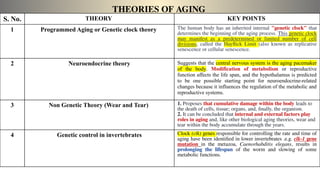
S. No. THEORY KEY POINTS
1 Programmed Aging or Genetic clock theory The human body has an inherited internal "genetic clock" that
determines the beginning of the aging process. This genetic clock
may manifest as a predetermined or limited number of cell
divisions, called the Hayflick Limit (also known as replicative
senescence or cellular senescence.
2 Neuroendocrine theory Suggests that the central nervous system is the aging pacemaker
of the body. Modification of metabolism or reproductive
function affects the life span, and the hypothalamus is predicted
to be one possible starting point for neuroendocrine-related
changes because it influences the regulation of the metabolic and
reproductive systems.
3 Non Genetic Theory (Wear and Tear) 1. Proposes that cumulative damage within the body leads to
the death of cells, tissue; organs, and, finally, the organism.
2. It can be concluded that internal and external factors play
roles in aging and, like other biological aging theories, wear and
tear within the body accumulate through the years.
4 Genetic control in invertebrates Clock (clk) genes responsible for controlling the rate and time of
aging have been identified in lower invertebrates .e.g. clk-1 gene
mutation in the metazoa, Caenorhabditis elegans, results in
prolonging the lifespan of the worm and slowing of some
metabolic functions.
THEORIES OF AGING
S. No. THEORY KEY POINTS
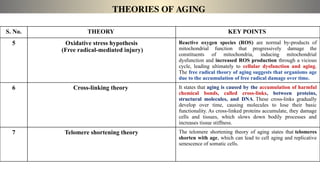
5 Oxidative stress hypothesis
(Free radical-mediated injury)
Reactive oxygen species (ROS) are normal by-products of
mitochondrial function that progressively damage the
constituents of mitochondria, inducing mitochondrial
dysfunction and increased ROS production through a vicious
cycle, leading ultimately to cellular dysfunction and aging.
The free radical theory of aging suggests that organisms age
due to the accumulation of free radical damage over time.
6 Cross-linking theory It states that aging is caused by the accumulation of harmful
chemical bonds, called cross-links, between proteins,
structural molecules, and DNA. These cross-links gradually
develop over time, causing molecules to lose their basic
functionality. As cross-linked proteins accumulate, they damage
cells and tissues, which slows down bodily processes and
increases tissue stiffness.
7 Telomere shortening theory The telomere shortening theory of aging states that telomeres
shorten with age, which can lead to cell aging and replicative
senescence of somatic cells.
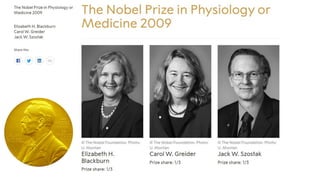
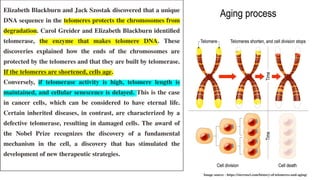
Elizabeth Blackburn and Jack Szostak discovered that a unique
DNA sequence in the telomeres protects the chromosomes from
degradation. Carol Greider and Elizabeth Blackburn identified
telomerase, the enzyme that makes telomere DNA. These
discoveries explained how the ends of the chromosomes are
protected by the telomeres and that they are built by telomerase.
If the telomeres are shortened, cells age.
Conversely, if telomerase activity is high, telomere length is
maintained, and cellular senescence is delayed. This is the case
in cancer cells, which can be considered to have eternal life.
Certain inherited diseases, in contrast, are characterized by a
defective telomerase, resulting in damaged cells. The award of
the Nobel Prize recognizes the discovery of a fundamental
mechanism in the cell, a discovery that has stimulated the
development of new therapeutic strategies.
Image source - https://sierrasci.com/history-of-telomeres-and-aging/
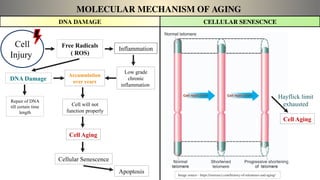
MOLECULAR MECHANISM OF AGING
DNA DAMAGE CELLULAR SENESCNCE
Cell
Injury
Free Radicals
( ROS)
DNA Damage
Repair of DNA
till certain time
length
Inflammation
Low grade
chronic
inflammation
Accumulation
over years
Cell will not
function properly
Cell Aging
Cellular Senescence
Apoptosis
Cell Aging
Hayflick limit
exhausted
Image source - https://sierrasci.com/history-of-telomeres-and-aging/
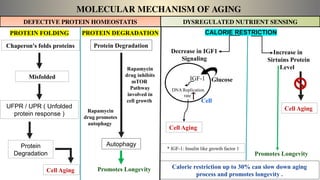
DEFECTIVE PROTEIN HOMEOSTATIS DYSREGULATED NUTRIENT SENSING
MOLECULAR MECHANISM OF AGING
PROTEIN FOLDING PROTEIN DEGRADATION
Chaperon's folds proteins
Misfolded
UFPR / UPR ( Unfolded
protein response )
Protein
Degradation
Cell Aging
Protein Degradation
Autophagy
Rapamycin
drug inhibits
mTOR
Pathway
involved in
cell growth
Rapamycin
drug promotes
autophagy
CALORIE RESTRICTION
Decrease in IGF1
Signaling
Increase in
Sirtuins Protein
Level
Cell Aging
Promotes Longevity
Glucose
IGF-1
DNA Replication
rate
Cell Aging
* IGF-1: Insulin like growth factor 1
Calorie restriction up to 30% can slow down aging
process and promotes longevity .
Cell
Promotes Longevity
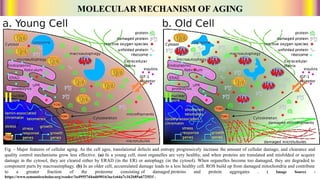
Fig. - Major features of cellular aging. As the cell ages, translational defects and entropy progressively increase the amount of cellular damage, and clearance and
quality control mechanisms grow less effective. (a) In a young cell, most organelles are very healthy, and when proteins are translated and misfolded or acquire
damage in the cytosol, they are cleared either by ERAD (in the ER) or autophagy (in the cytosol). When organelles become too damaged, they are degraded to
component parts by macroautophagy. (b) In an older cell, accumulated damage leads to a less healthy cell. ROS build up from damaged mitochondria and contribute
to a greater fraction of the proteome consisting of damaged proteins and protein aggregates . ( Image Source -
https://www.semanticscholar.org/reader/3a49557d4ad690163ae1e64a7c162b85a6725f1f ).
ORGAN CHANGES IN AGING
HOW TO SLOW DOWN AGING PROCESS
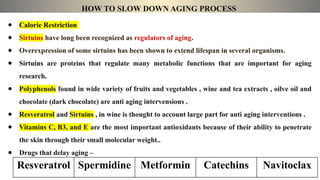
● Calorie Restriction
● Sirtuins have long been recognized as regulators of aging.
● Overexpression of some sirtuins has been shown to extend lifespan in several organisms.
● Sirtuins are proteins that regulate many metabolic functions that are important for aging
research.
● Polyphenols found in wide variety of fruits and vegetables , wine and tea extracts , oilve oil and
chocolate (dark chocolate) are anti aging intervensions .
● Resveratrol and Sirtuins , in wine is thought to account large part for anti aging interventions .
● Vitamins C, B3, and E are the most important antioxidants because of their ability to penetrate
the skin through their small molecular weight..
● Drugs that delay aging –
Resveratrol Spermidine Metformin Catechins Navitoclax
• Cellular aging is a multifaceted process influenced by a combination of genetic, environmental, and lifestyle
factors.
• As cells age, they undergo various changes, including alterations in gene expression, DNA damage, telomere
shortening, and decline in mitochondrial function.
• These changes contribute to the gradual decline in tissue and organ function, leading to age-related diseases
and ultimately mortality.
• Understanding the mechanisms underlying cellular aging is crucial for developing interventions to promote
healthy aging and mitigate age-related diseases. Strategies such as caloric restriction, regular exercise, and
pharmacological interventions targeting cellular pathways involved in aging hold promise for extending
healthspan and lifespan.
• Moreover, emerging technologies such as cellular reprogramming and gene editing offer exciting avenues for
rejuvenating aged cells and tissues, potentially revolutionizing the field of regenerative medicine.
CONCLUSION
REFERENCE
1) Gilbert SF. Developmental Biology. 6th edition. Sunderland (MA): Sinauer Associates; 2000. Aging:
The Biology of Senescence. Available from: https://www.ncbi.nlm.nih.gov/books/NBK10041/
2) López-Otín, C., Blasco, M. A., Partridge, L., Serrano, M., & Kroemer, G. (2023). Hallmarks of aging:
An expanding universe. Cell, 186(2), 243–278. https://doi.org/10.1016/j.cell.2022.11.001
3) Jayanthi, P., Joshua, E., & Ranganathan, K. (2010). Ageing and its implications. Journal of oral and
maxillofacial pathology : JOMFP, 14(2), 48–51. https://doi.org/10.4103/0973-029X.72500
4) Campisi J. (2013). Aging, cellular senescence, and cancer. Annual review of physiology, 75, 685–705.
https://doi.org/10.1146/annurev-physiol-030212-183653
5) Kumar, V., Abbas, A. K., Aster, J. C. (2020). Robbins & Cotran Pathologic Basis of Disease E-Book.
Netherlands: Elsevier Health Sciences.
6) Mohan, H. (2018). Textbook of Pathology. India: Jaypee Brothers Medical Publishers Pvt. Limited.
7) https://universe-review.ca/R10-27-ageing01.htm
THANK YOU
TAKE HOME MESSAGE –
"hara hachi bu": Don't obsess over weight loss or calorie intake,
Eat slowly, Focus on food, and Listen to your body.

Cellular Aging and Its Molecular Mechanism

  • 1.
    M.Sc. Zoology Batch: 2022-2024 S.S KHANNA GIRLS DEGREE COLLEGE [ Constituent College Of University Of Allahabad ]
  • 2.
    WHY DO WEALL AGE ?
  • 3.
    INTRODUCTION Aging is aprogressive, deleterious and intrinsic phenomenon in an organism. In 1952, the process of ageing was referred to by Medawar as “unsolved problem in biology.” Cellular aging is the result of a progressive decline in the proliferative capacity and life span of cells and the effects of continuous exposure to exogenous factors that cause accumulation of cellular and molecular damage.
  • 4.
    There are morethan 300 theories/ hypothesis of Aging The lack of an unified theory of aging underlines the multifaceted , diverse and complex nature of aging.
  • 5.
    THEORIES OF AGING S.No. THEORY KEY POINTS 1 Programmed Aging or Genetic clock theory The human body has an inherited internal "genetic clock" that determines the beginning of the aging process. This genetic clock may manifest as a predetermined or limited number of cell divisions, called the Hayflick Limit (also known as replicative senescence or cellular senescence. 2 Neuroendocrine theory Suggests that the central nervous system is the aging pacemaker of the body. Modification of metabolism or reproductive function affects the life span, and the hypothalamus is predicted to be one possible starting point for neuroendocrine-related changes because it influences the regulation of the metabolic and reproductive systems. 3 Non Genetic Theory (Wear and Tear) 1. Proposes that cumulative damage within the body leads to the death of cells, tissue; organs, and, finally, the organism. 2. It can be concluded that internal and external factors play roles in aging and, like other biological aging theories, wear and tear within the body accumulate through the years. 4 Genetic control in invertebrates Clock (clk) genes responsible for controlling the rate and time of aging have been identified in lower invertebrates .e.g. clk-1 gene mutation in the metazoa, Caenorhabditis elegans, results in prolonging the lifespan of the worm and slowing of some metabolic functions.
  • 6.
    THEORIES OF AGING S.No. THEORY KEY POINTS 5 Oxidative stress hypothesis (Free radical-mediated injury) Reactive oxygen species (ROS) are normal by-products of mitochondrial function that progressively damage the constituents of mitochondria, inducing mitochondrial dysfunction and increased ROS production through a vicious cycle, leading ultimately to cellular dysfunction and aging. The free radical theory of aging suggests that organisms age due to the accumulation of free radical damage over time. 6 Cross-linking theory It states that aging is caused by the accumulation of harmful chemical bonds, called cross-links, between proteins, structural molecules, and DNA. These cross-links gradually develop over time, causing molecules to lose their basic functionality. As cross-linked proteins accumulate, they damage cells and tissues, which slows down bodily processes and increases tissue stiffness. 7 Telomere shortening theory The telomere shortening theory of aging states that telomeres shorten with age, which can lead to cell aging and replicative senescence of somatic cells.
  • 8.
    Elizabeth Blackburn andJack Szostak discovered that a unique DNA sequence in the telomeres protects the chromosomes from degradation. Carol Greider and Elizabeth Blackburn identified telomerase, the enzyme that makes telomere DNA. These discoveries explained how the ends of the chromosomes are protected by the telomeres and that they are built by telomerase. If the telomeres are shortened, cells age. Conversely, if telomerase activity is high, telomere length is maintained, and cellular senescence is delayed. This is the case in cancer cells, which can be considered to have eternal life. Certain inherited diseases, in contrast, are characterized by a defective telomerase, resulting in damaged cells. The award of the Nobel Prize recognizes the discovery of a fundamental mechanism in the cell, a discovery that has stimulated the development of new therapeutic strategies. Image source - https://sierrasci.com/history-of-telomeres-and-aging/
  • 9.
    MOLECULAR MECHANISM OFAGING DNA DAMAGE CELLULAR SENESCNCE Cell Injury Free Radicals ( ROS) DNA Damage Repair of DNA till certain time length Inflammation Low grade chronic inflammation Accumulation over years Cell will not function properly Cell Aging Cellular Senescence Apoptosis Cell Aging Hayflick limit exhausted Image source - https://sierrasci.com/history-of-telomeres-and-aging/
  • 10.
    DEFECTIVE PROTEIN HOMEOSTATISDYSREGULATED NUTRIENT SENSING MOLECULAR MECHANISM OF AGING PROTEIN FOLDING PROTEIN DEGRADATION Chaperon's folds proteins Misfolded UFPR / UPR ( Unfolded protein response ) Protein Degradation Cell Aging Protein Degradation Autophagy Rapamycin drug inhibits mTOR Pathway involved in cell growth Rapamycin drug promotes autophagy CALORIE RESTRICTION Decrease in IGF1 Signaling Increase in Sirtuins Protein Level Cell Aging Promotes Longevity Glucose IGF-1 DNA Replication rate Cell Aging * IGF-1: Insulin like growth factor 1 Calorie restriction up to 30% can slow down aging process and promotes longevity . Cell Promotes Longevity
  • 11.
    Fig. - Majorfeatures of cellular aging. As the cell ages, translational defects and entropy progressively increase the amount of cellular damage, and clearance and quality control mechanisms grow less effective. (a) In a young cell, most organelles are very healthy, and when proteins are translated and misfolded or acquire damage in the cytosol, they are cleared either by ERAD (in the ER) or autophagy (in the cytosol). When organelles become too damaged, they are degraded to component parts by macroautophagy. (b) In an older cell, accumulated damage leads to a less healthy cell. ROS build up from damaged mitochondria and contribute to a greater fraction of the proteome consisting of damaged proteins and protein aggregates . ( Image Source - https://www.semanticscholar.org/reader/3a49557d4ad690163ae1e64a7c162b85a6725f1f ).
  • 12.
  • 13.
    HOW TO SLOWDOWN AGING PROCESS ● Calorie Restriction ● Sirtuins have long been recognized as regulators of aging. ● Overexpression of some sirtuins has been shown to extend lifespan in several organisms. ● Sirtuins are proteins that regulate many metabolic functions that are important for aging research. ● Polyphenols found in wide variety of fruits and vegetables , wine and tea extracts , oilve oil and chocolate (dark chocolate) are anti aging intervensions . ● Resveratrol and Sirtuins , in wine is thought to account large part for anti aging interventions . ● Vitamins C, B3, and E are the most important antioxidants because of their ability to penetrate the skin through their small molecular weight.. ● Drugs that delay aging – Resveratrol Spermidine Metformin Catechins Navitoclax
  • 14.
    • Cellular agingis a multifaceted process influenced by a combination of genetic, environmental, and lifestyle factors. • As cells age, they undergo various changes, including alterations in gene expression, DNA damage, telomere shortening, and decline in mitochondrial function. • These changes contribute to the gradual decline in tissue and organ function, leading to age-related diseases and ultimately mortality. • Understanding the mechanisms underlying cellular aging is crucial for developing interventions to promote healthy aging and mitigate age-related diseases. Strategies such as caloric restriction, regular exercise, and pharmacological interventions targeting cellular pathways involved in aging hold promise for extending healthspan and lifespan. • Moreover, emerging technologies such as cellular reprogramming and gene editing offer exciting avenues for rejuvenating aged cells and tissues, potentially revolutionizing the field of regenerative medicine. CONCLUSION
  • 15.
    REFERENCE 1) Gilbert SF.Developmental Biology. 6th edition. Sunderland (MA): Sinauer Associates; 2000. Aging: The Biology of Senescence. Available from: https://www.ncbi.nlm.nih.gov/books/NBK10041/ 2) López-Otín, C., Blasco, M. A., Partridge, L., Serrano, M., & Kroemer, G. (2023). Hallmarks of aging: An expanding universe. Cell, 186(2), 243–278. https://doi.org/10.1016/j.cell.2022.11.001 3) Jayanthi, P., Joshua, E., & Ranganathan, K. (2010). Ageing and its implications. Journal of oral and maxillofacial pathology : JOMFP, 14(2), 48–51. https://doi.org/10.4103/0973-029X.72500 4) Campisi J. (2013). Aging, cellular senescence, and cancer. Annual review of physiology, 75, 685–705. https://doi.org/10.1146/annurev-physiol-030212-183653 5) Kumar, V., Abbas, A. K., Aster, J. C. (2020). Robbins & Cotran Pathologic Basis of Disease E-Book. Netherlands: Elsevier Health Sciences. 6) Mohan, H. (2018). Textbook of Pathology. India: Jaypee Brothers Medical Publishers Pvt. Limited. 7) https://universe-review.ca/R10-27-ageing01.htm
  • 16.
    THANK YOU TAKE HOMEMESSAGE – "hara hachi bu": Don't obsess over weight loss or calorie intake, Eat slowly, Focus on food, and Listen to your body.