 Introduction about the topic
 What is aging?
 Theories for explaining the process of aging
 History: when did formal studies about aging started?
 Optimal aging
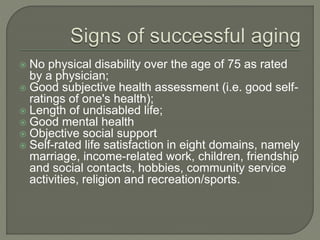
 Signs of successful aging
 About life extension sciences
 How can quality of life can be improved?
 How to extend life period?
 Conclusion
In this topic ‘AGING’ we will know that what
aging actually is and how it occurs. A little bit
of history. Does it occurs in all living beings or
all cells of a multicellular being or just in
particular cells. We will also study that how it
proceeds on or how can we explain the fact
aging. How the aging is optimal? Further more
I'm going to tell that how aging can be slowed
down. And about the life extension and life
extension sciences. At the end we will look
down upon the strategies to lengthen the
cellular life.
The gradual negative
physiological activity of
living cells in an organism
over a period of time is
designated as aging.
Stochastic
Non-stochastic/Biological
Physiological
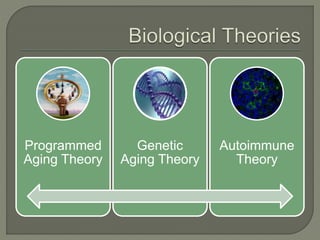
Programmed
Aging Theory
Genetic
Aging Theory
Autoimmune
Theory
Life span and the death are all
programmed
A biological clock controls cell behavior
and lifespan
There are specific number of meiosis for
every kind of cell
Some of the cells do not divide and just
age
 life span of a cell or organism is
genetically determined
 The number of repeats in a telomere
determines the maximum life span of a
cell, since each time a cell divides,
multiple repeats are lost. Once telomeres
have been reduced to a certain size, the
cell reaches a crisis point and is
prevented from dividing further
Changes in immune system are
responsible for the effects of aging
 The system that
produces antibodies loses its ability to
distinguish between “self” and foreign
proteins.
Free
Radical
Theory
Somatic
Mutation
Theory
Wear
And Tear
Theory
Cells are damaged by free radicals
They oxidize DNA
organisms age because cells
accumulate free radical damage over time
Mutations are those inheritable changes
that occur in the cellular DNA.
Chromosomes are damaged or the
mutation occurs due to radiation or much
sun exposure
Any change in genetic complement of
somatic cells leads to aging
 animals and cells, like machines, simply
wear out
however, unlike machines, have some
ability to repair themselves
waste products accumulate within cells
and interfere with function
Activity theory
Continuity
theory
Disengagement
theory
For successful ageing the activities should
be changed
Activities of an individual effect the aging
process
Ones behavior also determines the extent
and speed of aging
Thoughts are very important
Peoples ways of engaging with a society
effects aging
A lonely person will age faster than others
 The first formal studies of ageing appear
to be those of Muhammad ibn Yusuf al-
harawi (1582) in his book entitled Ainul
Hayat
Optimal aging refers to the fact that if one
is aging properly or not
According to the age of the person
According to physical health
 No physical disability over the age of 75 as rated
by a physician;
 Good subjective health assessment (i.e. good self-
ratings of one's health);
 Length of undisabled life;
 Good mental health
 Objective social support
 Self-rated life satisfaction in eight domains, namely
marriage, income-related work, children, friendship
and social contacts, hobbies, community service
activities, religion and recreation/sports.
 Life extension science, also known as anti-
aging medicine, indefinite life
extension, experimental gerontology,
and biomedical gerontology
 the scientific study of the biological,
psychological, and sociological phenomena
associated with old age and aging is called
gerontology
 It also includes how to prevent various aging
issues
By eating good food
Living happily
Making social
connections
Fooling genes
Aging is the accumulation of changes in a
person over time. Also it’s a natural
process it cannot be prevented but can be
slowed down by taking care of oneself.
There are a lot of theories being proposed
to explain the process of aging. But none
of them can completely explain the
process.
Aging
Aging

Aging

  • 2.
     Introduction aboutthe topic  What is aging?  Theories for explaining the process of aging  History: when did formal studies about aging started?  Optimal aging  Signs of successful aging  About life extension sciences  How can quality of life can be improved?  How to extend life period?  Conclusion
  • 3.
    In this topic‘AGING’ we will know that what aging actually is and how it occurs. A little bit of history. Does it occurs in all living beings or all cells of a multicellular being or just in particular cells. We will also study that how it proceeds on or how can we explain the fact aging. How the aging is optimal? Further more I'm going to tell that how aging can be slowed down. And about the life extension and life extension sciences. At the end we will look down upon the strategies to lengthen the cellular life.
  • 4.
    The gradual negative physiologicalactivity of living cells in an organism over a period of time is designated as aging.
  • 5.
  • 6.
  • 7.
    Life span andthe death are all programmed A biological clock controls cell behavior and lifespan There are specific number of meiosis for every kind of cell Some of the cells do not divide and just age
  • 8.
     life spanof a cell or organism is genetically determined  The number of repeats in a telomere determines the maximum life span of a cell, since each time a cell divides, multiple repeats are lost. Once telomeres have been reduced to a certain size, the cell reaches a crisis point and is prevented from dividing further
  • 9.
    Changes in immunesystem are responsible for the effects of aging  The system that produces antibodies loses its ability to distinguish between “self” and foreign proteins.
  • 10.
  • 11.
    Cells are damagedby free radicals They oxidize DNA organisms age because cells accumulate free radical damage over time
  • 12.
    Mutations are thoseinheritable changes that occur in the cellular DNA. Chromosomes are damaged or the mutation occurs due to radiation or much sun exposure Any change in genetic complement of somatic cells leads to aging
  • 13.
     animals andcells, like machines, simply wear out however, unlike machines, have some ability to repair themselves waste products accumulate within cells and interfere with function
  • 14.
  • 15.
    For successful ageingthe activities should be changed Activities of an individual effect the aging process
  • 16.
    Ones behavior alsodetermines the extent and speed of aging Thoughts are very important
  • 17.
    Peoples ways ofengaging with a society effects aging A lonely person will age faster than others
  • 19.
     The firstformal studies of ageing appear to be those of Muhammad ibn Yusuf al- harawi (1582) in his book entitled Ainul Hayat
  • 20.
    Optimal aging refersto the fact that if one is aging properly or not According to the age of the person According to physical health
  • 21.
     No physicaldisability over the age of 75 as rated by a physician;  Good subjective health assessment (i.e. good self- ratings of one's health);  Length of undisabled life;  Good mental health  Objective social support  Self-rated life satisfaction in eight domains, namely marriage, income-related work, children, friendship and social contacts, hobbies, community service activities, religion and recreation/sports.
  • 22.
     Life extensionscience, also known as anti- aging medicine, indefinite life extension, experimental gerontology, and biomedical gerontology  the scientific study of the biological, psychological, and sociological phenomena associated with old age and aging is called gerontology  It also includes how to prevent various aging issues
  • 23.
    By eating goodfood Living happily Making social connections
  • 24.
  • 32.
    Aging is theaccumulation of changes in a person over time. Also it’s a natural process it cannot be prevented but can be slowed down by taking care of oneself. There are a lot of theories being proposed to explain the process of aging. But none of them can completely explain the process.