Dr.M.MUHIL MD.,PhD ,PGDip Bioethics
Professor &HOD Physiology
Trichy SRM Medical College Hospital&RC
Trichy.
Aging & Oxidative stress
2.
Learning Objectives
▪ Introduction
▪Theories of aging
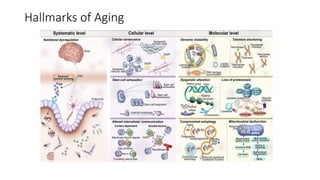
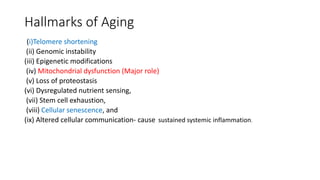
▪ Hallmarks of AGING
▪ oxidative stress and Antioxidant
▪ Physiological changes with aging
▪ “Successful aging”
▪ Anti-aging
▪ Recent updates
2
3.
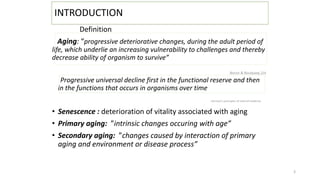
INTRODUCTION
Definition
Aging: “progressive deteriorativechanges, during the adult period of
life, which underlie an increasing vulnerability to challenges and thereby
decrease ability of organism to survive”
Progressive universal decline first in the functional reserve and then
in the functions that occurs in organisms over time
• Senescence : deterioration of vitality associated with aging
• Primary aging: ”intrinsic changes occuring with age”
• Secondary aging: ”changes caused by interaction of primary
aging and environment or disease process”
Boron & Boulpaep,2/e
3
Harrison’s principles of internal medicine
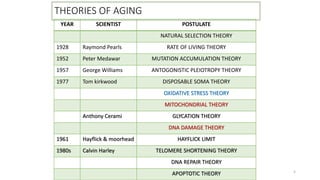
THEORIES OF AGING
YEARSCIENTIST POSTULATE
NATURAL SELECTION THEORY
1928 Raymond Pearls RATE OF LIVING THEORY
1952 Peter Medawar MUTATION ACCUMULATION THEORY
1957 George Williams ANTOGONISTIC PLEIOTROPY THEORY
1977 Tom kirkwood DISPOSABLE SOMA THEORY
OXIDATIVE STRESS THEORY
MITOCHONDRIAL THEORY
Anthony Cerami GLYCATION THEORY
DNA DAMAGE THEORY
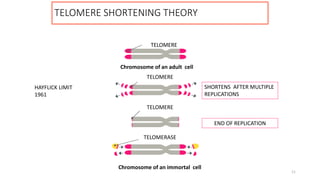
1961 Hayflick & moorhead HAYFLICK LIMIT
1980s Calvin Harley TELOMERE SHORTENING THEORY
DNA REPAIR THEORY
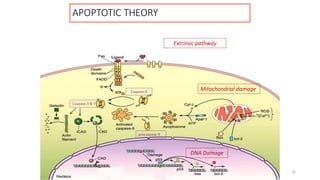
APOPTOTIC THEORY 5
Mitochondria and Aging
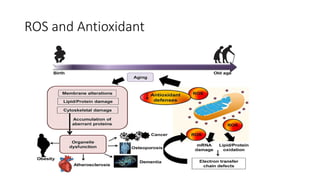
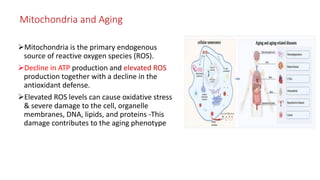
➢Mitochondriais the primary endogenous
source of reactive oxygen species (ROS).
➢Decline in ATP production and elevated ROS
production together with a decline in the
antioxidant defense.
➢Elevated ROS levels can cause oxidative stress
& severe damage to the cell, organelle
membranes, DNA, lipids, and proteins -This
damage contributes to the aging phenotype
13.
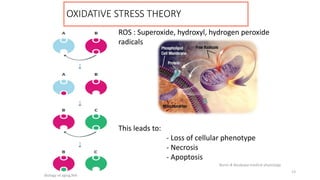
ROS : Superoxide,hydroxyl, hydrogen peroxide
radicals
This leads to:
- Loss of cellular phenotype
- Necrosis
- Apoptosis
OXIDATIVE STRESS THEORY
13
Boron & Boulpaep medical physiology
Biology of aging,NIA
14.
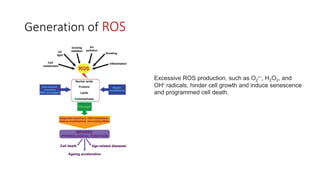
Generation of ROS
ExcessiveROS production, such as O2
•–, H2O2, and
OH• radicals, hinder cell growth and induce senescence
and programmed cell death.
15.
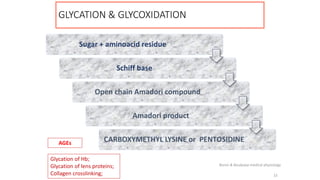
GLYCATION & GLYCOXIDATION
15
Boron& Boulpaep medical physiology
Sugar + aminoacid residue
Schiff base
Open chain Amadori compound
Amadori product
CARBOXYMETHYL LYSINE or PENTOSIDINE
Glycation of Hb;
Glycation of lens proteins;
Collagen crosslinking;
AGEs
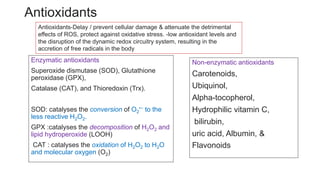
Antioxidants
Enzymatic antioxidants
Superoxide dismutase(SOD), Glutathione
peroxidase (GPX),
Catalase (CAT), and Thioredoxin (Trx).
SOD: catalyses the conversion of O2
•− to the
less reactive H2O2.
GPX :catalyses the decomposition of H2O2 and
lipid hydroperoxide (LOOH)
CAT : catalyses the oxidation of H2O2 to H2O
and molecular oxygen (O2)
Non-enzymatic antioxidants
Carotenoids,
Ubiquinol,
Alpha-tocopherol,
Hydrophilic vitamin C,
bilirubin,
uric acid, Albumin, &
Flavonoids
Antioxidants-Delay / prevent cellular damage & attenuate the detrimental
effects of ROS, protect against oxidative stress. -low antioxidant levels and
the disruption of the dynamic redox circuitry system, resulting in the
accretion of free radicals in the body
18.
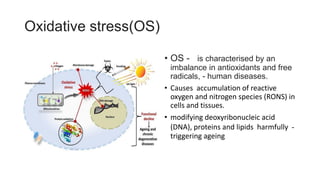
Oxidative stress(OS)
• OS- is characterised by an
imbalance in antioxidants and free
radicals, - human diseases.
• Causes accumulation of reactive
oxygen and nitrogen species (RONS) in
cells and tissues.
• modifying deoxyribonucleic acid
(DNA), proteins and lipids harmfully -
triggering ageing
19.
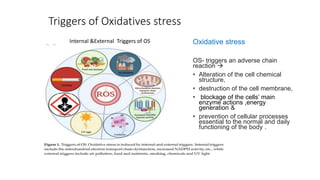
Triggers of Oxidativesstress
Internal &External Triggers of OS Oxidative stress
OS- triggers an adverse chain
reaction →
• Alteration of the cell chemical
structure,
• destruction of the cell membrane,
• blockage of the cells’ main
enzyme actions ,energy
generation &
• prevention of cellular processes
essential to the normal and daily
functioning of the body .
20.
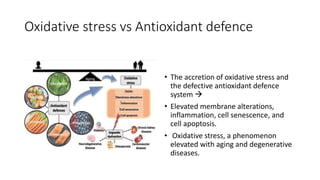
Oxidative stress vsAntioxidant defence
• The accretion of oxidative stress and
the defective antioxidant defence
system →
• Elevated membrane alterations,
inflammation, cell senescence, and
cell apoptosis.
• Oxidative stress, a phenomenon
elevated with aging and degenerative
diseases.
CHANGES IN SKELETALMUSCLE
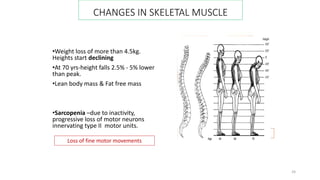
•Weight loss of more than 4.5kg.
Heights start declining
•At 70 yrs-height falls 2.5% - 5% lower
than peak.
•Lean body mass & Fat free mass
•Sarcopenia –due to inactivity,
progressive loss of motor neurons
innervating type II motor units.
NORMAL AGED
Loss of fine motor movements
24
23.
CHANGES IN CARDIOVASCULARSYSTEM
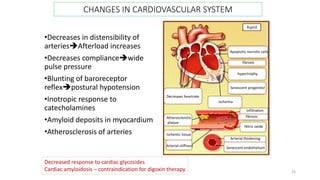
•Decreases in distensibility of
arteries➔Afterload increases
•Decreases compliance➔wide
pulse pressure
•Blunting of baroreceptor
reflex➔postural hypotension
•Inotropic response to
catecholamines
•Amyloid deposits in myocardium
•Atherosclerosis of arteries
Decreased response to cardiac glycosides
Cardiac amyloidosis – contraindication for digoxin therapy 25
ls
Apoptotic necrotic cells
fibrosis
hypertrophy
ischemia
Senescent progenitor
Decreases heartrate
Atherosclerotic
plaque
Ischemic tissue
Arterial stiffness
infiltration
fibrosis
Arterial thickening
Senescent endothelium
Nitric oxide
24.
RESPIRATORY SYSTEM
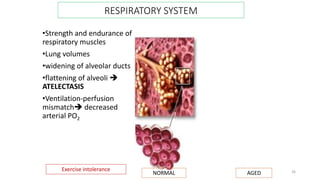
•Strength andendurance of
respiratory muscles
•Lung volumes
•widening of alveolar ducts
•flattening of alveoli ➔
ATELECTASIS
•Ventilation-perfusion
mismatch➔ decreased
arterial PO2
NORMAL AGED
Exercise intolerance 26
25.
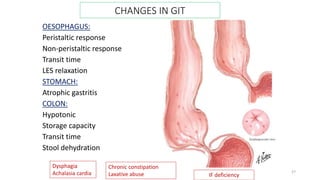
OESOPHAGUS:
Peristaltic response
Non-peristaltic response
Transittime
LES relaxation
STOMACH:
Atrophic gastritis
COLON:
Hypotonic
Storage capacity
Transit time
Stool dehydration
Dysphagia
Achalasia cardia 27
CHANGES IN GIT
IF deficiency
Chronic constipation
Laxative abuse
26.
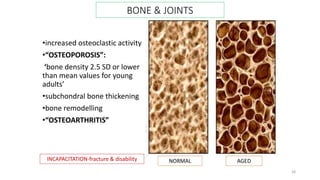
BONE & JOINTS
•increasedosteoclastic activity
•“OSTEOPOROSIS”:
‘bone density 2.5 SD or lower
than mean values for young
adults’
•subchondral bone thickening
•bone remodelling
•“OSTEOARTHRITIS”
NORMAL AGED
INCAPACITATION-fracture & disability
28
27.
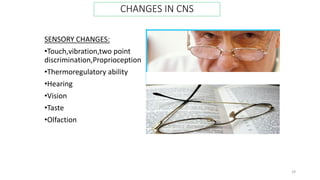
CHANGES IN CNS
SENSORYCHANGES:
•Touch,vibration,two point
discrimination,Proprioception
•Thermoregulatory ability
•Hearing
•Vision
•Taste
•Olfaction
29
28.
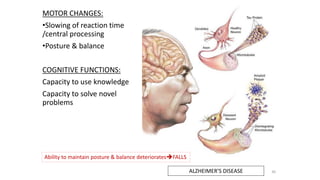
MOTOR CHANGES:
•Slowing ofreaction time
/central processing
•Posture & balance
COGNITIVE FUNCTIONS:
Capacity to use knowledge
Capacity to solve novel
problems
ALZHEIMER’S DISEASE
Ability to maintain posture & balance deteriorates➔FALLS
30
29.
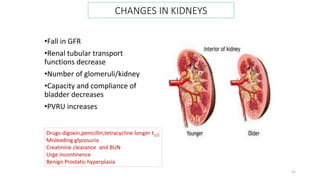
CHANGES IN KIDNEYS
•Fallin GFR
•Renal tubular transport
functions decrease
•Number of glomeruli/kidney
•Capacity and compliance of
bladder decreases
•PVRU increases
Drugs-digoxin,penicillin,tetracycline-longer t1/2
Misleading glycosuria
Creatinine clearance and BUN
Urge incontinence
Benign Prostatic hyperplasia
31
30.
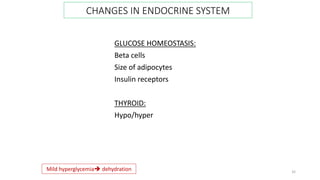
CHANGES IN ENDOCRINESYSTEM
GLUCOSE HOMEOSTASIS:
Beta cells
Size of adipocytes
Insulin receptors
THYROID:
Hypo/hyper
Mild hyperglycemia➔ dehydration 32
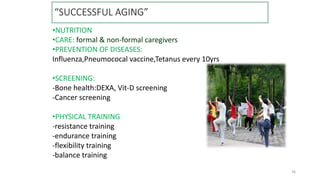
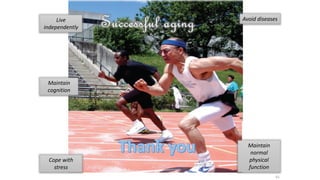
“SUCCESSFUL AGING”
•NUTRITION
•CARE: formal& non-formal caregivers
•PREVENTION OF DISEASES:
Influenza,Pneumococal vaccine,Tetanus every 10yrs
•SCREENING:
-Bone health:DEXA, Vit-D screening
-Cancer screening
•PHYSICAL TRAINING
-resistance training
-endurance training
-flexibility training
-balance training
36
35.
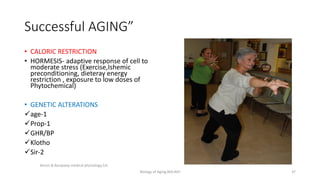
Successful AGING”
• CALORICRESTRICTION
• HORMESIS- adaptive response of cell to
moderate stress (Exercise,Ishemic
preconditioning, dieteray energy
restriction , exposure to low doses of
Phytochemical)
• GENETIC ALTERATIONS
✓age-1
✓Prop-1
✓GHR/BP
✓Klotho
✓Sir-2
Biology of Aging,NIA,NIH 37
Boron & Boulpaep medical physiology,2/e
36.
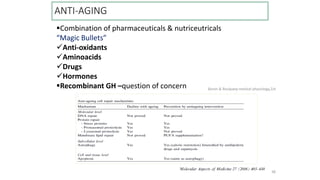
ANTI-AGING
▪Combination of pharmaceuticals& nutriceutricals
“Magic Bullets”
✓Anti-oxidants
✓Aminoacids
✓Drugs
✓Hormones
▪Recombinant GH –question of concern
38
Boron & Boulpaep medical physiology,2/e
37.
FOCUS OF RESEARCH
•Measuring telomerase may help detect cancer.
• Stopping telomerase may fight cancer by causing death of
cancer cells.
• Telomerase may be used to help with wound healing or the
immune response.
• Subdermal injection of hyaluronic acid and platelets for
skin wrinkling associated with aging
• Rapamycin prolongs life acting on mTOR
• Revarestrol activates Sir-2 causing longevity
39
Biology of aging,NIA
38.
REFERENCES
• Boron &Boulpaep Medical physiology;
• Harrison’s principles of internal medicine,17/e;
• Davidson’s textbook of medicine;
• Biology of aging,Handbook of NIA,NIH,US;
Journals
• Geriatric medicine,Western journal of medicine,1981;
• Molecular aspects of medicine,2006;
• ADAM medical physiology;
40
 Most read
 Most read