
Dr Doha Rasheedy
Assistant lecturer of geriatric medicine
Geriatrics Intensive care unit
Geriatric medicine department
Ain Shams University
 Aging is a process of general,
irreversible, and progressive
physical deterioration that
occurs over time.
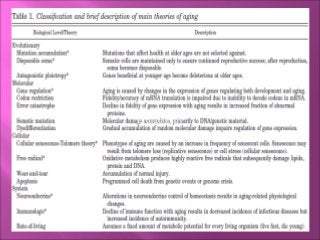
Theories are classified in 4
levels:
•Evolutionary
•Molecular
•Cellular
•System
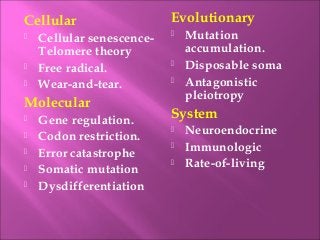
Cellular
 Cellular senescence-
Telomere theory
 Free radical.
 Wear-and-tear.
Molecular
 Gene regulation.
 Codon restriction.
 Error catastrophe
 Somatic mutation
 Dysdifferentiation
Evolutionary
 Mutation
accumulation.
 Disposable soma
 Antagonistic
pleiotropy
System
 Neuroendocrine
 Immunologic
 Rate-of-living
Evolutionary
 Free radicals and oxidants--called reactive
oxygen species (ROS) are highly reactive
molecules that can damage all sorts of
cellular components.
 ROS can originate from exogenous sources
such as ultraviolet (UV) and ionizing
radiations or from several intracellular
sources:
1-The major source is the mitochondrial generation
of ATP energy using oxygen.
2- The peroxisomes, organelles that degrade fatty
acids .
3-Cytochrome P450 enzymes. SOR is a by-product
of many of these detoxification reactions .
4-White blood cells (phagocytes) attack germs with
a mixture of oxidants including SOR.
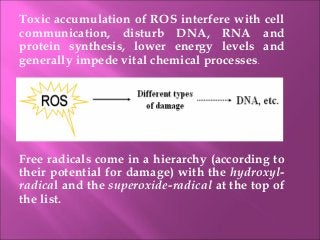
Toxic accumulation of ROS interfere with cell
communication, disturb DNA, RNA and
protein synthesis, lower energy levels and
generally impede vital chemical processes.
Free radicals come in a hierarchy (according to
their potential for damage) with the hydroxyl-
radical and the superoxide-radical at the top of
the list.
 To protect against oxidation there are
many different types of antioxidants,
from vitamins C and E selenium, CoQ10
and lipoic acid to enzymes such as
superoxide dismutase (SOD), catalase,
and glutathione peroxidase. Briefly,
antioxidant enzymes are capable of
degrading ROS into inert compounds
through a series of chemical reactions.
 The pineal hormone melatonin also
plays multiple antioxidant roles
Cell
senescence/telomere
theory.
 Replicative senescence is a specific type
of cellular senescence that ultimately
results from loss of telomeres (specialized
structures composed of a repeating DNA
sequence and located at the ends of each
linear chromosome; With each cell
division, a small amount of DNA is lost at
each chromosome end, resulting in shorter
telomeres, altered telomere structure, and
eventual replicative senescence.
 Activation of the telomerase
enzyme will regenerate telomeres,
prevent replicative senescence, and
immortalize human primary cell
cultures
Evidence
 Specialized immortal cell types such as stem
cells, germ cells, and T lymphocytes express
telomerase and will either maintain telomere
length or delay telomere attrition.
 all cancer cells activate telomerase or an
alternate pathway of telomere extension to
avoid replicative senescence.
 For structures such as teeth, it is clear that
mechanical wear and tear can contribute to
the phenotype of ageing. However, such
effects are likely to be more closely related to
chronological time than to intrinsic biological
ageing
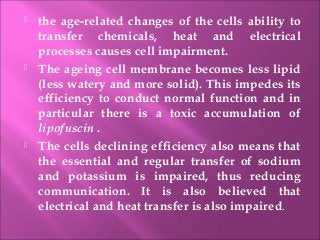
 the age-related changes of the cells ability to
transfer chemicals, heat and electrical
processes causes cell impairment.
 The ageing cell membrane becomes less lipid
(less watery and more solid). This impedes its
efficiency to conduct normal function and in
particular there is a toxic accumulation of
lipofuscin .
 The cells declining efficiency also means that
the essential and regular transfer of sodium
and potassium is impaired, thus reducing
communication. It is also believed that
electrical and heat transfer is also impaired.
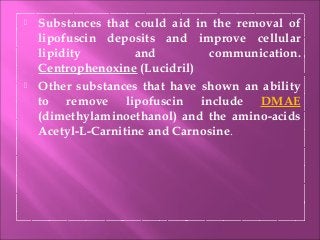
 Substances that could aid in the removal of
lipofuscin deposits and improve cellular
lipidity and communication.
Centrophenoxine (Lucidril)
 Other substances that have shown an ability
to remove lipofuscin include DMAE
(dimethylaminoethanol) and the amino-acids
Acetyl-L-Carnitine and Carnosine.
The Mitochondrial Decline
Theory
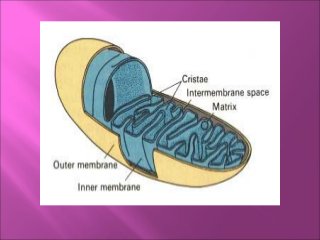
 Mitochondria are the energy generators of the
cell. They typically produce 90% or more of
all the ATP bioenergy made in the body.
 Mitochondria have their own DNA mtDNA
has no histone protection or significant
enzymes repair systems to offer free radical
protection .
 Therefore, mtDNA is far more subject to free
radical damage than nDNA.
 As mtDNA damage accumulates over the
lifetime of an individual, ATP production ,
decreases dramatically and gradually
produces a cellular energy crisis.
The Neuro-
endocrine Theory
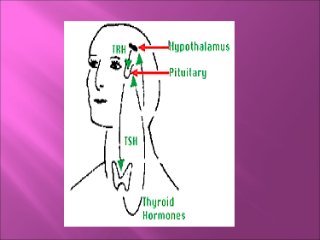
 Hypothalamo-pituitary-adrenal (HPA)
axis I s the master regulator, the
“pacemaker” that signals the onset and
termination of each life stage.
 One of the major functions of the HPA
axis is to master the physiological
adjustments necessary for preservation
and maintenance of the internal
“homeostasis” (steady state) despite the
continuing changes in the environment
 During life span, chronic exposure to
severe stress from a multitude of physical,
biological, or emotional stimuli may
exhaust or weaken the capacity to adapt
and lead to the so-called “diseases of
adaptation” and death . Aging would then
result from “a decreasing ability to survive
stress”.
 One theory for the hypothalamus loss of
regulation is that it is damaged by the
hormone cortisol. Which is considered to
be responsible for stress. It is known to be
one of the few hormones that increases
with age.
The Cross-Linking
Theory
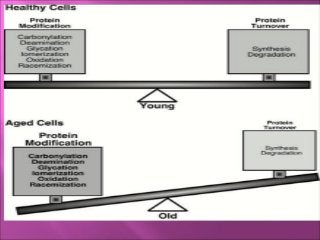
 In this theory the binding of glucose (simple
sugars) to protein, (a process that occurs under
the presence of oxygen) non-enzymatic
glycosylation causes various problems.
 The cross-linking of proteins may be
responsible for cardiac enlargement and the
hardening of collagen and atherosclerosis.
 Cross linked proteins have also been
implicated in cataract and renal disorders.
 It is also theorized that sugars binding to
DNA may cause damage that leads to
malformed cells and thus cancer.
The Hayflick Limit
Theory
 The human cell is limited in the number of
times it can divide. Part of this theory may be
affected by cell waste accumulation (The
Membrane Theory of Aging).
 The human cells ability to divide is limited to
approximately 50-times, after which they
simply stop dividing (and hence die).
 The Hayflick Limit indicates the need to slow
down the rate of cell division if we want to
live long lives. Cell division can be slowed
down by diet and lifestyle etc.
 The use of ribonucleic acids (RNAs, the
building-blocks of DNA), improve cell repair
processes, enhance cellular capabilities and
increase the maximum number of cell
divisions in animals and vitro tests. Human
clinical studies with RNA supplements such
as NeyGeront ® and RN13 ® indicate that
there are a number of biological,
physiological and practical improvements for
geriatric patients.
 Carnosine is another potent Hayflick Limit
extender.
Evolutionary Theories of
Aging:
the mutation accumulation theory
the antagonistic pleiotropy theory
 Aging is an inevitable result of the declining
force of natural selection with age. For
example, a mutant gene that kills young
children will be strongly selected against
(will not be passed to the next generation)
while a lethal mutation with effects confined
to people over the age of 80 will experience no
selection because people with this mutation
will have already passed it to their offspring
by that age. Over successive generations, late-
acting deleterious mutations will accumulate,
leading to an increase in mortality rates late
in life. 
 The theory of antagonistic pleiotropy is based
on two assumptions. First, it is assumed that a
particular gene may have an effect not on one
trait only but on several traits of an organism
(pleiotropy). The second assumption is that
these pleiotropic effects may affect individual
fitness in opposite (antagonistic) ways.
 Such genes will be maintained in the
population due to their positive effect on
reproduction at young ages despite their
negative effects at old age (their negative
effects in later life will look exactly like the
aging process)
 Late-acting deleterious genes may
even be favored by selection and be
actively accumulated in populations
if they have any beneficial effects
early in life
 Today, very little can be done!
• Healthy lifestyle
• Avoid premature aging
• Prevent diseases of aging
• Caloric restriction?
• Non-biological lifespan extension
• Cryonics, brain uploads.
• Biological interventions
• Replacement of depleted cell populations
• Regeneration
• Stem cell treatments
• Genetic modification
• Telomerase reactivation
• Drugs that affect the aging process
Biology of ageing

Biology of ageing

  • 1.
    Dr Doha Rasheedy Assistantlecturer of geriatric medicine Geriatrics Intensive care unit Geriatric medicine department Ain Shams University
  • 2.
     Aging isa process of general, irreversible, and progressive physical deterioration that occurs over time.
  • 3.
    Theories are classifiedin 4 levels: •Evolutionary •Molecular •Cellular •System
  • 4.
    Cellular  Cellular senescence- Telomeretheory  Free radical.  Wear-and-tear. Molecular  Gene regulation.  Codon restriction.  Error catastrophe  Somatic mutation  Dysdifferentiation Evolutionary  Mutation accumulation.  Disposable soma  Antagonistic pleiotropy System  Neuroendocrine  Immunologic  Rate-of-living
  • 5.
  • 7.
     Free radicalsand oxidants--called reactive oxygen species (ROS) are highly reactive molecules that can damage all sorts of cellular components.  ROS can originate from exogenous sources such as ultraviolet (UV) and ionizing radiations or from several intracellular sources: 1-The major source is the mitochondrial generation of ATP energy using oxygen. 2- The peroxisomes, organelles that degrade fatty acids . 3-Cytochrome P450 enzymes. SOR is a by-product of many of these detoxification reactions . 4-White blood cells (phagocytes) attack germs with a mixture of oxidants including SOR.
  • 8.
    Toxic accumulation ofROS interfere with cell communication, disturb DNA, RNA and protein synthesis, lower energy levels and generally impede vital chemical processes. Free radicals come in a hierarchy (according to their potential for damage) with the hydroxyl- radical and the superoxide-radical at the top of the list.
  • 9.
     To protectagainst oxidation there are many different types of antioxidants, from vitamins C and E selenium, CoQ10 and lipoic acid to enzymes such as superoxide dismutase (SOD), catalase, and glutathione peroxidase. Briefly, antioxidant enzymes are capable of degrading ROS into inert compounds through a series of chemical reactions.  The pineal hormone melatonin also plays multiple antioxidant roles
  • 10.
  • 11.
     Replicative senescenceis a specific type of cellular senescence that ultimately results from loss of telomeres (specialized structures composed of a repeating DNA sequence and located at the ends of each linear chromosome; With each cell division, a small amount of DNA is lost at each chromosome end, resulting in shorter telomeres, altered telomere structure, and eventual replicative senescence.
  • 12.
     Activation ofthe telomerase enzyme will regenerate telomeres, prevent replicative senescence, and immortalize human primary cell cultures
  • 13.
    Evidence  Specialized immortalcell types such as stem cells, germ cells, and T lymphocytes express telomerase and will either maintain telomere length or delay telomere attrition.  all cancer cells activate telomerase or an alternate pathway of telomere extension to avoid replicative senescence.
  • 15.
     For structuressuch as teeth, it is clear that mechanical wear and tear can contribute to the phenotype of ageing. However, such effects are likely to be more closely related to chronological time than to intrinsic biological ageing
  • 17.
     the age-relatedchanges of the cells ability to transfer chemicals, heat and electrical processes causes cell impairment.  The ageing cell membrane becomes less lipid (less watery and more solid). This impedes its efficiency to conduct normal function and in particular there is a toxic accumulation of lipofuscin .  The cells declining efficiency also means that the essential and regular transfer of sodium and potassium is impaired, thus reducing communication. It is also believed that electrical and heat transfer is also impaired.
  • 18.
     Substances thatcould aid in the removal of lipofuscin deposits and improve cellular lipidity and communication. Centrophenoxine (Lucidril)  Other substances that have shown an ability to remove lipofuscin include DMAE (dimethylaminoethanol) and the amino-acids Acetyl-L-Carnitine and Carnosine.
  • 19.
  • 21.
     Mitochondria arethe energy generators of the cell. They typically produce 90% or more of all the ATP bioenergy made in the body.  Mitochondria have their own DNA mtDNA has no histone protection or significant enzymes repair systems to offer free radical protection .  Therefore, mtDNA is far more subject to free radical damage than nDNA.  As mtDNA damage accumulates over the lifetime of an individual, ATP production , decreases dramatically and gradually produces a cellular energy crisis.
  • 22.
  • 24.
     Hypothalamo-pituitary-adrenal (HPA) axisI s the master regulator, the “pacemaker” that signals the onset and termination of each life stage.  One of the major functions of the HPA axis is to master the physiological adjustments necessary for preservation and maintenance of the internal “homeostasis” (steady state) despite the continuing changes in the environment
  • 25.
     During lifespan, chronic exposure to severe stress from a multitude of physical, biological, or emotional stimuli may exhaust or weaken the capacity to adapt and lead to the so-called “diseases of adaptation” and death . Aging would then result from “a decreasing ability to survive stress”.  One theory for the hypothalamus loss of regulation is that it is damaged by the hormone cortisol. Which is considered to be responsible for stress. It is known to be one of the few hormones that increases with age.
  • 26.
  • 28.
     In thistheory the binding of glucose (simple sugars) to protein, (a process that occurs under the presence of oxygen) non-enzymatic glycosylation causes various problems.  The cross-linking of proteins may be responsible for cardiac enlargement and the hardening of collagen and atherosclerosis.  Cross linked proteins have also been implicated in cataract and renal disorders.  It is also theorized that sugars binding to DNA may cause damage that leads to malformed cells and thus cancer.
  • 29.
  • 30.
     The humancell is limited in the number of times it can divide. Part of this theory may be affected by cell waste accumulation (The Membrane Theory of Aging).  The human cells ability to divide is limited to approximately 50-times, after which they simply stop dividing (and hence die).  The Hayflick Limit indicates the need to slow down the rate of cell division if we want to live long lives. Cell division can be slowed down by diet and lifestyle etc.
  • 31.
     The useof ribonucleic acids (RNAs, the building-blocks of DNA), improve cell repair processes, enhance cellular capabilities and increase the maximum number of cell divisions in animals and vitro tests. Human clinical studies with RNA supplements such as NeyGeront ® and RN13 ® indicate that there are a number of biological, physiological and practical improvements for geriatric patients.  Carnosine is another potent Hayflick Limit extender.
  • 32.
    Evolutionary Theories of Aging: themutation accumulation theory the antagonistic pleiotropy theory
  • 33.
     Aging isan inevitable result of the declining force of natural selection with age. For example, a mutant gene that kills young children will be strongly selected against (will not be passed to the next generation) while a lethal mutation with effects confined to people over the age of 80 will experience no selection because people with this mutation will have already passed it to their offspring by that age. Over successive generations, late- acting deleterious mutations will accumulate, leading to an increase in mortality rates late in life. 
  • 34.
     The theoryof antagonistic pleiotropy is based on two assumptions. First, it is assumed that a particular gene may have an effect not on one trait only but on several traits of an organism (pleiotropy). The second assumption is that these pleiotropic effects may affect individual fitness in opposite (antagonistic) ways.  Such genes will be maintained in the population due to their positive effect on reproduction at young ages despite their negative effects at old age (their negative effects in later life will look exactly like the aging process)
  • 35.
     Late-acting deleteriousgenes may even be favored by selection and be actively accumulated in populations if they have any beneficial effects early in life
  • 37.
     Today, verylittle can be done! • Healthy lifestyle • Avoid premature aging • Prevent diseases of aging • Caloric restriction?
  • 38.
    • Non-biological lifespanextension • Cryonics, brain uploads. • Biological interventions • Replacement of depleted cell populations • Regeneration • Stem cell treatments • Genetic modification • Telomerase reactivation • Drugs that affect the aging process