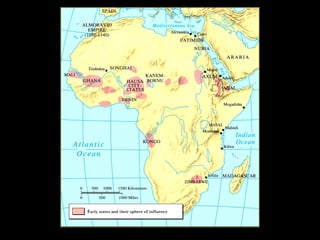
Chapter 15
Pgs. 406-429
Explain effects of Islam on North
Africa
Learning Goals
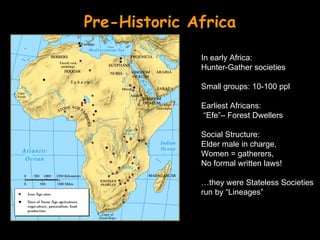
Pre-Historic Africa

              In early Africa:
              Hunter-Gather societies

              Small groups: 10-100 ppl

              Earliest Africans:
              “Efe”– Forest Dwellers

              Social Structure:
              Elder male in charge,
              Women = gatherers,
              No formal written laws!

              …they were Stateless Societies
              run by “Lineages”
“Lineages” (NC)
• Who: Early-Africans
• What: descendants of a common
  ancestor- family line.
• Where: Africa
• When: 800-1500
• Why: in African societies, families are
  organized in these family groups
How do you trace ‘Lineage’?
    Patrilineal (NC)                Matrilineal (NC)
• Family line traced through   • Family line traced through
           FATHER                         MOTHER
• Inheritance passes from      • Inheritance passes from
  father to son                  mother to SON
• When a boy marries, his      • MEN still hold the power
  wife & kids live with HIS      & authority 
  parents
“Stateless Societies” (NC)
Who: Africans
What: African groups that developed
systems of governing based on lineages, not
rulers; NO central power!!
Where: CENTRAL Africa
When: 800-1500
Why: instead of having one political ruler,
authority was balanced among powerful
lineages/families = different from the rest of
the world
Section 1
Muslim States
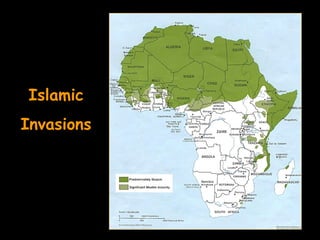
• Muslims from Middle East travel into
  Northern Africa & bring ISLAM, so…
• North Africa = Muslim!
• Rulers = Muslim!
• Islamic Law!
• Many are still Muslim today!!
2 groups of Islamic North
           Africans:
• Almoravids (1000s)
• Almohads (1100s)
“Almoravids” (NC)
• Who: Nomadic “Berbers” that became
  Islamic Africans
• What: group of Berber Islamic Africans, a
  strict religious brotherhood that lived in a
  monastery; “people of the ribat/
  (monastery)”
• Where: NORTH Africa
• When: 1000s-1100s
• Why: they took over North Africa, Ghana,
  and Spain (where they were called the
  Moors) and made them Muslim
“Almohads” (NC)
• Who: Nomadic “Berbers” who became
  Islamic Africans
• What: group of Berber Islamic Africans
  that took over the Almoravids
• Where: North Africa
• When: 1100s
• Why: they took over the Almoravids,
  conquered Spain– those areas have a lot
  of Muslims today..
Islamic
Invasions
Section 2
Learning goals

Explain how the gold-salt trade
led to the rise of Ghana.

Describe the Songhai empire.
1. Empire of Ghana
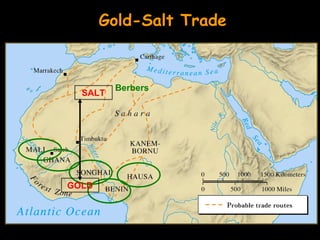
• Berbers found out that camels could cover
  larger distances than other pack animals
  (oxen, donkeys, horses), so….
 They travel on new routes across the
  desert & trade INCREASED!! (worksheet)
 The trade routes go through Ghana
  (wksht)
• …what did they trade??....
Gold-Salt Trade


         Berbers
  SALT


GOLD
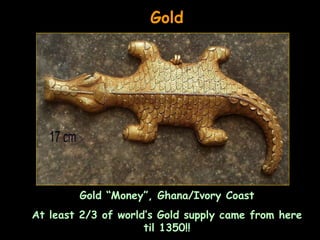
Gold


        Gold “Money”, Ghana/Ivory Coast
At least 2/3 of world’s Gold supply came from here
                     til 1350!!
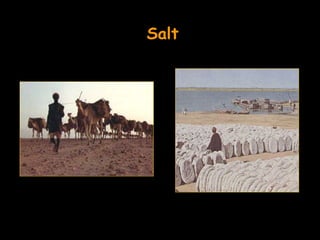
Salt
• Ghana rulers controlled trade = becomes
  super rich
• Trade = Ghana  Islam
• In 1076-- Almoravids conquer Ghana
• = Gold & Salt trade is disrupted….
• = Ghana never regains power!!
“Ghana” (NC)
• Who: Soninke farmers
• What: powerful empire founded by the
  Soninke farmers named after their war
  chief: Ghana; controlled Gold & Salt trade
• Where: West Africa
• When:
• Why: Ghana rulers controlled trade in W.
  Africa & commanded a large army=
  powerful, rich empire; when trade fell apart
  so did their power
2. Mali Empire   [13c-15c]


  SALT


GOLD
2. Mali Empire
• So, Ghana declines in power…
• = people in Ghana act on their own,
  control themselves
• = miners find Gold! to the east of Ghana
  (near the ocean)
• = trade routes to the East
• = new group- Mali- become rich & seize
  power!!
There are 3 Important guys in
            Mali…
#1. Sundiata    [1210-1255]


       “Lion Prince”
“Sundiata” (NC)
• Who: Mali’s first great leader
• What: became Mali’s “Mansa” (Emperor),
  took over Ghana, & ruled successfully
• Where: Mali, West Africa
• When: 1210?-1255
• Why: put able administrators in charge of
  Mali’s $$, defense, & foreign affairs;
  promoted agriculture; re-est. Gold-Salt
  trade = important center of trade
#2. Mansa Musa   [r. 1312-1332]
“Mansa Musa” (NC)
• Who: important Islamic ruler of Mali after
  Sundiata
• What: effectively ruled & expanded Mali
• Where: Mali, West Africa
• When: 1312-1332
• Why: he expanded Mali to 2x the size of
  Ghana; divided large empire into
  provinces w/ governors; built mosques;
  Timbuktu became one of the most imp.
  Cities under him
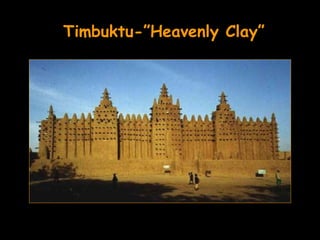
Timbuktu-”Heavenly Clay”
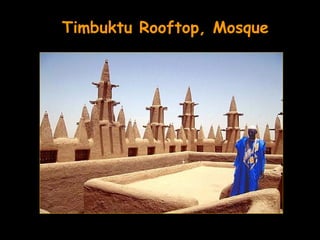
Timbuktu Rooftop, Mosque
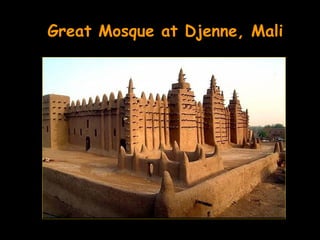
Great Mosque at Djenne, Mali
#3. Ibn Battuta (NC)
• Who: an Islamic traveler & historian
• What: traveled to all Islamic countries &
  told people in Mali about it
• Where: from North Africa, traveled to Mali
• When: 1352
• Why: he traveled to Islamic countries &
  learned about them – he then informed
  those in Mali about it
Last part on Mali…
• After Mansa Musa:
his successors lacked his ability to
  govern well…
 goldfields developed somewhere else
• = Gold trade shifted and went away…
• = The empire of Mali weakened!!
“Mali”
•   Who:
•   What:
•   Where:
•   When:
•   Why:
3. Songhai Empire   [15c-16c]


SALT


 GOLD
Sunni Ali   [r.1464-1492]

             • Aggressive Muslim
               ruler of Songhai
             • Built a vast empire
               through Military
               conquest
             • Captured Timbuktu
               from Mali
             • Created centralized
               gov’t
Askia Mohammed   [r.1493-1529]

            • Muslim rebel that took
              over Sunni Ali’s son
            • Excellent
              administrator:
            • Set up tax system
            • Put officials in charge
              of treasury, military,
              agriculture
Askia Mohammed’s Tomb   [1443-1538]


            Gao, Mali
The end of the Songhai…
• Songhai didn’t have modern weapons!!
  (only swords & spears) 
• = Morrocans invaded w. gunpowder &
  cannons!! AHH!
• = Morrocan troops quickly defeat
  Songhai…
• = ENDS 1000yrs. of powerful kingdoms in
  West Africa!!!
“Songhai” (NC)
•   Who:
•   What:
•   Where:
•   When:
•   Why:
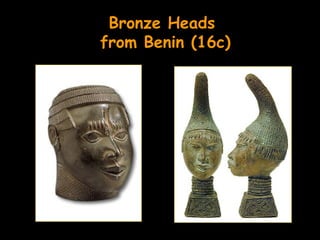
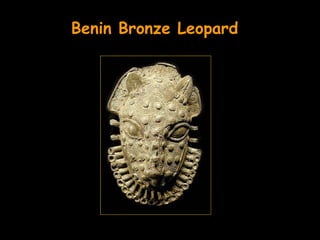
Benin Empire   [15c-19c]
Bronze Heads
from Benin (16c)
Benin Bronze Leopard
You still need to do NC:
• Hausa (pg. 417)
• Yoruba (pg. 418)
• Benin (pg. 419)
Section 3
Learning Goal
Explain how Islam influenced
East African peoples
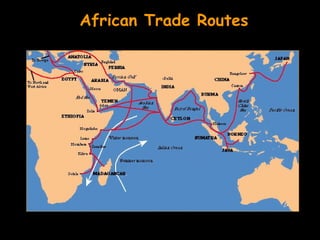
African Trade Routes
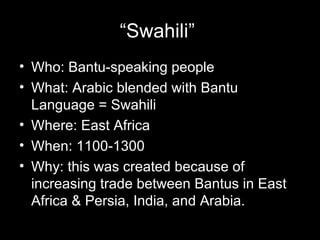
“Swahili”
• Who: Bantu-speaking people
• What: Arabic blended with Bantu
  Language = Swahili
• Where: East Africa
• When: 1100-1300
• Why: this was created because of
  increasing trade between Bantus in East
  Africa & Persia, India, and Arabia.
Swahili-Speaking Areas of E. Africa


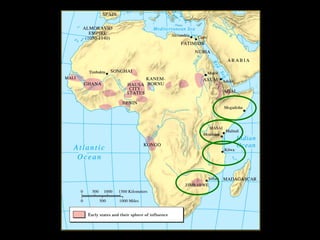
  SWAHILI [“the coast’] = Bantu + some Arabic
Great Zimbabwe        [1200-1450]


  “Zimbabwe” = “stone enclosure”
“Great Zimbabwe” (NC)
• Who: Shona people
• What: a city which grew into an empire built
  on gold trade
• Where: South-Eastern Africa
• When: 1200-1450
• Why: controlled trade routes = became rich
  & powerful = leaders taxed the traders who
  travelled through = became economic,
  political, religious center of it’s empire;
  eventually was abandoned
Manamotopa Empire                          [1450-1630]
Who: Founded by Mutota from Great Zimbabwe

                                 What: new empire that replaced Great Zim
                                       in power; military dominated


                                Why: conquered all of Zimbabwe; control of
                                   Eastern Africa; forced conquered areas
                                       to mine gold for them; Portuguese
                                       took over = European POWER!!
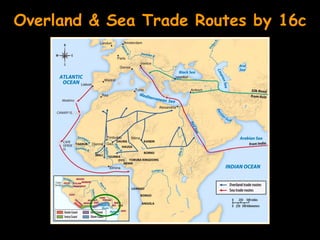
Overland & Sea Trade Routes by 16c
African Trade [15c-17c]

Ch 15 african h istory

  • 1.
  • 2.
    Explain effects ofIslam on North Africa Learning Goals
  • 3.
    Pre-Historic Africa In early Africa: Hunter-Gather societies Small groups: 10-100 ppl Earliest Africans: “Efe”– Forest Dwellers Social Structure: Elder male in charge, Women = gatherers, No formal written laws! …they were Stateless Societies run by “Lineages”
  • 4.
    “Lineages” (NC) • Who:Early-Africans • What: descendants of a common ancestor- family line. • Where: Africa • When: 800-1500 • Why: in African societies, families are organized in these family groups
  • 5.
    How do youtrace ‘Lineage’? Patrilineal (NC) Matrilineal (NC) • Family line traced through • Family line traced through FATHER MOTHER • Inheritance passes from • Inheritance passes from father to son mother to SON • When a boy marries, his • MEN still hold the power wife & kids live with HIS & authority  parents
  • 6.
    “Stateless Societies” (NC) Who:Africans What: African groups that developed systems of governing based on lineages, not rulers; NO central power!! Where: CENTRAL Africa When: 800-1500 Why: instead of having one political ruler, authority was balanced among powerful lineages/families = different from the rest of the world
  • 7.
  • 9.
    Muslim States • Muslimsfrom Middle East travel into Northern Africa & bring ISLAM, so… • North Africa = Muslim! • Rulers = Muslim! • Islamic Law! • Many are still Muslim today!!
  • 10.
    2 groups ofIslamic North Africans: • Almoravids (1000s) • Almohads (1100s)
  • 11.
    “Almoravids” (NC) • Who:Nomadic “Berbers” that became Islamic Africans • What: group of Berber Islamic Africans, a strict religious brotherhood that lived in a monastery; “people of the ribat/ (monastery)” • Where: NORTH Africa • When: 1000s-1100s • Why: they took over North Africa, Ghana, and Spain (where they were called the Moors) and made them Muslim
  • 12.
    “Almohads” (NC) • Who:Nomadic “Berbers” who became Islamic Africans • What: group of Berber Islamic Africans that took over the Almoravids • Where: North Africa • When: 1100s • Why: they took over the Almoravids, conquered Spain– those areas have a lot of Muslims today..
  • 13.
  • 14.
  • 15.
    Learning goals Explain howthe gold-salt trade led to the rise of Ghana. Describe the Songhai empire.
  • 16.
    1. Empire ofGhana • Berbers found out that camels could cover larger distances than other pack animals (oxen, donkeys, horses), so….  They travel on new routes across the desert & trade INCREASED!! (worksheet)  The trade routes go through Ghana (wksht) • …what did they trade??....
  • 17.
    Gold-Salt Trade Berbers SALT GOLD
  • 18.
    Gold Gold “Money”, Ghana/Ivory Coast At least 2/3 of world’s Gold supply came from here til 1350!!
  • 19.
  • 20.
    • Ghana rulerscontrolled trade = becomes super rich • Trade = Ghana  Islam • In 1076-- Almoravids conquer Ghana • = Gold & Salt trade is disrupted…. • = Ghana never regains power!!
  • 21.
    “Ghana” (NC) • Who:Soninke farmers • What: powerful empire founded by the Soninke farmers named after their war chief: Ghana; controlled Gold & Salt trade • Where: West Africa • When: • Why: Ghana rulers controlled trade in W. Africa & commanded a large army= powerful, rich empire; when trade fell apart so did their power
  • 22.
    2. Mali Empire [13c-15c] SALT GOLD
  • 23.
    2. Mali Empire •So, Ghana declines in power… • = people in Ghana act on their own, control themselves • = miners find Gold! to the east of Ghana (near the ocean) • = trade routes to the East • = new group- Mali- become rich & seize power!!
  • 24.
    There are 3Important guys in Mali…
  • 25.
    #1. Sundiata [1210-1255] “Lion Prince”
  • 26.
    “Sundiata” (NC) • Who:Mali’s first great leader • What: became Mali’s “Mansa” (Emperor), took over Ghana, & ruled successfully • Where: Mali, West Africa • When: 1210?-1255 • Why: put able administrators in charge of Mali’s $$, defense, & foreign affairs; promoted agriculture; re-est. Gold-Salt trade = important center of trade
  • 27.
    #2. Mansa Musa [r. 1312-1332]
  • 28.
    “Mansa Musa” (NC) •Who: important Islamic ruler of Mali after Sundiata • What: effectively ruled & expanded Mali • Where: Mali, West Africa • When: 1312-1332 • Why: he expanded Mali to 2x the size of Ghana; divided large empire into provinces w/ governors; built mosques; Timbuktu became one of the most imp. Cities under him
  • 29.
  • 30.
  • 31.
    Great Mosque atDjenne, Mali
  • 32.
    #3. Ibn Battuta(NC) • Who: an Islamic traveler & historian • What: traveled to all Islamic countries & told people in Mali about it • Where: from North Africa, traveled to Mali • When: 1352 • Why: he traveled to Islamic countries & learned about them – he then informed those in Mali about it
  • 33.
    Last part onMali… • After Mansa Musa: his successors lacked his ability to govern well…  goldfields developed somewhere else • = Gold trade shifted and went away… • = The empire of Mali weakened!!
  • 34.
    “Mali” • Who: • What: • Where: • When: • Why:
  • 35.
    3. Songhai Empire [15c-16c] SALT GOLD
  • 36.
    Sunni Ali [r.1464-1492] • Aggressive Muslim ruler of Songhai • Built a vast empire through Military conquest • Captured Timbuktu from Mali • Created centralized gov’t
  • 37.
    Askia Mohammed [r.1493-1529] • Muslim rebel that took over Sunni Ali’s son • Excellent administrator: • Set up tax system • Put officials in charge of treasury, military, agriculture
  • 38.
    Askia Mohammed’s Tomb [1443-1538] Gao, Mali
  • 39.
    The end ofthe Songhai… • Songhai didn’t have modern weapons!! (only swords & spears)  • = Morrocans invaded w. gunpowder & cannons!! AHH! • = Morrocan troops quickly defeat Songhai… • = ENDS 1000yrs. of powerful kingdoms in West Africa!!!
  • 40.
    “Songhai” (NC) • Who: • What: • Where: • When: • Why:
  • 41.
    Benin Empire [15c-19c]
  • 42.
  • 43.
  • 44.
    You still needto do NC: • Hausa (pg. 417) • Yoruba (pg. 418) • Benin (pg. 419)
  • 45.
  • 46.
    Learning Goal Explain howIslam influenced East African peoples
  • 48.
  • 49.
    “Swahili” • Who: Bantu-speakingpeople • What: Arabic blended with Bantu Language = Swahili • Where: East Africa • When: 1100-1300 • Why: this was created because of increasing trade between Bantus in East Africa & Persia, India, and Arabia.
  • 50.
    Swahili-Speaking Areas ofE. Africa SWAHILI [“the coast’] = Bantu + some Arabic
  • 52.
    Great Zimbabwe [1200-1450] “Zimbabwe” = “stone enclosure”
  • 53.
    “Great Zimbabwe” (NC) •Who: Shona people • What: a city which grew into an empire built on gold trade • Where: South-Eastern Africa • When: 1200-1450 • Why: controlled trade routes = became rich & powerful = leaders taxed the traders who travelled through = became economic, political, religious center of it’s empire; eventually was abandoned
  • 54.
    Manamotopa Empire [1450-1630] Who: Founded by Mutota from Great Zimbabwe What: new empire that replaced Great Zim in power; military dominated Why: conquered all of Zimbabwe; control of Eastern Africa; forced conquered areas to mine gold for them; Portuguese took over = European POWER!!
  • 56.
    Overland & SeaTrade Routes by 16c
  • 57.