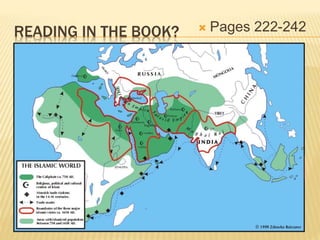
READING IN THE BOOK?  Pages 222-242
 Great West, East, and South African states
arose as a result of the growth and spread of
Islamic trade and culture.
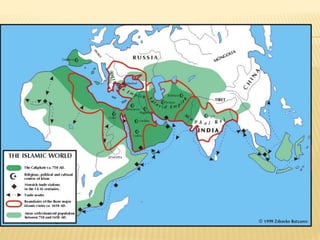
 In West Africa, Islam and its culture spread by
cultural diffusion, in East Africa by colonization
of port cities.
 With trade came a new culture, giving African
kingdoms not just a new religion but Islamic
literacy, trade, methods of statecraft, and art.
 Like Classical Greek civilization, Islamic
civilization illustrates culture and commercial
hegemony can wield power equal to that of
political hegemony.
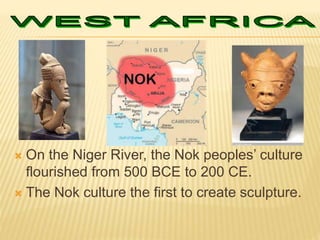
 On the Niger River, the Nok peoples’ culture
flourished from 500 BCE to 200 CE.
 The Nok culture the first to create sculpture.
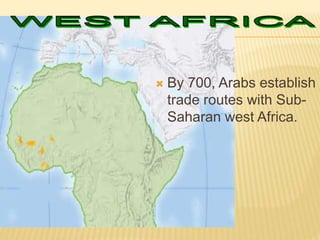
 By 700, Arabs establish
trade routes with Sub-
Saharan west Africa.
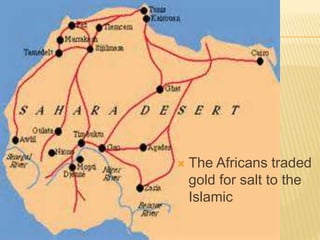
 The Africans traded
gold for salt to the
Islamic
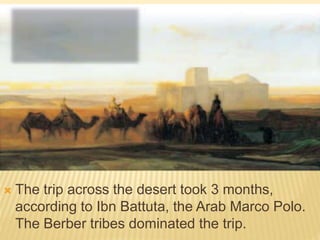
 The trip across the desert took 3 months,
according to Ibn Battuta, the Arab Marco Polo.
The Berber tribes dominated the trip.
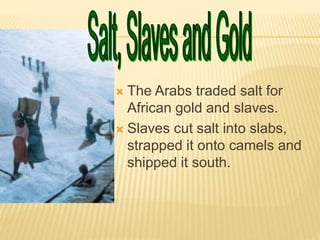
 The Arabs traded salt for
African gold and slaves.
 Slaves cut salt into slabs,
strapped it onto camels and
shipped it south.
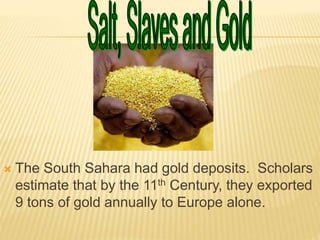
 The South Sahara had gold deposits. Scholars
estimate that by the 11th Century, they exported
9 tons of gold annually to Europe alone.
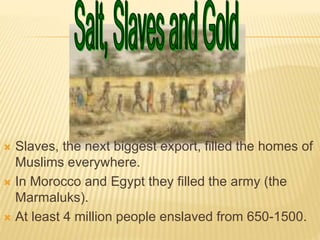
 Slaves, the next biggest export, filled the homes of
Muslims everywhere.
 In Morocco and Egypt they filled the army (the
Marmaluks).
 At least 4 million people enslaved from 650-1500.
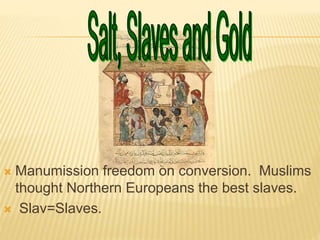
 Manumission freedom on conversion. Muslims
thought Northern Europeans the best slaves.
 Slav=Slaves.
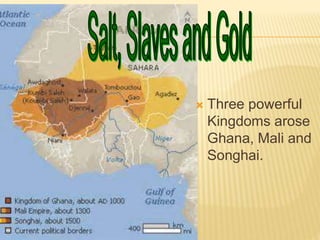
 Three powerful
Kingdoms arose
Ghana, Mali and
Songhai.
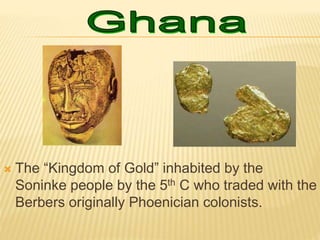
 The “Kingdom of Gold” inhabited by the
Soninke people by the 5th C who traded with the
Berbers originally Phoenician colonists.
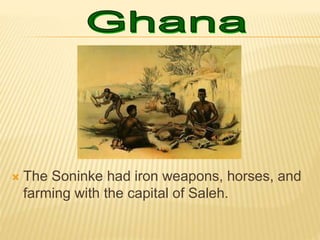
 The Soninke had iron weapons, horses, and
farming with the capital of Saleh.
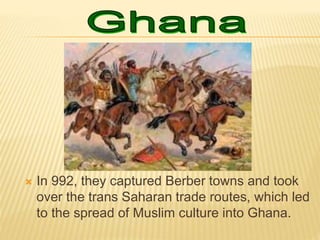
 In 992, they captured Berber towns and took
over the trans Saharan trade routes, which led
to the spread of Muslim culture into Ghana.
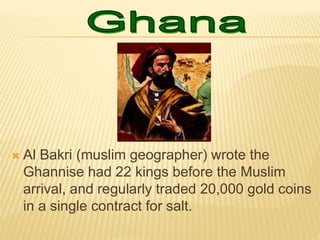
 Al Bakri (muslim geographer) wrote the
Ghannise had 22 kings before the Muslim
arrival, and regularly traded 20,000 gold coins
in a single contract for salt.
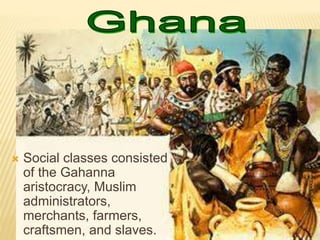
 Social classes consisted
of the Gahanna
aristocracy, Muslim
administrators,
merchants, farmers,
craftsmen, and slaves.
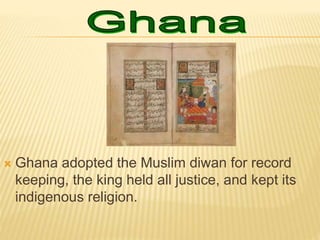
 Ghana adopted the Muslim diwan for record
keeping, the king held all justice, and kept its
indigenous religion.
 By 1077, the Almoravids, Saharan tribesmen
converted to Islam, swept into Ghana and
imposed a Muslim King ending independence.
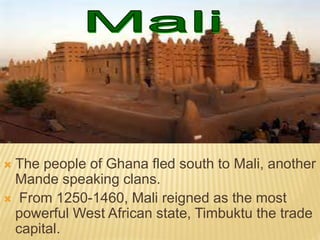
 The people of Ghana fled south to Mali, another
Mande speaking clans.
 From 1250-1460, Mali reigned as the most
powerful West African state, Timbuktu the trade
capital.
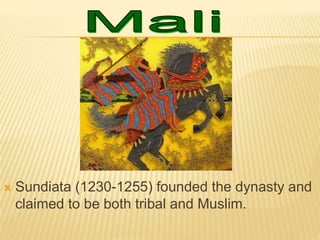
 Sundiata (1230-1255) founded the dynasty and
claimed to be both tribal and Muslim.
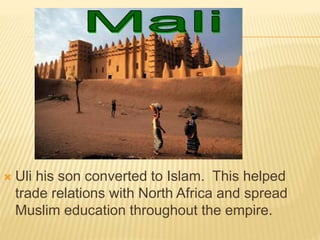
 Uli his son converted to Islam. This helped
trade relations with North Africa and spread
Muslim education throughout the empire.
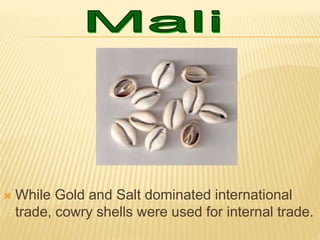
 While Gold and Salt dominated international
trade, cowry shells were used for internal trade.
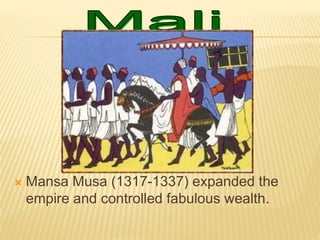
 Mansa Musa (1317-1337) expanded the
empire and controlled fabulous wealth.
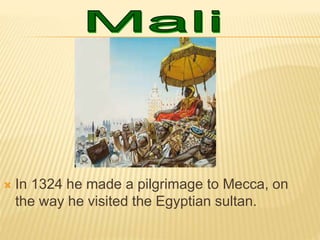
 In 1324 he made a pilgrimage to Mecca, on
the way he visited the Egyptian sultan.
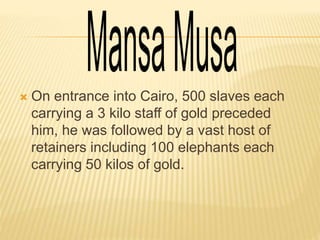
 On entrance into Cairo, 500 slaves each
carrying a 3 kilo staff of gold preceded
him, he was followed by a vast host of
retainers including 100 elephants each
carrying 50 kilos of gold.
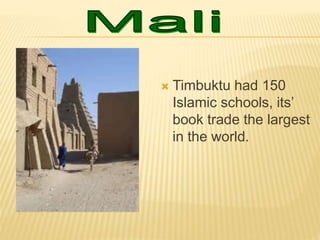
 Timbuktu had 150
Islamic schools, its’
book trade the largest
in the world.
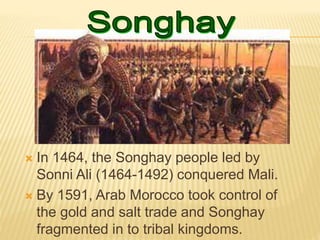
 In 1464, the Songhay people led by
Sonni Ali (1464-1492) conquered Mali.
 By 1591, Arab Morocco took control of
the gold and salt trade and Songhay
fragmented in to tribal kingdoms.
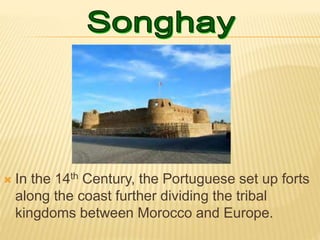
 In the 14th Century, the Portuguese set up forts
along the coast further dividing the tribal
kingdoms between Morocco and Europe.
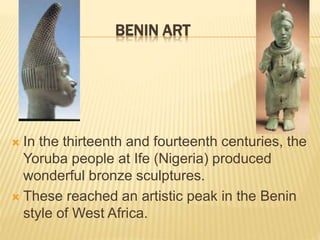
BENIN ART
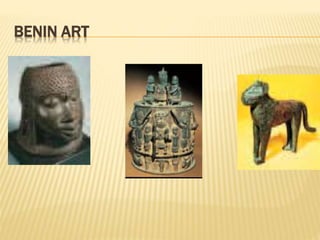
 In the thirteenth and fourteenth centuries, the
Yoruba people at Ife (Nigeria) produced
wonderful bronze sculptures.
 These reached an artistic peak in the Benin
style of West Africa.
BENIN ART
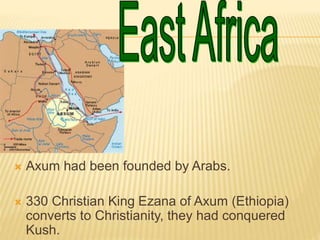
 Axum had been founded by Arabs.
 330 Christian King Ezana of Axum (Ethiopia)
converts to Christianity, they had conquered
Kush.
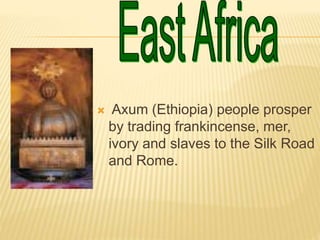
 Axum (Ethiopia) people prosper
by trading frankincense, mer,
ivory and slaves to the Silk Road
and Rome.
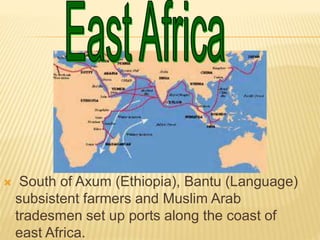
 South of Axum (Ethiopia), Bantu (Language)
subsistent farmers and Muslim Arab
tradesmen set up ports along the coast of
east Africa.
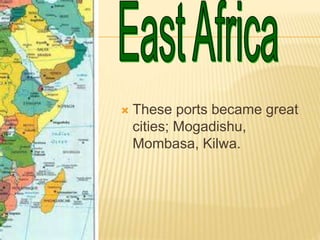
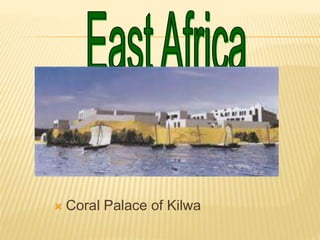
 These ports became great
cities; Mogadishu,
Mombasa, Kilwa.
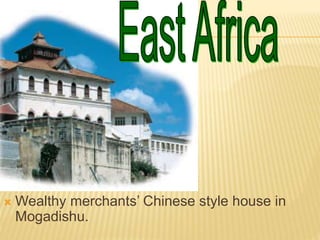
 Wealthy merchants’ Chinese style house in
Mogadishu.
 Coral Palace of Kilwa
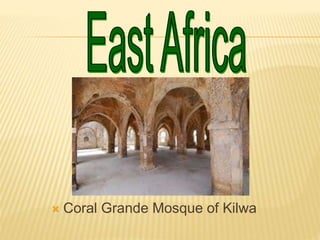
 Coral Grande Mosque of Kilwa
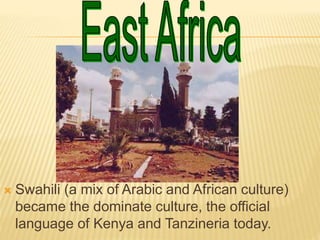
 Swahili (a mix of Arabic and African culture)
became the dominate culture, the official
language of Kenya and Tanzineria today.
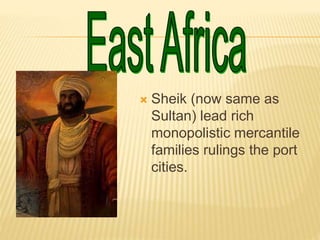
 Sheik (now same as
Sultan) lead rich
monopolistic mercantile
families rulings the port
cities.
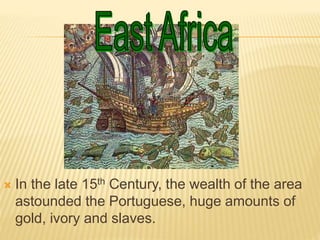
 In the late 15th Century, the wealth of the area
astounded the Portuguese, huge amounts of
gold, ivory and slaves.
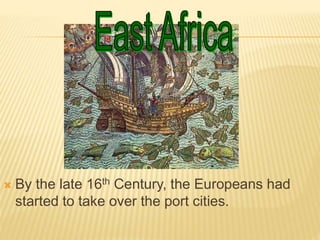
 By the late 16th Century, the Europeans had
started to take over the port cities.
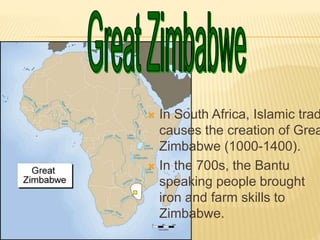
 In South Africa, Islamic trad
causes the creation of Grea
Zimbabwe (1000-1400).
 In the 700s, the Bantu
speaking people brought
iron and farm skills to
Zimbabwe.
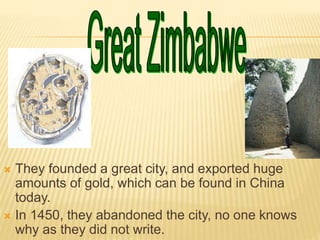
 They founded a great city, and exported huge
amounts of gold, which can be found in China
today.
 In 1450, they abandoned the city, no one knows
why as they did not write.
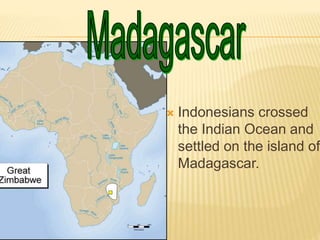
 Indonesians crossed
the Indian Ocean and
settled on the island of
Madagascar.
 15th-16th Centuries, the Portuguese then
Spanish set up forts all along the African coast
against Muslims to secure the trade route to
India.
 16th-19th Centuries, Europeans took 22 million
slaves taken out or die from Africa.
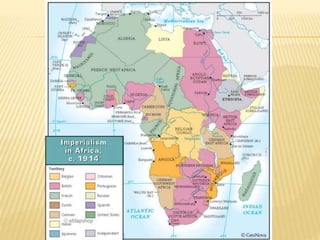
 Between 1880 and 1900, England and France
took all of Africa with a little going to Germany,
Belgium, Italy, Spain, and Portugal.
HOME WORK
 Pg 234 1-2, 6

Islam to Africa

  • 1.
    READING IN THEBOOK?  Pages 222-242
  • 2.
     Great West,East, and South African states arose as a result of the growth and spread of Islamic trade and culture.  In West Africa, Islam and its culture spread by cultural diffusion, in East Africa by colonization of port cities.
  • 3.
     With tradecame a new culture, giving African kingdoms not just a new religion but Islamic literacy, trade, methods of statecraft, and art.  Like Classical Greek civilization, Islamic civilization illustrates culture and commercial hegemony can wield power equal to that of political hegemony.
  • 4.
     On theNiger River, the Nok peoples’ culture flourished from 500 BCE to 200 CE.  The Nok culture the first to create sculpture.
  • 5.
     By 700,Arabs establish trade routes with Sub- Saharan west Africa.
  • 6.
     The Africanstraded gold for salt to the Islamic
  • 7.
     The tripacross the desert took 3 months, according to Ibn Battuta, the Arab Marco Polo. The Berber tribes dominated the trip.
  • 8.
     The Arabstraded salt for African gold and slaves.  Slaves cut salt into slabs, strapped it onto camels and shipped it south.
  • 9.
     The SouthSahara had gold deposits. Scholars estimate that by the 11th Century, they exported 9 tons of gold annually to Europe alone.
  • 10.
     Slaves, thenext biggest export, filled the homes of Muslims everywhere.  In Morocco and Egypt they filled the army (the Marmaluks).  At least 4 million people enslaved from 650-1500.
  • 11.
     Manumission freedomon conversion. Muslims thought Northern Europeans the best slaves.  Slav=Slaves.
  • 12.
     Three powerful Kingdomsarose Ghana, Mali and Songhai.
  • 13.
     The “Kingdomof Gold” inhabited by the Soninke people by the 5th C who traded with the Berbers originally Phoenician colonists.
  • 14.
     The Soninkehad iron weapons, horses, and farming with the capital of Saleh.
  • 15.
     In 992,they captured Berber towns and took over the trans Saharan trade routes, which led to the spread of Muslim culture into Ghana.
  • 16.
     Al Bakri(muslim geographer) wrote the Ghannise had 22 kings before the Muslim arrival, and regularly traded 20,000 gold coins in a single contract for salt.
  • 17.
     Social classesconsisted of the Gahanna aristocracy, Muslim administrators, merchants, farmers, craftsmen, and slaves.
  • 18.
     Ghana adoptedthe Muslim diwan for record keeping, the king held all justice, and kept its indigenous religion.
  • 19.
     By 1077,the Almoravids, Saharan tribesmen converted to Islam, swept into Ghana and imposed a Muslim King ending independence.
  • 20.
     The peopleof Ghana fled south to Mali, another Mande speaking clans.  From 1250-1460, Mali reigned as the most powerful West African state, Timbuktu the trade capital.
  • 21.
     Sundiata (1230-1255)founded the dynasty and claimed to be both tribal and Muslim.
  • 22.
     Uli hisson converted to Islam. This helped trade relations with North Africa and spread Muslim education throughout the empire.
  • 23.
     While Goldand Salt dominated international trade, cowry shells were used for internal trade.
  • 24.
     Mansa Musa(1317-1337) expanded the empire and controlled fabulous wealth.
  • 25.
     In 1324he made a pilgrimage to Mecca, on the way he visited the Egyptian sultan.
  • 26.
     On entranceinto Cairo, 500 slaves each carrying a 3 kilo staff of gold preceded him, he was followed by a vast host of retainers including 100 elephants each carrying 50 kilos of gold.
  • 27.
     Timbuktu had150 Islamic schools, its’ book trade the largest in the world.
  • 28.
     In 1464,the Songhay people led by Sonni Ali (1464-1492) conquered Mali.  By 1591, Arab Morocco took control of the gold and salt trade and Songhay fragmented in to tribal kingdoms.
  • 29.
     In the14th Century, the Portuguese set up forts along the coast further dividing the tribal kingdoms between Morocco and Europe.
  • 30.
    BENIN ART  Inthe thirteenth and fourteenth centuries, the Yoruba people at Ife (Nigeria) produced wonderful bronze sculptures.  These reached an artistic peak in the Benin style of West Africa.
  • 31.
  • 32.
     Axum hadbeen founded by Arabs.  330 Christian King Ezana of Axum (Ethiopia) converts to Christianity, they had conquered Kush.
  • 33.
     Axum (Ethiopia)people prosper by trading frankincense, mer, ivory and slaves to the Silk Road and Rome.
  • 34.
     South ofAxum (Ethiopia), Bantu (Language) subsistent farmers and Muslim Arab tradesmen set up ports along the coast of east Africa.
  • 35.
     These portsbecame great cities; Mogadishu, Mombasa, Kilwa.
  • 37.
     Wealthy merchants’Chinese style house in Mogadishu.
  • 38.
  • 39.
     Coral GrandeMosque of Kilwa
  • 40.
     Swahili (amix of Arabic and African culture) became the dominate culture, the official language of Kenya and Tanzineria today.
  • 41.
     Sheik (nowsame as Sultan) lead rich monopolistic mercantile families rulings the port cities.
  • 42.
     In thelate 15th Century, the wealth of the area astounded the Portuguese, huge amounts of gold, ivory and slaves.
  • 43.
     By thelate 16th Century, the Europeans had started to take over the port cities.
  • 44.
     In SouthAfrica, Islamic trad causes the creation of Grea Zimbabwe (1000-1400).  In the 700s, the Bantu speaking people brought iron and farm skills to Zimbabwe.
  • 45.
     They foundeda great city, and exported huge amounts of gold, which can be found in China today.  In 1450, they abandoned the city, no one knows why as they did not write.
  • 46.
     Indonesians crossed theIndian Ocean and settled on the island of Madagascar.
  • 47.
     15th-16th Centuries,the Portuguese then Spanish set up forts all along the African coast against Muslims to secure the trade route to India.  16th-19th Centuries, Europeans took 22 million slaves taken out or die from Africa.  Between 1880 and 1900, England and France took all of Africa with a little going to Germany, Belgium, Italy, Spain, and Portugal.
  • 49.
    HOME WORK  Pg234 1-2, 6