John P. McKay Bennett ● D. Hill ● John Buckler 
Patricia Buckley Ebrey ● Roger B. Beck 
Clare Haru Crowston ● Merry E. Wiesner-Hanks 
A History of World Societies 
Ninth Edition 
CHAPTER 10 
African Societies and Kingdoms, 
1000 B.C.E.–1500 C.E. modified by J. Usher 
Copyright © 2011 by Bedford/St. Martin’s
Study Questions for Chapter 10 
• How did Africa’s geography help shape its history and help to create diverse 
cultures? 
• What was the Bantu migration and what were some of its key features? 
• How did trans-Saharan affect West African culture and society? 
• What is significant about the city-state of Aksum? 
• What is significant about the society that grew in Great Zimbabwe? 
• Was Africa really a “dark continent,” isolated from the rest of the world, or is 
that a myth?
I. The Land and Peoples of Africa 
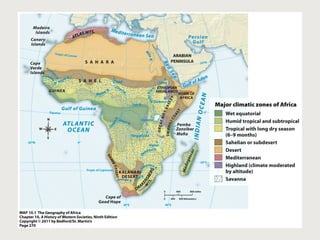
A. Africa’s Geographical and Human Diversity 
• 1. Arid plains created opportunities to hunt wild game. Wetter regions 
allowed the production of grain crops. Hunting and gathering took place in 
the tropical forests. Rivers and lakes throughout the African continent 
provided opportunities for fishing economies. 
• 2. Coastal tribes intermingled with various trading entities such as the 
Greeks or the Romans. Black Africans lived in the savanna and rain forest 
region south of the Sahara. 
B. Egypt, Race, and Being African 
• 1. Nineteenth-century Europeans could not accept the fact that Africans 
were capable of such amazing art and architecture. A now thoroughly 
discredited concept known as the Hamitic thesis emerged, positing that the 
advanced technologies were brought to Africa by a Caucasian race identified 
as the Hamites. 
• 2. Due to the history of Egypt and the varied groups, including the Greeks 
and Persians, that were involved in its development, historians debate 
whether Egypt is part of African culture or part of Middle Eastern culture.
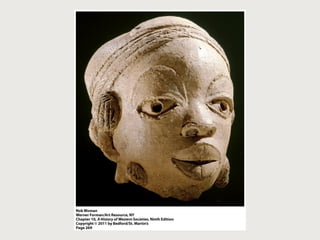
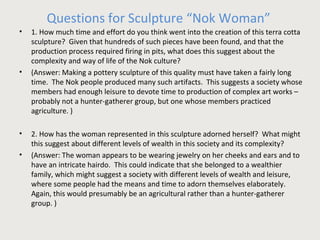
Questions for Sculpture “Nok Woman” 
• 1. How much time and effort do you think went into the creation of this terra cotta 
sculpture? Given that hundreds of such pieces have been found, and that the 
production process required firing in pits, what does this suggest about the 
complexity and way of life of the Nok culture? 
• (Answer: Making a pottery sculpture of this quality must have taken a fairly long 
time. The Nok people produced many such artifacts. This suggests a society whose 
members had enough leisure to devote time to production of complex art works – 
probably not a hunter-gatherer group, but one whose members practiced 
agriculture. ) 
• 2. How has the woman represented in this sculpture adorned herself? What might 
this suggest about different levels of wealth in this society and its complexity? 
• (Answer: The woman appears to be wearing jewelry on her cheeks and ears and to 
have an intricate hairdo. This could indicate that she belonged to a wealthier 
family, which might suggest a society with different levels of wealth and leisure, 
where some people had the means and time to adorn themselves elaborately. 
Again, this would presumably be an agricultural rather than a hunter-gatherer 
group. )
II. Early African Societies 
A. Settled Agriculture and Its Impact 
• 1. Plant cultivation may have entered African culture from Judaea. The 
development of settled agricultural production led to the need for the 
establishment of permanent villages. 
• 2. The “slash and burn” method was used to clear fields for agricultural 
production. 
• 3. Indigenous cereal grains such as millet and sorghum were domesticated, 
while other plant varieties were brought into Africa. Livestock included 
domesticated donkeys, pigs, and various types of poultry. 
• 4. Settled populations took up various trades, including ironworking. 
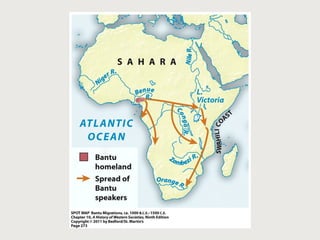
B. Bantu Migrations 
• 1. Bantu languages include Swahili, Zulu, Sotho, and Tswana. Few of the 
early Bantu-speakers wrote down their languages. 
• 2. Reasons for Bantu migrations are unclear. Possibly rapid population 
growth caused a need to migrate into eastern and southern African 
territories.
II. Early African Societies 
C. Life in the Kingdoms of the Western Sudan, 
ca. 1000 B.C.E.–800 C.E. 
• 1. The Senegal and Niger Rivers provided fertile soil 
conducive to agricultural production. Local populations were 
affiliated by blood kinship and were governed by village 
chiefs. 
• 2. Some of the villages formed kingdoms. The king shared 
power with the Queen Mother, who was a full member of 
the council and had the right to chose the next king. 
• 3. Religious beliefs were based on ancestral spirits who could 
seek God’s blessings for their families and communities. 
Others believed in nature spirits living in the sky, rocks, and 
other items of nature. Kingship and shared religious patterns 
helped keep the populations together.
III. The Trans-Saharan Trade 
A. The Berbers of North Africa 
• 1. Caravan routes between the Mediterranean Sea and the Sudan were 
established by the Berbers. Most caravan travel was done at night due to 
the desert heat. 
• 2. Caravans along the routes were threatened by the Tuareg, Berber 
raiders who lived in the desert. Water wells along the routes were 
sometimes poisoned so that the raids would be easier. 
B. Effects of Trade on West African Society 
• 1. The increase of trade influenced the development of mining for gold, 
which was exported on the trade routes. 
• 2. Slaves became a commodity of export and labor for local gold mines. 
Many Africans were forced into Muslim military service. 
• 3. The trade routes produced wealth, which helped stimulated the 
development of urban centers, where Muslim traders began to settle.
III. The Trans-Saharan Trade 
C. The Spread of Islam in Africa 
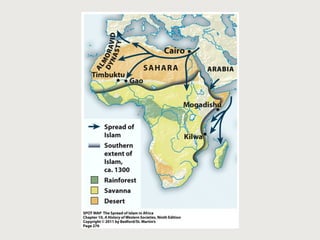
• 1. Arab invaders conquered North Africa and introduced 
Islam to the Berbers. Some peoples who traded with the 
Berbers converted to Islam in an effort to maintain their 
trading status. Others converted to avoid Muslim Berber 
attacks. 
• 2. Arabs began to teach populations in West Africa. The 
Muslims taught the king of Ghana various uses for 
technology, and he converted his kingdom to Islam. 
• 3. Islam crossed the Red Sea and entered the East African 
coast. The city of Mogadishu established a Muslim sultanate 
with a slave military corps.
IV. African Kingdoms and Empires, 
ca. 800–1500 
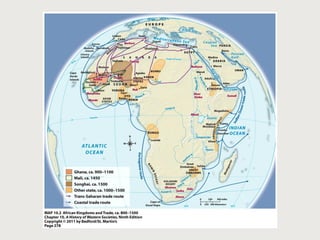
A. The Kingdom of Ghana, ca. 900–1100 
• 1. An indigenous tribe identified as the Soninke people called 
their ruler ghana, or war chief. The kingdom of Ghana took 
control of the southern caravan routes after it captured the 
town of Awdaghost from the Berbers. 
• 2. The Ghanaian king located his court in the city of Koumbi 
Saleh, where Muslim populations lived separate from 
Africans. 
• 3. The king needed to produce an annual income to support 
the large and expensive kingdom. Subordinate chieftains 
paid tribute, while traders entering and leaving the kingdom 
were charged duties.
IV. African Kingdoms and Empires, 
ca. 800–1500 
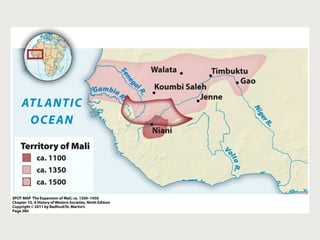
B. The Kingdom of Mali, ca. 1200–1450 
• 1. Trade and agricultural production supported a large 
population in Mali. The capital city of Niani was transformed 
into a major financial and trading center. 
• 2. Sundiata, the founder of Mali, began Mali’s imperial 
expansion, conquering Ghana and increasing Mali power by 
taking control of numerous cities along the trade routes. 
• 3. Mansa Musa converted to Islam and made the pilgrimage 
to Mecca. He later commissioned architects to build 
mosques in the city of Timbuktu.
IV. African Kingdoms and Empires, 
ca. 800–1500 
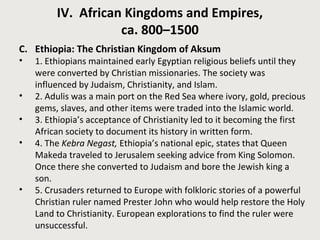
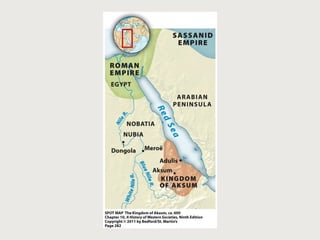
C. Ethiopia: The Christian Kingdom of Aksum 
• 1. Ethiopians maintained early Egyptian religious beliefs until they 
were converted by Christian missionaries. The society was 
influenced by Judaism, Christianity, and Islam. 
• 2. Adulis was a main port on the Red Sea where ivory, gold, precious 
gems, slaves, and other items were traded into the Islamic world. 
• 3. Ethiopia’s acceptance of Christianity led to it becoming the first 
African society to document its history in written form. 
• 4. The Kebra Negast, Ethiopia’s national epic, states that Queen 
Makeda traveled to Jerusalem seeking advice from King Solomon. 
Once there she converted to Judaism and bore the Jewish king a 
son. 
• 5. Crusaders returned to Europe with folkloric stories of a powerful 
Christian ruler named Prester John who would help restore the Holy 
Land to Christianity. European explorations to find the ruler were 
unsuccessful.
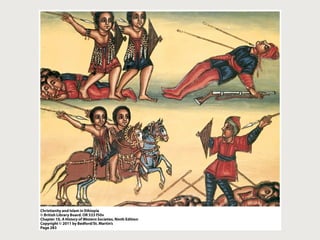
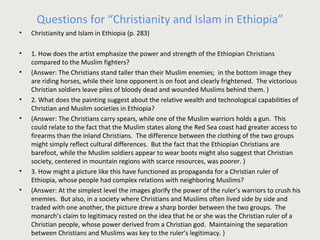
Questions for “Christianity and Islam in Ethiopia” 
• Christianity and Islam in Ethiopia (p. 283) 
• 1. How does the artist emphasize the power and strength of the Ethiopian Christians 
compared to the Muslim fighters? 
• (Answer: The Christians stand taller than their Muslim enemies; in the bottom image they 
are riding horses, while their lone opponent is on foot and clearly frightened. The victorious 
Christian soldiers leave piles of bloody dead and wounded Muslims behind them. ) 
• 2. What does the painting suggest about the relative wealth and technological capabilities of 
Christian and Muslim societies in Ethiopia? 
• (Answer: The Christians carry spears, while one of the Muslim warriors holds a gun. This 
could relate to the fact that the Muslim states along the Red Sea coast had greater access to 
firearms than the inland Christians. The difference between the clothing of the two groups 
might simply reflect cultural differences. But the fact that the Ethiopian Christians are 
barefoot, while the Muslim soldiers appear to wear boots might also suggest that Christian 
society, centered in mountain regions with scarce resources, was poorer. ) 
• 3. How might a picture like this have functioned as propaganda for a Christian ruler of 
Ethiopia, whose people had complex relations with neighboring Muslims? 
• (Answer: At the simplest level the images glorify the power of the ruler’s warriors to crush his 
enemies. But also, in a society where Christians and Muslims often lived side by side and 
traded with one another, the picture drew a sharp border between the two groups. The 
monarch’s claim to legitimacy rested on the idea that he or she was the Christian ruler of a 
Christian people, whose power derived from a Christian god. Maintaining the separation 
between Christians and Muslims was key to the ruler’s legitimacy. )
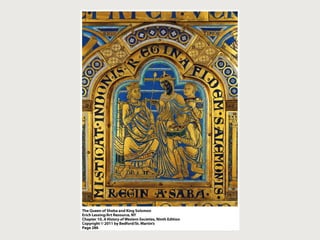
Questions for “The Queen of Sheba and King Solomon” 
• 1. How is this composition connected to the Christian Crusades aimed at “reconquering” Jerusalem 
that began in the last years of the eleventh century? 
• (Answer: As the text explains, Christian participants in the early Crusades (in Palestine) heard 
stories of an isolated Christian kingdom beyond the Muslim world (the kingdom of “Prester John”). 
The image reflects some awareness of the Ethiopian Solomonic -dynasty’s foundation myth – the 
Queen of Sheba’s visit to King Solomon of ancient Israel. ) 
• 
• 2. This image depicts Queen Sheba presenting gifts to Solomon. Ethiopian representations of the 
Solomon-Sheba story frequently show the two in bed together and/or the later theft of the Ark of 
the Covenant by Sheba’s son Menilek and his retinue. Why might Catholic European artists choose 
not to depict the latter scenes? 
• (Answer: In the Catholic image presented, the Queen appears as a kind of supplicant, bringing gifts 
as tribute to King Solomon, one of the great patriarchs of Judaism and Christianity. But the 
Ethiopian myth takes this story further, claiming that Sheba fathered Solomon’s son and that 
Ethiopia was the sole legitimate heir to the sacred power of Jerusalem and Solomon’s dynasty. This 
was a claim that European Catholics would never have accepted. ) 
• 
• 3. What might the “black” face of Queen Sheba, combined with her garb, suggest about European 
“racial” consciousness in the twelfth century? 
• (Answer: The Queen has a “black” face, reflecting European awareness of physical differences 
between themselves and people from sub-Saharan Africa. However, she is a ruler, depicted as 
dignified, and garbed as a European ruler might be. The image does not suggest that she is savage 
or “barbarian,” in the way that Europeans of centuries later often thought of Africans.)
IV. African Kingdoms and Empires, 
ca. 800–1500 
D. The East African City-States 
• 1. The Swahili culture, named after a Bantu language with a strong Arabic 
influence, was distributed throughout the eastern coast of Africa. 
• 2. Kilwa became the most powerful trading city on Africa’s east coast. The 
island city and the nearby mainland were controlled by a sheik. Tribal chiefs 
and councils of elders ruled the region farther inland. 
• 3. Slaves were a major export from the East African coast. The establishment 
of eastern Muslim communities increased the slave traffic. 
E. Southern Africa and Great Zimbabwe 
• 1. South Africa was isolated by mountain ranges and deserts. Natural resources 
included precious metals and diamonds. 
• 2. The earliest residents of southern Africa were hunter/gatherers. However, 
the ruins of an ancient city named Great Zimbabwe indicate a wealthy 
population that capitalized on the gold trade of South Africa.

Mckaych10 africanempires

  • 1.
    John P. McKayBennett ● D. Hill ● John Buckler Patricia Buckley Ebrey ● Roger B. Beck Clare Haru Crowston ● Merry E. Wiesner-Hanks A History of World Societies Ninth Edition CHAPTER 10 African Societies and Kingdoms, 1000 B.C.E.–1500 C.E. modified by J. Usher Copyright © 2011 by Bedford/St. Martin’s
  • 2.
    Study Questions forChapter 10 • How did Africa’s geography help shape its history and help to create diverse cultures? • What was the Bantu migration and what were some of its key features? • How did trans-Saharan affect West African culture and society? • What is significant about the city-state of Aksum? • What is significant about the society that grew in Great Zimbabwe? • Was Africa really a “dark continent,” isolated from the rest of the world, or is that a myth?
  • 3.
    I. The Landand Peoples of Africa A. Africa’s Geographical and Human Diversity • 1. Arid plains created opportunities to hunt wild game. Wetter regions allowed the production of grain crops. Hunting and gathering took place in the tropical forests. Rivers and lakes throughout the African continent provided opportunities for fishing economies. • 2. Coastal tribes intermingled with various trading entities such as the Greeks or the Romans. Black Africans lived in the savanna and rain forest region south of the Sahara. B. Egypt, Race, and Being African • 1. Nineteenth-century Europeans could not accept the fact that Africans were capable of such amazing art and architecture. A now thoroughly discredited concept known as the Hamitic thesis emerged, positing that the advanced technologies were brought to Africa by a Caucasian race identified as the Hamites. • 2. Due to the history of Egypt and the varied groups, including the Greeks and Persians, that were involved in its development, historians debate whether Egypt is part of African culture or part of Middle Eastern culture.
  • 5.
    Questions for Sculpture“Nok Woman” • 1. How much time and effort do you think went into the creation of this terra cotta sculpture? Given that hundreds of such pieces have been found, and that the production process required firing in pits, what does this suggest about the complexity and way of life of the Nok culture? • (Answer: Making a pottery sculpture of this quality must have taken a fairly long time. The Nok people produced many such artifacts. This suggests a society whose members had enough leisure to devote time to production of complex art works – probably not a hunter-gatherer group, but one whose members practiced agriculture. ) • 2. How has the woman represented in this sculpture adorned herself? What might this suggest about different levels of wealth in this society and its complexity? • (Answer: The woman appears to be wearing jewelry on her cheeks and ears and to have an intricate hairdo. This could indicate that she belonged to a wealthier family, which might suggest a society with different levels of wealth and leisure, where some people had the means and time to adorn themselves elaborately. Again, this would presumably be an agricultural rather than a hunter-gatherer group. )
  • 7.
    II. Early AfricanSocieties A. Settled Agriculture and Its Impact • 1. Plant cultivation may have entered African culture from Judaea. The development of settled agricultural production led to the need for the establishment of permanent villages. • 2. The “slash and burn” method was used to clear fields for agricultural production. • 3. Indigenous cereal grains such as millet and sorghum were domesticated, while other plant varieties were brought into Africa. Livestock included domesticated donkeys, pigs, and various types of poultry. • 4. Settled populations took up various trades, including ironworking. B. Bantu Migrations • 1. Bantu languages include Swahili, Zulu, Sotho, and Tswana. Few of the early Bantu-speakers wrote down their languages. • 2. Reasons for Bantu migrations are unclear. Possibly rapid population growth caused a need to migrate into eastern and southern African territories.
  • 9.
    II. Early AfricanSocieties C. Life in the Kingdoms of the Western Sudan, ca. 1000 B.C.E.–800 C.E. • 1. The Senegal and Niger Rivers provided fertile soil conducive to agricultural production. Local populations were affiliated by blood kinship and were governed by village chiefs. • 2. Some of the villages formed kingdoms. The king shared power with the Queen Mother, who was a full member of the council and had the right to chose the next king. • 3. Religious beliefs were based on ancestral spirits who could seek God’s blessings for their families and communities. Others believed in nature spirits living in the sky, rocks, and other items of nature. Kingship and shared religious patterns helped keep the populations together.
  • 10.
    III. The Trans-SaharanTrade A. The Berbers of North Africa • 1. Caravan routes between the Mediterranean Sea and the Sudan were established by the Berbers. Most caravan travel was done at night due to the desert heat. • 2. Caravans along the routes were threatened by the Tuareg, Berber raiders who lived in the desert. Water wells along the routes were sometimes poisoned so that the raids would be easier. B. Effects of Trade on West African Society • 1. The increase of trade influenced the development of mining for gold, which was exported on the trade routes. • 2. Slaves became a commodity of export and labor for local gold mines. Many Africans were forced into Muslim military service. • 3. The trade routes produced wealth, which helped stimulated the development of urban centers, where Muslim traders began to settle.
  • 11.
    III. The Trans-SaharanTrade C. The Spread of Islam in Africa • 1. Arab invaders conquered North Africa and introduced Islam to the Berbers. Some peoples who traded with the Berbers converted to Islam in an effort to maintain their trading status. Others converted to avoid Muslim Berber attacks. • 2. Arabs began to teach populations in West Africa. The Muslims taught the king of Ghana various uses for technology, and he converted his kingdom to Islam. • 3. Islam crossed the Red Sea and entered the East African coast. The city of Mogadishu established a Muslim sultanate with a slave military corps.
  • 13.
    IV. African Kingdomsand Empires, ca. 800–1500 A. The Kingdom of Ghana, ca. 900–1100 • 1. An indigenous tribe identified as the Soninke people called their ruler ghana, or war chief. The kingdom of Ghana took control of the southern caravan routes after it captured the town of Awdaghost from the Berbers. • 2. The Ghanaian king located his court in the city of Koumbi Saleh, where Muslim populations lived separate from Africans. • 3. The king needed to produce an annual income to support the large and expensive kingdom. Subordinate chieftains paid tribute, while traders entering and leaving the kingdom were charged duties.
  • 15.
    IV. African Kingdomsand Empires, ca. 800–1500 B. The Kingdom of Mali, ca. 1200–1450 • 1. Trade and agricultural production supported a large population in Mali. The capital city of Niani was transformed into a major financial and trading center. • 2. Sundiata, the founder of Mali, began Mali’s imperial expansion, conquering Ghana and increasing Mali power by taking control of numerous cities along the trade routes. • 3. Mansa Musa converted to Islam and made the pilgrimage to Mecca. He later commissioned architects to build mosques in the city of Timbuktu.
  • 17.
    IV. African Kingdomsand Empires, ca. 800–1500 C. Ethiopia: The Christian Kingdom of Aksum • 1. Ethiopians maintained early Egyptian religious beliefs until they were converted by Christian missionaries. The society was influenced by Judaism, Christianity, and Islam. • 2. Adulis was a main port on the Red Sea where ivory, gold, precious gems, slaves, and other items were traded into the Islamic world. • 3. Ethiopia’s acceptance of Christianity led to it becoming the first African society to document its history in written form. • 4. The Kebra Negast, Ethiopia’s national epic, states that Queen Makeda traveled to Jerusalem seeking advice from King Solomon. Once there she converted to Judaism and bore the Jewish king a son. • 5. Crusaders returned to Europe with folkloric stories of a powerful Christian ruler named Prester John who would help restore the Holy Land to Christianity. European explorations to find the ruler were unsuccessful.
  • 20.
    Questions for “Christianityand Islam in Ethiopia” • Christianity and Islam in Ethiopia (p. 283) • 1. How does the artist emphasize the power and strength of the Ethiopian Christians compared to the Muslim fighters? • (Answer: The Christians stand taller than their Muslim enemies; in the bottom image they are riding horses, while their lone opponent is on foot and clearly frightened. The victorious Christian soldiers leave piles of bloody dead and wounded Muslims behind them. ) • 2. What does the painting suggest about the relative wealth and technological capabilities of Christian and Muslim societies in Ethiopia? • (Answer: The Christians carry spears, while one of the Muslim warriors holds a gun. This could relate to the fact that the Muslim states along the Red Sea coast had greater access to firearms than the inland Christians. The difference between the clothing of the two groups might simply reflect cultural differences. But the fact that the Ethiopian Christians are barefoot, while the Muslim soldiers appear to wear boots might also suggest that Christian society, centered in mountain regions with scarce resources, was poorer. ) • 3. How might a picture like this have functioned as propaganda for a Christian ruler of Ethiopia, whose people had complex relations with neighboring Muslims? • (Answer: At the simplest level the images glorify the power of the ruler’s warriors to crush his enemies. But also, in a society where Christians and Muslims often lived side by side and traded with one another, the picture drew a sharp border between the two groups. The monarch’s claim to legitimacy rested on the idea that he or she was the Christian ruler of a Christian people, whose power derived from a Christian god. Maintaining the separation between Christians and Muslims was key to the ruler’s legitimacy. )
  • 22.
    Questions for “TheQueen of Sheba and King Solomon” • 1. How is this composition connected to the Christian Crusades aimed at “reconquering” Jerusalem that began in the last years of the eleventh century? • (Answer: As the text explains, Christian participants in the early Crusades (in Palestine) heard stories of an isolated Christian kingdom beyond the Muslim world (the kingdom of “Prester John”). The image reflects some awareness of the Ethiopian Solomonic -dynasty’s foundation myth – the Queen of Sheba’s visit to King Solomon of ancient Israel. ) • • 2. This image depicts Queen Sheba presenting gifts to Solomon. Ethiopian representations of the Solomon-Sheba story frequently show the two in bed together and/or the later theft of the Ark of the Covenant by Sheba’s son Menilek and his retinue. Why might Catholic European artists choose not to depict the latter scenes? • (Answer: In the Catholic image presented, the Queen appears as a kind of supplicant, bringing gifts as tribute to King Solomon, one of the great patriarchs of Judaism and Christianity. But the Ethiopian myth takes this story further, claiming that Sheba fathered Solomon’s son and that Ethiopia was the sole legitimate heir to the sacred power of Jerusalem and Solomon’s dynasty. This was a claim that European Catholics would never have accepted. ) • • 3. What might the “black” face of Queen Sheba, combined with her garb, suggest about European “racial” consciousness in the twelfth century? • (Answer: The Queen has a “black” face, reflecting European awareness of physical differences between themselves and people from sub-Saharan Africa. However, she is a ruler, depicted as dignified, and garbed as a European ruler might be. The image does not suggest that she is savage or “barbarian,” in the way that Europeans of centuries later often thought of Africans.)
  • 23.
    IV. African Kingdomsand Empires, ca. 800–1500 D. The East African City-States • 1. The Swahili culture, named after a Bantu language with a strong Arabic influence, was distributed throughout the eastern coast of Africa. • 2. Kilwa became the most powerful trading city on Africa’s east coast. The island city and the nearby mainland were controlled by a sheik. Tribal chiefs and councils of elders ruled the region farther inland. • 3. Slaves were a major export from the East African coast. The establishment of eastern Muslim communities increased the slave traffic. E. Southern Africa and Great Zimbabwe • 1. South Africa was isolated by mountain ranges and deserts. Natural resources included precious metals and diamonds. • 2. The earliest residents of southern Africa were hunter/gatherers. However, the ruins of an ancient city named Great Zimbabwe indicate a wealthy population that capitalized on the gold trade of South Africa.

Editor's Notes

  • #4 I. The Land and the Peoples of Africa A. Africa’s Geographical and Human Diversity 1. Arid plains created opportunities to hunt wild game. Wetter regions allowed the production of grain crops. Hunting and gathering took place in the tropical forests. Rivers and lakes throughout the African continent provided opportunities for fishing economies. 2. Coastal tribes intermingled with various trading entities such as the Greeks or the Romans. Black Africans lived in the savanna and rain forest region south of the Sahara. B. Egypt, Race, and Being African 1. Nineteenth-century Europeans could not accept the fact that Africans were capable of such amazing art and architecture. A now thoroughly discredited concept known as the Hamitic thesis emerged, positing that the advanced technologies were brought to Africa by a Caucasian race identified as the Hamites. 2. Due to the history of Egypt and the varied groups, including the Greeks and Persians, that were involved in its development, historians debate whether Egypt is part of African culture or part of Middle Eastern culture.
  • #5 Nok Woman (p. 269)   1. How much time and effort do you think went into the creation of this terra cotta sculpture? Given that hundreds of such pieces have been found, and that the production process required firing in pits, what does this suggest about the complexity and way of life of the Nok culture? (Answer: Making a pottery sculpture of this quality must have taken a fairly long time. The Nok people produced many such artifacts. This suggests a society whose members had enough leisure to devote time to production of complex art works – probably not a hunter-gatherer group, but one whose members practiced agriculture. )   2. How has the woman represented in this sculpture adorned herself? What might this suggest about different levels of wealth in this society and its complexity? (Answer: The woman appears to be wearing jewelry on her cheeks and ears and to have an intricate hairdo. This could indicate that she belonged to a wealthier family, which might suggest a society with different levels of wealth and leisure, where some people had the means and time to adorn themselves elaborately. Again, this would presumably be an agricultural rather than a hunter-gatherer group. )
  • #8 II. Early African Societies A. Settled Agriculture and Its Impact 1. Plant cultivation may have entered African culture from Judaea. The development of settled agricultural production led to the need for the establishment of permanent villages. 2. The “slash and burn” method was used to clear fields for agricultural production. 3. Indigenous cereal grains such as millet and sorghum were domesticated, while other plant varieties were brought into Africa. Livestock included domesticated donkeys, pigs, and various types of poultry. 4. Settled populations took up various trades, including ironworking. B. Bantu Migrations 1. Bantu languages include Swahili, Zulu, Sotho, and Tswana. Few of the early Bantu-speakers wrote down their languages. 2. Reasons for Bantu migrations are unclear. Possibly rapid population growth caused a need to migrate into eastern and southern African territories.
  • #10 II. Early African Societies C. Life in the Kingdoms of the Western Sudan, ca. 1000 B.C.E.–800 C.E. 1. The Senegal and Niger Rivers provided fertile soil conducive to agricultural production. Local populations were affiliated by blood kinship and were governed by village chiefs. 2. Some of the villages formed kingdoms. The king shared power with the Queen Mother, who was a full member of the council and had the right to chose the next king. 3. Religious beliefs were based on ancestral spirits who could seek God’s blessings for their families and communities. Others believed in nature spirits living in the sky, rocks, and other items of nature. Kingship and shared religious patterns helped keep the populations together.
  • #11 III. The Trans-Saharan Trade A. The Berbers of North Africa 1. Caravan routes between the Mediterranean Sea and the Sudan were established by the Berbers. Most caravan travel was done at night due to the desert heat. 2. Caravans along the routes were threatened by the Tuareg, Berber raiders who lived in the desert. Water wells along the routes were sometimes poisoned so that the raids would be easier. B. Effects of Trade on West African Society 1. The increase of trade influenced the development of mining for gold, which was exported on the trade routes. 2. Slaves became a commodity of export and labor for local gold mines. Many Africans were forced into Muslim military service. 3. The trade routes produced wealth, which helped stimulated the development of urban centers, where Muslim traders began to settle.
  • #12 III. The Trans-Saharan Trade C. The Spread of Islam in Africa 1. Arab invaders conquered North Africa and introduced Islam to the Berbers. Some peoples who traded with the Berbers converted to Islam in an effort to maintain their trading status. Others converted to avoid Muslim Berber attacks. 2. Arabs began to teach populations in West Africa. The Muslims taught the king of Ghana various uses for technology, and he converted his kingdom to Islam. 3. Islam crossed the Red Sea and entered the East African coast. The city of Mogadishu established a Muslim sultanate with a slave military corps.
  • #14 IV. African Kingdoms and Empires ca. 800–1500 A. The Kingdom of Ghana, ca. 900–1100 1. An indigenous tribe identified as the Soninke people called their ruler ghana, or war chief. The kingdom of Ghana took control of the southern caravan routes after it captured the town of Awdaghost from the Berbers. 2. The Ghanaian king located his court in the city of Koumbi Saleh, where Muslim populations lived separate from Africans. 3. The king needed to produce an annual income to support the large and expensive kingdom. Subordinate chieftains paid tribute, while traders entering and leaving the kingdom were charged duties.
  • #16 IV. African Kingdoms and Empires ca. 800–1500 B. The Kingdom of Mali, ca. 1200–1450 1. Trade and agricultural production supported a large population in Mali. The capital city of Niani was transformed into a major financial and trading center. 2. Sundiata, the founder of Mali, began Mali’s imperial expansion, conquering Ghana and increasing Mali power by taking control of numerous cities along the trade routes. 3. Mansa Musa converted to Islam and made the pilgrimage to Mecca. He later commissioned architects to build mosques in the city of Timbuktu.
  • #18 IV. African Kingdoms and Empires, ca. 800–1500 C. Ethiopia: The Christian Kingdom of Aksum 1. Ethiopians maintained early Egyptian religious beliefs until they were converted by Christian missionaries. The society was influenced by Judaism, Christianity, and Islam. 2. Adulis was a main port on the Red Sea where ivory, gold, precious gems, slaves, and other items were traded into the Islamic world. 3. Ethiopia’s acceptance of Christianity led to it becoming the first African society to document its history in written form. 4. The Kebra Negast, Ethiopia’s national epic, states that Queen Makeda traveled to Jerusalem seeking advice from King Solomon. Once there she converted to Judaism and bore the Jewish king a son. 5. Crusaders returned to Europe with folkloric stories of a powerful Christian ruler named Prester John who would help restore the Holy Land to Christianity. European explorations to find the ruler were unsuccessful.
  • #20 Christianity and Islam in Ethiopia (p. 283) 1. How does the artist emphasize the power and strength of the Ethiopian Christians compared to the Muslim fighters? (Answer: The Christians stand taller than their Muslim enemies; in the bottom image they are riding horses, while their lone opponent is on foot and clearly frightened. The victorious Christian soldiers leave piles of bloody dead and wounded Muslims behind them. )   2. What does the painting suggest about the relative wealth and technological capabilities of Christian and Muslim societies in Ethiopia? (Answer: The Christians carry spears, while one of the Muslim warriors holds a gun. This could relate to the fact that the Muslim states along the Red Sea coast had greater access to firearms than the inland Christians. The difference between the clothing of the two groups might simply reflect cultural differences. But the fact that the Ethiopian Christians are barefoot, while the Muslim soldiers appear to wear boots might also suggest that Christian society, centered in mountain regions with scarce resources, was poorer. )   3. How might a picture like this have functioned as propaganda for a Christian ruler of Ethiopia, whose people had complex relations with neighboring Muslims? (Answer: At the simplest level the images glorify the power of the ruler’s warriors to crush his enemies. But also, in a society where Christians and Muslims often lived side by side and traded with one another, the picture drew a sharp border between the two groups. The monarch’s claim to legitimacy rested on the idea that he or she was the Christian ruler of a Christian people, whose power derived from a Christian god. Maintaining the separation between Christians and Muslims was key to the ruler’s legitimacy. )
  • #22 Queen of Sheba and King Solomon (p. 286) 1. How is this composition connected to the Christian Crusades aimed at “reconquering” Jerusalem that began in the last years of the eleventh century? (Answer: As the text explains, Christian participants in the early Crusades (in Palestine) heard stories of an isolated Christian kingdom beyond the Muslim world (the kingdom of “Prester John”). The image reflects some awareness of the Ethiopian Solomonic -dynasty’s foundation myth – the Queen of Sheba’s visit to King Solomon of ancient Israel. )   2. This image depicts Queen Sheba presenting gifts to Solomon. Ethiopian representations of the Solomon-Sheba story frequently show the two in bed together and/or the later theft of the Ark of the Covenant by Sheba’s son Menilek and his retinue. Why might Catholic European artists choose not to depict the latter scenes? (Answer: In the Catholic image presented, the Queen appears as a kind of supplicant, bringing gifts as tribute to King Solomon, one of the great patriarchs of Judaism and Christianity. But the Ethiopian myth takes this story further, claiming that Sheba fathered Solomon’s son and that Ethiopia was the sole legitimate heir to the sacred power of Jerusalem and Solomon’s dynasty. This was a claim that European Catholics would never have accepted. )   3. What might the “black” face of Queen Sheba, combined with her garb, suggest about European “racial” consciousness in the twelfth century? (Answer: The Queen has a “black” face, reflecting European awareness of physical differences between themselves and people from sub-Saharan Africa. However, she is a ruler, depicted as dignified, and garbed as a European ruler might be. The image does not suggest that she is savage or “barbarian,” in the way that Europeans of centuries later often thought of Africans.)
  • #24 IV. African Kingdoms and Empires, ca. 800–1500 D. The East African City-States 1. The Swahili culture, named after a Bantu language with a strong Arabic influence, was distributed throughout the eastern coast of Africa. 2. Kilwa became the most powerful trading city on Africa’s east coast. The island city and the nearby mainland were controlled by a sheik. Tribal chiefs and councils of elders ruled the region farther inland. 3. Slaves were a major export from the East African coast. The establishment of eastern Muslim communities increased the slave traffic. E. Southern Africa and Great Zimbabwe 1. South Africa was isolated by mountain ranges and deserts. Natural resources included precious metals and diamonds. 2. The earliest residents of southern Africa were hunter/gatherers. However, the ruins of an ancient city named Great Zimbabwe indicate a wealthy population that capitalized on the gold trade of South Africa.