Some General Elements of Early Africa 
 Stateless Societies 
 somewhat common 
 kinship fundamental 
 little concentrated power, no taxes, 
armies, or bureaucrats 
 Religion 
 animism 
 cosmology 
 ethical codes 
 ancestor worship 
 West Africa before Urbanization 
 iron smelting, terra cotta sculpture, settled agriculture 
 jump from stone to iron--few examples of bronze artifacts 
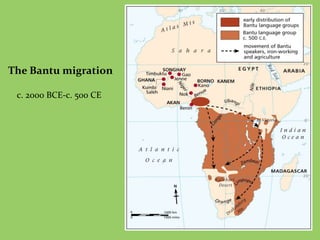
 Bantu migrations carry knowledge of iron working and settled agriculture
The Bantu migration 
c. 2000 BCE-c. 500 CE
Language 
Families of 
Africa
Early African 
States
Meroe 
Kush (Nubia) 
• from 1000 BCE 
• linked to Egypt, but autonomous 
• conquers Egypt, c. 750 BCE
Sub-Saharan Africa 
• extension of agriculture along the Sahel (“coast”) 
• followed by establishment of West African kingdoms 
o Ghana--first great sub-Saharan state, c.400-c.1100 CE 
The Sahel ⟼
The Camel: Courier of the Desert 
♘ evolves in North America: one branch across Bering Strait, other to 
South America ⇒ the llama and alpaca 
♘ dromedary (one hump, Middle East and Africa) 
and bactrian (two humps, Asia) 
♘ carries twice the load of an ox at double the speed 
♘ can drink 30 gallons of water in 10 minutes, then none for 10 days in 
hot weather, for months in mild weather 
♘ can withstand huge temperature variations 
♘ urine is like syrup, feces super-dry 
♘ can live off fat (in humps) without using proteins ⇒ retains muscle mass 
♘ not efficient at coitus, and a 13-month gestation ⇒ camel shortage!!!!
Islam Arrives 
 Arabs sweep through N. Africa and into Spain by 711 
 conservative Muslim reformers arrive in N. Africa later 
 (Berber) Almoravids (c.1050-1150) 
 (Berber) Almohads succeed Almoravids (c.1120-1270)
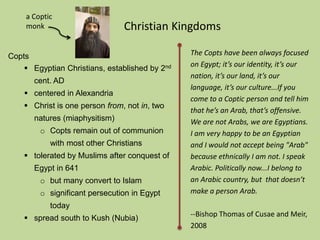
Copts 
Christian Kingdoms 
 Egyptian Christians, established by 2nd 
cent. AD 
 centered in Alexandria 
 Christ is one person from, not in, two 
natures (miaphysitism) 
o Copts remain out of communion 
with most other Christians 
 tolerated by Muslims after conquest of 
Egypt in 641 
o but many convert to Islam 
o significant persecution in Egypt 
today 
 spread south to Kush (Nubia) 
The Copts have been always focused 
on Egypt; it’s our identity, it’s our 
nation, it’s our land, it’s our 
language, it’s our culture...If you 
come to a Coptic person and tell him 
that he’s an Arab, that’s offensive. 
We are not Arabs, we are Egyptians. 
I am very happy to be an Egyptian 
and I would not accept being "Arab" 
because ethnically I am not. I speak 
Arabic. Politically now...I belong to 
an Arabic country, but that doesn’t 
make a person Arab. 
--Bishop Thomas of Cusae and Meir, 
2008 
a Coptic 
monk
Christian Kingdoms (cont’d) 
Axum 
 defeats Kush, c. 300 BCE. 
 converts to Christianity c. 350 CE 
 falls by c. 1000 (mysteriously) 
 more or less becomes Ethiopia 
The Obelisk of Axum 
The Chapel of the Tablet
Christian Kingdoms (cont’d) 
Ethiopia 
 established by 11th cent., heir to (Christian) Axum 
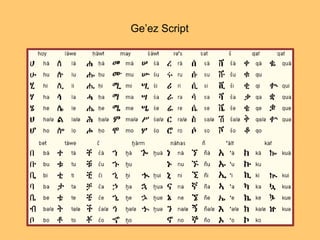
 uses two languages: Amharic (for speech) and Ge’ez (for religion) 
 Ge’ez script is only indigenous script in Africa 
 King Lalibela (late 12th cent.) 
o creates eleven churches hewn entirely from bedrock 
 country today is about 2/3 Christian, 1/3 Muslim 
 Ethiopian Orthodox Church is among those in communion with Copts 
Bet Giorgis 
(Church of 
St. George)
Ge’ez Script
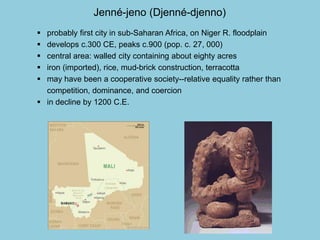
Jenné-jeno (Djenné-djenno) 
 probably first city in sub-Saharan Africa, on Niger R. floodplain 
 develops c.300 CE, peaks c.900 (pop. c. 27, 000) 
 central area: walled city containing about eighty acres 
 iron (imported), rice, mud-brick construction, terracotta 
 may have been a cooperative society--relative equality rather than 
competition, dominance, and coercion 
 in decline by 1200 C.E.
Sudanic States 
 states in the Sahel—”Sudanic” refers to a language family, not today’s Sudan 
 two branches roughly equivalent to Nilo-Saharan and Niger-Congo A 
 gold is the source of wealth and power 
 Mediterranean world (Rome, Carthage, Greece, etc.) fuels demand 
 gold of little interest to locals—value iron and copper above all 
 gold trade spurred by Muslim Arabs 
 trans-Saharan trade made possible with domestication of camels 
 three great states: Ghana, Mali, and Songhai 
 Islam serves as a universalistic faith 
o fuses with traditional practices and beliefs 
o slavery becomes more widespread 
• seen also as a step toward conversion 
o c.750-1450, Muslims virtually only external influence on sub-Saharan 
Africa
Sudanic States: Ghana 
 no relation to modern-day Ghana 
 flourishes c. 400-1100 
 major trading center at Kumbi-Saleh 
 vast reserves of gold and salt 
It is said that beyond the source of 
the Nile there is darkness and 
beyond the darkness are waters that 
make the gold grow...to the town of 
Ghana is a three-months’ journey 
through deserts. In the country of 
Ghana gold grows in the sand as 
carrots do, and it is plucked at 
sunrise. 
--Ibn al-Faqih, Iranian scholar, c.900
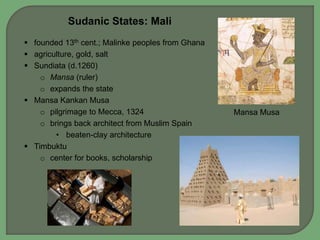
Sudanic States: Mali 
 founded 13th cent.; Malinke peoples from Ghana 
 agriculture, gold, salt 
 Sundiata (d.1260) 
o Mansa (ruler) 
o expands the state 
 Mansa Kankan Musa 
o pilgrimage to Mecca, 1324 
o brings back architect from Muslim Spain 
• beaten-clay architecture 
 Timbuktu 
o center for books, scholarship 
Mansa Musa
caravan to Timbuktu 
Salt 
Photographic essay: Mali 
mine at Taudenni salt at market in Mopti
Sudanic States: Songhai 
(Songhay) 
 middle of Niger valley 
 independent by 700 
 Muslim by 1010 
 Capital at Gao 
 Sonni Ali (1464-1492) 
 expands territory 
 successors are called askia 
 heavily Islamic 
 defeated by Morocco, 1591 
 Hausa states develop, northern 
Nigeria 
o keep Songhai’s political and 
religious traditions alive
Swahili 
States 
 centered in modern-day 
Somalia, Kenya, 
Tanzania 
 Swahili (“coastal”; cf. 
Sahel) is blend of 
Bantu, Arabian, 
European languages 
 growth begins 
c.1000 
 extensive contacts 
with Arabia, 
Indonesia, India, 
even China 
 monsoon winds 
o India to Africa in 
winter 
o Africa to India in 
summer
West Africa: Beyond the Sahel 
 Nok, c.1000 BC - 300 CE 
o modern-day Nigeria 
o terracotta, iron 
o discovered by tin miners in 1928 
 Benin, 14th-19th cents. 
o southern coast of West Africa 
o remarkable work in bronze and ivory 
o heavy involvement in the Atlantic slave trade Nok 
Benin bronzes
Southeast Africa: Great Zimbabwe 
 Bantu confederation of Shona speakers 
 Zimbabwe (stone courts)—impressive stonework 
 flourishes 14th – 16th cents. 
 Great Zimbabwe the greatest of 300 zimbabwe 
 ruler called Mwene Mutapa (“Lord of the Conquered Land”) 
 control of gold sources in the interior 
 trade with Arabs
Trade Routes of Post-Islamic Africa

Chapter 8

  • 2.
    Some General Elementsof Early Africa  Stateless Societies  somewhat common  kinship fundamental  little concentrated power, no taxes, armies, or bureaucrats  Religion  animism  cosmology  ethical codes  ancestor worship  West Africa before Urbanization  iron smelting, terra cotta sculpture, settled agriculture  jump from stone to iron--few examples of bronze artifacts  Bantu migrations carry knowledge of iron working and settled agriculture
  • 3.
    The Bantu migration c. 2000 BCE-c. 500 CE
  • 4.
  • 5.
  • 6.
    Meroe Kush (Nubia) • from 1000 BCE • linked to Egypt, but autonomous • conquers Egypt, c. 750 BCE
  • 7.
    Sub-Saharan Africa •extension of agriculture along the Sahel (“coast”) • followed by establishment of West African kingdoms o Ghana--first great sub-Saharan state, c.400-c.1100 CE The Sahel ⟼
  • 8.
    The Camel: Courierof the Desert ♘ evolves in North America: one branch across Bering Strait, other to South America ⇒ the llama and alpaca ♘ dromedary (one hump, Middle East and Africa) and bactrian (two humps, Asia) ♘ carries twice the load of an ox at double the speed ♘ can drink 30 gallons of water in 10 minutes, then none for 10 days in hot weather, for months in mild weather ♘ can withstand huge temperature variations ♘ urine is like syrup, feces super-dry ♘ can live off fat (in humps) without using proteins ⇒ retains muscle mass ♘ not efficient at coitus, and a 13-month gestation ⇒ camel shortage!!!!
  • 9.
    Islam Arrives Arabs sweep through N. Africa and into Spain by 711  conservative Muslim reformers arrive in N. Africa later  (Berber) Almoravids (c.1050-1150)  (Berber) Almohads succeed Almoravids (c.1120-1270)
  • 10.
    Copts Christian Kingdoms  Egyptian Christians, established by 2nd cent. AD  centered in Alexandria  Christ is one person from, not in, two natures (miaphysitism) o Copts remain out of communion with most other Christians  tolerated by Muslims after conquest of Egypt in 641 o but many convert to Islam o significant persecution in Egypt today  spread south to Kush (Nubia) The Copts have been always focused on Egypt; it’s our identity, it’s our nation, it’s our land, it’s our language, it’s our culture...If you come to a Coptic person and tell him that he’s an Arab, that’s offensive. We are not Arabs, we are Egyptians. I am very happy to be an Egyptian and I would not accept being "Arab" because ethnically I am not. I speak Arabic. Politically now...I belong to an Arabic country, but that doesn’t make a person Arab. --Bishop Thomas of Cusae and Meir, 2008 a Coptic monk
  • 11.
    Christian Kingdoms (cont’d) Axum  defeats Kush, c. 300 BCE.  converts to Christianity c. 350 CE  falls by c. 1000 (mysteriously)  more or less becomes Ethiopia The Obelisk of Axum The Chapel of the Tablet
  • 12.
    Christian Kingdoms (cont’d) Ethiopia  established by 11th cent., heir to (Christian) Axum  uses two languages: Amharic (for speech) and Ge’ez (for religion)  Ge’ez script is only indigenous script in Africa  King Lalibela (late 12th cent.) o creates eleven churches hewn entirely from bedrock  country today is about 2/3 Christian, 1/3 Muslim  Ethiopian Orthodox Church is among those in communion with Copts Bet Giorgis (Church of St. George)
  • 13.
  • 14.
    Jenné-jeno (Djenné-djenno) probably first city in sub-Saharan Africa, on Niger R. floodplain  develops c.300 CE, peaks c.900 (pop. c. 27, 000)  central area: walled city containing about eighty acres  iron (imported), rice, mud-brick construction, terracotta  may have been a cooperative society--relative equality rather than competition, dominance, and coercion  in decline by 1200 C.E.
  • 15.
    Sudanic States states in the Sahel—”Sudanic” refers to a language family, not today’s Sudan  two branches roughly equivalent to Nilo-Saharan and Niger-Congo A  gold is the source of wealth and power  Mediterranean world (Rome, Carthage, Greece, etc.) fuels demand  gold of little interest to locals—value iron and copper above all  gold trade spurred by Muslim Arabs  trans-Saharan trade made possible with domestication of camels  three great states: Ghana, Mali, and Songhai  Islam serves as a universalistic faith o fuses with traditional practices and beliefs o slavery becomes more widespread • seen also as a step toward conversion o c.750-1450, Muslims virtually only external influence on sub-Saharan Africa
  • 17.
    Sudanic States: Ghana  no relation to modern-day Ghana  flourishes c. 400-1100  major trading center at Kumbi-Saleh  vast reserves of gold and salt It is said that beyond the source of the Nile there is darkness and beyond the darkness are waters that make the gold grow...to the town of Ghana is a three-months’ journey through deserts. In the country of Ghana gold grows in the sand as carrots do, and it is plucked at sunrise. --Ibn al-Faqih, Iranian scholar, c.900
  • 18.
    Sudanic States: Mali  founded 13th cent.; Malinke peoples from Ghana  agriculture, gold, salt  Sundiata (d.1260) o Mansa (ruler) o expands the state  Mansa Kankan Musa o pilgrimage to Mecca, 1324 o brings back architect from Muslim Spain • beaten-clay architecture  Timbuktu o center for books, scholarship Mansa Musa
  • 19.
    caravan to Timbuktu Salt Photographic essay: Mali mine at Taudenni salt at market in Mopti
  • 20.
    Sudanic States: Songhai (Songhay)  middle of Niger valley  independent by 700  Muslim by 1010  Capital at Gao  Sonni Ali (1464-1492)  expands territory  successors are called askia  heavily Islamic  defeated by Morocco, 1591  Hausa states develop, northern Nigeria o keep Songhai’s political and religious traditions alive
  • 21.
    Swahili States centered in modern-day Somalia, Kenya, Tanzania  Swahili (“coastal”; cf. Sahel) is blend of Bantu, Arabian, European languages  growth begins c.1000  extensive contacts with Arabia, Indonesia, India, even China  monsoon winds o India to Africa in winter o Africa to India in summer
  • 22.
    West Africa: Beyondthe Sahel  Nok, c.1000 BC - 300 CE o modern-day Nigeria o terracotta, iron o discovered by tin miners in 1928  Benin, 14th-19th cents. o southern coast of West Africa o remarkable work in bronze and ivory o heavy involvement in the Atlantic slave trade Nok Benin bronzes
  • 23.
    Southeast Africa: GreatZimbabwe  Bantu confederation of Shona speakers  Zimbabwe (stone courts)—impressive stonework  flourishes 14th – 16th cents.  Great Zimbabwe the greatest of 300 zimbabwe  ruler called Mwene Mutapa (“Lord of the Conquered Land”)  control of gold sources in the interior  trade with Arabs
  • 24.
    Trade Routes ofPost-Islamic Africa