A.SMITHA,I M.sc ., Biotechnology
Under the guidance
Dr.R.Kalaivani, Asst. Prof. of Biotechnology, Bon Secours college for women, Thanjavur
 Chromatography is an important biophysical technique that enables the
separation, identification, and purification of the qualitative and quantitative
analysis.
 It is a separation technique in which a mobile phase carrying a mixture is caused to
move in contact to move in contact with a selectively absorbent stationary phase.
 Affinity chromatography is a type of liquid chromatography for the separation,
purification or specific analysis of sample component.
 It utilize the reversible biological interaction or molecular recognition called
affinity which refers to the attracting forced exerted in different degrees between
atoms which cause them to remain in combination.
 Example: enzyme with an inhibitor
 antigen with an antibody etc.
 It was discovered by Pedro Cuatrecasas and Meir Wilcheck
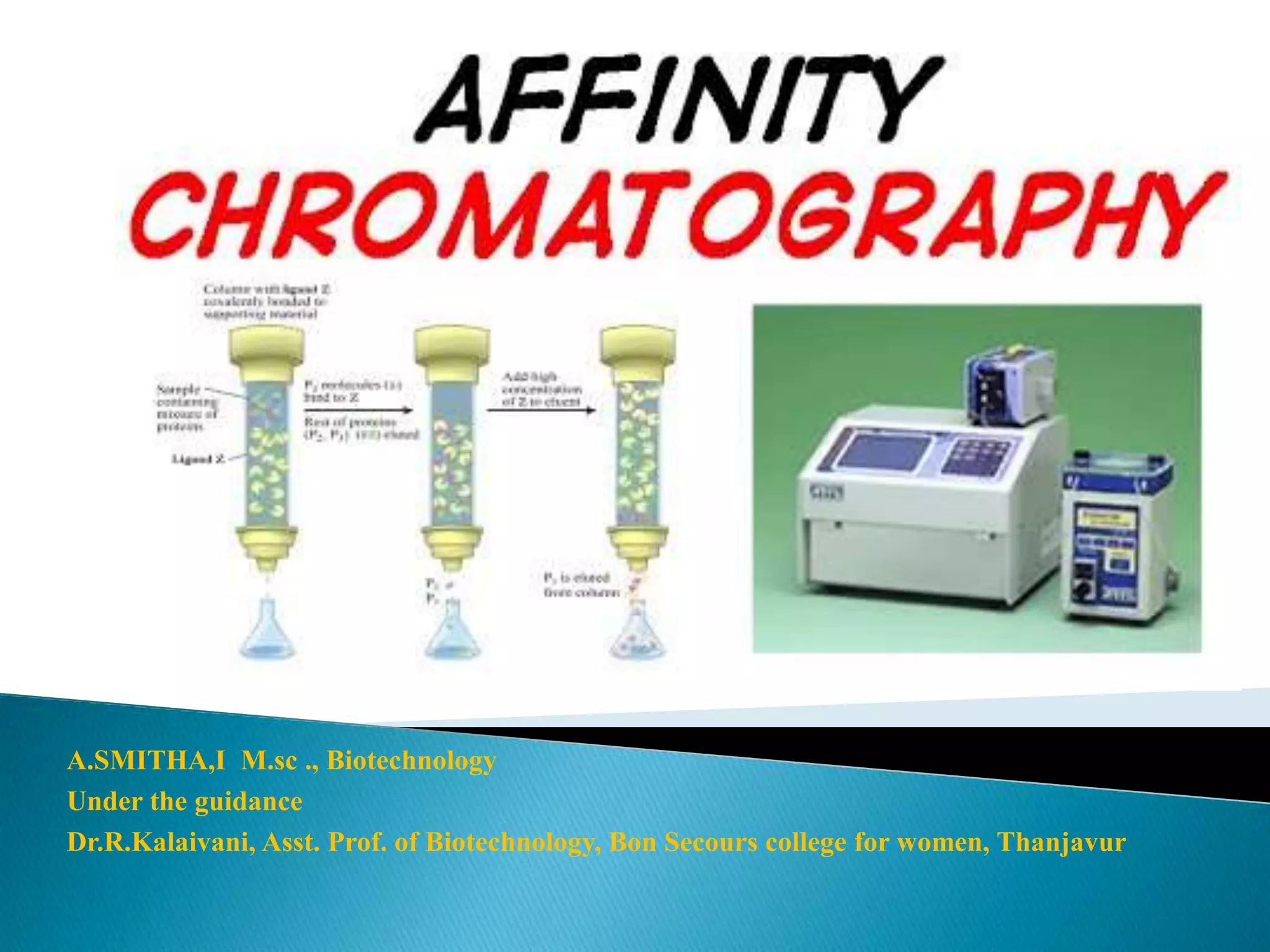
 The stationary phase consists of a support medium, on which the substrate (ligand)
 is bound covalently, in such a way that the reactive groups that are essential for
binding of the target molecule are exposed.
 As the crude mixture of the substances is passed through the chromatography
column, substances with binding site for the immobilized substrate bind to the
stationary phase, while all other substance is eluted in the void volume of the
column.
 Once the other substance are eluted, the bound target molecules can be eluted by
methods such as including a competing ligand in the mobile phase or changing the
pH, ionic strength or polarity condition.
MATRIX
 The matrix is an inert support to which a ligand can be directly or indirectly
coupled.
 In order to for the matrix to be effective it must have certain characters:
 Matrix should be chemically and physically inert.
 It must be insoluble in solvents and buffers employed in the process.
 It must be chemically and mechanically stable.
 It must be easily coupled to a ligand or spacer arm onto which the ligand
can be attached.
 It must exhibit good flow properties and have a relatively large surface
area for attachment.
 The most useful matrix materials are agarose and polyacrylamide.
LIGAND
 It refers to the molecule that binds reversibly to a specific target molecule.
 The ligand can be selected only after the nature of the macromolecules to be
isolated is known.
 When a hormone receptor protein is to be purified by affinity chromatography,
the hormone itself is an ideal candidate for the ligand.
 For antibody isolation, an antigen or hapten may be used as ligand.
 If an enzyme is to be purified, a substrate analog, inhibitor, cofactor, or effector
may be used as a the immobilized ligand.
 Affinity medium is equilibrated in binding buffer.
 Sample is applied under conditions that favor specific binding of the target
molecules to a complementary binding substance bind specifically, but reversibly,
to the ligand and unbound material washes through the column.
 Elution is performed specifically, using a competitive ligand , or non-specifically,
by changing the pH, ionic strength or polarity. Target protein is collected in a
purified, concentrated form.
 Affinity medium is re-equilibrated with binding buffer.
1. PREPARATION OF COLUMN
 The column is loaded with solid support such as sepharose, agarose, cellulose etc.
 Ligand is selected according to the desired isolate.
 spacer arm is attached between the ligand and solid support.
3. ELUTION OF LIGAND – MOLECULE COMPLEX
 Target substance is recovered by changing conditions to favor elution of the
bound molecules.
ADVANTAGES
 High specificity
 Target molecules can be obtained in a highly pure state
 step purification
 The matrix can be reused rapidly
 The matrix is solid, can be easily washed and dried.
 Give purified product with high yield
 Affinity chromatography can also be used to remove specific contaminants,
such as proteases.
 It is essentially a sample purification technique , used primarily for biological
molecules such as proteins.
Its major applications includes:
 Separation of mixture of compounds.
 Removal of impurities or in purification process.
 In enzyme assays
 Detection of substrates
 Investigation of binding sites of enzymes
 In in vitro antigen- antibody reactions
 Detective of single Nucleotide polymorphisms and mutations in nucleic acids.
 Time consuming method.
 More amounts of solvents are required which may be expensive.
 Intense labour.
 Non specific adsorption cannot be totally eliminated , it can be minimized.
 Limited availability and high cost of immobilized ligands.
 Proteins get denatured if required pH is not adjusted.
THANK YOU

Affinity Chromatography.pptx

  • 1.
    A.SMITHA,I M.sc .,Biotechnology Under the guidance Dr.R.Kalaivani, Asst. Prof. of Biotechnology, Bon Secours college for women, Thanjavur
  • 2.
     Chromatography isan important biophysical technique that enables the separation, identification, and purification of the qualitative and quantitative analysis.  It is a separation technique in which a mobile phase carrying a mixture is caused to move in contact to move in contact with a selectively absorbent stationary phase.  Affinity chromatography is a type of liquid chromatography for the separation, purification or specific analysis of sample component.  It utilize the reversible biological interaction or molecular recognition called affinity which refers to the attracting forced exerted in different degrees between atoms which cause them to remain in combination.  Example: enzyme with an inhibitor  antigen with an antibody etc.  It was discovered by Pedro Cuatrecasas and Meir Wilcheck
  • 4.
     The stationaryphase consists of a support medium, on which the substrate (ligand)  is bound covalently, in such a way that the reactive groups that are essential for binding of the target molecule are exposed.  As the crude mixture of the substances is passed through the chromatography column, substances with binding site for the immobilized substrate bind to the stationary phase, while all other substance is eluted in the void volume of the column.  Once the other substance are eluted, the bound target molecules can be eluted by methods such as including a competing ligand in the mobile phase or changing the pH, ionic strength or polarity condition.
  • 5.
    MATRIX  The matrixis an inert support to which a ligand can be directly or indirectly coupled.  In order to for the matrix to be effective it must have certain characters:  Matrix should be chemically and physically inert.  It must be insoluble in solvents and buffers employed in the process.  It must be chemically and mechanically stable.  It must be easily coupled to a ligand or spacer arm onto which the ligand can be attached.  It must exhibit good flow properties and have a relatively large surface area for attachment.  The most useful matrix materials are agarose and polyacrylamide.
  • 6.
    LIGAND  It refersto the molecule that binds reversibly to a specific target molecule.  The ligand can be selected only after the nature of the macromolecules to be isolated is known.  When a hormone receptor protein is to be purified by affinity chromatography, the hormone itself is an ideal candidate for the ligand.  For antibody isolation, an antigen or hapten may be used as ligand.  If an enzyme is to be purified, a substrate analog, inhibitor, cofactor, or effector may be used as a the immobilized ligand.
  • 7.
     Affinity mediumis equilibrated in binding buffer.  Sample is applied under conditions that favor specific binding of the target molecules to a complementary binding substance bind specifically, but reversibly, to the ligand and unbound material washes through the column.  Elution is performed specifically, using a competitive ligand , or non-specifically, by changing the pH, ionic strength or polarity. Target protein is collected in a purified, concentrated form.  Affinity medium is re-equilibrated with binding buffer. 1. PREPARATION OF COLUMN  The column is loaded with solid support such as sepharose, agarose, cellulose etc.  Ligand is selected according to the desired isolate.  spacer arm is attached between the ligand and solid support.
  • 9.
    3. ELUTION OFLIGAND – MOLECULE COMPLEX  Target substance is recovered by changing conditions to favor elution of the bound molecules. ADVANTAGES  High specificity  Target molecules can be obtained in a highly pure state  step purification  The matrix can be reused rapidly  The matrix is solid, can be easily washed and dried.  Give purified product with high yield  Affinity chromatography can also be used to remove specific contaminants, such as proteases.
  • 10.
     It isessentially a sample purification technique , used primarily for biological molecules such as proteins. Its major applications includes:  Separation of mixture of compounds.  Removal of impurities or in purification process.  In enzyme assays  Detection of substrates  Investigation of binding sites of enzymes  In in vitro antigen- antibody reactions  Detective of single Nucleotide polymorphisms and mutations in nucleic acids.
  • 11.
     Time consumingmethod.  More amounts of solvents are required which may be expensive.  Intense labour.  Non specific adsorption cannot be totally eliminated , it can be minimized.  Limited availability and high cost of immobilized ligands.  Proteins get denatured if required pH is not adjusted.
  • 13.