prepared by:
Ashwathi Govind
INDEX
1. Support or matrix used in immobilization technology
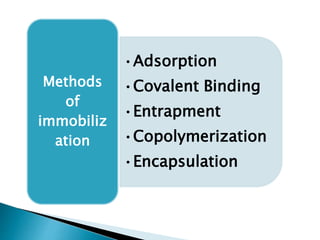
2. Methods of immobilization
3. Enzyme immobilization
4. Advantages of enzyme immobilization
5. Disadvantages of enzyme immobilization
6. Application of enzyme immobilization
7. Reference
An immobilized
enzyme is one whose
movement in space
has been restricted
either completely or to
a small limited region
Immobilization is defined as the process of confining the
enzyme molecule to a solid support over which substrate is
passed and converted to product.
1st immobilized enzyme
was amino acylase of
Aspergillus orzyzae
The matrix or support
immobilize the enzyme by
holding it permanently or
temporarily for a brief
period of time.
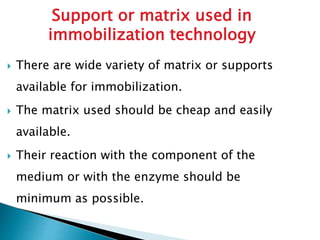
 There are wide variety of matrix or supports
available for immobilization.
 The matrix used should be cheap and easily
available.
 Their reaction with the component of the
medium or with the enzyme should be
minimum as possible.
Support or matrix used in
immobilization technology
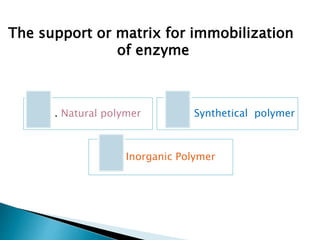
1. Natural polymer 2. Synthetical polymer
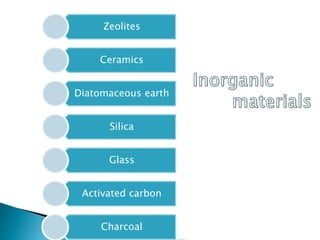
3. Inorganic Polymer
The support or matrix for immobilization
of enzyme
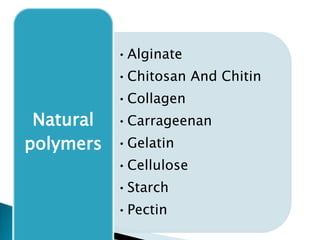
•Alginate
•Chitosan And Chitin
•Collagen
•Carrageenan
•Gelatin
•Cellulose
•Starch
•Pectin
Natural
polymers
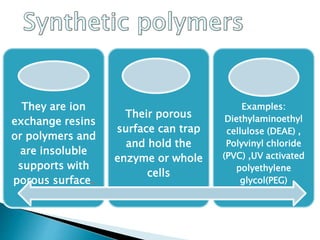
They are ion
exchange resins
or polymers and
are insoluble
supports with
porous surface.
Their porous
surface can trap
and hold the
enzyme or whole
cells
Examples:
Diethylaminoethyl
cellulose (DEAE) ,
Polyvinyl chloride
(PVC) ,UV activated
polyethylene
glycol(PEG)
Zeolites
Ceramics
Diatomaceous earth
Silica
Glass
Activated carbon
Charcoal
•Adsorption
•Covalent Binding
•Entrapment
•Copolymerization
•Encapsulation
Methods
of
immobiliz
ation
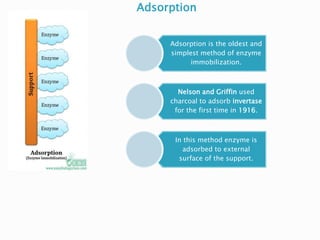
Adsorption
Adsorption is the oldest and
simplest method of enzyme
immobilization.
Nelson and Griffin used
charcoal to adsorb invertase
for the first time in 1916.
In this method enzyme is
adsorbed to external
surface of the support.
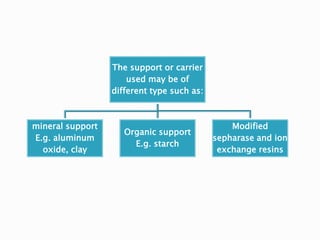
The support or carrier
used may be of
different type such as:
mineral support
E.g. aluminum
oxide, clay
Organic support
E.g. starch
Modified
sepharase and ion
exchange resins
There is no permanent bond formation between carrier
and the enzyme in adsorption method.
Only weak bond stabilize the enzyme to the support or
carrier.
The weak bonds
(low energy bond)
involved are
mainly
• Ionic interaction
• Hydrogen bonds
• Vander wall force
For significant surface bonding the
carrier particle size must be small
(500 A to 1mm diameter)
 The greatest advantages of adsorption method is that
there will not be “pore diffusion limitation”
 Since the enzymes are immobilized externally on the
support or carrier.
1.Static process: Immobilization to
carrier by allowing the solution
containing enzyme to contact the
carrier without stirring
2.Dynamic batch process:
Carrier is placed in the enzyme
solution and mixed by stirring
or agitation
3.Reactor loading process:
Carrier is placed in the
reactor and then the enzyme
solution is transferred to the
reactor with continuous
agitation.
4.Electrode position process:
Carrier is placed near to an
electrode in an enzyme bath
and then the current is put on
under the electric field the
enzyme migrate to the carrier
and deposited on its surface.
1.No pore diffusion limitation
2.Easy to carry out
3.No reagents are required
4.Minimum activation steps involved
5.Comparatively cheap method of immobilization
6.Less disruptive to enzyme than chemical methods
Advantages of adsorption methods
Desorption of
enzyme from the
carrieer
Efficiency is less
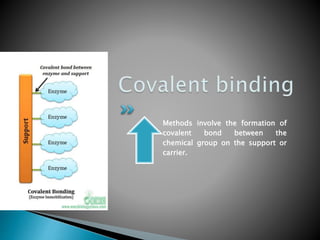
Methods involve the formation of
covalent bond between the
chemical group on the support or
carrier.
Hydroxyl group and amino groups of support or
enzyme form covalent bond more easily.
Chemical group in the support or carrier that can
form covalent bonds with support are amino groups,
carboxyl groups, imino groups, hydroxyl groups,
carboxyl groups thiol groups, methylthiol groups.
guanidyl groups, imidazole groups and phenol ring.
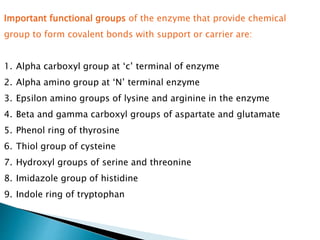
Important functional groups of the enzyme that provide chemical
group to form covalent bonds with support or carrier are:
1. Alpha carboxyl group at ‘c’ terminal of enzyme
2. Alpha amino group at ‘N’ terminal enzyme
3. Epsilon amino groups of lysine and arginine in the enzyme
4. Beta and gamma carboxyl groups of aspartate and glutamate
5. Phenol ring of thyrosine
6. Thiol group of cysteine
7. Hydroxyl groups of serine and threonine
8. Imidazole group of histidine
9. Indole ring of tryptophan
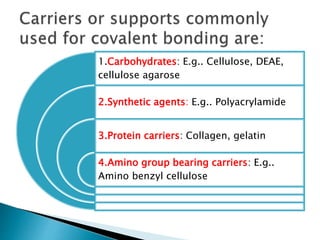
1.Carbohydrates: E.g.. Cellulose, DEAE,
cellulose agarose
2.Synthetic agents: E.g.. Polyacrylamide
3.Protein carriers: Collagen, gelatin
4.Amino group bearing carriers: E.g..
Amino benzyl cellulose
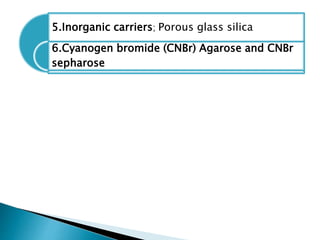
5.Inorganic carriers; Porous glass silica
6.Cyanogen bromide (CNBr) Agarose and CNBr
sepharose
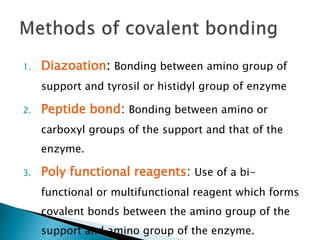
1. Diazoation: Bonding between amino group of
support and tyrosil or histidyl group of enzyme
2. Peptide bond: Bonding between amino or
carboxyl groups of the support and that of the
enzyme.
3. Poly functional reagents: Use of a bi-
functional or multifunctional reagent which forms
covalent bonds between the amino group of the
support and amino group of the enzyme.
a) Strong linkage of enzyme to the support
b) No leakage or desorption problem
c) Comparatively simple method
d) A variety of support with different functional
group available
e) Wide applicability
1.Chemical modification
of enzyme leading to the
loss of functional
conformation of enzyme
2.Enzyme inactivation by
changes in the conformation
when undergoes reactions at
the active site. This can be
overcome through
immobilization in the
presence of enzyme’s
substrate or a competitive
inhibitor
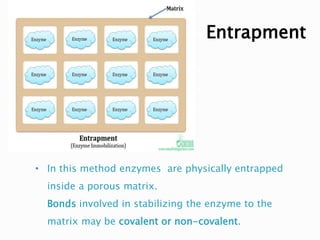
• In this method enzymes are physically entrapped
inside a porous matrix.
Bonds involved in stabilizing the enzyme to the
matrix may be covalent or non-covalent.
Entrapment
• The matrix used will be a water soluble
polymer
• The form and the nature of matrix varies with
different enzymes
• Pore size of matrix is adjusted to prevent the
loss of enzyme .
• Pore size of the matrix can be adjusted with the
concentration of the polymer used.
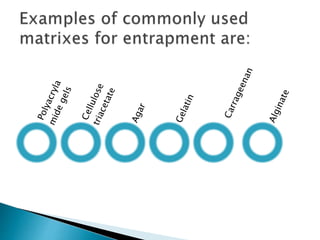
• Agar-agar and carrageenan have comparatively
large pore sizes
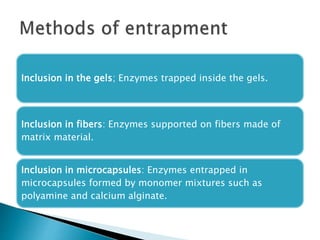
Inclusion in the gels; Enzymes trapped inside the gels.
Inclusion in fibers: Enzymes supported on fibers made of
matrix material.
Inclusion in microcapsules: Enzymes entrapped in
microcapsules formed by monomer mixtures such as
polyamine and calcium alginate.
 Fast method of immobilization
 Cheap (low cost matrixes available)
 Easy to practice at small scale
 Mild conditions are required
 Less chance of conformational changes in
enzyme
 Can be used for sensing application
1.Leakage of enzyme
2.Pore diffusion limitation
3.Chance of microbial contamination
4.Not much success in industrial process
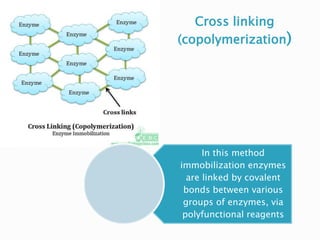
Cross linking
(copolymerization)
In this method
immobilization enzymes
are linked by covalent
bonds between various
groups of enzymes, via
polyfunctional reagents
Unlike other method there is no matrix or support
involved in this method.
Commonly used polyfunctional reagents are
glutaraldehyde and diazonium salt.
This method is cheap and simple but not often used
with pure enzymes.
This method is widely used in commercial
preparations and industrial applications .
The greatest disadvantages or demerit of
this method is that the polyfunctional reagents
used for cross linking the enzyme may denature
or structurally modify the enzyme leading to the
loss of catalytic properties.
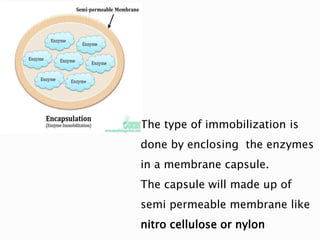
• The type of immobilization is
done by enclosing the enzymes
in a membrane capsule.
The capsule will made up of
semi permeable membrane like
nitro cellulose or nylon
In
In this method the effectiveness
depends upon the stability of
enzyme inside the capsule.
Cheap and simple method
Large quantity of enzymes can be
immobilized by encapsulation
Pore size limitation
Only small substrate molecule
is able to cross the membrane
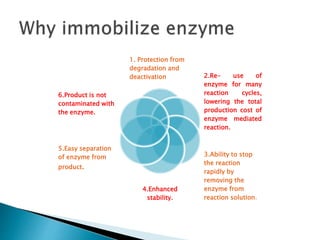
1. Protection from
degradation and
deactivation 2.Re- use of
enzyme for many
reaction cycles,
lowering the total
production cost of
enzyme mediated
reaction.
3.Ability to stop
the reaction
rapidly by
removing the
enzyme from
reaction solution.
4.Enhanced
stability.
5.Easy separation
of enzyme from
product.
6.Product is not
contaminated with
the enzyme.
1. High cost for the isolation, purification and recovery of
active enzyme
2. Industrial application are limited, only very few industries
are using immobilized enzymes or immobilized whole cells.
3. Catalytic properties of some enzymes are reduced or
completely lost after their immobilization on support or
carrier.
4. Some enzyme become unstable after immobilization.
5. Enzymes are inactivated by heat generated by the system.
1. Industrial production
Industrial production of antibiotics, beverages, amino acids, etc.; use
immobilized enzyme or whole cells.
2. Biomedical applications:
Immobilized enzyme can be used to overcome inborn metabolic disorder.
Immobilization technique are effectively used in drug delivery system
especially to oncogenic sites.
3. Food industry:
Enzyme like pectinases and celluloses immobilized on suitable carriers are
successfully used in the production of jams, jellies and syrups from fruits
and vegetables.
4. Research:
The use of immobilized enzyme allow researcher to increase the efficiency
of different enzyme such as horse radish peroxidase(HRP) in blotting
experiments and different proteases for cell or organelle lysis.
5. Production of bio diesel: From vegetable oil.
6. Waste water management: Treatment of sewage and
industrial effluents.
7.Textile industry: scouring, bio-polishing and desizing of fabrics.
8. Detergent industry: Immobilization of lipase enzyme for
effective dirt removal from cloths
9.Immobilized enzyme engineering
• Several of the immobilized enzymes are currently
undergoing active investigation in the
pharmaceutical, sugar, brewing, diary and fine
chemical industries.
 www.easy biologyclass.com/enzyme cell
immobilization- techniques/amp
 R.L Foster; the nature of enzymology, The
nature of enzymology, A Holsted Press Book
Enzyme Imobilisation.

Enzyme Imobilisation.

  • 1.
  • 2.
    INDEX 1. Support ormatrix used in immobilization technology 2. Methods of immobilization 3. Enzyme immobilization 4. Advantages of enzyme immobilization 5. Disadvantages of enzyme immobilization 6. Application of enzyme immobilization 7. Reference
  • 3.
    An immobilized enzyme isone whose movement in space has been restricted either completely or to a small limited region Immobilization is defined as the process of confining the enzyme molecule to a solid support over which substrate is passed and converted to product. 1st immobilized enzyme was amino acylase of Aspergillus orzyzae
  • 4.
    The matrix orsupport immobilize the enzyme by holding it permanently or temporarily for a brief period of time.
  • 5.
     There arewide variety of matrix or supports available for immobilization.  The matrix used should be cheap and easily available.  Their reaction with the component of the medium or with the enzyme should be minimum as possible. Support or matrix used in immobilization technology
  • 6.
    1. Natural polymer2. Synthetical polymer 3. Inorganic Polymer The support or matrix for immobilization of enzyme
  • 7.
  • 8.
    They are ion exchangeresins or polymers and are insoluble supports with porous surface. Their porous surface can trap and hold the enzyme or whole cells Examples: Diethylaminoethyl cellulose (DEAE) , Polyvinyl chloride (PVC) ,UV activated polyethylene glycol(PEG)
  • 9.
  • 10.
  • 11.
    Adsorption Adsorption is theoldest and simplest method of enzyme immobilization. Nelson and Griffin used charcoal to adsorb invertase for the first time in 1916. In this method enzyme is adsorbed to external surface of the support.
  • 12.
    The support orcarrier used may be of different type such as: mineral support E.g. aluminum oxide, clay Organic support E.g. starch Modified sepharase and ion exchange resins
  • 13.
    There is nopermanent bond formation between carrier and the enzyme in adsorption method. Only weak bond stabilize the enzyme to the support or carrier. The weak bonds (low energy bond) involved are mainly • Ionic interaction • Hydrogen bonds • Vander wall force
  • 14.
    For significant surfacebonding the carrier particle size must be small (500 A to 1mm diameter)  The greatest advantages of adsorption method is that there will not be “pore diffusion limitation”  Since the enzymes are immobilized externally on the support or carrier.
  • 15.
    1.Static process: Immobilizationto carrier by allowing the solution containing enzyme to contact the carrier without stirring 2.Dynamic batch process: Carrier is placed in the enzyme solution and mixed by stirring or agitation
  • 16.
    3.Reactor loading process: Carrieris placed in the reactor and then the enzyme solution is transferred to the reactor with continuous agitation. 4.Electrode position process: Carrier is placed near to an electrode in an enzyme bath and then the current is put on under the electric field the enzyme migrate to the carrier and deposited on its surface.
  • 17.
    1.No pore diffusionlimitation 2.Easy to carry out 3.No reagents are required 4.Minimum activation steps involved 5.Comparatively cheap method of immobilization 6.Less disruptive to enzyme than chemical methods Advantages of adsorption methods
  • 18.
    Desorption of enzyme fromthe carrieer Efficiency is less
  • 19.
    Methods involve theformation of covalent bond between the chemical group on the support or carrier.
  • 20.
    Hydroxyl group andamino groups of support or enzyme form covalent bond more easily. Chemical group in the support or carrier that can form covalent bonds with support are amino groups, carboxyl groups, imino groups, hydroxyl groups, carboxyl groups thiol groups, methylthiol groups. guanidyl groups, imidazole groups and phenol ring.
  • 21.
    Important functional groupsof the enzyme that provide chemical group to form covalent bonds with support or carrier are: 1. Alpha carboxyl group at ‘c’ terminal of enzyme 2. Alpha amino group at ‘N’ terminal enzyme 3. Epsilon amino groups of lysine and arginine in the enzyme 4. Beta and gamma carboxyl groups of aspartate and glutamate 5. Phenol ring of thyrosine 6. Thiol group of cysteine 7. Hydroxyl groups of serine and threonine 8. Imidazole group of histidine 9. Indole ring of tryptophan
  • 22.
    1.Carbohydrates: E.g.. Cellulose,DEAE, cellulose agarose 2.Synthetic agents: E.g.. Polyacrylamide 3.Protein carriers: Collagen, gelatin 4.Amino group bearing carriers: E.g.. Amino benzyl cellulose
  • 23.
    5.Inorganic carriers; Porousglass silica 6.Cyanogen bromide (CNBr) Agarose and CNBr sepharose
  • 24.
    1. Diazoation: Bondingbetween amino group of support and tyrosil or histidyl group of enzyme 2. Peptide bond: Bonding between amino or carboxyl groups of the support and that of the enzyme. 3. Poly functional reagents: Use of a bi- functional or multifunctional reagent which forms covalent bonds between the amino group of the support and amino group of the enzyme.
  • 25.
    a) Strong linkageof enzyme to the support b) No leakage or desorption problem c) Comparatively simple method d) A variety of support with different functional group available e) Wide applicability
  • 26.
    1.Chemical modification of enzymeleading to the loss of functional conformation of enzyme 2.Enzyme inactivation by changes in the conformation when undergoes reactions at the active site. This can be overcome through immobilization in the presence of enzyme’s substrate or a competitive inhibitor
  • 27.
    • In thismethod enzymes are physically entrapped inside a porous matrix. Bonds involved in stabilizing the enzyme to the matrix may be covalent or non-covalent. Entrapment
  • 28.
    • The matrixused will be a water soluble polymer • The form and the nature of matrix varies with different enzymes • Pore size of matrix is adjusted to prevent the loss of enzyme . • Pore size of the matrix can be adjusted with the concentration of the polymer used. • Agar-agar and carrageenan have comparatively large pore sizes
  • 30.
    Inclusion in thegels; Enzymes trapped inside the gels. Inclusion in fibers: Enzymes supported on fibers made of matrix material. Inclusion in microcapsules: Enzymes entrapped in microcapsules formed by monomer mixtures such as polyamine and calcium alginate.
  • 31.
     Fast methodof immobilization  Cheap (low cost matrixes available)  Easy to practice at small scale  Mild conditions are required  Less chance of conformational changes in enzyme  Can be used for sensing application
  • 32.
    1.Leakage of enzyme 2.Porediffusion limitation 3.Chance of microbial contamination 4.Not much success in industrial process
  • 33.
    Cross linking (copolymerization) In thismethod immobilization enzymes are linked by covalent bonds between various groups of enzymes, via polyfunctional reagents
  • 34.
    Unlike other methodthere is no matrix or support involved in this method. Commonly used polyfunctional reagents are glutaraldehyde and diazonium salt. This method is cheap and simple but not often used with pure enzymes. This method is widely used in commercial preparations and industrial applications .
  • 35.
    The greatest disadvantagesor demerit of this method is that the polyfunctional reagents used for cross linking the enzyme may denature or structurally modify the enzyme leading to the loss of catalytic properties.
  • 36.
    • The typeof immobilization is done by enclosing the enzymes in a membrane capsule. The capsule will made up of semi permeable membrane like nitro cellulose or nylon
  • 37.
    In In this methodthe effectiveness depends upon the stability of enzyme inside the capsule.
  • 38.
    Cheap and simplemethod Large quantity of enzymes can be immobilized by encapsulation
  • 39.
    Pore size limitation Onlysmall substrate molecule is able to cross the membrane
  • 40.
    1. Protection from degradationand deactivation 2.Re- use of enzyme for many reaction cycles, lowering the total production cost of enzyme mediated reaction. 3.Ability to stop the reaction rapidly by removing the enzyme from reaction solution. 4.Enhanced stability. 5.Easy separation of enzyme from product. 6.Product is not contaminated with the enzyme.
  • 41.
    1. High costfor the isolation, purification and recovery of active enzyme 2. Industrial application are limited, only very few industries are using immobilized enzymes or immobilized whole cells. 3. Catalytic properties of some enzymes are reduced or completely lost after their immobilization on support or carrier. 4. Some enzyme become unstable after immobilization. 5. Enzymes are inactivated by heat generated by the system.
  • 42.
    1. Industrial production Industrialproduction of antibiotics, beverages, amino acids, etc.; use immobilized enzyme or whole cells. 2. Biomedical applications: Immobilized enzyme can be used to overcome inborn metabolic disorder. Immobilization technique are effectively used in drug delivery system especially to oncogenic sites. 3. Food industry: Enzyme like pectinases and celluloses immobilized on suitable carriers are successfully used in the production of jams, jellies and syrups from fruits and vegetables.
  • 43.
    4. Research: The useof immobilized enzyme allow researcher to increase the efficiency of different enzyme such as horse radish peroxidase(HRP) in blotting experiments and different proteases for cell or organelle lysis. 5. Production of bio diesel: From vegetable oil. 6. Waste water management: Treatment of sewage and industrial effluents. 7.Textile industry: scouring, bio-polishing and desizing of fabrics. 8. Detergent industry: Immobilization of lipase enzyme for effective dirt removal from cloths
  • 44.
    9.Immobilized enzyme engineering •Several of the immobilized enzymes are currently undergoing active investigation in the pharmaceutical, sugar, brewing, diary and fine chemical industries.
  • 45.
     www.easy biologyclass.com/enzymecell immobilization- techniques/amp  R.L Foster; the nature of enzymology, The nature of enzymology, A Holsted Press Book