PRINCIPAL OF AFFINITYCHROMATOGRAPHY
Affinity chromatography is one of the most diverse and powerful chromatographic
methods for purification of a specific molecule or a group of molecules from complex
mixtures.
It is based on highly specific biological interactions between two molecules such as
interactions between enzyme and substrate, receptor and ligand, or antibody and
antigen.
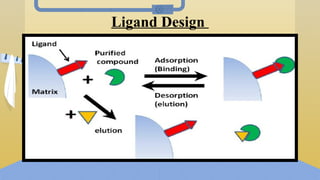
These interactions which are typically reversible are used for purification by placing
one of the interacting molecules referred to as affinity ligand onto a solid matrix to
create a stationary phase while a target molecule is in the mobile phase.
Many of the commonly used ligands coupled to affinity matrices are now commercially
available and are ready to use.
4.
An ideal chromatographicbed material (matrix)
1. It must possess suitable groups to which ligand can be covalently coupled. Many groups may be
introduced into matrix to couple ligands. They may be nucleo philic as NH2, SH, OH or
electrophilic such as activated acid chlorides, carbonyls activated by carbodiimide, iothiocyanate
or diazonium salts.
2. It must remain unchanged under the conditions of attachment of ligand.
3. During the binding of the macromolecule and its subsequent displacement from ligand, it must
retain its physical and chemical stability.
4. It must not exhibit non-specific adsorption.
5. It should have an open pore structure.
The most commonly used matrices are cross-linked dextrans (e.g. Sephacryl), agarose (e.g.
Sepharose), polyacrylamide gel (Bio gel P), polystyrene, cellulose, porous glass and silica.
5.
How Ligand Bindswith Matrix?
1. For attachment of the ligand with the matrix, the matrix is given preliminary treatment with
cyanogens bromideat pH11.
2. This causes activation of the matrix and the molecules containing primary amino groups could
then easily be coupled to CNBr activated matrices.
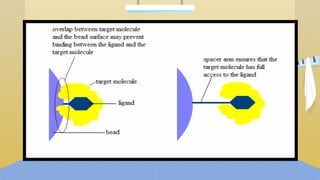
3. Different spacer arms including 1,6-diamino hexane, 6-amino hexanoic acid, and 1,4-bis(epoxy-
propoxy)butane have been used to which the ligand can be attached by conventional organo
synthetic procedures involving the use of succinic anhydride and a water soluble carbodiimide.
4. A number of supports of agarose, dextran and polyacrylamide type are commercially available
with a variety of spacer arms and ligands.
COMPONENTS OF AFFINITYCHROMATOGRAPHY
Stationary Phase (Matrix): A solid support where ligands are immobilized. Common materials
include agarose, cellulose, and silica beads.
Ligand: A specific molecule that binds the target biomolecule. Examples include antibodies, protein
A/G, metal ions, lectins, and DNA/RNA sequences.
Mobile Phase (Buffers):
• Binding Buffer – Promotes interaction between ligand and target.
• Washing Buffer – Removes unbound impurities.
• Elution Buffer – Releases the target molecule (pH change, salt gradient, or competitive binding).
Chromatography Column: Holds the stationary phase and ensures controlled flow of the sample and
buffers. Can be pre-packed or manually filled.
Detection System: Confirms the purity of the eluted target using UV spectrophotometry, SDS-PAGE,
or Western blotting.
TYPE OF AFFINITYCHROMATOGRAPHY
1 ️
1️⃣Immunoaffinity Chromatography (IAC): Uses antibodies to capture specific antigens or proteins (e.g., antibody
purification).
2️⃣Metal Chelate Affinity Chromatography (IMAC): Utilizes metal ions (Ni² , Co² , Zn² , Cu² )
⁺ ⁺ ⁺ ⁺ to bind His-tagged
proteins
.
3 ️
3️⃣Lectin Affinity Chromatography: Uses lectins to bind glycoproteins and carbohydrate-containing molecules.
4️⃣Protein A/G Affinity Chromatography: Specifically purifies immunoglobulins (antibodies) using Protein A or G.
5 ️
5️⃣Dye-Ligand Affinity Chromatography: Employs synthetic dye ligands to bind enzymes and proteins based on
structural similarities.
6️⃣Nucleic Acid Affinity Chromatography: Uses DNA or RNA sequences to purify nucleic acid-binding proteins.
7 ️
7️⃣Heparin Affinity Chromatography: Binds coagulation factors, growth factors, and plasma proteins using
heparin as a ligand.
13.
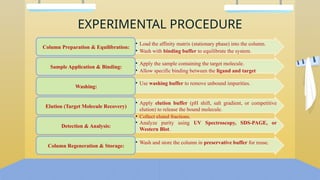
EXPERIMENTAL PROCEDURE
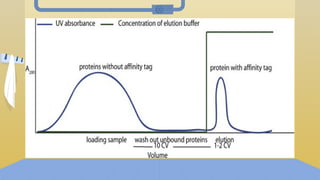
• Loadthe affinity matrix (stationary phase) into the column.
• Wash with binding buffer to equilibrate the system.
Column Preparation & Equilibration:
• Apply the sample containing the target molecule.
• Allow specific binding between the ligand and target
Sample Application & Binding:
• Use washing buffer to remove unbound impurities.
Washing:
• Apply elution buffer (pH shift, salt gradient, or competitive
elution) to release the bound molecule.
• Collect eluted fractions.
Elution (Target Molecule Recovery)
• Analyze purity using UV Spectroscopy, SDS-PAGE, or
Western Blot.
Detection & Analysis:
• Wash and store the column in preservative buffer for reuse.
Column Regeneration & Storage:
14.
APPLICATIONS
Application Examples Description
ProteinPurification
Enzymes, antibodies, recombinant
proteins
Used for purifying proteins based on
specific interactions with ligands.
Nucleic Acid Isolation DNA, RNA
Isolates specific DNA or RNA sequences
using complementary nucleotide sequences
as ligands.
Antibody Purification
Monoclonal and polyclonal
antibodies
Purifies antibodies using ligands such as
protein A, protein G, or protein L.
Enzyme Purification Specific enzymes
Isolates enzymes using substrate analogs or
inhibitors as ligands.
Biopharmaceutical Production
Monoclonal antibodies, insulin,
therapeutic proteins
Ensures high purity and activity of
biopharmaceuticals for clinical use.
Drug Development Screening potential drug candidates
Identifies and screens drug candidates based
on binding interactions with target
molecules.
15.
APPLICATIONS
Food Additive PurificationEnzymes, Flavors, food additives
Purifies food additives to ensure product quality and
safety.
Quality Control Detecting contaminants in food products
Used in quality control to detect and quantify specific
contaminants or adulterants in food products.
Protein-Protein Interactions
Studying complexes between target proteins
and binding partners
Studies interactions between proteins by isolating
complexes formed between them.
Protein-DNA Interactions
Understanding gene regulation and
transcriptional control
Studies interactions between proteins and DNA,
important for understanding gene regulation.
Biomarker Discovery
Identifying biomarkers for disease diagnosis
and prognosis
Used in discovering and validating biomarkers for
diagnostics.
Diagnostic Assays
Enzyme-linked immunosorbent assays
(ELISAs)
Develops diagnostic assays by capturing and
detecting target antigens using specific antibodies.
Pollutant Detection
Detecting heavy metals and organic
contaminants in the environment
Detects and quantifies environmental pollutants using
specific ligands.
Bioremediation
Isolating enzymes or microorganisms for
degrading or detoxifying environmental
pollutants
Used in bioremediation processes to purify enzymes
or microorganisms for pollutant degradation.
Application Examples Description
16.
ADVANTAGES AND DISADVANTAGES
Advantages
•High Specificity: Highly selective
purification based on specific
interactions.
• Efficiency: Can purify complex mixtures
in a single step.
• High Purity: Provides high levels of
purity, suitable for sensitive applications.
• Versatility: Can be used to purify a wide
range of biomolecules.
• Scalability: Can be adapted for small-
scale and large-scale applications.
• Automation Compatibility: Suitable for
high-throughput applications and reduces
manual labor.
Disadvantages
• Cost: Expensive ligands and matrices,
especially for large-scale applications.
• Ligand Leakage: Risk of ligand leaking
from the matrix, contaminating the
purified product.
• Limited Reusability: Columns and
matrices may degrade over time.
• Complex Sample Preparation: Time-
consuming optimization of binding and
elution conditions.
• Scalability Issues: Challenges in scaling
up for industrial production.
• Potential for Non-Specific Binding:
Risk of non-specific binding reducing
purity.
17.
CONCLUTION
Affinity chromatographyis a powerful and versatile technique for biomolecule
purification.
It relies on specific interactions between the target molecule and a ligand.
The technique offers high specificity, efficiency, and purity.
Applications include biotechnology, pharmaceuticals, food industry, and research.
Challenges include cost, ligand leakage, and scalability issues.
Ongoing innovations are improving the technique, such as stable ligands, automation,
and miniaturization.
Affinity chromatography continues to be relevant and significant in scientific research
and industrial applications.