AFFINITY CHROMATOGRAPHY
MD NADIR HASSAN
CONTENTS
1.INTRODUCTION
2.HISTORY
3.PRINCIPLE
4.COMPONENTS
5.TYPES
6.EXPERIMENTAL PROCEDURE
7.APPLICATIONS ,ADVANTAGES AND
LIMITATIONS
8.CONCLUSION
AFFINITY CHROMATOGRAPHY
 Biomolecules are purified using techniques that separate according to
differences in specific properties.
PROPERTY TECHNIQUE
Charge Ion exchange chromatography
Size Gel filtration chromatography
Biorecognition Affinity chromatography
 It is a technique that enables the purification of biomolecule on the basis of its
biological function.
 Interaction between a biomolecule and a specific ligand hold the basis of
separtion.
SAMPLE LIGAND
Enzyme Co factor, inhibitor
Antibody Antigen, virus
Lectin Polysaccharide,glycoprotein
Nucleic acid Histones, bases
Hormones Receptors,carrier proteins
HISTORY
 In1910, German scientist Emil
Starkenstein published an article
describing the concept of
resolving macromolecules via
their interaction with an
immobilised substrate.
 The credit for the invention and
term of affinity chromatography
goes to Pedro Cuatecasas and
Meir Wilchek.
 Their article(1968) briefly
describe the technique of enzyme
purification via immobilised
substrate and inhibitors.
 In 1987,Pedro and Meir won
Wolf Prize in medicine for their
invention.
PRINCIPLE
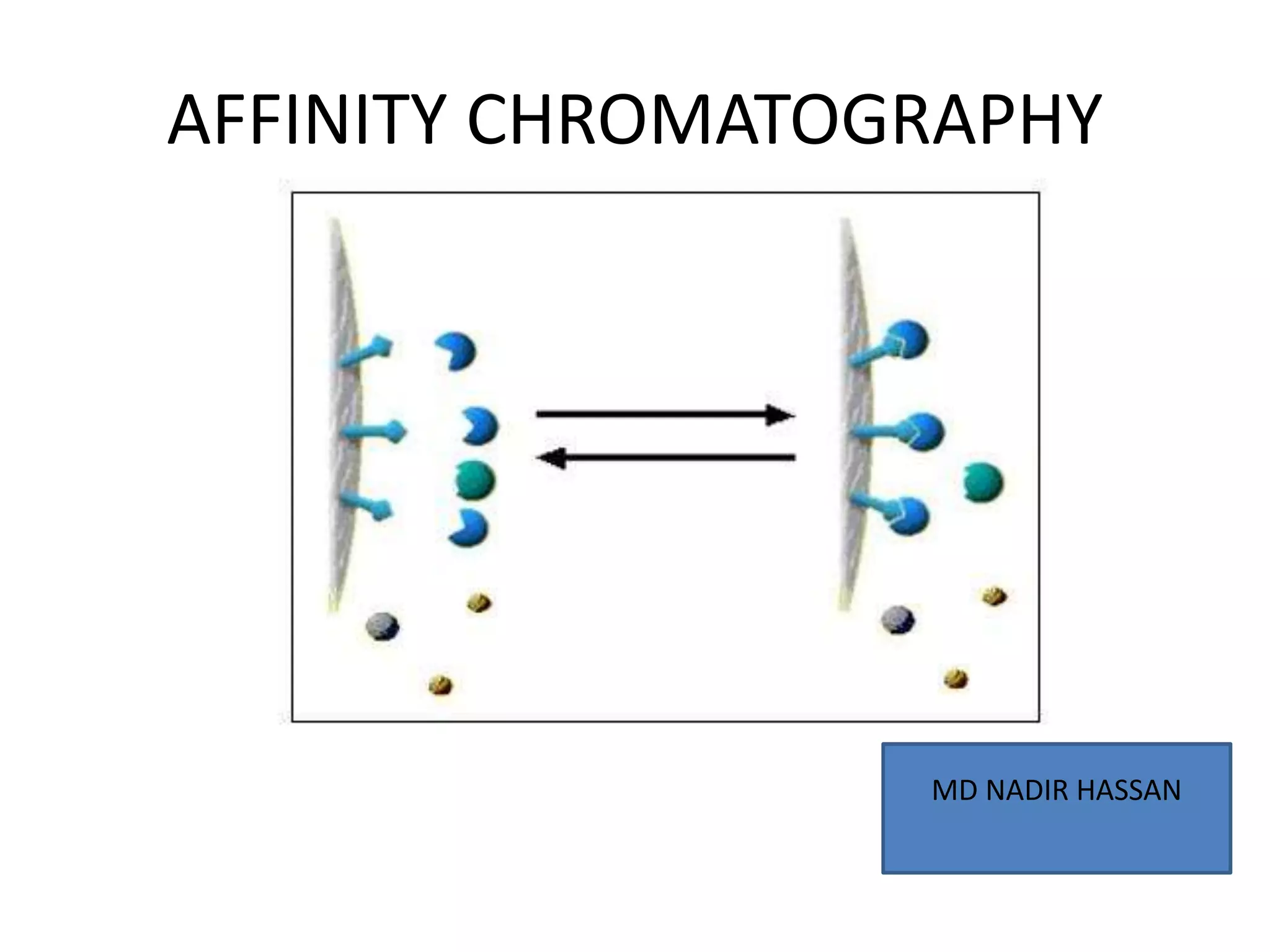
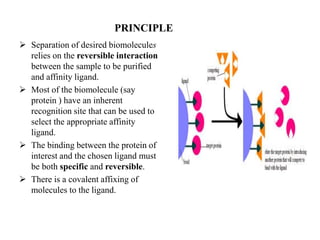
 Separation of desired biomolecules
relies on the reversible interaction
between the sample to be purified
and affinity ligand.
 Most of the biomolecule (say
protein ) have an inherent
recognition site that can be used to
select the appropriate affinity
ligand.
 The binding between the protein of
interest and the chosen ligand must
be both specific and reversible.
 There is a covalent affixing of
molecules to the ligand.
COMPONENTS
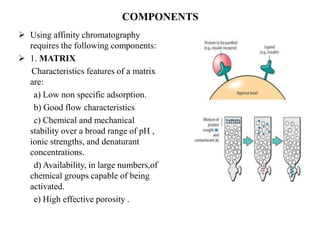
 Using affinity chromatography
requires the following components:
 1. MATRIX
Characteristics features of a matrix
are:
a) Low non specific adsorption.
b) Good flow characteristics
c) Chemical and mechanical
stability over a broad range of pH ,
ionic strengths, and denaturant
concentrations.
d) Availability, in large numbers,of
chemical groups capable of being
activated.
e) High effective porosity .
TYPES OF MATRIX
• AGAROSE
Often used and ferry all the desirable features.
Only disadvantage is its susceptibility to contraction when denaturant
solutions are used.
• POLYACRYLAMIDE
Lack porosity and undeseribility increase with substitution.
• CONTROLLED POROSITY GLASS BEADS
Mechanical rigidity, chemical inertness, and good flow rates are its
feature but it has high non specific adsorption.
LIGAND
The selection of ligand should have two most important requirements:
a) Ligand interaction should be less with desired macromolecule.
b) The ligand should possess functional groups that can be modified to
form covalent linkage with the supporting matrix.
COUPLING OF LIGAND TO MATRIX INVOLVES:
Activation of matrix functional groups
Coupling of the ligand to these activated groups
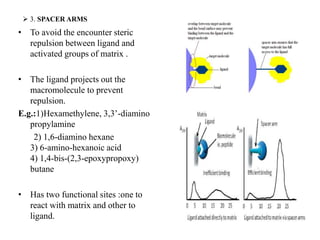
 3. SPACER ARMS
• To avoid the encounter steric
repulsion between ligand and
activated groups of matrix .
• The ligand projects out the
macromolecule to prevent
repulsion.
E.g.:1)Hexamethylene, 3,3’-diamino
propylamine
2) 1,6-diamino hexane
3) 6-amino-hexanoic acid
4) 1,4-bis-(2,3-epoxypropoxy)
butane
• Has two functional sites :one to
react with matrix and other to
ligand.
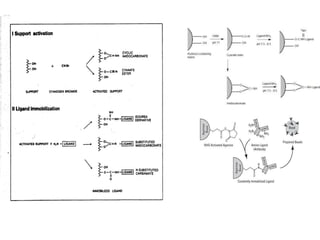
 LIGAND IMMOBILIZATION
• The most common procedure is to link a coupling agent to the matrix and then add the
liagand.
• Most of the common couplers are :
1. CYANOGEN-BROMIDE-ACTIVATED AGAROSE
Cyanogen bromide(CNBr) reacts strongly with the amino group.
Useful in coupling enzymes, coenzymes, inhibitors, antigens, nucelic acid.
2. AMINOETHYL- AND HYDRAZIDE-ACTIVATED POLYACRYLAMIDE
More ligands can be coupled in this.
Capacity of polyacrylamide support column is greater than agarose.
The most common linkers are
-CONH-CH2-CH2-NH2
CONH-NH2
3. THIOPROPYL-AGAROSE
Has 2-thiopyridyl groups linked to agarose by a spacer of a 2-hydroxypropyl
residues.
2-thiopyridyl group react with terminal thiol groups.
TYPES
 On the basis of types of ligand ,affinity has few categorisation:
1.IMMUNO AFFINITY CHROMATOGRAPHY
• Antibodies is used as immobilised ligand.
• Purify range of proteins
• Monoclonal antibodies may be linked with agarose matrix.
2.METAL CHELATE CHROMATOGRAPHY
• Immobilised metal ion such as Cuprous,Zinc or transition metal such as
Nickel is used.
• Reacts with imidazole group of histidine,thiol group of cysteine,indole
group of tryptophan residues of proteins.
• Formation of co ordinate bond is there.
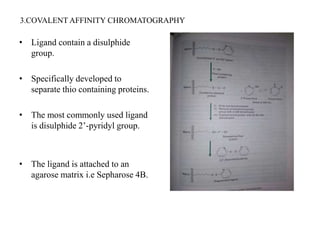
3.COVALENT AFFINITY CHROMATOGRAPHY
• Ligand contain a disulphide
group.
• Specifically developed to
separate thio containing proteins.
• The most commonly used ligand
is disulphide 2’-pyridyl group.
• The ligand is attached to an
agarose matrix i.e Sepharose 4B.
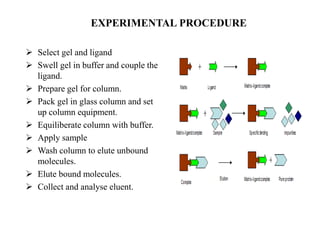
EXPERIMENTAL PROCEDURE
 Select gel and ligand
 Swell gel in buffer and couple the
ligand.
 Prepare gel for column.
 Pack gel in glass column and set
up column equipment.
 Equiliberate column with buffer.
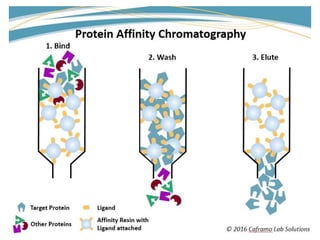
 Apply sample
 Wash column to elute unbound
molecules.
 Elute bound molecules.
 Collect and analyse eluent.
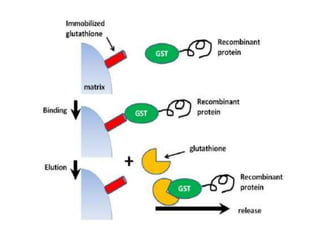
ELUTION
 Generally two methods of elution are there:
 First is by washing the column with a solution of a compound which
competes with bound ligand and has higher affinity.
 Require large volumes of eluent .
 Increasing the competitor concentration does not alter time require to remove
desire molecule.
 The second approach is to drastically change the environment of the
complex.
 The methods are
Change ionic strength
Change of pH
 This does not totally unfold the protein.
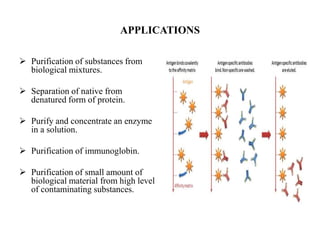
APPLICATIONS
 Purification of substances from
biological mixtures.
 Separation of native from
denatured form of protein.
 Purify and concentrate an enzyme
in a solution.
 Purification of immunoglobin.
 Purification of small amount of
biological material from high level
of contaminating substances.
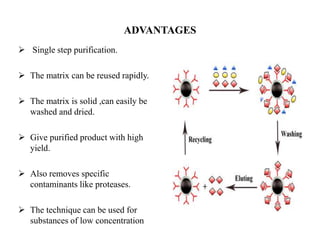
ADVANTAGES
 Single step purification.
 The matrix can be reused rapidly.
 The matrix is solid ,can easily be
washed and dried.
 Give purified product with high
yield.
 Also removes specific
contaminants like proteases.
 The technique can be used for
substances of low concentration
LIMITATIONS
 Non specific adsorption can totally be not eliminated,can only be
minimised.
 Limited availability
 High cost of immobilised ligand
 If required pH is not adjusted ,protein get denatured.
 Creates problem when two macromolecules has same affinity for a
particular ligand.
CONCLUSION
 Affinity chromatography is one of the most reliable chromatographic
technique.
 This technique offers high selectivity,hence high resolution and usually
high amount of protein of interest.
 It is theoretically capable of giving absolute purifications even from
complex mixtures in a single process.
THANK YOU

Affinity chromatography

  • 1.
  • 2.
  • 3.
    AFFINITY CHROMATOGRAPHY  Biomoleculesare purified using techniques that separate according to differences in specific properties. PROPERTY TECHNIQUE Charge Ion exchange chromatography Size Gel filtration chromatography Biorecognition Affinity chromatography  It is a technique that enables the purification of biomolecule on the basis of its biological function.  Interaction between a biomolecule and a specific ligand hold the basis of separtion. SAMPLE LIGAND Enzyme Co factor, inhibitor Antibody Antigen, virus Lectin Polysaccharide,glycoprotein Nucleic acid Histones, bases Hormones Receptors,carrier proteins
  • 4.
    HISTORY  In1910, Germanscientist Emil Starkenstein published an article describing the concept of resolving macromolecules via their interaction with an immobilised substrate.  The credit for the invention and term of affinity chromatography goes to Pedro Cuatecasas and Meir Wilchek.  Their article(1968) briefly describe the technique of enzyme purification via immobilised substrate and inhibitors.  In 1987,Pedro and Meir won Wolf Prize in medicine for their invention.
  • 5.
    PRINCIPLE  Separation ofdesired biomolecules relies on the reversible interaction between the sample to be purified and affinity ligand.  Most of the biomolecule (say protein ) have an inherent recognition site that can be used to select the appropriate affinity ligand.  The binding between the protein of interest and the chosen ligand must be both specific and reversible.  There is a covalent affixing of molecules to the ligand.
  • 6.
    COMPONENTS  Using affinitychromatography requires the following components:  1. MATRIX Characteristics features of a matrix are: a) Low non specific adsorption. b) Good flow characteristics c) Chemical and mechanical stability over a broad range of pH , ionic strengths, and denaturant concentrations. d) Availability, in large numbers,of chemical groups capable of being activated. e) High effective porosity .
  • 7.
    TYPES OF MATRIX •AGAROSE Often used and ferry all the desirable features. Only disadvantage is its susceptibility to contraction when denaturant solutions are used. • POLYACRYLAMIDE Lack porosity and undeseribility increase with substitution. • CONTROLLED POROSITY GLASS BEADS Mechanical rigidity, chemical inertness, and good flow rates are its feature but it has high non specific adsorption.
  • 8.
    LIGAND The selection ofligand should have two most important requirements: a) Ligand interaction should be less with desired macromolecule. b) The ligand should possess functional groups that can be modified to form covalent linkage with the supporting matrix. COUPLING OF LIGAND TO MATRIX INVOLVES: Activation of matrix functional groups Coupling of the ligand to these activated groups
  • 9.
     3. SPACERARMS • To avoid the encounter steric repulsion between ligand and activated groups of matrix . • The ligand projects out the macromolecule to prevent repulsion. E.g.:1)Hexamethylene, 3,3’-diamino propylamine 2) 1,6-diamino hexane 3) 6-amino-hexanoic acid 4) 1,4-bis-(2,3-epoxypropoxy) butane • Has two functional sites :one to react with matrix and other to ligand.
  • 10.
     LIGAND IMMOBILIZATION •The most common procedure is to link a coupling agent to the matrix and then add the liagand. • Most of the common couplers are : 1. CYANOGEN-BROMIDE-ACTIVATED AGAROSE Cyanogen bromide(CNBr) reacts strongly with the amino group. Useful in coupling enzymes, coenzymes, inhibitors, antigens, nucelic acid. 2. AMINOETHYL- AND HYDRAZIDE-ACTIVATED POLYACRYLAMIDE More ligands can be coupled in this. Capacity of polyacrylamide support column is greater than agarose. The most common linkers are -CONH-CH2-CH2-NH2 CONH-NH2 3. THIOPROPYL-AGAROSE Has 2-thiopyridyl groups linked to agarose by a spacer of a 2-hydroxypropyl residues. 2-thiopyridyl group react with terminal thiol groups.
  • 12.
    TYPES  On thebasis of types of ligand ,affinity has few categorisation: 1.IMMUNO AFFINITY CHROMATOGRAPHY • Antibodies is used as immobilised ligand. • Purify range of proteins • Monoclonal antibodies may be linked with agarose matrix. 2.METAL CHELATE CHROMATOGRAPHY • Immobilised metal ion such as Cuprous,Zinc or transition metal such as Nickel is used. • Reacts with imidazole group of histidine,thiol group of cysteine,indole group of tryptophan residues of proteins. • Formation of co ordinate bond is there.
  • 13.
    3.COVALENT AFFINITY CHROMATOGRAPHY •Ligand contain a disulphide group. • Specifically developed to separate thio containing proteins. • The most commonly used ligand is disulphide 2’-pyridyl group. • The ligand is attached to an agarose matrix i.e Sepharose 4B.
  • 14.
    EXPERIMENTAL PROCEDURE  Selectgel and ligand  Swell gel in buffer and couple the ligand.  Prepare gel for column.  Pack gel in glass column and set up column equipment.  Equiliberate column with buffer.  Apply sample  Wash column to elute unbound molecules.  Elute bound molecules.  Collect and analyse eluent.
  • 15.
    ELUTION  Generally twomethods of elution are there:  First is by washing the column with a solution of a compound which competes with bound ligand and has higher affinity.  Require large volumes of eluent .  Increasing the competitor concentration does not alter time require to remove desire molecule.  The second approach is to drastically change the environment of the complex.  The methods are Change ionic strength Change of pH  This does not totally unfold the protein.
  • 17.
    APPLICATIONS  Purification ofsubstances from biological mixtures.  Separation of native from denatured form of protein.  Purify and concentrate an enzyme in a solution.  Purification of immunoglobin.  Purification of small amount of biological material from high level of contaminating substances.
  • 19.
    ADVANTAGES  Single steppurification.  The matrix can be reused rapidly.  The matrix is solid ,can easily be washed and dried.  Give purified product with high yield.  Also removes specific contaminants like proteases.  The technique can be used for substances of low concentration
  • 20.
    LIMITATIONS  Non specificadsorption can totally be not eliminated,can only be minimised.  Limited availability  High cost of immobilised ligand  If required pH is not adjusted ,protein get denatured.  Creates problem when two macromolecules has same affinity for a particular ligand.
  • 21.
    CONCLUSION  Affinity chromatographyis one of the most reliable chromatographic technique.  This technique offers high selectivity,hence high resolution and usually high amount of protein of interest.  It is theoretically capable of giving absolute purifications even from complex mixtures in a single process.
  • 22.