By
Mr. Vinayak R. Bodhankar
M. Pharm. (Ph.D*)
Content
 Introduction, theory
 Instrumentation
 Applications
 It is purification of biomolecules with respect to specific binding of that
biomolecule due to the chemical structure
 It is method of separating biochemical mixtures based on highly specific
interactions such as antigen – antibody, enzyme – substrate, etc.
 It is applicable for biological sample.
 Stationary phase: Gel matrix
(ligand: obtained from algae containing linear sugar molecule)
 Mobile phase: Liquid (Buffer solution)
 Introduction
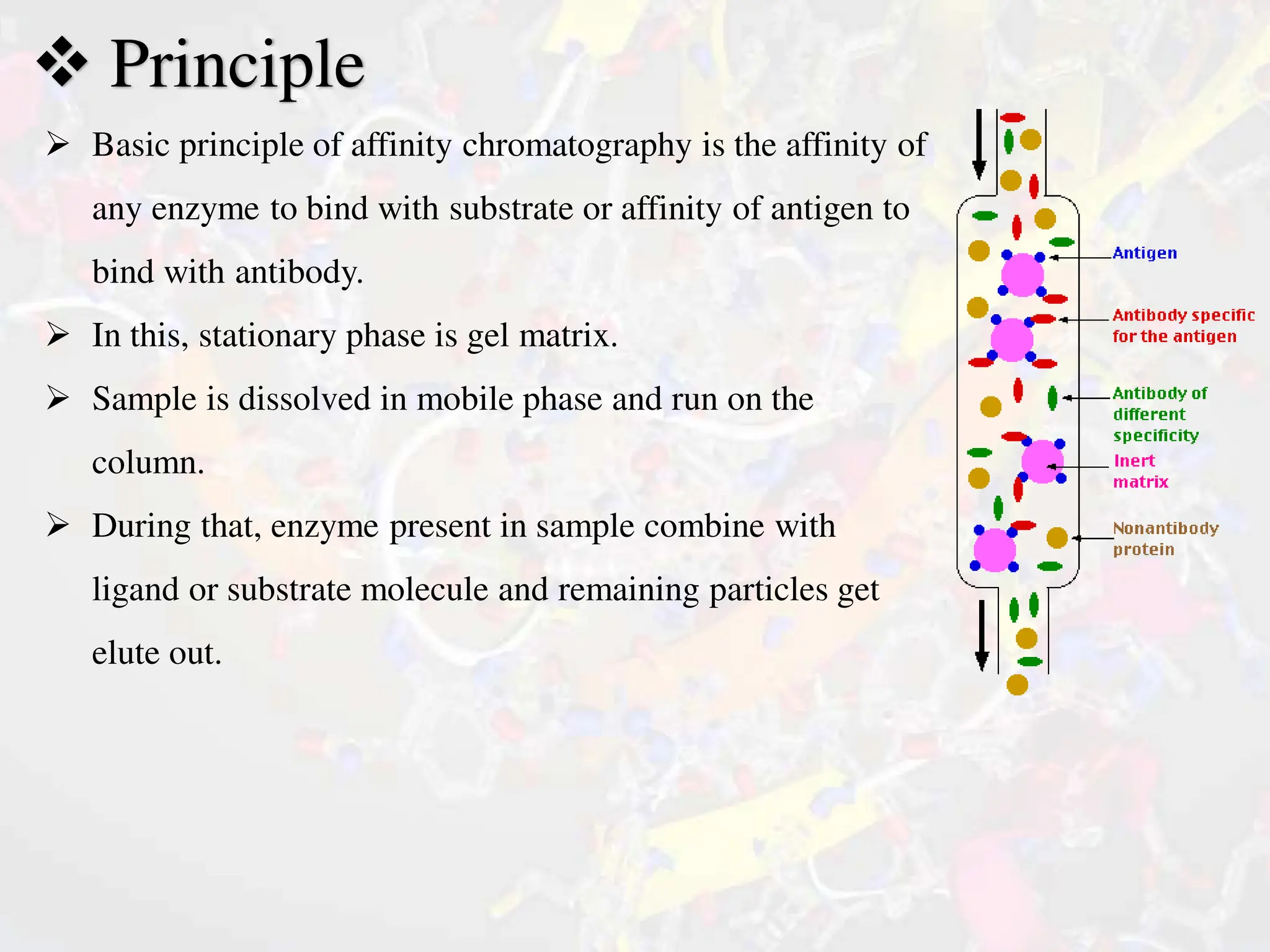
 Basic principle of affinity chromatography is the affinity of
any enzyme to bind with substrate or affinity of antigen to
bind with antibody.
 In this, stationary phase is gel matrix.
 Sample is dissolved in mobile phase and run on the
column.
 During that, enzyme present in sample combine with
ligand or substrate molecule and remaining particles get
elute out.
 Principle
 Preparation of column:
Stationary phase i.e., gel (Ligand matrix) is filled in column and allow to saturate.
 Application of sample:
Sample is mixed with mobile phase and forms a solution.
(Sample comes down slowly through the column)
 Complex formation:
 Wash out:
Washing with distilled water or organic solvent, complex remains as it is and extra
material get remove from the sample.
 Elution:
Complex moves out slowly from the column.
 Detection:
 Methodology
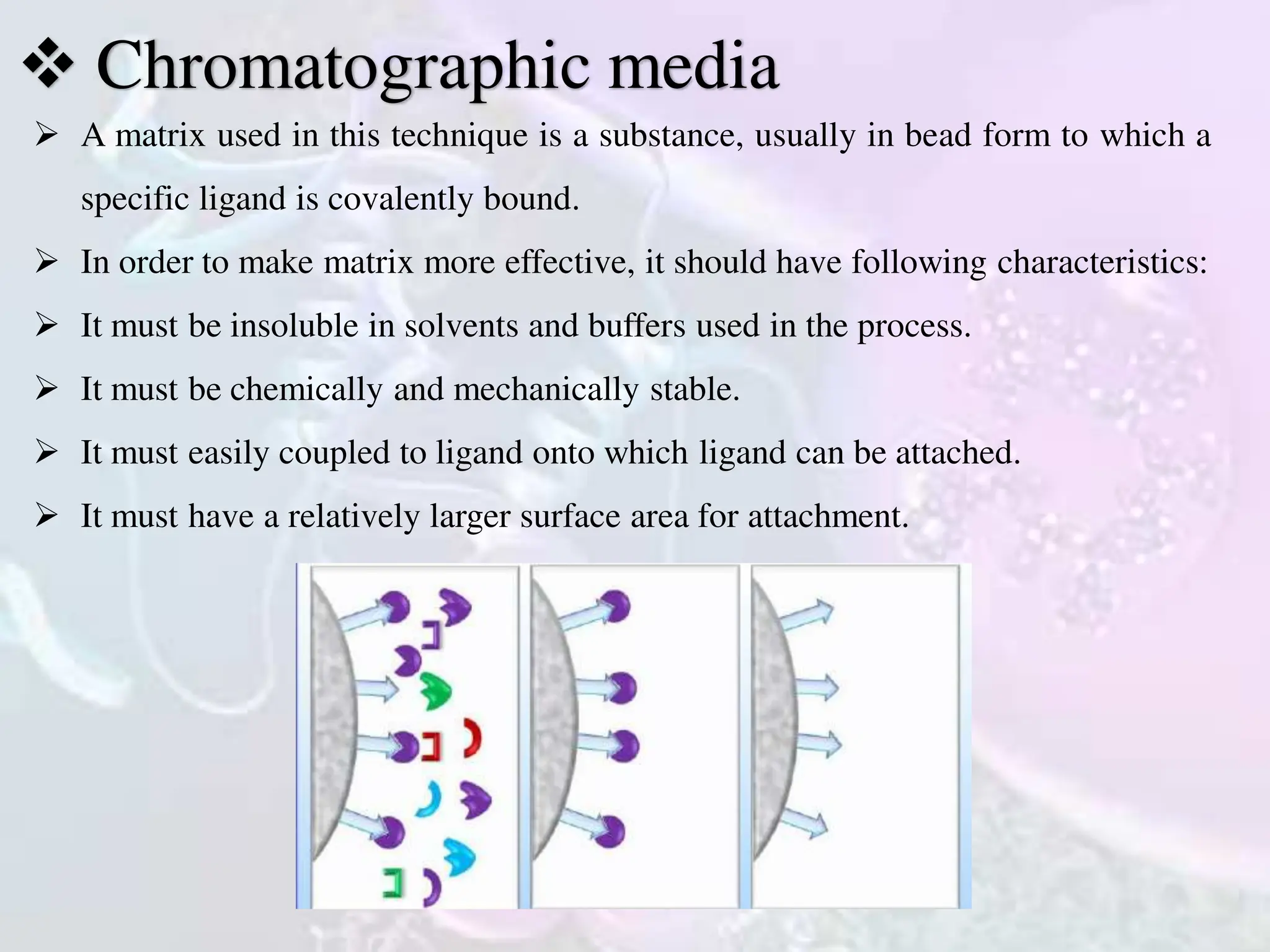
 Chromatographic media
 A matrix used in this technique is a substance, usually in bead form to which a
specific ligand is covalently bound.
 In order to make matrix more effective, it should have following characteristics:
 It must be insoluble in solvents and buffers used in the process.
 It must be chemically and mechanically stable.
 It must easily coupled to ligand onto which ligand can be attached.
 It must have a relatively larger surface area for attachment.
 Immobilized ligand
 The ligand can be selected only after the nature of the macromolecule to be
isolated is known.
 When a hormone receptor protein is to be purified, then hormone itself is an
ideal candidate for ligand.
 For antibody isolation, an antigen may be used as ligand.
 If an enzyme is to be purified, a substrate analog, inhibitor or effector may be
used as an immobilized ligand
 Several procedures have been developed for the covalent attachment of the
ligand to the stationary phase. All procedures proceed in two chemical steps.
1. Activation of functional groups on the matrix.
2. Joining of the ligand to the functional groups on the matrix
 Attachment of ligand to the matrix
 Applications
 It is used for isolation and purification of all biological macromolecules.
 Used to purify nucleic acid, antibodies and enzymes.
 To notice which biological compound binds to a particular substance.
 Used in genetic engineering: nucleic acid purification
 Production of vaccines: Antibody purification from blood serum.
 Basic metabolic research: protein or enzyme purification from cell free extracts.

Affinity chromatography by Mr. Vinayak B

  • 1.
    By Mr. Vinayak R.Bodhankar M. Pharm. (Ph.D*)
  • 2.
    Content  Introduction, theory Instrumentation  Applications
  • 3.
     It ispurification of biomolecules with respect to specific binding of that biomolecule due to the chemical structure  It is method of separating biochemical mixtures based on highly specific interactions such as antigen – antibody, enzyme – substrate, etc.  It is applicable for biological sample.  Stationary phase: Gel matrix (ligand: obtained from algae containing linear sugar molecule)  Mobile phase: Liquid (Buffer solution)  Introduction
  • 4.
     Basic principleof affinity chromatography is the affinity of any enzyme to bind with substrate or affinity of antigen to bind with antibody.  In this, stationary phase is gel matrix.  Sample is dissolved in mobile phase and run on the column.  During that, enzyme present in sample combine with ligand or substrate molecule and remaining particles get elute out.  Principle
  • 5.
     Preparation ofcolumn: Stationary phase i.e., gel (Ligand matrix) is filled in column and allow to saturate.  Application of sample: Sample is mixed with mobile phase and forms a solution. (Sample comes down slowly through the column)  Complex formation:  Wash out: Washing with distilled water or organic solvent, complex remains as it is and extra material get remove from the sample.  Elution: Complex moves out slowly from the column.  Detection:  Methodology
  • 6.
     Chromatographic media A matrix used in this technique is a substance, usually in bead form to which a specific ligand is covalently bound.  In order to make matrix more effective, it should have following characteristics:  It must be insoluble in solvents and buffers used in the process.  It must be chemically and mechanically stable.  It must easily coupled to ligand onto which ligand can be attached.  It must have a relatively larger surface area for attachment.
  • 7.
     Immobilized ligand The ligand can be selected only after the nature of the macromolecule to be isolated is known.  When a hormone receptor protein is to be purified, then hormone itself is an ideal candidate for ligand.  For antibody isolation, an antigen may be used as ligand.  If an enzyme is to be purified, a substrate analog, inhibitor or effector may be used as an immobilized ligand
  • 8.
     Several procedureshave been developed for the covalent attachment of the ligand to the stationary phase. All procedures proceed in two chemical steps. 1. Activation of functional groups on the matrix. 2. Joining of the ligand to the functional groups on the matrix  Attachment of ligand to the matrix
  • 9.
     Applications  Itis used for isolation and purification of all biological macromolecules.  Used to purify nucleic acid, antibodies and enzymes.  To notice which biological compound binds to a particular substance.  Used in genetic engineering: nucleic acid purification  Production of vaccines: Antibody purification from blood serum.  Basic metabolic research: protein or enzyme purification from cell free extracts.