Subject Name: Instrumental Methods of
Analysis
Unit Name: Chromatographic Techniques
History of Affinity Chromatography
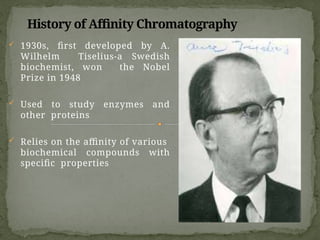
 1930s, first developed by A.
Wilhelm Tiselius-a Swedish
biochemist, won the Nobel
Prize in 1948
 Used to study enzymes and
other proteins
 Relies on the affinity of various
biochemical compounds with
specific properties
Introduction to Affinity
Chromatography
 Affinity chromatography is one of the most diverse and
powerful chromatographic methods for purification of a
specific molecule or a group of molecules from complex
mixtures.
 It is a method of separating a mixture of proteins or nucleic
acids by specific interactions of those molecules with a
component known as a ligand, which is immobilized on a
support.
 Mixture of proteins is passed through the column, one of
the proteins binds to the ligand on the basis of specificity
and high affinity (they fit together like a lock and key).
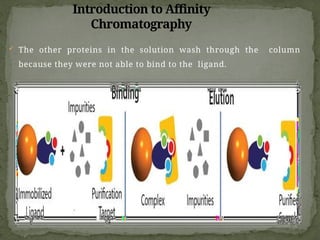
 The other proteins in the solution wash through the column
because they were not able to bind to the ligand.
Introduction to Affinity
Chromatography
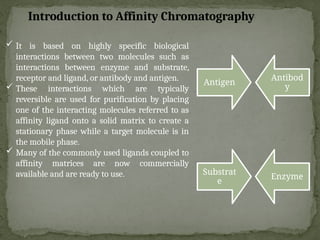
 It is based on highly specific biological
interactions between two molecules such as
interactions between enzyme and substrate,
receptor and ligand, or antibody and antigen.
 These interactions which are typically
reversible are used for purification by placing
one of the interacting molecules referred to as
affinity ligand onto a solid matrix to create a
stationary phase while a target molecule is in
the mobile phase.
 Many of the commonly used ligands coupled to
affinity matrices are now commercially
available and are ready to use.
Antigen
Antibod
y
Substrat
e
Enzyme
Introduction to Affinity Chromatography
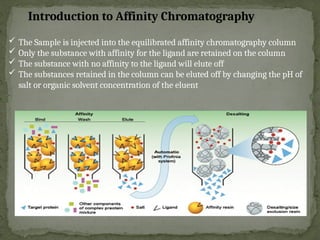
 The Sample is injected into the equilibrated affinity chromatography column
 Only the substance with affinity for the ligand are retained on the column
 The substance with no affinity to the ligand will elute off
 The substances retained in the column can be eluted off by changing the pH of
salt or organic solvent concentration of the eluent
Introduction to Affinity Chromatography
Specificity of Affinity Chromatography
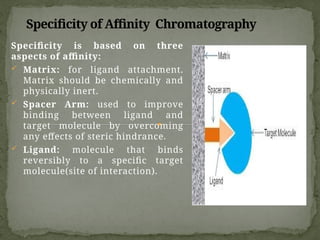
Specificity is based on three
aspects of affinity:
 Matrix: for ligand attachment.
Matrix should be chemically and
physically inert.
 Spacer Arm: used to improve
binding between ligand and
target molecule by overcoming
any effects of steric hindrance.
 Ligand: molecule that binds
reversibly to a specific target
molecule(site of interaction).
1. Matrix
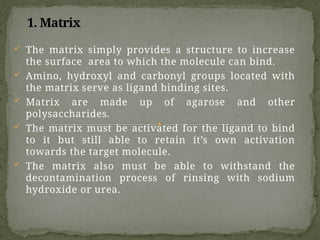
 The matrix simply provides a structure to increase
the surface area to which the molecule can bind.
 Amino, hydroxyl and carbonyl groups located with
the matrix serve as ligand binding sites.
 Matrix are made up of agarose and other
polysaccharides.
 The matrix must be activated for the ligand to bind
to it but still able to retain it’s own activation
towards the target molecule.
 The matrix also must be able to withstand the
decontamination process of rinsing with sodium
hydroxide or urea.
1. Matrix
For having an effective matrix, it must have certain
characters:
 It must be insoluble in solvents and buffers employed
in the process.
 It must be chemically and mechanically stable.
 It must be easily coupled to a ligand or spacer arm
onto which the ligand can be attached.
 It must exhibit good flow properties and have a
relatively large surface area for attachment.
Types of Matrix Used
Solid Support:
1. Carbohydrate Polymers: ex, agarose, cellulose, dextran.
 Commercially available agarose in 1-12% is usually adequate.
 cross linking with divinylsulfone(DVS) or 1,4-butanediol diglycidyl ether
increases both the chemical and thermal stability of the gel but may diminish
the binding capacity. DVS increases the gel’s rigidity.
 Cross linked agarose tolerates any solvents except strong acids and oxidizers
but may be damaged by some rare enzymes and must not be frozen or dried.
 Agarose gel activates complement system in human blood and must never be
used in vivo ( e.g., for affinity removing of toxins from blood).
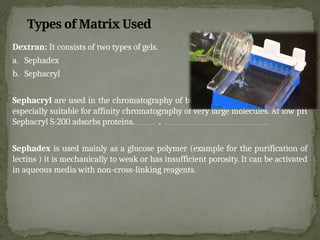
Dextran: It consists of two types of gels.
a. Sephadex
b. Sephacryl
Sephacryl are used in the chromatography of biomolecules. Sephacryl S-1000 is
especially suitable for affinity chromatography of very large molecules. At low pH
Sephacryl S-200 adsorbs proteins.
Sephadex is used mainly as a glucose polymer (example for the purification of
lectins ) it is mechanically to weak or has insufficient porosity. It can be activated
in aqueous media with non-cross-linking reagents.
Types of Matrix Used
B. Synthetic Polymers:
Polyacrylamide(PAA) is synthesized by copolymerization of acrylamide and a
cross linking agent. Primary disadvantage is that the gels are either soft or have
small pores. PAA gel is resistant against enzymatic attacks and does not adsorb
biomolecules.
Hydroxy Alkyl Methacrylate Gels: The gel is chemically and mechanically more
stable than PAA gel but is more hydrophobic and thus it is inappropriate for many
applications.
Trisacryl: It is hydrophilic, biologically inert, rigid, and macroporous. Despite its
low working volume( it contains more than 30% of solids) it is used for large scale
preparations.
Types of Matrix Used
C. Mixed Gels: Polyacrylamide-agarose gels (ultrogel AcA) were developed for gel
filtration and tested for affinity chromatography.
D. Inorganic Materials: When extreme rigidity of the support is needed , as for
HPLC and large-scale applications, inorganic materials are used ( irregular porous
glass or silica particles). They are soluble pH >8, although a coating of zirconium
will enhance their stability. otherwise, glass or silica may be coated with an inert
polymer.
E. Magnetic Carriers : Magnetic sorbent particles (magnogel AcA 44 and
Actmagnogel AcA 44) are useful for batch extraction from large volumes of diluted
and/or turbid solutions.
Types of Matrix Used
2. Spacer Arm
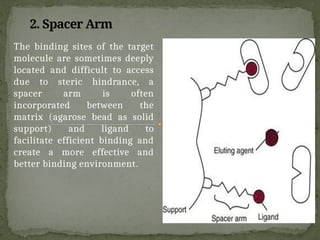
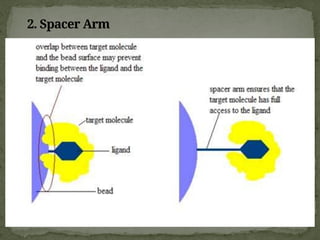
The binding sites of the target
molecule are sometimes deeply
located and difficult to access
due to steric hindrance, a
spacer arm is often
incorporated between the
matrix (agarose bead as solid
support) and ligand to
facilitate efficient binding and
create a more effective and
better binding environment.
2. Spacer Arm
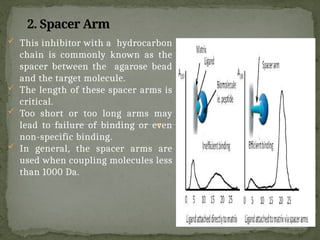
 This inhibitor with a hydrocarbon
chain is commonly known as the
spacer between the agarose bead
and the target molecule.
 The length of these spacer arms is
critical.
 Too short or too long arms may
lead to failure of binding or even
non-specific binding.
 In general, the spacer arms are
used when coupling molecules less
than 1000 Da.
2. Spacer Arm
3. Ligand
 The Ligand binds only to the desired molecule within the
solution.
 It attaches to the matrix which is made up of an inert
substance.
 It should only interact with the desired molecule and form a
temporary bond.
 The ligand/molecule complex will remain in the column,
eluting everything else off.
 The ligand/molecule complex dissociates by changing the
pH.
 The ligand can be selected only after the nature of the
macromolecule to be isolated is known.
 The chosen ligand must bind strongly to the molecule of
interest.
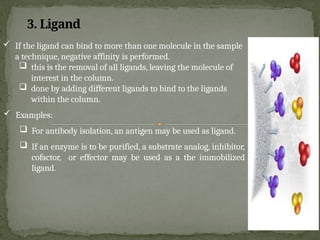
 If the ligand can bind to more than one molecule in the sample
a technique, negative affinity is performed.
 this is the removal of all ligands, leaving the molecule of
interest in the column.
 done by adding different ligands to bind to the ligands
within the column.
 Examples:
 For antibody isolation, an antigen may be used as ligand.
 If an enzyme is to be purified, a substrate analog, inhibitor,
cofactor, or effector may be used as a the immobilized
ligand.
3. Ligand
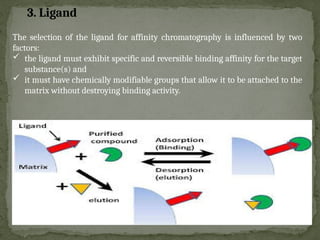
The selection of the ligand for affinity chromatography is influenced by two
factors:
 the ligand must exhibit specific and reversible binding affinity for the target
substance(s) and
 it must have chemically modifiable groups that allow it to be attached to the
matrix without destroying binding activity.
3. Ligand
Immobilization of ligand
 Immobilization of the affinity ligand is also very important when designing
an affinity chromatography method for biomolecule purification.
 Activity of the affinity ligand can be affected by multi-site attachment,
 Multi-site attachment occurs when an affinity ligand is attached through
more than one functional group on a single ligand molecule.
 Orientation of the affinity ligand, and If these multiple attachment sites
cause the affinity ligand to become denatured or distorted, multisite
attachment can lead to reduced binding affinity.
 However, in some instances, the additional attachment sites can result in
more stable ligand attachment steric hindrance.
3. Ligand
Covalent Immobilization
 Covalent immobilization is one of the most common ways of attaching
an affinity ligand to a solid support material.
 There is a wide range of coupling chemistries available when
considering covalent immobilization methods.
 Amine, sulfhydryl, hydroxyl, aldehyde, and carboxyl groups have been
used to link affinity ligands.
 Covalent attachment methods are more selective than other
immobilization methods, they generally require more steps and
chemical reagents onto support materials.
3. Ligand
Adsorption of Affinity Ligands: Adsorption can be either nonspecific or
specific.
 Nonspecific Adsorption: In nonspecific adsorption the affinity
ligand simply adsorbs to the surface of the support material and is a
result of Coulombic interactions, hydrogen bonding and/or
hydrophobic interactions.
 Bio Specific Adsorption: it is commonly performed by using avidin
or streptavidin for the adsorption of biotin containing affinity ligands
or protein A or protein G for the adsorption of antibodies in, and/or
hydrophobic interactions.
3. Ligand
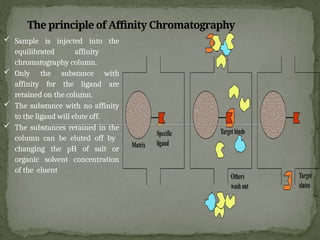
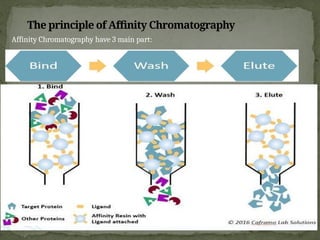
The principle of Affinity Chromatography
 Sample is injected into the
equilibrated affinity
chromatography column.
 Only the substance with
affinity for the ligand are
retained on the column.
 The substance with no affinity
to the ligand will elute off.
 The substances retained in the
column can be eluted off by
changing the pH of salt or
organic solvent concentration
of the eluent
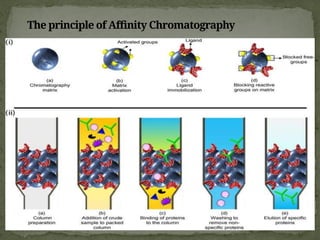
The principle of Affinity Chromatography
Affinity Chromatography have 3 main part:
Procedure
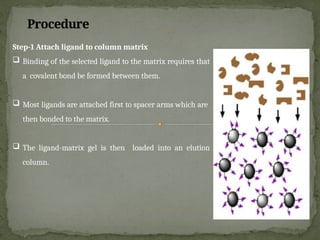
Step-1 Attach ligand to column matrix
 Binding of the selected ligand to the matrix requires that
a covalent bond be formed between them.
 Most ligands are attached first to spacer arms which are
then bonded to the matrix.
 The ligand-matrix gel is then loaded into an elution
column.
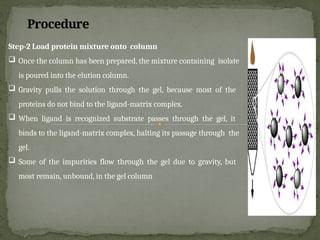
Step-2 Load protein mixture onto column
 Once the column has been prepared, the mixture containing isolate
is poured into the elution column.
 Gravity pulls the solution through the gel, because most of the
proteins do not bind to the ligand-matrix complex.
 When ligand is recognized substrate passes through the gel, it
binds to the ligand-matrix complex, halting its passage through the
gel.
 Some of the impurities flow through the gel due to gravity, but
most remain, unbound, in the gel column
Procedure
Procedure
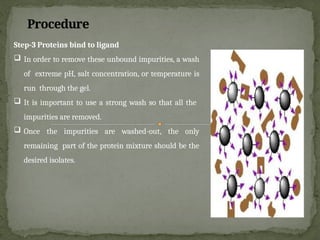
Step-3 Proteins bind to ligand
 In order to remove these unbound impurities, a wash
of extreme pH, salt concentration, or temperature is
run through the gel.
 It is important to use a strong wash so that all the
impurities are removed.
 Once the impurities are washed-out, the only
remaining part of the protein mixture should be the
desired isolates.
Procedure
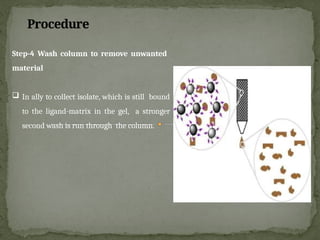
Step-4 Wash column to remove unwanted
material
 In ally to collect isolate, which is still bound
to the ligand-matrix in the gel, a stronger
second wash is run through the column.
Procedure
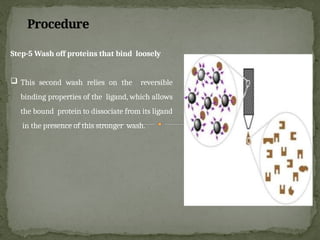
Step-5 Wash off proteins that bind loosely
 This second wash relies on the reversible
binding properties of the ligand, which allows
the bound protein to dissociate from its ligand
in the presence of this stronger wash.
Procedure
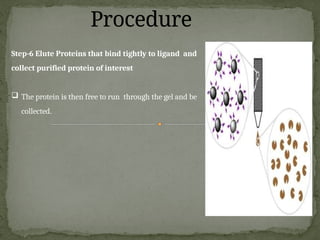
Step-6 Elute Proteins that bind tightly to ligand and
collect purified protein of interest
 The protein is then free to run through the gel and be
collected.
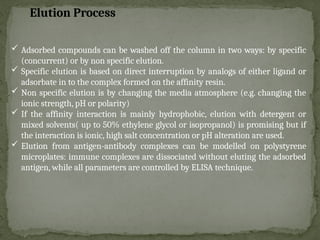
 Adsorbed compounds can be washed off the column in two ways: by specific
(concurrent) or by non specific elution.
 Specific elution is based on direct interruption by analogs of either ligand or
adsorbate in to the complex formed on the affinity resin.
 Non specific elution is by changing the media atmosphere (e.g. changing the
ionic strength, pH or polarity)
 If the affinity interaction is mainly hydrophobic, elution with detergent or
mixed solvents( up to 50% ethylene glycol or isopropanol) is promising but if
the interaction is ionic, high salt concentration or pH alteration are used.
 Elution from antigen-antibody complexes can be modelled on polystyrene
microplates: immune complexes are dissociated without eluting the adsorbed
antigen, while all parameters are controlled by ELISA technique.
Elution Process
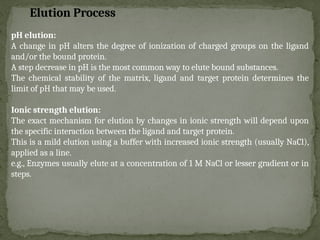
pH elution:
A change in pH alters the degree of ionization of charged groups on the ligand
and/or the bound protein.
A step decrease in pH is the most common way to elute bound substances.
The chemical stability of the matrix, ligand and target protein determines the
limit of pH that may be used.
Ionic strength elution:
The exact mechanism for elution by changes in ionic strength will depend upon
the specific interaction between the ligand and target protein.
This is a mild elution using a buffer with increased ionic strength (usually NaCl),
applied as a line.
e.g., Enzymes usually elute at a concentration of 1 M NaCl or lesser gradient or in
steps.
Elution Process
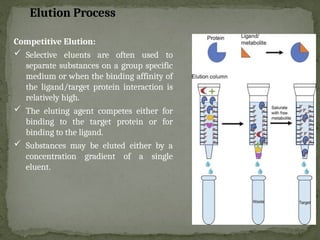
Competitive Elution:
 Selective eluents are often used to
separate substances on a group specific
medium or when the binding affinity of
the ligand/target protein interaction is
relatively high.
 The eluting agent competes either for
binding to the target protein or for
binding to the ligand.
 Substances may be eluted either by a
concentration gradient of a single
eluent.
Elution Process
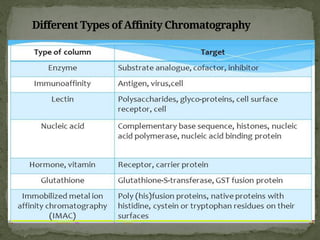
Different Types of Affinity Chromatography
Advantages
 Extremely high specificity
 High degrees of purity can be obtained
 The process is very reproducible
 The binding sites of biological molecules can be simply
investigated
Disadvantages:
 Expensive ligands
 Leakage of ligand
 Degradation of the solid support
 Limited lifetime
 Non-specific adsorption
Affinity Chromatography
Applications of Affinity Chromatography
Immunoglobulin Purification (Antibody Immobilization):
 Used to purify antibody against a specific antigen
Ex: Immunoglobulins
 Antibodies can be immobilized by both covalent and adsorption methods.
 Random covalent immobilization methods generally link antibodies to the solid
support via their free amine groups using cyanogen bromide, N-
hydroxysuccinimide, N,N’-carbonyldiimidazole, tresyl chloride, or tosyl chloride.
 As these are random immobilization methods, the antibody binding sites may be
blocked due to improper orientation, multi-site attachment or steric hindrance.
 They can also be immobilized by adsorbing them onto secondary ligands.
Recombinant Tagged Proteins:
 Purification of proteins can be easier and simpler if the protein of interest is
tagged with a known sequence commonly referred to as a tag.
 This tag can range from a short sequence of amino acids to entire domains
or
 even whole proteins.
 Tags can act both as a marker for protein expression and to help facilitate
protein purification.
 Most commonly used tags are glutathione-S-transferase (GST), histidine
fusion (His or poly His tag) and protein A fusion tags.
 Other types of fusion tags are also available including maltose-binding
protein, thioredoxin, NusA ,GB1 domain for protein G
Applications of Affinity Chromatography
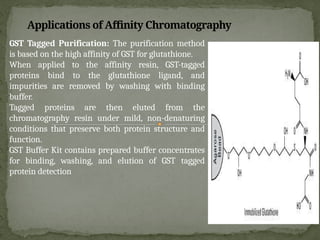
GST Tagged Purification: The purification method
is based on the high affinity of GST for glutathione.
When applied to the affinity resin, GST-tagged
proteins bind to the glutathione ligand, and
impurities are removed by washing with binding
buffer.
Tagged proteins are then eluted from the
chromatography resin under mild, non-denaturing
conditions that preserve both protein structure and
function.
GST Buffer Kit contains prepared buffer concentrates
for binding, washing, and elution of GST tagged
protein detection
Applications of Affinity Chromatography
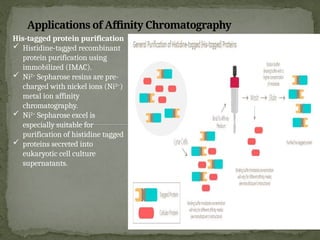
His-tagged protein purification
 Histidine-tagged recombinant
protein purification using
immobilized (IMAC).
 Ni2+
Sepharose resins are pre-
charged with nickel ions (Ni2+
)
metal ion affinity
chromatography.
 Ni2+
Sepharose excel is
especially suitable for
purification of histidine tagged
 proteins secreted into
eukaryotic cell culture
supernatants.
Applications of Affinity Chromatography
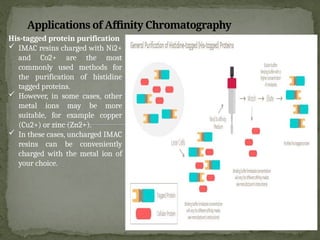
His-tagged protein purification
 IMAC resins charged with Ni2+
and Co2+ are the most
commonly used methods for
the purification of histidine
tagged proteins.
 However, in some cases, other
metal ions may be more
suitable, for example copper
(Cu2+) or zinc (Zn2+).
 In these cases, uncharged IMAC
resins can be conveniently
charged with the metal ion of
your choice.
Applications of Affinity Chromatography
Protein A, G, and L Purification:
 Proteins A, G, and L are native or recombinant proteins of microbial
origin which bind specifically to immunoglobulins including
immunoglobulin G (IgG).
 The most popular matrixes or supports for affinity applications which
utilize protein A, G, or L is beaded agarose (e.g. Sepharose CL-4B;
agarose cross-linked with 2,3 dibromopropanol and desulphated by
alkaline hydrolysis under reductive conditions), polyacrylamide, and
magnetic beads.
Applications of Affinity Chromatography
Biotin and biotinylated molecules purification:
 Biotin:(vitamin H or B7) cofactor in the metabolism of fatty acids and
leucine, and in gluconeogenesis.
 In affinity chromatography it is often used an affinity tag due to its
very strong interactions with avidin and streptavidin.
 One advantage of using biotin as an affinity tag is that it has a minimal
effect on the activity of a large biomolecule due to its small size (244
Da).
Applications of Affinity Chromatography
 Streptavidin is a large protein (60 kDa) that can be obtained from
Streptomyces avidinii and bind biotin.
 Avidin is a slightly larger glycoprotein (66 kDa) with slightly stronger
binding to biotin .
 Both avidin and streptavidin have four subunits that can each bind one
biotin molecule.
 Due to the strong interaction between biotin and (strept)avidin, harsh
elution conditions are required to disrupt the binding.
Applications of Affinity Chromatography
Lectin Affinity Chromatography:
 Lectins are carbohydrate binding proteins that contain two or more
carbohydrate binding sites and can be classified into five groups
according to their specificity to the monosaccharide.
 They exhibit the highest affinity for: mannose,
galactose/Nacetylgalactosamine, Nacetylglucosamine, fructose, and N-
acetylneuraminic acid. In this affinity technique, protein is bound to an
immobilized lectin through its sugar moieties .
 Once the glycosylated protein is bound to the affinity support, the
unbound contaminants are washed away, and the purified protein is
eluted.
Applications of Affinity Chromatography
Nucleic acid separation using immobilized metal affinity chromatography (IMAC)
 The method can be used to purify compounds containing purine or pyrimidine moieties
where the purine and pyrimidine moieties are shielded from interaction with the
column matrix from compounds containing a non-shielded purine or pyrimidine
moiety or group.
 Thus, double-stranded plasmid and genomic DNA, which has no low binding affinity
can be easily separated from RNA or oligonucleotides which bind strongly to
metalcharged chelating matrices
 IMAC columns clarify plasmid DNA from bacterial alkaline lysates, purify a ribozyme,
and remove primers and other contaminants from PCR reactions
Applications of Affinity Chromatography
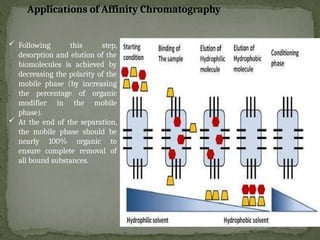
Reversed Phase Chromatography
 Reversed phase chromatography is a kind of affinity interaction between a
biomolecule dissolved in a solvent (mobile phase) that has some
hydrophobicity (e.g. proteins, peptides, and nucleic acids) and an immobilized
hydrophobic ligand (stationary phase).
 When using reversed phase chromatography, the most polar macromolecules
are eluted first and the most nonpolar macromolecules are eluted last: the
more polar (hydrophilic) a solute is, the faster the elution and vice versa.
 Initial step of reversed phase separation involves equilibration of the column
under suitable conditions (pH, ionic strength and polarity.)
 Next, sample is applied and bound to the immobilized matrix.
Applications of Affinity Chromatography
 Following this step,
desorption and elution of the
biomolecules is achieved by
decreasing the polarity of the
mobile phase (by increasing
the percentage of organic
modifier in the mobile
phase).
 At the end of the separation,
the mobile phase should be
nearly 100% organic to
ensure complete removal of
all bound substances.
Applications of Affinity Chromatography
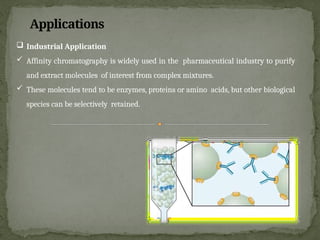
 Industrial Application
 Affinity chromatography is widely used in the pharmaceutical industry to purify
and extract molecules of interest from complex mixtures.
 These molecules tend to be enzymes, proteins or amino acids, but other biological
species can be selectively retained.
Applications
Applications
 Other
 Pregnancy test
 Allergy test
 Immune assay
 Kinetic studies
 Qualitative measurement of substrate.
 Vogel’s, Text Book of Quantitative Chemical Analysis
 R. Chatwal, Instrumental Methods of Chemical Analysis
 A.H. Beckett & J.B. Stenlake, Practical Pharmaceutical Chemistry
 Dr. G. Devala Rao, Pharmaceutical Analysis
 Dr. S. Ravi Sankar, Pharmaceutical Analysis
 Dr. A.V. Kasturi, Pharmaceutical Analysis
 Egon Stahl, Thin Layer Chromatography
 B.K. Sharma, Instrumental Methods of Chemical Analysis
 Skoog, Instrumental Analysis
 Ashutosh Kar, Pharmaceutical Drug Analysis
References:
52

IMA Unit-5 Affinity Chromatography.pptx

  • 1.
    Subject Name: InstrumentalMethods of Analysis Unit Name: Chromatographic Techniques
  • 2.
    History of AffinityChromatography  1930s, first developed by A. Wilhelm Tiselius-a Swedish biochemist, won the Nobel Prize in 1948  Used to study enzymes and other proteins  Relies on the affinity of various biochemical compounds with specific properties
  • 3.
    Introduction to Affinity Chromatography Affinity chromatography is one of the most diverse and powerful chromatographic methods for purification of a specific molecule or a group of molecules from complex mixtures.  It is a method of separating a mixture of proteins or nucleic acids by specific interactions of those molecules with a component known as a ligand, which is immobilized on a support.  Mixture of proteins is passed through the column, one of the proteins binds to the ligand on the basis of specificity and high affinity (they fit together like a lock and key).
  • 4.
     The otherproteins in the solution wash through the column because they were not able to bind to the ligand. Introduction to Affinity Chromatography
  • 5.
     It isbased on highly specific biological interactions between two molecules such as interactions between enzyme and substrate, receptor and ligand, or antibody and antigen.  These interactions which are typically reversible are used for purification by placing one of the interacting molecules referred to as affinity ligand onto a solid matrix to create a stationary phase while a target molecule is in the mobile phase.  Many of the commonly used ligands coupled to affinity matrices are now commercially available and are ready to use. Antigen Antibod y Substrat e Enzyme Introduction to Affinity Chromatography
  • 6.
     The Sampleis injected into the equilibrated affinity chromatography column  Only the substance with affinity for the ligand are retained on the column  The substance with no affinity to the ligand will elute off  The substances retained in the column can be eluted off by changing the pH of salt or organic solvent concentration of the eluent Introduction to Affinity Chromatography
  • 7.
    Specificity of AffinityChromatography Specificity is based on three aspects of affinity:  Matrix: for ligand attachment. Matrix should be chemically and physically inert.  Spacer Arm: used to improve binding between ligand and target molecule by overcoming any effects of steric hindrance.  Ligand: molecule that binds reversibly to a specific target molecule(site of interaction).
  • 8.
    1. Matrix  Thematrix simply provides a structure to increase the surface area to which the molecule can bind.  Amino, hydroxyl and carbonyl groups located with the matrix serve as ligand binding sites.  Matrix are made up of agarose and other polysaccharides.  The matrix must be activated for the ligand to bind to it but still able to retain it’s own activation towards the target molecule.  The matrix also must be able to withstand the decontamination process of rinsing with sodium hydroxide or urea.
  • 9.
    1. Matrix For havingan effective matrix, it must have certain characters:  It must be insoluble in solvents and buffers employed in the process.  It must be chemically and mechanically stable.  It must be easily coupled to a ligand or spacer arm onto which the ligand can be attached.  It must exhibit good flow properties and have a relatively large surface area for attachment.
  • 10.
    Types of MatrixUsed Solid Support: 1. Carbohydrate Polymers: ex, agarose, cellulose, dextran.  Commercially available agarose in 1-12% is usually adequate.  cross linking with divinylsulfone(DVS) or 1,4-butanediol diglycidyl ether increases both the chemical and thermal stability of the gel but may diminish the binding capacity. DVS increases the gel’s rigidity.  Cross linked agarose tolerates any solvents except strong acids and oxidizers but may be damaged by some rare enzymes and must not be frozen or dried.  Agarose gel activates complement system in human blood and must never be used in vivo ( e.g., for affinity removing of toxins from blood).
  • 11.
    Dextran: It consistsof two types of gels. a. Sephadex b. Sephacryl Sephacryl are used in the chromatography of biomolecules. Sephacryl S-1000 is especially suitable for affinity chromatography of very large molecules. At low pH Sephacryl S-200 adsorbs proteins. Sephadex is used mainly as a glucose polymer (example for the purification of lectins ) it is mechanically to weak or has insufficient porosity. It can be activated in aqueous media with non-cross-linking reagents. Types of Matrix Used
  • 12.
    B. Synthetic Polymers: Polyacrylamide(PAA)is synthesized by copolymerization of acrylamide and a cross linking agent. Primary disadvantage is that the gels are either soft or have small pores. PAA gel is resistant against enzymatic attacks and does not adsorb biomolecules. Hydroxy Alkyl Methacrylate Gels: The gel is chemically and mechanically more stable than PAA gel but is more hydrophobic and thus it is inappropriate for many applications. Trisacryl: It is hydrophilic, biologically inert, rigid, and macroporous. Despite its low working volume( it contains more than 30% of solids) it is used for large scale preparations. Types of Matrix Used
  • 13.
    C. Mixed Gels:Polyacrylamide-agarose gels (ultrogel AcA) were developed for gel filtration and tested for affinity chromatography. D. Inorganic Materials: When extreme rigidity of the support is needed , as for HPLC and large-scale applications, inorganic materials are used ( irregular porous glass or silica particles). They are soluble pH >8, although a coating of zirconium will enhance their stability. otherwise, glass or silica may be coated with an inert polymer. E. Magnetic Carriers : Magnetic sorbent particles (magnogel AcA 44 and Actmagnogel AcA 44) are useful for batch extraction from large volumes of diluted and/or turbid solutions. Types of Matrix Used
  • 14.
    2. Spacer Arm Thebinding sites of the target molecule are sometimes deeply located and difficult to access due to steric hindrance, a spacer arm is often incorporated between the matrix (agarose bead as solid support) and ligand to facilitate efficient binding and create a more effective and better binding environment.
  • 15.
    2. Spacer Arm This inhibitor with a hydrocarbon chain is commonly known as the spacer between the agarose bead and the target molecule.  The length of these spacer arms is critical.  Too short or too long arms may lead to failure of binding or even non-specific binding.  In general, the spacer arms are used when coupling molecules less than 1000 Da.
  • 16.
  • 17.
    3. Ligand  TheLigand binds only to the desired molecule within the solution.  It attaches to the matrix which is made up of an inert substance.  It should only interact with the desired molecule and form a temporary bond.  The ligand/molecule complex will remain in the column, eluting everything else off.  The ligand/molecule complex dissociates by changing the pH.  The ligand can be selected only after the nature of the macromolecule to be isolated is known.  The chosen ligand must bind strongly to the molecule of interest.
  • 18.
     If theligand can bind to more than one molecule in the sample a technique, negative affinity is performed.  this is the removal of all ligands, leaving the molecule of interest in the column.  done by adding different ligands to bind to the ligands within the column.  Examples:  For antibody isolation, an antigen may be used as ligand.  If an enzyme is to be purified, a substrate analog, inhibitor, cofactor, or effector may be used as a the immobilized ligand. 3. Ligand
  • 19.
    The selection ofthe ligand for affinity chromatography is influenced by two factors:  the ligand must exhibit specific and reversible binding affinity for the target substance(s) and  it must have chemically modifiable groups that allow it to be attached to the matrix without destroying binding activity. 3. Ligand
  • 20.
    Immobilization of ligand Immobilization of the affinity ligand is also very important when designing an affinity chromatography method for biomolecule purification.  Activity of the affinity ligand can be affected by multi-site attachment,  Multi-site attachment occurs when an affinity ligand is attached through more than one functional group on a single ligand molecule.  Orientation of the affinity ligand, and If these multiple attachment sites cause the affinity ligand to become denatured or distorted, multisite attachment can lead to reduced binding affinity.  However, in some instances, the additional attachment sites can result in more stable ligand attachment steric hindrance. 3. Ligand
  • 21.
    Covalent Immobilization  Covalentimmobilization is one of the most common ways of attaching an affinity ligand to a solid support material.  There is a wide range of coupling chemistries available when considering covalent immobilization methods.  Amine, sulfhydryl, hydroxyl, aldehyde, and carboxyl groups have been used to link affinity ligands.  Covalent attachment methods are more selective than other immobilization methods, they generally require more steps and chemical reagents onto support materials. 3. Ligand
  • 22.
    Adsorption of AffinityLigands: Adsorption can be either nonspecific or specific.  Nonspecific Adsorption: In nonspecific adsorption the affinity ligand simply adsorbs to the surface of the support material and is a result of Coulombic interactions, hydrogen bonding and/or hydrophobic interactions.  Bio Specific Adsorption: it is commonly performed by using avidin or streptavidin for the adsorption of biotin containing affinity ligands or protein A or protein G for the adsorption of antibodies in, and/or hydrophobic interactions. 3. Ligand
  • 23.
    The principle ofAffinity Chromatography  Sample is injected into the equilibrated affinity chromatography column.  Only the substance with affinity for the ligand are retained on the column.  The substance with no affinity to the ligand will elute off.  The substances retained in the column can be eluted off by changing the pH of salt or organic solvent concentration of the eluent
  • 24.
    The principle ofAffinity Chromatography
  • 25.
    The principle ofAffinity Chromatography Affinity Chromatography have 3 main part:
  • 26.
    Procedure Step-1 Attach ligandto column matrix  Binding of the selected ligand to the matrix requires that a covalent bond be formed between them.  Most ligands are attached first to spacer arms which are then bonded to the matrix.  The ligand-matrix gel is then loaded into an elution column.
  • 27.
    Step-2 Load proteinmixture onto column  Once the column has been prepared, the mixture containing isolate is poured into the elution column.  Gravity pulls the solution through the gel, because most of the proteins do not bind to the ligand-matrix complex.  When ligand is recognized substrate passes through the gel, it binds to the ligand-matrix complex, halting its passage through the gel.  Some of the impurities flow through the gel due to gravity, but most remain, unbound, in the gel column Procedure
  • 28.
    Procedure Step-3 Proteins bindto ligand  In order to remove these unbound impurities, a wash of extreme pH, salt concentration, or temperature is run through the gel.  It is important to use a strong wash so that all the impurities are removed.  Once the impurities are washed-out, the only remaining part of the protein mixture should be the desired isolates.
  • 29.
    Procedure Step-4 Wash columnto remove unwanted material  In ally to collect isolate, which is still bound to the ligand-matrix in the gel, a stronger second wash is run through the column.
  • 30.
    Procedure Step-5 Wash offproteins that bind loosely  This second wash relies on the reversible binding properties of the ligand, which allows the bound protein to dissociate from its ligand in the presence of this stronger wash.
  • 31.
    Procedure Step-6 Elute Proteinsthat bind tightly to ligand and collect purified protein of interest  The protein is then free to run through the gel and be collected.
  • 32.
     Adsorbed compoundscan be washed off the column in two ways: by specific (concurrent) or by non specific elution.  Specific elution is based on direct interruption by analogs of either ligand or adsorbate in to the complex formed on the affinity resin.  Non specific elution is by changing the media atmosphere (e.g. changing the ionic strength, pH or polarity)  If the affinity interaction is mainly hydrophobic, elution with detergent or mixed solvents( up to 50% ethylene glycol or isopropanol) is promising but if the interaction is ionic, high salt concentration or pH alteration are used.  Elution from antigen-antibody complexes can be modelled on polystyrene microplates: immune complexes are dissociated without eluting the adsorbed antigen, while all parameters are controlled by ELISA technique. Elution Process
  • 33.
    pH elution: A changein pH alters the degree of ionization of charged groups on the ligand and/or the bound protein. A step decrease in pH is the most common way to elute bound substances. The chemical stability of the matrix, ligand and target protein determines the limit of pH that may be used. Ionic strength elution: The exact mechanism for elution by changes in ionic strength will depend upon the specific interaction between the ligand and target protein. This is a mild elution using a buffer with increased ionic strength (usually NaCl), applied as a line. e.g., Enzymes usually elute at a concentration of 1 M NaCl or lesser gradient or in steps. Elution Process
  • 34.
    Competitive Elution:  Selectiveeluents are often used to separate substances on a group specific medium or when the binding affinity of the ligand/target protein interaction is relatively high.  The eluting agent competes either for binding to the target protein or for binding to the ligand.  Substances may be eluted either by a concentration gradient of a single eluent. Elution Process
  • 35.
    Different Types ofAffinity Chromatography
  • 36.
    Advantages  Extremely highspecificity  High degrees of purity can be obtained  The process is very reproducible  The binding sites of biological molecules can be simply investigated Disadvantages:  Expensive ligands  Leakage of ligand  Degradation of the solid support  Limited lifetime  Non-specific adsorption Affinity Chromatography
  • 37.
    Applications of AffinityChromatography Immunoglobulin Purification (Antibody Immobilization):  Used to purify antibody against a specific antigen Ex: Immunoglobulins  Antibodies can be immobilized by both covalent and adsorption methods.  Random covalent immobilization methods generally link antibodies to the solid support via their free amine groups using cyanogen bromide, N- hydroxysuccinimide, N,N’-carbonyldiimidazole, tresyl chloride, or tosyl chloride.  As these are random immobilization methods, the antibody binding sites may be blocked due to improper orientation, multi-site attachment or steric hindrance.  They can also be immobilized by adsorbing them onto secondary ligands.
  • 38.
    Recombinant Tagged Proteins: Purification of proteins can be easier and simpler if the protein of interest is tagged with a known sequence commonly referred to as a tag.  This tag can range from a short sequence of amino acids to entire domains or  even whole proteins.  Tags can act both as a marker for protein expression and to help facilitate protein purification.  Most commonly used tags are glutathione-S-transferase (GST), histidine fusion (His or poly His tag) and protein A fusion tags.  Other types of fusion tags are also available including maltose-binding protein, thioredoxin, NusA ,GB1 domain for protein G Applications of Affinity Chromatography
  • 39.
    GST Tagged Purification:The purification method is based on the high affinity of GST for glutathione. When applied to the affinity resin, GST-tagged proteins bind to the glutathione ligand, and impurities are removed by washing with binding buffer. Tagged proteins are then eluted from the chromatography resin under mild, non-denaturing conditions that preserve both protein structure and function. GST Buffer Kit contains prepared buffer concentrates for binding, washing, and elution of GST tagged protein detection Applications of Affinity Chromatography
  • 40.
    His-tagged protein purification Histidine-tagged recombinant protein purification using immobilized (IMAC).  Ni2+ Sepharose resins are pre- charged with nickel ions (Ni2+ ) metal ion affinity chromatography.  Ni2+ Sepharose excel is especially suitable for purification of histidine tagged  proteins secreted into eukaryotic cell culture supernatants. Applications of Affinity Chromatography
  • 41.
    His-tagged protein purification IMAC resins charged with Ni2+ and Co2+ are the most commonly used methods for the purification of histidine tagged proteins.  However, in some cases, other metal ions may be more suitable, for example copper (Cu2+) or zinc (Zn2+).  In these cases, uncharged IMAC resins can be conveniently charged with the metal ion of your choice. Applications of Affinity Chromatography
  • 42.
    Protein A, G,and L Purification:  Proteins A, G, and L are native or recombinant proteins of microbial origin which bind specifically to immunoglobulins including immunoglobulin G (IgG).  The most popular matrixes or supports for affinity applications which utilize protein A, G, or L is beaded agarose (e.g. Sepharose CL-4B; agarose cross-linked with 2,3 dibromopropanol and desulphated by alkaline hydrolysis under reductive conditions), polyacrylamide, and magnetic beads. Applications of Affinity Chromatography
  • 43.
    Biotin and biotinylatedmolecules purification:  Biotin:(vitamin H or B7) cofactor in the metabolism of fatty acids and leucine, and in gluconeogenesis.  In affinity chromatography it is often used an affinity tag due to its very strong interactions with avidin and streptavidin.  One advantage of using biotin as an affinity tag is that it has a minimal effect on the activity of a large biomolecule due to its small size (244 Da). Applications of Affinity Chromatography
  • 44.
     Streptavidin isa large protein (60 kDa) that can be obtained from Streptomyces avidinii and bind biotin.  Avidin is a slightly larger glycoprotein (66 kDa) with slightly stronger binding to biotin .  Both avidin and streptavidin have four subunits that can each bind one biotin molecule.  Due to the strong interaction between biotin and (strept)avidin, harsh elution conditions are required to disrupt the binding. Applications of Affinity Chromatography
  • 45.
    Lectin Affinity Chromatography: Lectins are carbohydrate binding proteins that contain two or more carbohydrate binding sites and can be classified into five groups according to their specificity to the monosaccharide.  They exhibit the highest affinity for: mannose, galactose/Nacetylgalactosamine, Nacetylglucosamine, fructose, and N- acetylneuraminic acid. In this affinity technique, protein is bound to an immobilized lectin through its sugar moieties .  Once the glycosylated protein is bound to the affinity support, the unbound contaminants are washed away, and the purified protein is eluted. Applications of Affinity Chromatography
  • 46.
    Nucleic acid separationusing immobilized metal affinity chromatography (IMAC)  The method can be used to purify compounds containing purine or pyrimidine moieties where the purine and pyrimidine moieties are shielded from interaction with the column matrix from compounds containing a non-shielded purine or pyrimidine moiety or group.  Thus, double-stranded plasmid and genomic DNA, which has no low binding affinity can be easily separated from RNA or oligonucleotides which bind strongly to metalcharged chelating matrices  IMAC columns clarify plasmid DNA from bacterial alkaline lysates, purify a ribozyme, and remove primers and other contaminants from PCR reactions Applications of Affinity Chromatography
  • 47.
    Reversed Phase Chromatography Reversed phase chromatography is a kind of affinity interaction between a biomolecule dissolved in a solvent (mobile phase) that has some hydrophobicity (e.g. proteins, peptides, and nucleic acids) and an immobilized hydrophobic ligand (stationary phase).  When using reversed phase chromatography, the most polar macromolecules are eluted first and the most nonpolar macromolecules are eluted last: the more polar (hydrophilic) a solute is, the faster the elution and vice versa.  Initial step of reversed phase separation involves equilibration of the column under suitable conditions (pH, ionic strength and polarity.)  Next, sample is applied and bound to the immobilized matrix. Applications of Affinity Chromatography
  • 48.
     Following thisstep, desorption and elution of the biomolecules is achieved by decreasing the polarity of the mobile phase (by increasing the percentage of organic modifier in the mobile phase).  At the end of the separation, the mobile phase should be nearly 100% organic to ensure complete removal of all bound substances. Applications of Affinity Chromatography
  • 49.
     Industrial Application Affinity chromatography is widely used in the pharmaceutical industry to purify and extract molecules of interest from complex mixtures.  These molecules tend to be enzymes, proteins or amino acids, but other biological species can be selectively retained. Applications
  • 50.
    Applications  Other  Pregnancytest  Allergy test  Immune assay  Kinetic studies  Qualitative measurement of substrate.
  • 51.
     Vogel’s, TextBook of Quantitative Chemical Analysis  R. Chatwal, Instrumental Methods of Chemical Analysis  A.H. Beckett & J.B. Stenlake, Practical Pharmaceutical Chemistry  Dr. G. Devala Rao, Pharmaceutical Analysis  Dr. S. Ravi Sankar, Pharmaceutical Analysis  Dr. A.V. Kasturi, Pharmaceutical Analysis  Egon Stahl, Thin Layer Chromatography  B.K. Sharma, Instrumental Methods of Chemical Analysis  Skoog, Instrumental Analysis  Ashutosh Kar, Pharmaceutical Drug Analysis References:
  • 52.