ADVANCED
SENSOR
BYSUBHAJIT KARMAKAR
3rd year, A.E.I.E
HALDIA INSTITUTE OFHALDIA INSTITUTE OF
TECHNOLOGYTECHNOLOGY
Contents Of The Topic
 Introduction
 Analog & Digital Sensors
 Position Sensors
 Temperature Sensor
 Light Sensor
 Motion Sensor
 Conclusion
 Bibliography
Let us know something about
sensors…
• Devices which perform an input function are commonly called Sensors because
they "sense" a physical change in some characteristic that changes in response to
some excitation, for example heat or force and covert that into an electrical signal.
Devices which perform an output function are generally called Actuators and are
used to control some external device, for example movement.
Analogue & Digital Sensors
Analogue Sensor
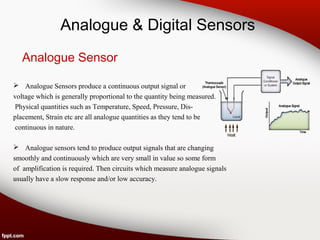
 Analogue Sensors produce a continuous output signal or
voltage which is generally proportional to the quantity being measured.
Physical quantities such as Temperature, Speed, Pressure, Dis-
placement, Strain etc are all analogue quantities as they tend to be
continuous in nature.
 Analogue sensors tend to produce output signals that are changing
smoothly and continuously which are very small in value so some form
of amplification is required. Then circuits which measure analogue signals
usually have a slow response and/or low accuracy.
Digital Sensor
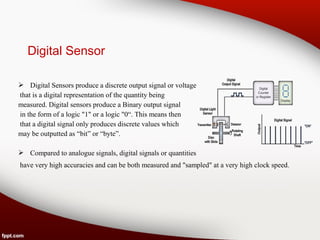
 Digital Sensors produce a discrete output signal or voltage
that is a digital representation of the quantity being
measured. Digital sensors produce a Binary output signal
in the form of a logic "1" or a logic "0“. This means then
that a digital signal only produces discrete values which
may be outputted as “bit” or “byte”.
 Compared to analogue signals, digital signals or quantities
have very high accuracies and can be both measured and "sampled" at a very high clock speed.
Position Sensor
As their name implies, these types of sensors provide
a "position“ feedback. One method of
determining a position, is to use either distance
which could be the distance between two points
such as the distance travelled or moved away
from some fixed point, or by "rotation“.
Potentiometer
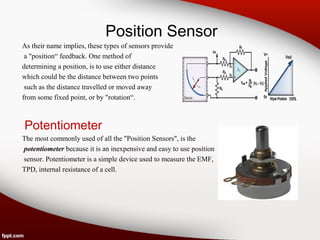
The most commonly used of all the "Position Sensors", is the
potentiometer because it is an inexpensive and easy to use position
sensor. Potentiometer is a simple device used to measure the EMF,
TPD, internal resistance of a cell.
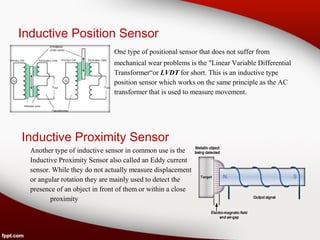
Inductive Position Sensor
One type of positional sensor that does not suffer from
mechanical wear problems is the "Linear Variable Differential
Transformer“or LVDT for short. This is an inductive type
position sensor which works on the same principle as the AC
transformer that is used to measure movement.
Inductive Proximity Sensor
Another type of inductive sensor in common use is the
Inductive Proximity Sensor also called an Eddy current
sensor. While they do not actually measure displacement
or angular rotation they are mainly used to detect the
presence of an object in front of them or within a close
proximity
Temperature Sensor
Temperature Sensors measure the amount of heat energy or even coldness that is generated by
an object or system, and can "sense" or detect any physical change to that temperature producing
either an analogue or digital output.
Temperature sensors consist of two basic physical types:-
1) Contact Temperature Sensor:- These types of temperature sensor are required to be in
physical contact with the object being sensed and use conduction to monitor changes in
temperature
2) Non-contact Temperature Sensor:- These types of temperature sensor use convection and
radiation to monitor changes in temperature.
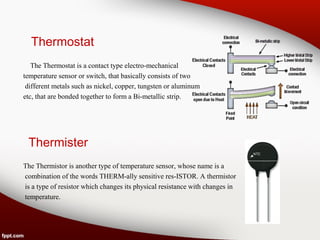
Thermostat
The Thermostat is a contact type electro-mechanical
temperature sensor or switch, that basically consists of two
different metals such as nickel, copper, tungsten or aluminum
etc, that are bonded together to form a Bi-metallic strip.
Thermister
The Thermistor is another type of temperature sensor, whose name is a
combination of the words THERM-ally sensitive res-ISTOR. A thermistor
is a type of resistor which changes its physical resistance with changes in
temperature.
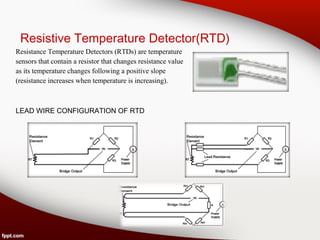
Resistive Temperature Detector(RTD)
Resistance Temperature Detectors (RTDs) are temperature
sensors that contain a resistor that changes resistance value
as its temperature changes following a positive slope
(resistance increases when temperature is increasing).
LEAD WIRE CONFIGURATION OF RTD
Thermocouple
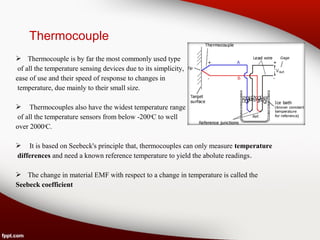
 Thermocouple is by far the most commonly used type
of all the temperature sensing devices due to its simplicity,
ease of use and their speed of response to changes in
temperature, due mainly to their small size.
 Thermocouples also have the widest temperature range
of all the temperature sensors from below -200o
C to well
over 2000o
C.
 It is based on Seebeck's principle that, thermocouples can only measure temperature
differences and need a known reference temperature to yield the abolute readings.
 The change in material EMF with respect to a change in temperature is called the
Seebeck coefficient
Light Sensor
 The light sensor is a passive devices that convert this "light energy" whether visible or in the
infrared parts of the spectrum into an electrical signal output. Light sensors are more commonly
known as "Photoelectric Devices" or "Photo Sensors" because the convert light energy into
electricity.
Light Sensors are classified in four types:
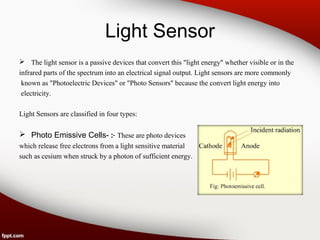
 Photo Emissive Cells- :- These are photo devices
which release free electrons from a light sensitive material
such as cesium when struck by a photon of sufficient energy.
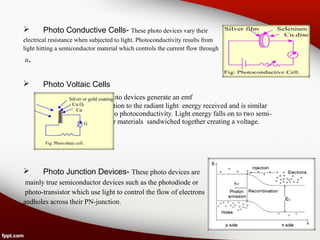
 Photo Conductive Cells- These photo devices vary their
electrical resistance when subjected to light. Photoconductivity results from
light hitting a semiconductor material which controls the current flow through
it.
 Photo Voltaic Cells
These photo devices generate an emf
in proportion to the radiant light energy received and is similar
in effect to photoconductivity. Light energy falls on to two semi-
conductor materials sandwiched together creating a voltage.
 Photo Junction Devices- These photo devices are
mainly true semiconductor devices such as the photodiode or
photo-transistor which use light to control the flow of electrons
andholes across their PN-junction.
Light Dependent Resistor
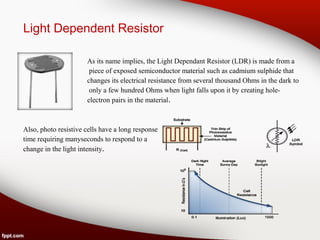
As its name implies, the Light Dependant Resistor (LDR) is made from a
piece of exposed semiconductor material such as cadmium sulphide that
changes its electrical resistance from several thousand Ohms in the dark to
only a few hundred Ohms when light falls upon it by creating hole-
electron pairs in the material.
Also, photo resistive cells have a long response
time requiring manyseconds to respond to a
change in the light intensity.
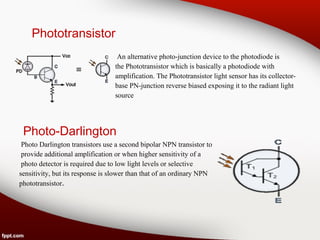
Phototransistor
An alternative photo-junction device to the photodiode is
the Phototransistor which is basically a photodiode with
amplification. The Phototransistor light sensor has its collector-
base PN-junction reverse biased exposing it to the radiant light
source
Photo-Darlington
Photo Darlington transistors use a second bipolar NPN transistor to
provide additional amplification or when higher sensitivity of a
photo detector is required due to low light levels or selective
sensitivity, but its response is slower than that of an ordinary NPN
phototransistor.
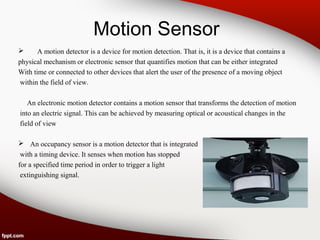
Motion Sensor
 A motion detector is a device for motion detection. That is, it is a device that contains a
physical mechanism or electronic sensor that quantifies motion that can be either integrated
With time or connected to other devices that alert the user of the presence of a moving object
within the field of view.
An electronic motion detector contains a motion sensor that transforms the detection of motion
into an electric signal. This can be achieved by measuring optical or acoustical changes in the
field of view
 An occupancy sensor is a motion detector that is integrated
with a timing device. It senses when motion has stopped
for a specified time period in order to trigger a light
extinguishing signal.
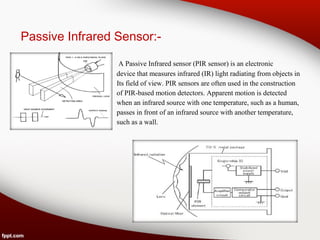
Passive Infrared Sensor:-
A Passive Infrared sensor (PIR sensor) is an electronic
device that measures infrared (IR) light radiating from objects in
Its field of view. PIR sensors are often used in the construction
of PIR-based motion detectors. Apparent motion is detected
when an infrared source with one temperature, such as a human,
passes in front of an infrared source with another temperature,
such as a wall.
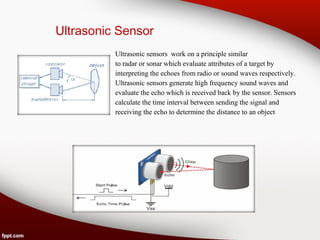
Ultrasonic Sensor
Ultrasonic sensors work on a principle similar
to radar or sonar which evaluate attributes of a target by
interpreting the echoes from radio or sound waves respectively.
Ultrasonic sensors generate high frequency sound waves and
evaluate the echo which is received back by the sensor. Sensors
calculate the time interval between sending the signal and
receiving the echo to determine the distance to an object
Conclusion
• There are many other advance sensor in the world which are able to perform
difference actions. Here are very examples of them but we can apply them into many
other applications
Bibliography
 http://www.wikipedia.org
 http://www.advancedsensors.co.uk
 http://www.sensors-research.com
 http://ieeexplore.ieee.org/xpl/freeabs_all.jsp?arnumber=610263
 Jeffrey Cole & Steven Dubowsky, The Application of Advanced Robotics and Sensor
Technologies.
Advanced Sensors

Advanced Sensors

  • 1.
    ADVANCED SENSOR BYSUBHAJIT KARMAKAR 3rd year,A.E.I.E HALDIA INSTITUTE OFHALDIA INSTITUTE OF TECHNOLOGYTECHNOLOGY
  • 2.
    Contents Of TheTopic  Introduction  Analog & Digital Sensors  Position Sensors  Temperature Sensor  Light Sensor  Motion Sensor  Conclusion  Bibliography
  • 3.
    Let us knowsomething about sensors… • Devices which perform an input function are commonly called Sensors because they "sense" a physical change in some characteristic that changes in response to some excitation, for example heat or force and covert that into an electrical signal. Devices which perform an output function are generally called Actuators and are used to control some external device, for example movement.
  • 4.
    Analogue & DigitalSensors Analogue Sensor  Analogue Sensors produce a continuous output signal or voltage which is generally proportional to the quantity being measured. Physical quantities such as Temperature, Speed, Pressure, Dis- placement, Strain etc are all analogue quantities as they tend to be continuous in nature.  Analogue sensors tend to produce output signals that are changing smoothly and continuously which are very small in value so some form of amplification is required. Then circuits which measure analogue signals usually have a slow response and/or low accuracy.
  • 5.
    Digital Sensor  DigitalSensors produce a discrete output signal or voltage that is a digital representation of the quantity being measured. Digital sensors produce a Binary output signal in the form of a logic "1" or a logic "0“. This means then that a digital signal only produces discrete values which may be outputted as “bit” or “byte”.  Compared to analogue signals, digital signals or quantities have very high accuracies and can be both measured and "sampled" at a very high clock speed.
  • 6.
    Position Sensor As theirname implies, these types of sensors provide a "position“ feedback. One method of determining a position, is to use either distance which could be the distance between two points such as the distance travelled or moved away from some fixed point, or by "rotation“. Potentiometer The most commonly used of all the "Position Sensors", is the potentiometer because it is an inexpensive and easy to use position sensor. Potentiometer is a simple device used to measure the EMF, TPD, internal resistance of a cell.
  • 7.
    Inductive Position Sensor Onetype of positional sensor that does not suffer from mechanical wear problems is the "Linear Variable Differential Transformer“or LVDT for short. This is an inductive type position sensor which works on the same principle as the AC transformer that is used to measure movement. Inductive Proximity Sensor Another type of inductive sensor in common use is the Inductive Proximity Sensor also called an Eddy current sensor. While they do not actually measure displacement or angular rotation they are mainly used to detect the presence of an object in front of them or within a close proximity
  • 8.
    Temperature Sensor Temperature Sensorsmeasure the amount of heat energy or even coldness that is generated by an object or system, and can "sense" or detect any physical change to that temperature producing either an analogue or digital output. Temperature sensors consist of two basic physical types:- 1) Contact Temperature Sensor:- These types of temperature sensor are required to be in physical contact with the object being sensed and use conduction to monitor changes in temperature 2) Non-contact Temperature Sensor:- These types of temperature sensor use convection and radiation to monitor changes in temperature.
  • 9.
    Thermostat The Thermostat isa contact type electro-mechanical temperature sensor or switch, that basically consists of two different metals such as nickel, copper, tungsten or aluminum etc, that are bonded together to form a Bi-metallic strip. Thermister The Thermistor is another type of temperature sensor, whose name is a combination of the words THERM-ally sensitive res-ISTOR. A thermistor is a type of resistor which changes its physical resistance with changes in temperature.
  • 10.
    Resistive Temperature Detector(RTD) ResistanceTemperature Detectors (RTDs) are temperature sensors that contain a resistor that changes resistance value as its temperature changes following a positive slope (resistance increases when temperature is increasing). LEAD WIRE CONFIGURATION OF RTD
  • 11.
    Thermocouple  Thermocouple isby far the most commonly used type of all the temperature sensing devices due to its simplicity, ease of use and their speed of response to changes in temperature, due mainly to their small size.  Thermocouples also have the widest temperature range of all the temperature sensors from below -200o C to well over 2000o C.  It is based on Seebeck's principle that, thermocouples can only measure temperature differences and need a known reference temperature to yield the abolute readings.  The change in material EMF with respect to a change in temperature is called the Seebeck coefficient
  • 12.
    Light Sensor  Thelight sensor is a passive devices that convert this "light energy" whether visible or in the infrared parts of the spectrum into an electrical signal output. Light sensors are more commonly known as "Photoelectric Devices" or "Photo Sensors" because the convert light energy into electricity. Light Sensors are classified in four types:  Photo Emissive Cells- :- These are photo devices which release free electrons from a light sensitive material such as cesium when struck by a photon of sufficient energy.
  • 13.
     Photo ConductiveCells- These photo devices vary their electrical resistance when subjected to light. Photoconductivity results from light hitting a semiconductor material which controls the current flow through it.  Photo Voltaic Cells These photo devices generate an emf in proportion to the radiant light energy received and is similar in effect to photoconductivity. Light energy falls on to two semi- conductor materials sandwiched together creating a voltage.  Photo Junction Devices- These photo devices are mainly true semiconductor devices such as the photodiode or photo-transistor which use light to control the flow of electrons andholes across their PN-junction.
  • 14.
    Light Dependent Resistor Asits name implies, the Light Dependant Resistor (LDR) is made from a piece of exposed semiconductor material such as cadmium sulphide that changes its electrical resistance from several thousand Ohms in the dark to only a few hundred Ohms when light falls upon it by creating hole- electron pairs in the material. Also, photo resistive cells have a long response time requiring manyseconds to respond to a change in the light intensity.
  • 15.
    Phototransistor An alternative photo-junctiondevice to the photodiode is the Phototransistor which is basically a photodiode with amplification. The Phototransistor light sensor has its collector- base PN-junction reverse biased exposing it to the radiant light source Photo-Darlington Photo Darlington transistors use a second bipolar NPN transistor to provide additional amplification or when higher sensitivity of a photo detector is required due to low light levels or selective sensitivity, but its response is slower than that of an ordinary NPN phototransistor.
  • 16.
    Motion Sensor  Amotion detector is a device for motion detection. That is, it is a device that contains a physical mechanism or electronic sensor that quantifies motion that can be either integrated With time or connected to other devices that alert the user of the presence of a moving object within the field of view. An electronic motion detector contains a motion sensor that transforms the detection of motion into an electric signal. This can be achieved by measuring optical or acoustical changes in the field of view  An occupancy sensor is a motion detector that is integrated with a timing device. It senses when motion has stopped for a specified time period in order to trigger a light extinguishing signal.
  • 17.
    Passive Infrared Sensor:- APassive Infrared sensor (PIR sensor) is an electronic device that measures infrared (IR) light radiating from objects in Its field of view. PIR sensors are often used in the construction of PIR-based motion detectors. Apparent motion is detected when an infrared source with one temperature, such as a human, passes in front of an infrared source with another temperature, such as a wall.
  • 18.
    Ultrasonic Sensor Ultrasonic sensorswork on a principle similar to radar or sonar which evaluate attributes of a target by interpreting the echoes from radio or sound waves respectively. Ultrasonic sensors generate high frequency sound waves and evaluate the echo which is received back by the sensor. Sensors calculate the time interval between sending the signal and receiving the echo to determine the distance to an object
  • 19.
    Conclusion • There aremany other advance sensor in the world which are able to perform difference actions. Here are very examples of them but we can apply them into many other applications
  • 20.
    Bibliography  http://www.wikipedia.org  http://www.advancedsensors.co.uk http://www.sensors-research.com  http://ieeexplore.ieee.org/xpl/freeabs_all.jsp?arnumber=610263  Jeffrey Cole & Steven Dubowsky, The Application of Advanced Robotics and Sensor Technologies.