



SensorsSensorsSensorsSensors
Outlines
• Introduction
• Describing Sensor Performance
• Temperature Sensors
• Light Sensors
• Force Sensors
• Displacement Sensors
• Motion Sensors
• Sound Sensors
• Sensor Interfacing
Introduction
• To be useful, systems must interact with their environment. To do this they use
sensors and actuators
• Sensors and actuators are examples of transducers
A transducer is a device that converts
one physical quantity into another
• examples include:
• a mercury-in-glass thermometer (converts temperature into displacement of a column
of mercury)
• a microphone (converts sound into an electrical signal).
• We will look at sensors in this lecture and at actuators in the next lecture
• Almost any physical property of a material that changes in response to
some excitation can be used to produce a sensor
• widely used sensors include those that are:
• resistive
• inductive
• capacitive
• piezoelectric
• photo resistive
• elastic
• thermal.
• in this lecture we will look at several examples
Describing Sensor Performance
• Range
• maximum and minimum values that can be measured
• Resolution or discrimination
• smallest discernible change in the measured value
• Error
• difference between the measured and actual values
• random errors
• systematic errors
• Accuracy, inaccuracy, uncertainty
• accuracy is a measure of the maximum expected error
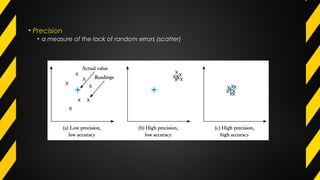
• Precision
• a measure of the lack of random errors (scatter)
• Linearity
• maximum deviation from a ‘straight-line’ response
• normally expressed as a percentage of the full-scale value
• Sensitivity
• a measure of the change produced at the output for a given change in the quantity
being measured
Temperature sensors
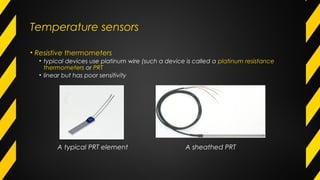
• Resistive thermometers
• typical devices use platinum wire (such a device is called a platinum resistance
thermometers or PRT
• linear but has poor sensitivity
A typical PRT element A sheathed PRT
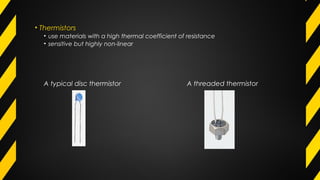
• Thermistors
• use materials with a high thermal coefficient of resistance
• sensitive but highly non-linear
A typical disc thermistor A threaded thermistor
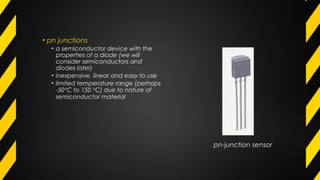
• pn junctions
• a semiconductor device with the
properties of a diode (we will
consider semiconductors and
diodes later)
• inexpensive, linear and easy to use
• limited temperature range (perhaps
-50°C to 150 °C) due to nature of
semiconductor material
pn-junction sensor
Light Sensors
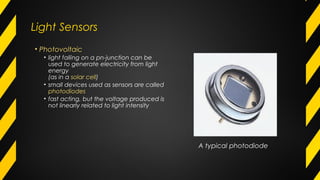
• Photovoltaic
• light falling on a pn-junction can be
used to generate electricity from light
energy
(as in a solar cell)
• small devices used as sensors are called
photodiodes
• fast acting, but the voltage produced is
not linearly related to light intensity
A typical photodiode
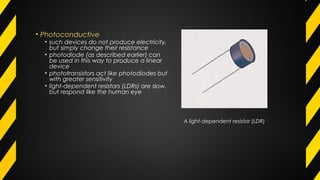
• Photoconductive
• such devices do not produce electricity,
but simply change their resistance
• photodiode (as described earlier) can
be used in this way to produce a linear
device
• phototransistors act like photodiodes but
with greater sensitivity
• light-dependent resistors (LDRs) are slow,
but respond like the human eye
A light-dependent resistor (LDR)
Force Sensors
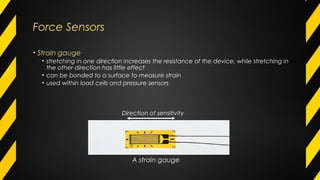
• Strain gauge
• stretching in one direction increases the resistance of the device, while stretching in
the other direction has little effect
• can be bonded to a surface to measure strain
• used within load cells and pressure sensors
A strain gauge
Direction of sensitivity
Displacement Sensors
• Potentiometers
• resistive potentiometers are one of the most widely used forms of position sensor
• can be angular or linear
• consists of a length of resistive material with a sliding contact onto the resistive track
• when used as a position transducer a potential is placed across the two end
terminals, the voltage on the sliding contact is then proportional to its position
• an inexpensive and easy to use sensor
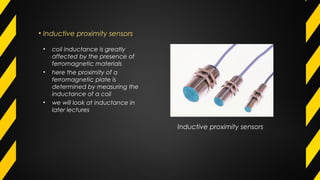
• Inductive proximity sensors
Inductive proximity sensors
• coil inductance is greatly
affected by the presence of
ferromagnetic materials
• here the proximity of a
ferromagnetic plate is
determined by measuring the
inductance of a coil
• we will look at inductance in
later lectures
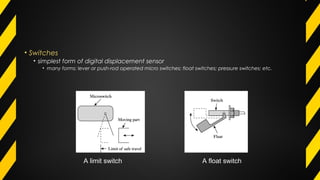
• Switches
• simplest form of digital displacement sensor
• many forms: lever or push-rod operated micro switches; float switches; pressure switches; etc.
A limit switch A float switch
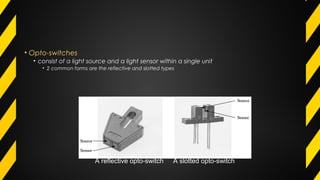
• Opto-switches
• consist of a light source and a light sensor within a single unit
• 2 common forms are the reflective and slotted types
A reflective opto-switch A slotted opto-switch
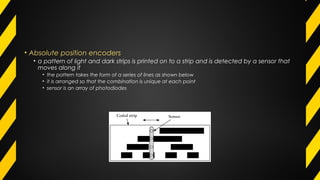
• Absolute position encoders
• a pattern of light and dark strips is printed on to a strip and is detected by a sensor that
moves along it
• the pattern takes the form of a series of lines as shown below
• it is arranged so that the combination is unique at each point
• sensor is an array of photodiodes
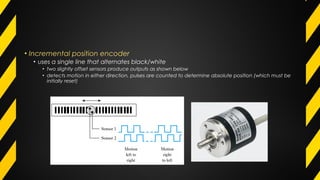
• Incremental position encoder
• uses a single line that alternates black/white
• two slightly offset sensors produce outputs as shown below
• detects motion in either direction, pulses are counted to determine absolute position (which must be
initially reset)
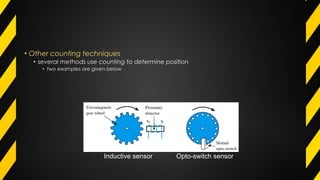
• Other counting techniques
• several methods use counting to determine position
• two examples are given below
Opto-switch sensorInductive sensor
Motion Sensors
• Motion sensors measure quantities such as velocity and acceleration
• can be obtained by differentiating displacement
• differentiation tends to amplify high-frequency noise
• Alternatively can be measured directly
• some sensors give velocity directly
• e.g. measuring frequency of pulses in the counting techniques described earlier gives speed rather
than position
• some sensors give acceleration directly
• e.g. accelerometers usually measure the force on a mass
Sound Sensors
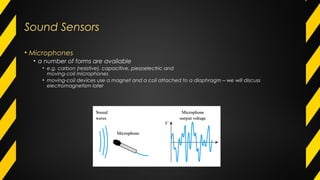
• Microphones
• a number of forms are available
• e.g. carbon (resistive), capacitive, piezoelectric and
moving-coil microphones
• moving-coil devices use a magnet and a coil attached to a diaphragm – we will discuss
electromagnetism later
Sensor Interfacing
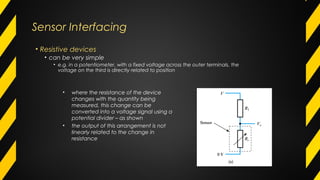
• Resistive devices
• can be very simple
• e.g. in a potentiometer, with a fixed voltage across the outer terminals, the
voltage on the third is directly related to position
• where the resistance of the device
changes with the quantity being
measured, this change can be
converted into a voltage signal using a
potential divider – as shown
• the output of this arrangement is not
linearly related to the change in
resistance
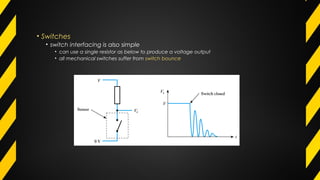
• Switches
• switch interfacing is also simple
• can use a single resistor as below to produce a voltage output
• all mechanical switches suffer from switch bounce
• Capacitive and inductive sensors
• sensors that change their capacitance or inductance in response to external influences
normally require the use of alternating current (AC) circuitry
• such circuits need not be complicated
• we will consider AC circuits in later lectures
Key Points
• A wide range of sensors is available
• Some sensors produce an output voltage related to the measured quantity and
therefore supply power
• Other devices simply change their physical properties
• Some sensors produce an output that is linearly related to the quantity being measured,
others do not
• Interfacing may be required to produce signals in the correct form
Skillcruise.com

sensors

  • 1.
  • 2.
    Outlines • Introduction • DescribingSensor Performance • Temperature Sensors • Light Sensors • Force Sensors • Displacement Sensors • Motion Sensors • Sound Sensors • Sensor Interfacing
  • 3.
    Introduction • To beuseful, systems must interact with their environment. To do this they use sensors and actuators • Sensors and actuators are examples of transducers A transducer is a device that converts one physical quantity into another • examples include: • a mercury-in-glass thermometer (converts temperature into displacement of a column of mercury) • a microphone (converts sound into an electrical signal). • We will look at sensors in this lecture and at actuators in the next lecture
  • 4.
    • Almost anyphysical property of a material that changes in response to some excitation can be used to produce a sensor • widely used sensors include those that are: • resistive • inductive • capacitive • piezoelectric • photo resistive • elastic • thermal. • in this lecture we will look at several examples
  • 5.
    Describing Sensor Performance •Range • maximum and minimum values that can be measured • Resolution or discrimination • smallest discernible change in the measured value • Error • difference between the measured and actual values • random errors • systematic errors • Accuracy, inaccuracy, uncertainty • accuracy is a measure of the maximum expected error
  • 6.
    • Precision • ameasure of the lack of random errors (scatter)
  • 7.
    • Linearity • maximumdeviation from a ‘straight-line’ response • normally expressed as a percentage of the full-scale value • Sensitivity • a measure of the change produced at the output for a given change in the quantity being measured
  • 8.
    Temperature sensors • Resistivethermometers • typical devices use platinum wire (such a device is called a platinum resistance thermometers or PRT • linear but has poor sensitivity A typical PRT element A sheathed PRT
  • 9.
    • Thermistors • usematerials with a high thermal coefficient of resistance • sensitive but highly non-linear A typical disc thermistor A threaded thermistor
  • 10.
    • pn junctions •a semiconductor device with the properties of a diode (we will consider semiconductors and diodes later) • inexpensive, linear and easy to use • limited temperature range (perhaps -50°C to 150 °C) due to nature of semiconductor material pn-junction sensor
  • 11.
    Light Sensors • Photovoltaic •light falling on a pn-junction can be used to generate electricity from light energy (as in a solar cell) • small devices used as sensors are called photodiodes • fast acting, but the voltage produced is not linearly related to light intensity A typical photodiode
  • 12.
    • Photoconductive • suchdevices do not produce electricity, but simply change their resistance • photodiode (as described earlier) can be used in this way to produce a linear device • phototransistors act like photodiodes but with greater sensitivity • light-dependent resistors (LDRs) are slow, but respond like the human eye A light-dependent resistor (LDR)
  • 13.
    Force Sensors • Straingauge • stretching in one direction increases the resistance of the device, while stretching in the other direction has little effect • can be bonded to a surface to measure strain • used within load cells and pressure sensors A strain gauge Direction of sensitivity
  • 14.
    Displacement Sensors • Potentiometers •resistive potentiometers are one of the most widely used forms of position sensor • can be angular or linear • consists of a length of resistive material with a sliding contact onto the resistive track • when used as a position transducer a potential is placed across the two end terminals, the voltage on the sliding contact is then proportional to its position • an inexpensive and easy to use sensor
  • 15.
    • Inductive proximitysensors Inductive proximity sensors • coil inductance is greatly affected by the presence of ferromagnetic materials • here the proximity of a ferromagnetic plate is determined by measuring the inductance of a coil • we will look at inductance in later lectures
  • 16.
    • Switches • simplestform of digital displacement sensor • many forms: lever or push-rod operated micro switches; float switches; pressure switches; etc. A limit switch A float switch
  • 17.
    • Opto-switches • consistof a light source and a light sensor within a single unit • 2 common forms are the reflective and slotted types A reflective opto-switch A slotted opto-switch
  • 18.
    • Absolute positionencoders • a pattern of light and dark strips is printed on to a strip and is detected by a sensor that moves along it • the pattern takes the form of a series of lines as shown below • it is arranged so that the combination is unique at each point • sensor is an array of photodiodes
  • 19.
    • Incremental positionencoder • uses a single line that alternates black/white • two slightly offset sensors produce outputs as shown below • detects motion in either direction, pulses are counted to determine absolute position (which must be initially reset)
  • 20.
    • Other countingtechniques • several methods use counting to determine position • two examples are given below Opto-switch sensorInductive sensor
  • 21.
    Motion Sensors • Motionsensors measure quantities such as velocity and acceleration • can be obtained by differentiating displacement • differentiation tends to amplify high-frequency noise • Alternatively can be measured directly • some sensors give velocity directly • e.g. measuring frequency of pulses in the counting techniques described earlier gives speed rather than position • some sensors give acceleration directly • e.g. accelerometers usually measure the force on a mass
  • 22.
    Sound Sensors • Microphones •a number of forms are available • e.g. carbon (resistive), capacitive, piezoelectric and moving-coil microphones • moving-coil devices use a magnet and a coil attached to a diaphragm – we will discuss electromagnetism later
  • 23.
    Sensor Interfacing • Resistivedevices • can be very simple • e.g. in a potentiometer, with a fixed voltage across the outer terminals, the voltage on the third is directly related to position • where the resistance of the device changes with the quantity being measured, this change can be converted into a voltage signal using a potential divider – as shown • the output of this arrangement is not linearly related to the change in resistance
  • 24.
    • Switches • switchinterfacing is also simple • can use a single resistor as below to produce a voltage output • all mechanical switches suffer from switch bounce
  • 25.
    • Capacitive andinductive sensors • sensors that change their capacitance or inductance in response to external influences normally require the use of alternating current (AC) circuitry • such circuits need not be complicated • we will consider AC circuits in later lectures
  • 26.
    Key Points • Awide range of sensors is available • Some sensors produce an output voltage related to the measured quantity and therefore supply power • Other devices simply change their physical properties • Some sensors produce an output that is linearly related to the quantity being measured, others do not • Interfacing may be required to produce signals in the correct form
  • 27.