PROJECT PRESENTATION ON PIR BASED
LIGHTING CONTROL
 Presented By
Engineering Students
from Greater Noida
OBJECTIVE
TO DESIGN AND DEVELOP PIR BASED LIGHTING
CONTROL SYSTEM
PURPOSE
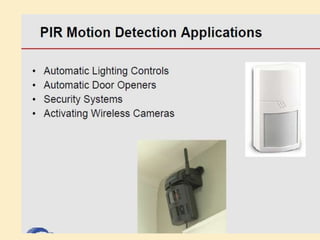
It can be used in any area where people
only occasionally walk or move through and
which is not required to be continously
lit,could benefit from the installation of a PIR
sensor.Some examples are
highway,paths,driveways,garden areas
INTRODUUCTION ABOUT PIR SENSOR
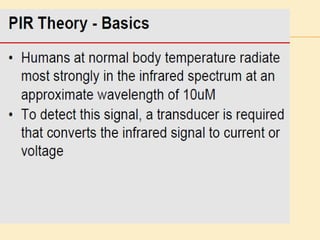
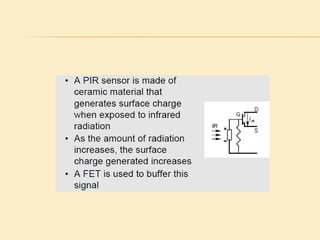
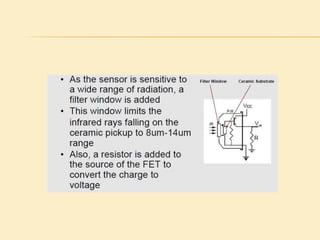
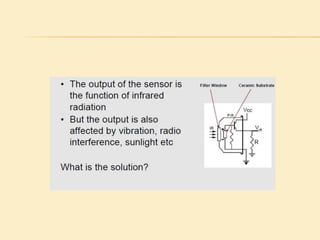
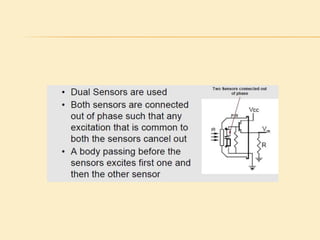
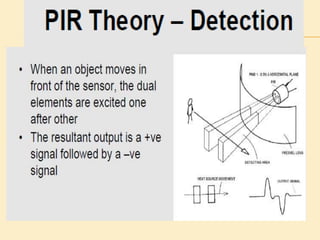
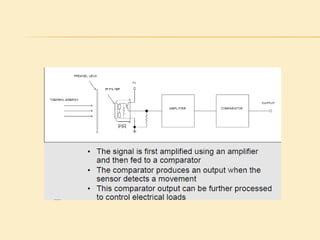
 The PIR (Passive Infra-Red) Sensor is a
pyroelectric device that detects motion by
measuring changes in
 the infrared levels emitted by surrounding
objects. This motion can be detected by
checking for a high
 signal on a single I/O pin.
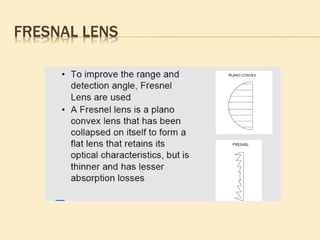
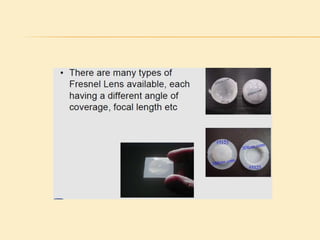
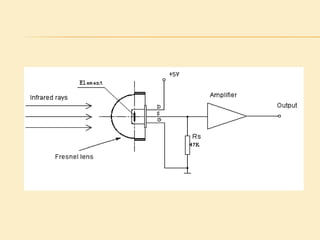
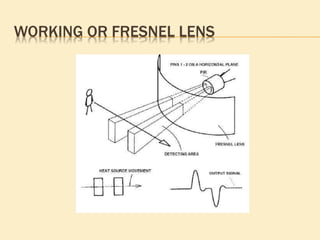
FRESNAL LENS
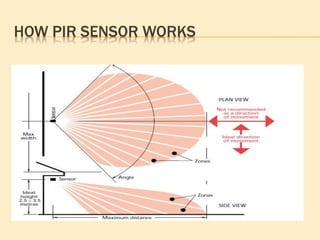
HOW PIR SENSOR WORKS
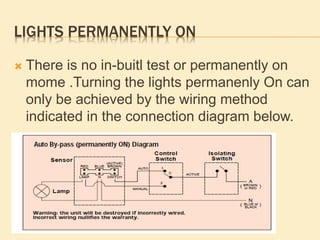
LIGHTS PERMANENTLY ON
 There is no in-buitl test or permanently on
mome .Turning the lights permanenly On can
only be achieved by the wiring method
indicated in the connection diagram below.
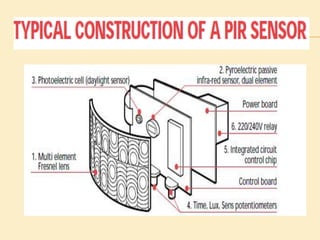
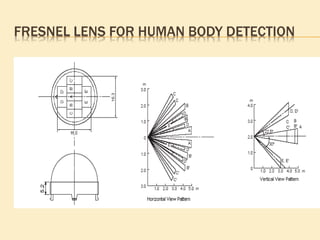
FRESNEL LENS FOR HUMAN BODY DETECTION
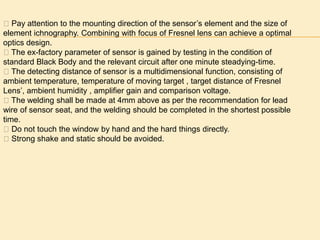
􀁹 Pay attention to the mounting direction of the sensor’s element and the size of
element ichnography. Combining with focus of Fresnel lens can achieve a optimal
optics design.
􀁹 The ex-factory parameter of sensor is gained by testing in the condition of
standard Black Body and the relevant circuit after one minute steadying-time.
􀁹 The detecting distance of sensor is a multidimensional function, consisting of
ambient temperature, temperature of moving target , target distance of Fresnel
Lens’, ambient humidity , amplifier gain and comparison voltage.
􀁹 The welding shall be made at 4mm above as per the recommendation for lead
wire of sensor seat, and the welding should be completed in the shortest possible
time.
􀁹 Do not touch the window by hand and the hard things directly.
􀁹 Strong shake and static should be avoided.
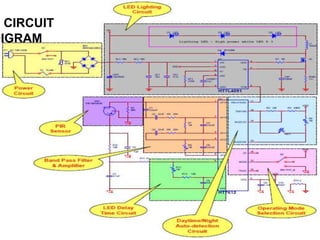
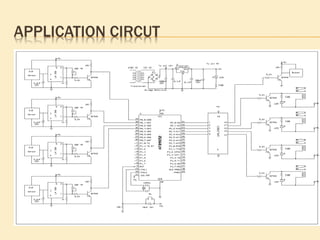
APPLICATION CIRCUIT
CIRCUIT
DIGRAM
WORKING
 The system comprises to laser transmitter-ldr
sensor pair, which are installed on the
highway 100 meter apart with the transmitter
and ldr sensor of each pair on the opposite
sides of the road.
 The system display the time taken by the
vehicle in crossing this 100 meter distance
from one pair to other with the resolution of
0.01 sec.,from which the speed of the vehicle
can be calculated as follows:
 Speed(kmph)=Distance/Time
 Reading on display=36000/Speed.
APPLICATION CIRCUT
WORKING OR FRESNEL LENS
CIRCUIT DESCRIPTION
 Our complete circuit is divided into six
section
 Power supply
 Sensor(signal conditioning)
 Rf transmitter and reciever
 Microcontroller
 LCD
 Output
POWER SUPPLY
 5 VOLT REGULATED POWER SUPPLY CIRCUIT.
In this project firstly we use one step down
transformer
Step down transformer step down the voltage from
220
volt Ac to 12 volt Ac. This Ac voltage is further
converted
into DC with the help of rectifier circuit.
 In rectifier circuit we use four diode. All the diodes
are arranges as a bridge rectifier circuit. Output of this
rectifier is pulsating Dc. To convert this pulsating DC
into smooth dc we use one capacitor as a filter
components. Capacitor converts the pulsating Dc into
LIGHT SENSOR
 In the light sensor we use one LDR. LDR is a
light dependent resistor. Resistance of the ldr
is depend on the intensisty of the light. As the
light on the ldr is change , resistance of ldr is
also change. Resistance of the ldr is varies
from 1k ohm to 500 k ohm.
 In this project we use ldr with only one 10k
ohm variable resistor. This 10 k ohm resistor
is connected to the positive voltage 5volt.
MICRCONTROLLER INTERFACE.
 Here we use ic 89s51 controller. This
controller is a 40 pin ic. Pin no 40 of the ic is
connected with the positive 5 volt supply. Pin
no 31 is also connected to the positive
supply. Pin no 20 of the ic is connected to the
ground pin. Pin no 9 is reset pin. In this pin
we connect a one capacitor and resistor to
provide a auto reset circuit.
RELAY
 In order to enable a circuit to be isolated from
the system only under faulty conditions,
protective relays are used. In normal cases, it is
open circuit relay. The relay is usually provided
with 4 terminals, two of which are connected to
relay winding and other two are connected to
the circuit to be controlled. It has following
characteristics :
 Sensitivity
 Speed
 Selectivity
 Relays: The relay takes advantage of the fact
that when electricity flows through a coil, it
becomes an electromagnet. The

electromagnetic coil attracts a steel plate, which
is attached to a switch. So the switch's motion
(ON and OFF) is controlled by the current
flowing to the coil, or not, respectively.
 A very useful feature of a relay is that it can be
used to electrically isolate different parts of a
circuit. It will allow a low voltage circuit (e.g.
5VDC) to switch the power in a high voltage
circuit (e.g. 100 VAC or more).
 The relay operates mechanically, so it can not
operate at high speed.
DIFFERENT TYPES OR RELAYS
 Electromagnetic relay
 Power Relay.
 Time Delay Relay.
 Latching Relay.
 Crystal Can Relay.
 Co-axial Relay.

LCD DETAIL
 Frequently, an 8051 program must interact
with the outside world using input and output
devices that communicate directly with a
human being. One of the most common
devices attached to an 8051 is an LCD
display. Some of the most common LCDs
connected to the 8051 are 16x2 and 20x2
displays. This means 16 characters per line
by 2 lines and 20 characters per line by 2
lines, respectively.
SCOPE
 While driving on highways, motorists should not
exceed the maximum speed limit permitted for
their vehicle.
 The speed checker has also enable an sound
alarm if the vehicle exceed the permissible
speed for the highway.
 With the help of this project we can sense the
speed of the vehicle and control their speed and
also disable the horn of the vehicle in the no
horn area.
REFRENCES
 WWW.SCRIBD.COM
 WWW.SCIENCEPROJECT.COM
 WWW.SQUIDOO.COM
 WWW.TOPPROJECTBLOGSPOT.COM
THANK YOU
Uploaded by –
www.Slidescope.com

Pir based lighting control

  • 1.
    PROJECT PRESENTATION ONPIR BASED LIGHTING CONTROL  Presented By Engineering Students from Greater Noida
  • 2.
    OBJECTIVE TO DESIGN ANDDEVELOP PIR BASED LIGHTING CONTROL SYSTEM
  • 3.
    PURPOSE It can beused in any area where people only occasionally walk or move through and which is not required to be continously lit,could benefit from the installation of a PIR sensor.Some examples are highway,paths,driveways,garden areas
  • 4.
    INTRODUUCTION ABOUT PIRSENSOR  The PIR (Passive Infra-Red) Sensor is a pyroelectric device that detects motion by measuring changes in  the infrared levels emitted by surrounding objects. This motion can be detected by checking for a high  signal on a single I/O pin.
  • 10.
  • 15.
  • 19.
    LIGHTS PERMANENTLY ON There is no in-buitl test or permanently on mome .Turning the lights permanenly On can only be achieved by the wiring method indicated in the connection diagram below.
  • 20.
    FRESNEL LENS FORHUMAN BODY DETECTION
  • 22.
    􀁹 Pay attentionto the mounting direction of the sensor’s element and the size of element ichnography. Combining with focus of Fresnel lens can achieve a optimal optics design. 􀁹 The ex-factory parameter of sensor is gained by testing in the condition of standard Black Body and the relevant circuit after one minute steadying-time. 􀁹 The detecting distance of sensor is a multidimensional function, consisting of ambient temperature, temperature of moving target , target distance of Fresnel Lens’, ambient humidity , amplifier gain and comparison voltage. 􀁹 The welding shall be made at 4mm above as per the recommendation for lead wire of sensor seat, and the welding should be completed in the shortest possible time. 􀁹 Do not touch the window by hand and the hard things directly. 􀁹 Strong shake and static should be avoided.
  • 23.
  • 24.
    WORKING  The systemcomprises to laser transmitter-ldr sensor pair, which are installed on the highway 100 meter apart with the transmitter and ldr sensor of each pair on the opposite sides of the road.  The system display the time taken by the vehicle in crossing this 100 meter distance from one pair to other with the resolution of 0.01 sec.,from which the speed of the vehicle can be calculated as follows:  Speed(kmph)=Distance/Time  Reading on display=36000/Speed.
  • 25.
  • 26.
  • 27.
    CIRCUIT DESCRIPTION  Ourcomplete circuit is divided into six section  Power supply  Sensor(signal conditioning)  Rf transmitter and reciever  Microcontroller  LCD  Output
  • 28.
    POWER SUPPLY  5VOLT REGULATED POWER SUPPLY CIRCUIT. In this project firstly we use one step down transformer Step down transformer step down the voltage from 220 volt Ac to 12 volt Ac. This Ac voltage is further converted into DC with the help of rectifier circuit.  In rectifier circuit we use four diode. All the diodes are arranges as a bridge rectifier circuit. Output of this rectifier is pulsating Dc. To convert this pulsating DC into smooth dc we use one capacitor as a filter components. Capacitor converts the pulsating Dc into
  • 29.
    LIGHT SENSOR  Inthe light sensor we use one LDR. LDR is a light dependent resistor. Resistance of the ldr is depend on the intensisty of the light. As the light on the ldr is change , resistance of ldr is also change. Resistance of the ldr is varies from 1k ohm to 500 k ohm.  In this project we use ldr with only one 10k ohm variable resistor. This 10 k ohm resistor is connected to the positive voltage 5volt.
  • 30.
    MICRCONTROLLER INTERFACE.  Herewe use ic 89s51 controller. This controller is a 40 pin ic. Pin no 40 of the ic is connected with the positive 5 volt supply. Pin no 31 is also connected to the positive supply. Pin no 20 of the ic is connected to the ground pin. Pin no 9 is reset pin. In this pin we connect a one capacitor and resistor to provide a auto reset circuit.
  • 31.
    RELAY  In orderto enable a circuit to be isolated from the system only under faulty conditions, protective relays are used. In normal cases, it is open circuit relay. The relay is usually provided with 4 terminals, two of which are connected to relay winding and other two are connected to the circuit to be controlled. It has following characteristics :  Sensitivity  Speed  Selectivity
  • 32.
     Relays: Therelay takes advantage of the fact that when electricity flows through a coil, it becomes an electromagnet. The electromagnetic coil attracts a steel plate, which is attached to a switch. So the switch's motion (ON and OFF) is controlled by the current flowing to the coil, or not, respectively.  A very useful feature of a relay is that it can be used to electrically isolate different parts of a circuit. It will allow a low voltage circuit (e.g. 5VDC) to switch the power in a high voltage circuit (e.g. 100 VAC or more).  The relay operates mechanically, so it can not operate at high speed.
  • 33.
    DIFFERENT TYPES ORRELAYS  Electromagnetic relay  Power Relay.  Time Delay Relay.  Latching Relay.  Crystal Can Relay.  Co-axial Relay. 
  • 34.
    LCD DETAIL  Frequently,an 8051 program must interact with the outside world using input and output devices that communicate directly with a human being. One of the most common devices attached to an 8051 is an LCD display. Some of the most common LCDs connected to the 8051 are 16x2 and 20x2 displays. This means 16 characters per line by 2 lines and 20 characters per line by 2 lines, respectively.
  • 35.
    SCOPE  While drivingon highways, motorists should not exceed the maximum speed limit permitted for their vehicle.  The speed checker has also enable an sound alarm if the vehicle exceed the permissible speed for the highway.  With the help of this project we can sense the speed of the vehicle and control their speed and also disable the horn of the vehicle in the no horn area.
  • 36.
    REFRENCES  WWW.SCRIBD.COM  WWW.SCIENCEPROJECT.COM WWW.SQUIDOO.COM  WWW.TOPPROJECTBLOGSPOT.COM
  • 37.
    THANK YOU Uploaded by– www.Slidescope.com