Presentation for
ANALOG ELECTRONICS
By: Ayesha Anum & Marwa Batool
(F20BPHY002, F20BPHY005)
1
Diode-based sensors
What are sensors?
3
“
“A sensor is a device that detects and
responds to some type of input from the
physical environment.”
4
Input:
The input could be light, heat,
motion, moisture, pressure, etc.
Output:
The output is a signal that is
converted to a human-readable
display at the sensor location.
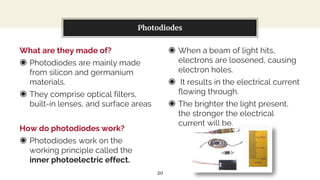
You can also split your content
◉ Most sensors are electronic but
some are simpler like glass
thermometer that presents visual
data.
◉ People use sensors to measure
temperature, gauge distance,
detect smoke, regulate pressure,
and a myriad of other uses.
Sensors
5
How do sensors work?
6
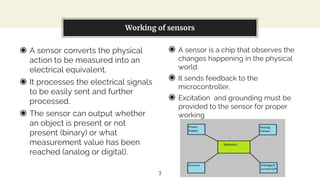
◉ A sensor converts the physical
action to be measured into an
electrical equivalent.
◉ It processes the electrical signals
to be easily sent and further
processed.
◉ The sensor can output whether
an object is present or not
present (binary) or what
measurement value has been
reached (analog or digital).
You can also split your content
◉ A sensor is a chip that observes the
changes happening in the physical
world.
◉ It sends feedback to the
microcontroller.
◉ Excitation and grounding must be
provided to the sensor for proper
working
Working of sensors
7
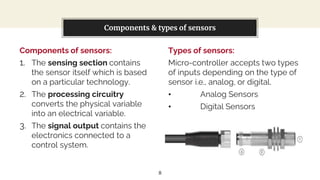
Components of sensors:
1. The sensing section contains
the sensor itself which is based
on a particular technology.
2. The processing circuitry
converts the physical variable
into an electrical variable.
3. The signal output contains the
electronics connected to a
control system.
You can also split your content
Types of sensors:
Micro-controller accepts two types
of inputs depending on the type of
sensor i.e., analog, or digital.
• Analog Sensors
• Digital Sensors
Components & types of sensors
8
Analog Sensors
9
“
“Analog sensors convert physical data
into analog signals.
10
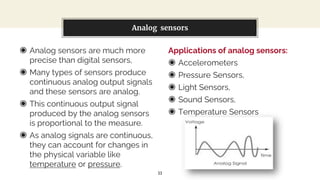
◉ Analog sensors are much more
precise than digital sensors,
◉ Many types of sensors produce
continuous analog output signals
and these sensors are analog.
◉ This continuous output signal
produced by the analog sensors
is proportional to the measure.
◉ As analog signals are continuous,
they can account for changes in
the physical variable like
temperature or pressure.
You can also split your content
Applications of analog sensors:
◉ Accelerometers
◉ Pressure Sensors,
◉ Light Sensors,
◉ Sound Sensors,
◉ Temperature Sensors
Analog sensors
11
Digital Sensors
12
“
“In digital sensors, the signal measured
is directly converted into digital signal
output inside the digital sensor itself.”
13
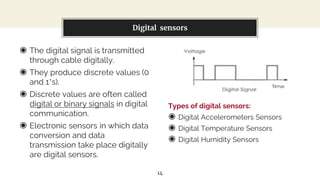
◉ The digital signal is transmitted
through cable digitally.
◉ They produce discrete values (0
and 1’s).
◉ Discrete values are often called
digital or binary signals in digital
communication.
◉ Electronic sensors in which data
conversion and data
transmission take place digitally
are digital sensors.
You can also split your content
Types of digital sensors:
◉ Digital Accelerometers Sensors
◉ Digital Temperature Sensors
◉ Digital Humidity Sensors
Digital sensors
14
Application of diodes in
sensors
1. LIGHT SENSORS
16
“A light sensor is a photoelectric
device that converts light energy
(photons) detected to electrical
energy (electrons).”
◉ Light sensors are a type of
photo-detector that detect light.
◉ Different types of light sensors
can be used to measure
illuminance.
◉ They respond to changes in the
amount of light received, or
convert light to electricity.
You can also split your content
Types of light sensors:
There are different types of light
sensors available; mainly they
include:
1. Photo-resistors
2. Photodiodes
3. Phototransistors
Light sensors
17
a) Photodiodes
18
“
“A photodiode is a semiconductor p–n
junction device that converts light into
an electrical current.”
19
What are they made of?
◉ Photodiodes are mainly made
from silicon and germanium
materials.
◉ They comprise optical filters,
built-in lenses, and surface areas
How do photodiodes work?
◉ Photodiodes work on the
working principle called the
inner photoelectric effect.
You can also split your content
◉ When a beam of light hits,
electrons are loosened, causing
electron holes.
◉ It results in the electrical current
flowing through.
◉ The brighter the light present,
the stronger the electrical
current will be.
Photodiodes
20
Construction:
◉ The construction of the
Photodiode light sensor is similar
to that of a PN-junction diode
◉ The diode’s outer casing is either
transparent or has a clear lens to
focus the light onto the PN
junction for increased sensitivity.
◉ The junction will respond to light
particularly longer wavelengths
such as red and infra-red rather
than visible light.
You can also split your content
Advantage:
◉ One main advantage of
photodiodes when used as light
sensors is their fast response to
changes in the light level.
Disadvantage:
◉ One disadvantage of this type of
photo device is the relatively
small current flow even when
fully lit.
Photodiodes
21
b) Phototransistors
22
“
“An electronic switching & current
amplification component which relies
on exposure of light to operate.”
23
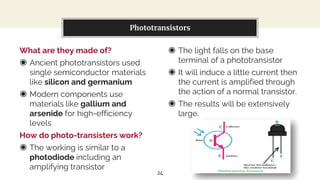
What are they made of?
◉ Ancient phototransistors used
single semiconductor materials
like silicon and germanium
◉ Modern components use
materials like gallium and
arsenide for high-efficiency
levels
How do photo-transisters work?
◉ The working is similar to a
photodiode including an
amplifying transistor
You can also split your content
◉ The light falls on the base
terminal of a phototransistor
◉ It will induce a little current then
the current is amplified through
the action of a normal transistor.
◉ The results will be extensively
large.
Phototransistors
24
Construction:
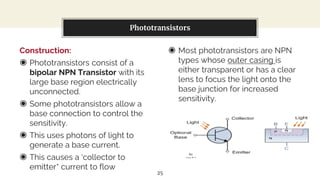
◉ Phototransistors consist of a
bipolar NPN Transistor with its
large base region electrically
unconnected.
◉ Some phototransistors allow a
base connection to control the
sensitivity.
◉ This uses photons of light to
generate a base current.
◉ This causes a ‘collector to
emitter’ current to flow
You can also split your content
◉ Most phototransistors are NPN
types whose outer casing is
either transparent or has a clear
lens to focus the light onto the
base junction for increased
sensitivity.
Phototransistors
25
Construction:
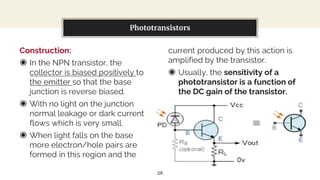
◉ In the NPN transistor, the
collector is biased positively to
the emitter so that the base
junction is reverse biased.
◉ With no light on the junction
normal leakage or dark current
flows which is very small.
◉ When light falls on the base
more electron/hole pairs are
formed in this region and the
You can also split your content
current produced by this action is
amplified by the transistor.
◉ Usually, the sensitivity of a
phototransistor is a function of
the DC gain of the transistor.
Phototransistors
26
Applications of phototransistors:
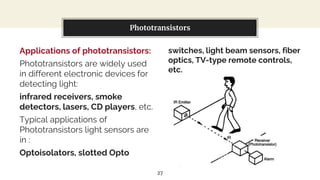
Phototransistors are widely used
in different electronic devices for
detecting light:
infrared receivers, smoke
detectors, lasers, CD players, etc.
Typical applications of
Phototransistors light sensors are
in :
Optoisolators, slotted Opto
You can also split your content
switches, light beam sensors, fiber
optics, TV-type remote controls,
etc.
Phototransistors
27
2) Temperature Sensors
28
“
“An electronic device that measures the
temperature of its environment and
converts the input data into electronic
data.”
29
◉ As a Temperature Sensor, the forward
current of the diode depends on the
temperature.
◉ If the forward voltage remains constant,
the increase in the temperature
decreases the forward current.
◉ It can be used to sense the temperature.
◉ Peltier or thermal diode is used for heat
monitoring in microprocessors
You can also split your content
Temperature sensors
30
a) Peltier or thermal diode as the temperature
sensor
31
“
“A Peltier diode is a diode that allows the
unidirectional flow of heat.”
32
◉ A thermal diode is a device
whose thermal resistance is
different for heat flow in one
direction than the other.
◉ When its first terminal is hotter
than the second terminal, heat
will flow effortlessly from the
first to the second terminal.
◉ When the second terminal is
hotter than the first terminal,
You can also split your content
little heat will flow from the second
terminal to the first terminal.
◉ Nowadays it is used in very large
quantities
◉ It is a single port of diode.
◉ It is issued for 2 main purposes:
1. making electricity.
2. for getting its work done.
Peltier diode
33
b) pn-Junction as a temperature sensor
34
◉ Dedicated diodes and PN
junctions are commonly used as
temperature sensors.
◉ But ESD and input protection
diodes can also be used to
measure temperature.
◉ The principle of using a diode as
a temperature sensor is
straightforward.
◉ With a constant current applied,
the voltage across a diode or PN
You can also split your content
junction will decrease by
approximately 1 to 2 mV/°C over
temperature.

◉ The voltage change over
temperature can be used with a
lookup table or an equation to
calculate a temperature for any
given diode voltage.
◉ In this case, the die temperature
of a high-speed op-amp can be
determined.
pn-Junction as a temperature sensor
35
Thank You
For watching!
36

Diode-based sensors

  • 1.
    Presentation for ANALOG ELECTRONICS By:Ayesha Anum & Marwa Batool (F20BPHY002, F20BPHY005) 1
  • 2.
  • 3.
  • 4.
    “ “A sensor isa device that detects and responds to some type of input from the physical environment.” 4
  • 5.
    Input: The input couldbe light, heat, motion, moisture, pressure, etc. Output: The output is a signal that is converted to a human-readable display at the sensor location. You can also split your content ◉ Most sensors are electronic but some are simpler like glass thermometer that presents visual data. ◉ People use sensors to measure temperature, gauge distance, detect smoke, regulate pressure, and a myriad of other uses. Sensors 5
  • 6.
  • 7.
    ◉ A sensorconverts the physical action to be measured into an electrical equivalent. ◉ It processes the electrical signals to be easily sent and further processed. ◉ The sensor can output whether an object is present or not present (binary) or what measurement value has been reached (analog or digital). You can also split your content ◉ A sensor is a chip that observes the changes happening in the physical world. ◉ It sends feedback to the microcontroller. ◉ Excitation and grounding must be provided to the sensor for proper working Working of sensors 7
  • 8.
    Components of sensors: 1.The sensing section contains the sensor itself which is based on a particular technology. 2. The processing circuitry converts the physical variable into an electrical variable. 3. The signal output contains the electronics connected to a control system. You can also split your content Types of sensors: Micro-controller accepts two types of inputs depending on the type of sensor i.e., analog, or digital. • Analog Sensors • Digital Sensors Components & types of sensors 8
  • 9.
  • 10.
    “ “Analog sensors convertphysical data into analog signals. 10
  • 11.
    ◉ Analog sensorsare much more precise than digital sensors, ◉ Many types of sensors produce continuous analog output signals and these sensors are analog. ◉ This continuous output signal produced by the analog sensors is proportional to the measure. ◉ As analog signals are continuous, they can account for changes in the physical variable like temperature or pressure. You can also split your content Applications of analog sensors: ◉ Accelerometers ◉ Pressure Sensors, ◉ Light Sensors, ◉ Sound Sensors, ◉ Temperature Sensors Analog sensors 11
  • 12.
  • 13.
    “ “In digital sensors,the signal measured is directly converted into digital signal output inside the digital sensor itself.” 13
  • 14.
    ◉ The digitalsignal is transmitted through cable digitally. ◉ They produce discrete values (0 and 1’s). ◉ Discrete values are often called digital or binary signals in digital communication. ◉ Electronic sensors in which data conversion and data transmission take place digitally are digital sensors. You can also split your content Types of digital sensors: ◉ Digital Accelerometers Sensors ◉ Digital Temperature Sensors ◉ Digital Humidity Sensors Digital sensors 14
  • 15.
  • 16.
  • 17.
    “A light sensoris a photoelectric device that converts light energy (photons) detected to electrical energy (electrons).” ◉ Light sensors are a type of photo-detector that detect light. ◉ Different types of light sensors can be used to measure illuminance. ◉ They respond to changes in the amount of light received, or convert light to electricity. You can also split your content Types of light sensors: There are different types of light sensors available; mainly they include: 1. Photo-resistors 2. Photodiodes 3. Phototransistors Light sensors 17
  • 18.
  • 19.
    “ “A photodiode isa semiconductor p–n junction device that converts light into an electrical current.” 19
  • 20.
    What are theymade of? ◉ Photodiodes are mainly made from silicon and germanium materials. ◉ They comprise optical filters, built-in lenses, and surface areas How do photodiodes work? ◉ Photodiodes work on the working principle called the inner photoelectric effect. You can also split your content ◉ When a beam of light hits, electrons are loosened, causing electron holes. ◉ It results in the electrical current flowing through. ◉ The brighter the light present, the stronger the electrical current will be. Photodiodes 20
  • 21.
    Construction: ◉ The constructionof the Photodiode light sensor is similar to that of a PN-junction diode ◉ The diode’s outer casing is either transparent or has a clear lens to focus the light onto the PN junction for increased sensitivity. ◉ The junction will respond to light particularly longer wavelengths such as red and infra-red rather than visible light. You can also split your content Advantage: ◉ One main advantage of photodiodes when used as light sensors is their fast response to changes in the light level. Disadvantage: ◉ One disadvantage of this type of photo device is the relatively small current flow even when fully lit. Photodiodes 21
  • 22.
  • 23.
    “ “An electronic switching& current amplification component which relies on exposure of light to operate.” 23
  • 24.
    What are theymade of? ◉ Ancient phototransistors used single semiconductor materials like silicon and germanium ◉ Modern components use materials like gallium and arsenide for high-efficiency levels How do photo-transisters work? ◉ The working is similar to a photodiode including an amplifying transistor You can also split your content ◉ The light falls on the base terminal of a phototransistor ◉ It will induce a little current then the current is amplified through the action of a normal transistor. ◉ The results will be extensively large. Phototransistors 24
  • 25.
    Construction: ◉ Phototransistors consistof a bipolar NPN Transistor with its large base region electrically unconnected. ◉ Some phototransistors allow a base connection to control the sensitivity. ◉ This uses photons of light to generate a base current. ◉ This causes a ‘collector to emitter’ current to flow You can also split your content ◉ Most phototransistors are NPN types whose outer casing is either transparent or has a clear lens to focus the light onto the base junction for increased sensitivity. Phototransistors 25
  • 26.
    Construction: ◉ In theNPN transistor, the collector is biased positively to the emitter so that the base junction is reverse biased. ◉ With no light on the junction normal leakage or dark current flows which is very small. ◉ When light falls on the base more electron/hole pairs are formed in this region and the You can also split your content current produced by this action is amplified by the transistor. ◉ Usually, the sensitivity of a phototransistor is a function of the DC gain of the transistor. Phototransistors 26
  • 27.
    Applications of phototransistors: Phototransistorsare widely used in different electronic devices for detecting light: infrared receivers, smoke detectors, lasers, CD players, etc. Typical applications of Phototransistors light sensors are in : Optoisolators, slotted Opto You can also split your content switches, light beam sensors, fiber optics, TV-type remote controls, etc. Phototransistors 27
  • 28.
  • 29.
    “ “An electronic devicethat measures the temperature of its environment and converts the input data into electronic data.” 29
  • 30.
    ◉ As aTemperature Sensor, the forward current of the diode depends on the temperature. ◉ If the forward voltage remains constant, the increase in the temperature decreases the forward current. ◉ It can be used to sense the temperature. ◉ Peltier or thermal diode is used for heat monitoring in microprocessors You can also split your content Temperature sensors 30
  • 31.
    a) Peltier orthermal diode as the temperature sensor 31
  • 32.
    “ “A Peltier diodeis a diode that allows the unidirectional flow of heat.” 32
  • 33.
    ◉ A thermaldiode is a device whose thermal resistance is different for heat flow in one direction than the other. ◉ When its first terminal is hotter than the second terminal, heat will flow effortlessly from the first to the second terminal. ◉ When the second terminal is hotter than the first terminal, You can also split your content little heat will flow from the second terminal to the first terminal. ◉ Nowadays it is used in very large quantities ◉ It is a single port of diode. ◉ It is issued for 2 main purposes: 1. making electricity. 2. for getting its work done. Peltier diode 33
  • 34.
    b) pn-Junction asa temperature sensor 34
  • 35.
    ◉ Dedicated diodesand PN junctions are commonly used as temperature sensors. ◉ But ESD and input protection diodes can also be used to measure temperature. ◉ The principle of using a diode as a temperature sensor is straightforward. ◉ With a constant current applied, the voltage across a diode or PN You can also split your content junction will decrease by approximately 1 to 2 mV/°C over temperature. ◉ The voltage change over temperature can be used with a lookup table or an equation to calculate a temperature for any given diode voltage. ◉ In this case, the die temperature of a high-speed op-amp can be determined. pn-Junction as a temperature sensor 35

  • 36.