Near Jnanabharathi Campus,Outer Ring Road, Mallathahalli, Bengaluru-56
What is an IR Sensor?
• IR sensor is an electronic device, that emits the light in order to sense some object of the
surroundings. An IR sensor can measure the heat of an object as well as detects the
motion. Usually, in the infrared spectrum, all the objects radiate some form of thermal
radiation. These types of radiations are invisible to our eyes, but infrared sensor can
detect these radiations.
• The emitter is simply an IR LED (Light Emitting Diode) and the detector is simply an IR
photodiode . Photodiode is sensitive to IR light of the same wavelength which is emitted
by the IR LED. When IR light falls on the photodiode, the resistances and the output
voltages will change in proportion to the magnitude of the IR light received.
• There are five basic elements used in a typical infrared detection system: an infrared
source, a transmission medium, optical component, infrared detectors or receivers and
signal processing. Infrared lasers and Infrared LED’s of specific wavelength used as
infrared sources.
• The three main types of media used for infrared transmission are vacuum, atmosphere
and optical fibers. Optical components are used to focus the infrared radiation or to limit
the spectral response.
Types of IR Sensor
There are two types of IR sensors are available and they are,
• Active Infrared Sensor
• Passive Infrared Sensor
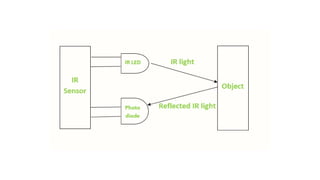
Active infrared sensors consist of two elements: infrared
source and infrared detector. Infrared sources include the LED or
infrared laser diode. Infrared detectors include photodiodes or
phototransistors. The energy emitted by the infrared source is
reflected by an object and falls on the infrared detector.
Passive infrared sensors are basically Infrared detectors.
Passive infrared sensors do not use any infrared source and
detector. They are of two types: quantum and thermal. Thermal
infrared sensors use infrared energy as the source of
heat. Thermocouples, pyroelectric detectors and bolometers are
the common types of thermal infrared detectors. Quantum type
infrared sensors offer higher detection performance. It is faster
than thermal type infrared detectors. The photo sensitivity of
quantum type detectors is wavelength dependent.
IR Transmitter or IR LED
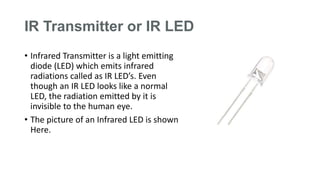
• Infrared Transmitter is a light emitting
diode (LED) which emits infrared
radiations called as IR LED’s. Even
though an IR LED looks like a normal
LED, the radiation emitted by it is
invisible to the human eye.
• The picture of an Infrared LED is shown
Here.
IR Receiver or Photodiode
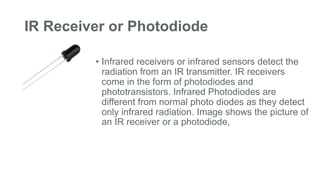
• Infrared receivers or infrared sensors detect the
radiation from an IR transmitter. IR receivers
come in the form of photodiodes and
phototransistors. Infrared Photodiodes are
different from normal photo diodes as they detect
only infrared radiation. Image shows the picture of
an IR receiver or a photodiode,
Night Vision Devices
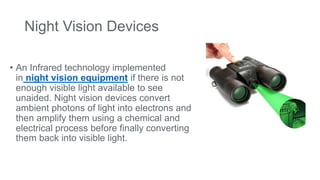
• An Infrared technology implemented
in night vision equipment if there is not
enough visible light available to see
unaided. Night vision devices convert
ambient photons of light into electrons and
then amplify them using a chemical and
electrical process before finally converting
them back into visible light.
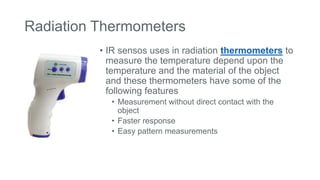
Radiation Thermometers
• IR sensos uses in radiation thermometers to
measure the temperature depend upon the
temperature and the material of the object
and these thermometers have some of the
following features
• Measurement without direct contact with the
object
• Faster response
• Easy pattern measurements
Infrared Tracking
• An Infrared tracking or Infrared homing, is a missile guidance
system which operates using the infrared electromagnetic
radiation emitted from a target to track it.
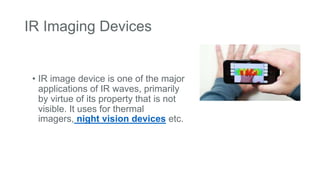
IR Imaging Devices
• IR image device is one of the major
applications of IR waves, primarily
by virtue of its property that is not
visible. It uses for thermal
imagers, night vision devices etc.
Other Key Application Areas
• Climatology
• Meteorology
• Photobiomodulation
• Flame Monitors
• Gas detectors
• Water analysis
• Moisture Analyzers
• Anesthesiology testing
• Petroleum exploration
• Rail safety
• Gas Analyzers
Infrared sensor

Infrared sensor

  • 1.
    Near Jnanabharathi Campus,OuterRing Road, Mallathahalli, Bengaluru-56
  • 6.
    What is anIR Sensor? • IR sensor is an electronic device, that emits the light in order to sense some object of the surroundings. An IR sensor can measure the heat of an object as well as detects the motion. Usually, in the infrared spectrum, all the objects radiate some form of thermal radiation. These types of radiations are invisible to our eyes, but infrared sensor can detect these radiations. • The emitter is simply an IR LED (Light Emitting Diode) and the detector is simply an IR photodiode . Photodiode is sensitive to IR light of the same wavelength which is emitted by the IR LED. When IR light falls on the photodiode, the resistances and the output voltages will change in proportion to the magnitude of the IR light received. • There are five basic elements used in a typical infrared detection system: an infrared source, a transmission medium, optical component, infrared detectors or receivers and signal processing. Infrared lasers and Infrared LED’s of specific wavelength used as infrared sources. • The three main types of media used for infrared transmission are vacuum, atmosphere and optical fibers. Optical components are used to focus the infrared radiation or to limit the spectral response.
  • 8.
    Types of IRSensor There are two types of IR sensors are available and they are, • Active Infrared Sensor • Passive Infrared Sensor
  • 10.
    Active infrared sensorsconsist of two elements: infrared source and infrared detector. Infrared sources include the LED or infrared laser diode. Infrared detectors include photodiodes or phototransistors. The energy emitted by the infrared source is reflected by an object and falls on the infrared detector.
  • 12.
    Passive infrared sensorsare basically Infrared detectors. Passive infrared sensors do not use any infrared source and detector. They are of two types: quantum and thermal. Thermal infrared sensors use infrared energy as the source of heat. Thermocouples, pyroelectric detectors and bolometers are the common types of thermal infrared detectors. Quantum type infrared sensors offer higher detection performance. It is faster than thermal type infrared detectors. The photo sensitivity of quantum type detectors is wavelength dependent.
  • 14.
    IR Transmitter orIR LED • Infrared Transmitter is a light emitting diode (LED) which emits infrared radiations called as IR LED’s. Even though an IR LED looks like a normal LED, the radiation emitted by it is invisible to the human eye. • The picture of an Infrared LED is shown Here.
  • 15.
    IR Receiver orPhotodiode • Infrared receivers or infrared sensors detect the radiation from an IR transmitter. IR receivers come in the form of photodiodes and phototransistors. Infrared Photodiodes are different from normal photo diodes as they detect only infrared radiation. Image shows the picture of an IR receiver or a photodiode,
  • 19.
    Night Vision Devices •An Infrared technology implemented in night vision equipment if there is not enough visible light available to see unaided. Night vision devices convert ambient photons of light into electrons and then amplify them using a chemical and electrical process before finally converting them back into visible light.
  • 20.
    Radiation Thermometers • IRsensos uses in radiation thermometers to measure the temperature depend upon the temperature and the material of the object and these thermometers have some of the following features • Measurement without direct contact with the object • Faster response • Easy pattern measurements
  • 21.
    Infrared Tracking • AnInfrared tracking or Infrared homing, is a missile guidance system which operates using the infrared electromagnetic radiation emitted from a target to track it.
  • 22.
    IR Imaging Devices •IR image device is one of the major applications of IR waves, primarily by virtue of its property that is not visible. It uses for thermal imagers, night vision devices etc.
  • 23.
    Other Key ApplicationAreas • Climatology • Meteorology • Photobiomodulation • Flame Monitors • Gas detectors • Water analysis • Moisture Analyzers • Anesthesiology testing • Petroleum exploration • Rail safety • Gas Analyzers