ACTUATOR AND SENSOR
ENGR. JOHN DENNIS ZAPANTA ESPIRITU
ACTUATOR
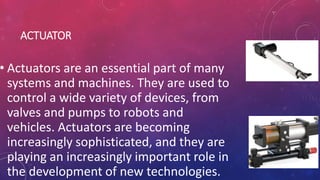
• Actuators are an essential part of many
systems and machines. They are used to
control a wide variety of devices, from
valves and pumps to robots and
vehicles. Actuators are becoming
increasingly sophisticated, and they are
playing an increasingly important role in
the development of new technologies.
ACTUATOR
• An actuator is a device that converts
energy into motion. It is used to
control a mechanism or system.
Actuators are used in a wide variety
of applications, including robotics,
automation, and manufacturing.
ACTUATORS:
• Servo Motor
• DC Motor
• Stepper Motor
• Solenoid
• Relay Module
• Piezo Buzzer
• Linear Actuator
• Pneumatic Cylinder
• Electromagnetic Lock
• Vibration Motor
• Gear Motor
• Brushless Motor
• Continuous Rotation
Servo
• Linear Servo
• Shape Memory Alloy
Actuator
• Hydraulic Actuator
• Thermal Actuator
• Magnetic Actuator
• Voice Coil Actuator
• Rack and Pinion
Actuator
SERVO MOTOR
• is a type of actuator that uses feedback to
control its position. It consists of a motor, a
sensor, and a controller. The motor converts
electrical energy into mechanical energy, the
sensor measures the position of the motor
shaft, and the controller compares the
measured position to the desired position
and sends a signal to the motor to adjust its
speed or torque until the desired position is
reached.
SOLENOID VALVE
• solenoid valve is an electromechanical
device that uses a solenoid to control the
flow of fluid through a valve. The
solenoid is a coil of wire that creates a
magnetic field when an electric current is
passed through it. The magnetic field
moves a plunger, which opens or closes
the valve.
SOLENOID VALVE
RELAY MODULE
• Relay module is a circuit board that
contains one or more relays. Relays are
electromechanical devices that can be
used to control a high-power load, such
as a motor or a solenoid, using a low-
power signal.
LINEAR ACTUATOR
• linear actuator is a device that converts
energy into linear motion. It is used to
move objects along a straight line. Linear
actuators are used in a wide variety of
applications
LINEAR ACTUATOR
• https://www.youtube.com/shorts/YD0
e_HFjhdQ
ELECTROMAGNETIC LOCK
• is a type of lock that uses an electromagnet
to hold a door or gate closed. It consists of
an electromagnet, an armature, and a
spring. The electromagnet is a coil of wire
that creates a magnetic field when current
flows through it. The armature is a metal
plate that is attracted to the electromagnet.
The spring is used to keep the armature in
place when the electromagnet is not
energized
BRUSHLESS MOTOR
• brushless motor is an electric motor that does
not have brushes. Instead, it uses electronic
commutation to control the flow of current to
the motor's windings. This makes brushless
motors more efficient and reliable than
brushed motors.
SHAPE MEMORY ALLOY ACTUATOR
• A shape memory alloy actuator (SMA
actuator) is a type of actuator that uses the
shape memory effect of shape memory alloys
to generate motion. Shape memory alloys are
materials that can return to their original
shape after being deformed.
HYDRAULIC ACTUATOR
• hydraulic actuator is a type of actuator that uses
pressurized fluid to generate motion. It consists of a
cylinder, a piston, and a piston rod. The cylinder is a
closed chamber that contains the pressurized fluid.
The piston is a movable disk that divides the
cylinder into two chambers. The piston rod is
attached to the piston and extends out of the
cylinder.
SENSOR
• Sensor is a device or instrument that detects and
measures physical properties or changes in the
environment and converts them into signals that
can be interpreted, displayed, recorded, or used for
further analysis. Sensors are used in a wide range of
applications across various fields, including
engineering, physics, chemistry, biology,
environmental monitoring, healthcare, automotive
technology, and more.
SENSOR
• Ultrasonic Distance Sensor
(HC-SR04)
• Light Dependent Resistor
(LDR)
• Temperature and Humidity
Sensor (DHT11/DHT22)
• Accelerometer
• Gyroscope
• Magnetometer
• Infrared (IR) Sensor
• Gas Sensor (MQ-2/MQ-
5/MQ-7)
• Sound Sensor (Microphone)
• Pressure Sensor
(BMP180/BMP280)
• Flex Sensor
• Force Sensor
• Tilt Sensor
• Hall Effect Sensor
• Capacitive Touch Sensor
• Proximity Sensor
(Inductive/Capacitive)
• Heart Rate Sensor (Pulse
Sensor)
• Soil Moisture Sensor
• pH Sensor
• RFID Reader
ULTRASONIC DISTANCE SENSOR (HC-SR04)
The HC-SR04 is an ultrasonic distance sensor that
uses sonar to measure the distance to an object. It is
a popular sensor for robotics and other projects that
require non-contact distance measurement.
The HC-SR04 has a range of 2 centimeters to 400
centimeters, and an accuracy of about 3 millimeters. It is also
relatively inexpensive and easy to use.
LIGHT DEPENDENT RESISTOR (LDR)
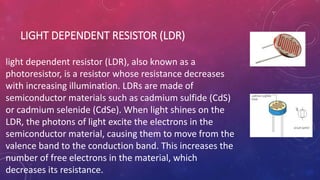
light dependent resistor (LDR), also known as a
photoresistor, is a resistor whose resistance decreases
with increasing illumination. LDRs are made of
semiconductor materials such as cadmium sulfide (CdS)
or cadmium selenide (CdSe). When light shines on the
LDR, the photons of light excite the electrons in the
semiconductor material, causing them to move from the
valence band to the conduction band. This increases the
number of free electrons in the material, which
decreases its resistance.
TEMPERATURE AND HUMIDITY SENSOR
(DHT11/DHT22)
• Temperature and humidity sensor (DHT11/DHT22). It is a small,
inexpensive sensor that can be used to measure the temperature and
humidity of the surrounding air.
• The DHT11 and DHT22 sensors are both based on the same principle.
They have a capacitive humidity sensor and a thermistor to measure
the temperature. The humidity sensor uses two electrodes with a
moisture-holding substrate between them. As the humidity changes,
the conductivity of the substrate changes, or the resistance between
these electrodes changes. The thermistor changes resistance with
temperature.
ACCELEROMETER
• Accelerometer is a sensor that measures acceleration. It can be used
to measure the vibration of a structure, the tilt of a device, or the
movement of a person. Accelerometers are used in a variety of
applications, including:
• Vehicle safety systems: Accelerometers are used to detect sudden
deceleration, which can be a sign of a collision.
• Industrial machinery: Accelerometers are used to monitor the
vibration of machinery and to detect potential problems.
• Consumer electronics: Accelerometers are used in smartphones,
tablets, and wearable devices to detect movement and orientation.
• Medical devices: Accelerometers are used in heart rate monitors and
other medical devices to track movement.
GYROSCOPE SENSOR
• Gyroscope sensor is a device that measures angular velocity. It is a
type of motion sensor that is used in a variety of applications,
including smartphones, drones, and self-driving cars.
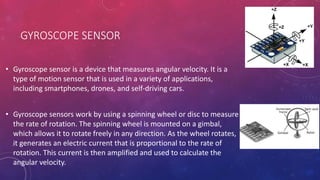
• Gyroscope sensors work by using a spinning wheel or disc to measure
the rate of rotation. The spinning wheel is mounted on a gimbal,
which allows it to rotate freely in any direction. As the wheel rotates,
it generates an electric current that is proportional to the rate of
rotation. This current is then amplified and used to calculate the
angular velocity.
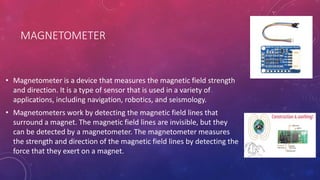
MAGNETOMETER
• Magnetometer is a device that measures the magnetic field strength
and direction. It is a type of sensor that is used in a variety of
applications, including navigation, robotics, and seismology.
• Magnetometers work by detecting the magnetic field lines that
surround a magnet. The magnetic field lines are invisible, but they
can be detected by a magnetometer. The magnetometer measures
the strength and direction of the magnetic field lines by detecting the
force that they exert on a magnet.
INFRARED (IR) SENSOR
• An infrared (IR) sensor is a device that detects infrared radiation. Infrared radiation
is a type of electromagnetic radiation that is invisible to the human eye. IR sensors
are used in a variety of applications, including:
• Remote controls: IR sensors are used in remote controls to detect the infrared
signals that are emitted by the remote control.
• Motion detectors: IR sensors are used in motion detectors to detect the movement
of people or objects.
• Proximity sensors: IR sensors are used in proximity sensors to detect the presence
of objects.
• Temperature sensors: IR sensors can be used to measure the temperature of
objects by detecting the infrared radiation that is emitted by the objects.
• Cameras: IR sensors can be used in cameras to see in the dark by detecting the
infrared radiation that is emitted by objects.
GAS SENSOR (MQ-2/MQ-5/MQ-7)
• The MQ-2, MQ-5, and MQ-7 are gas sensors that are commonly used to detect
flammable gases, smoke, and carbon monoxide, respectively. They are all metal
oxide semiconductor (MOS) sensors, which means that they work by changing
their electrical resistance in response to the presence of a gas.
• The MQ-2 is the most sensitive of the three sensors and can be used to detect a
wide range of flammable gases, including methane, propane, and butane. The MQ-
5 is less sensitive than the MQ-2, but it is more specific to smoke. The MQ-7 is the
least sensitive of the three sensors, but it is the most specific to carbon monoxide.
• All three sensors require a heater to operate. The heater vaporizes the gas so that
it can react with the sensor's surface. The change in resistance is then measured by
an Arduino or other microcontroller.
GAS SENSOR (MQ-2/MQ-5/MQ-7)
• It is a device that converts sound waves into electrical signals. The sound waves
vibrate a diaphragm, which is a thin piece of material. The vibrations are then
converted into an electrical signal by a transducer.There are many different sound
sensors available, but some of the most popular ones for Arduino include:
• KY-038 Sound Sensor: This is a small, inexpensive sensor that can be used to
detect sound. It has an analog output that can be read by Arduino.
• LM393 Sound Sensor: This is a more sensitive sensor that can be used to
detect louder sounds. It has a digital output that can be read by Arduino.
• Grove Sound Sensor: This is a sensor that is specifically designed for use with
the Arduino Grove system. It is easy to use and has a built-in potentiometer for
adjusting the sensitivity.
PRESSURE SENSOR (BMP180/BMP280)
• The BMP180 and BMP280 are both pressure sensors that
can be used with Arduino. They are both based on the
same piezoresistive sensor technology, but the BMP280
has some advantages over the BMP180, such as:
• Higher accuracy
• Lower power consumption
• Support for I2C and SPI communication
• The BMP180 and BMP280 can be used to measure
atmospheric pressure, which can be used to determine
altitude, weather conditions, and other applications.
PRESSURE SENSOR (BMP180/BMP280)
• The BMP180 and BMP280 are both pressure sensors that
can be used with Arduino. They are both based on the
same piezoresistive sensor technology, but the BMP280
has some advantages over the BMP180, such as:
• Higher accuracy
• Lower power consumption
• Support for I2C and SPI communication
• The BMP180 and BMP280 can be used to measure
atmospheric pressure, which can be used to determine
altitude, weather conditions, and other applications.
PROXIMITY SENSOR (INDUCTIVE/CAPACITIVE)
• A proximity sensor is a sensor that detects the presence of an object
without physical contact. There are two main types of proximity sensors:
inductive and capacitive.
• Inductive proximity sensors: Inductive proximity sensors work by detecting the change in
the magnetic field when an object approaches. The sensor has a coil that generates a
magnetic field. When an object approaches the sensor, the magnetic field is distorted,
which is detected by the sensor.
• Capacitive proximity sensors: Capacitive proximity sensors work by detecting the change in
capacitance when an object approaches. The sensor has two plates that are separated by a
small gap. When an object approaches the sensor, the capacitance between the plates
changes, which is detected by the sensor.
HEART RATE SENSOR (PULSE SENSOR)
• A heart rate sensor (pulse sensor) is a sensor that measures the human
heart rate. It is a type of photoplethysmography (PPG) sensor, which
means that it works by detecting the change in light absorption of blood
as it flows through the body.
• The heart rate sensor is a small, lightweight device that can be attached
to the fingertip or earlobe. It has two LEDs, one red and one infrared,
and a photodetector. The LEDs emit light, and the photodetector
measures the amount of light that is reflected back.
SOIL MOISTURE SENSOR
• A soil moisture sensor is a device that measures the amount of water in
soil. It is a type of capacitance sensor, which means that it works by
measuring the change in capacitance between two electrodes as the soil
moisture changes.
• The soil moisture sensor has two electrodes that are inserted into the
soil. The electrodes are separated by a small gap. The capacitance
between the electrodes is affected by the amount of water in the soil.
When the soil is dry, the capacitance is low. When the soil is wet, the
capacitance is high.
• The soil moisture sensor output is a voltage signal that is proportional to
the soil moisture. The output voltage can be measured by an Arduino or
other microcontroller.
PH SENSOR
•
pH sensor is a device that measures the acidity or alkalinity of a
solution. It is a type of ion-selective electrode (ISE) sensor, which means
that it works by measuring the change in electrical potential between
two electrodes as the pH of the solution changes.
• pH sensors are used in a variety of applications, including:
• Water quality monitoring:
• Agriculture:
• Research:
RFID READER
• RFID reader is a device that reads and writes data stored on
RFID tags. RFID tags are small, passive devices that contain a
microchip and an antenna. The microchip stores data, such as
a unique identification number, and the antenna allows the
tag to communicate with the reader.
• RFID readers work by emitting a radio frequency (RF) signal.
The RF signal is picked up by the antenna on the tag, and the
microchip in the tag sends back a response signal. The reader
then decodes the response signal to read the data stored on
the tag.
actuator

actuator

  • 1.
    ACTUATOR AND SENSOR ENGR.JOHN DENNIS ZAPANTA ESPIRITU
  • 2.
    ACTUATOR • Actuators arean essential part of many systems and machines. They are used to control a wide variety of devices, from valves and pumps to robots and vehicles. Actuators are becoming increasingly sophisticated, and they are playing an increasingly important role in the development of new technologies.
  • 3.
    ACTUATOR • An actuatoris a device that converts energy into motion. It is used to control a mechanism or system. Actuators are used in a wide variety of applications, including robotics, automation, and manufacturing.
  • 4.
    ACTUATORS: • Servo Motor •DC Motor • Stepper Motor • Solenoid • Relay Module • Piezo Buzzer • Linear Actuator • Pneumatic Cylinder • Electromagnetic Lock • Vibration Motor • Gear Motor • Brushless Motor • Continuous Rotation Servo • Linear Servo • Shape Memory Alloy Actuator • Hydraulic Actuator • Thermal Actuator • Magnetic Actuator • Voice Coil Actuator • Rack and Pinion Actuator
  • 5.
    SERVO MOTOR • isa type of actuator that uses feedback to control its position. It consists of a motor, a sensor, and a controller. The motor converts electrical energy into mechanical energy, the sensor measures the position of the motor shaft, and the controller compares the measured position to the desired position and sends a signal to the motor to adjust its speed or torque until the desired position is reached.
  • 6.
    SOLENOID VALVE • solenoidvalve is an electromechanical device that uses a solenoid to control the flow of fluid through a valve. The solenoid is a coil of wire that creates a magnetic field when an electric current is passed through it. The magnetic field moves a plunger, which opens or closes the valve.
  • 7.
  • 8.
    RELAY MODULE • Relaymodule is a circuit board that contains one or more relays. Relays are electromechanical devices that can be used to control a high-power load, such as a motor or a solenoid, using a low- power signal.
  • 9.
    LINEAR ACTUATOR • linearactuator is a device that converts energy into linear motion. It is used to move objects along a straight line. Linear actuators are used in a wide variety of applications
  • 10.
  • 11.
    ELECTROMAGNETIC LOCK • isa type of lock that uses an electromagnet to hold a door or gate closed. It consists of an electromagnet, an armature, and a spring. The electromagnet is a coil of wire that creates a magnetic field when current flows through it. The armature is a metal plate that is attracted to the electromagnet. The spring is used to keep the armature in place when the electromagnet is not energized
  • 12.
    BRUSHLESS MOTOR • brushlessmotor is an electric motor that does not have brushes. Instead, it uses electronic commutation to control the flow of current to the motor's windings. This makes brushless motors more efficient and reliable than brushed motors.
  • 13.
    SHAPE MEMORY ALLOYACTUATOR • A shape memory alloy actuator (SMA actuator) is a type of actuator that uses the shape memory effect of shape memory alloys to generate motion. Shape memory alloys are materials that can return to their original shape after being deformed.
  • 14.
    HYDRAULIC ACTUATOR • hydraulicactuator is a type of actuator that uses pressurized fluid to generate motion. It consists of a cylinder, a piston, and a piston rod. The cylinder is a closed chamber that contains the pressurized fluid. The piston is a movable disk that divides the cylinder into two chambers. The piston rod is attached to the piston and extends out of the cylinder.
  • 15.
    SENSOR • Sensor isa device or instrument that detects and measures physical properties or changes in the environment and converts them into signals that can be interpreted, displayed, recorded, or used for further analysis. Sensors are used in a wide range of applications across various fields, including engineering, physics, chemistry, biology, environmental monitoring, healthcare, automotive technology, and more.
  • 16.
    SENSOR • Ultrasonic DistanceSensor (HC-SR04) • Light Dependent Resistor (LDR) • Temperature and Humidity Sensor (DHT11/DHT22) • Accelerometer • Gyroscope • Magnetometer • Infrared (IR) Sensor • Gas Sensor (MQ-2/MQ- 5/MQ-7) • Sound Sensor (Microphone) • Pressure Sensor (BMP180/BMP280) • Flex Sensor • Force Sensor • Tilt Sensor • Hall Effect Sensor • Capacitive Touch Sensor • Proximity Sensor (Inductive/Capacitive) • Heart Rate Sensor (Pulse Sensor) • Soil Moisture Sensor • pH Sensor • RFID Reader
  • 17.
    ULTRASONIC DISTANCE SENSOR(HC-SR04) The HC-SR04 is an ultrasonic distance sensor that uses sonar to measure the distance to an object. It is a popular sensor for robotics and other projects that require non-contact distance measurement. The HC-SR04 has a range of 2 centimeters to 400 centimeters, and an accuracy of about 3 millimeters. It is also relatively inexpensive and easy to use.
  • 18.
    LIGHT DEPENDENT RESISTOR(LDR) light dependent resistor (LDR), also known as a photoresistor, is a resistor whose resistance decreases with increasing illumination. LDRs are made of semiconductor materials such as cadmium sulfide (CdS) or cadmium selenide (CdSe). When light shines on the LDR, the photons of light excite the electrons in the semiconductor material, causing them to move from the valence band to the conduction band. This increases the number of free electrons in the material, which decreases its resistance.
  • 19.
    TEMPERATURE AND HUMIDITYSENSOR (DHT11/DHT22) • Temperature and humidity sensor (DHT11/DHT22). It is a small, inexpensive sensor that can be used to measure the temperature and humidity of the surrounding air. • The DHT11 and DHT22 sensors are both based on the same principle. They have a capacitive humidity sensor and a thermistor to measure the temperature. The humidity sensor uses two electrodes with a moisture-holding substrate between them. As the humidity changes, the conductivity of the substrate changes, or the resistance between these electrodes changes. The thermistor changes resistance with temperature.
  • 20.
    ACCELEROMETER • Accelerometer isa sensor that measures acceleration. It can be used to measure the vibration of a structure, the tilt of a device, or the movement of a person. Accelerometers are used in a variety of applications, including: • Vehicle safety systems: Accelerometers are used to detect sudden deceleration, which can be a sign of a collision. • Industrial machinery: Accelerometers are used to monitor the vibration of machinery and to detect potential problems. • Consumer electronics: Accelerometers are used in smartphones, tablets, and wearable devices to detect movement and orientation. • Medical devices: Accelerometers are used in heart rate monitors and other medical devices to track movement.
  • 21.
    GYROSCOPE SENSOR • Gyroscopesensor is a device that measures angular velocity. It is a type of motion sensor that is used in a variety of applications, including smartphones, drones, and self-driving cars. • Gyroscope sensors work by using a spinning wheel or disc to measure the rate of rotation. The spinning wheel is mounted on a gimbal, which allows it to rotate freely in any direction. As the wheel rotates, it generates an electric current that is proportional to the rate of rotation. This current is then amplified and used to calculate the angular velocity.
  • 22.
    MAGNETOMETER • Magnetometer isa device that measures the magnetic field strength and direction. It is a type of sensor that is used in a variety of applications, including navigation, robotics, and seismology. • Magnetometers work by detecting the magnetic field lines that surround a magnet. The magnetic field lines are invisible, but they can be detected by a magnetometer. The magnetometer measures the strength and direction of the magnetic field lines by detecting the force that they exert on a magnet.
  • 23.
    INFRARED (IR) SENSOR •An infrared (IR) sensor is a device that detects infrared radiation. Infrared radiation is a type of electromagnetic radiation that is invisible to the human eye. IR sensors are used in a variety of applications, including: • Remote controls: IR sensors are used in remote controls to detect the infrared signals that are emitted by the remote control. • Motion detectors: IR sensors are used in motion detectors to detect the movement of people or objects. • Proximity sensors: IR sensors are used in proximity sensors to detect the presence of objects. • Temperature sensors: IR sensors can be used to measure the temperature of objects by detecting the infrared radiation that is emitted by the objects. • Cameras: IR sensors can be used in cameras to see in the dark by detecting the infrared radiation that is emitted by objects.
  • 24.
    GAS SENSOR (MQ-2/MQ-5/MQ-7) •The MQ-2, MQ-5, and MQ-7 are gas sensors that are commonly used to detect flammable gases, smoke, and carbon monoxide, respectively. They are all metal oxide semiconductor (MOS) sensors, which means that they work by changing their electrical resistance in response to the presence of a gas. • The MQ-2 is the most sensitive of the three sensors and can be used to detect a wide range of flammable gases, including methane, propane, and butane. The MQ- 5 is less sensitive than the MQ-2, but it is more specific to smoke. The MQ-7 is the least sensitive of the three sensors, but it is the most specific to carbon monoxide. • All three sensors require a heater to operate. The heater vaporizes the gas so that it can react with the sensor's surface. The change in resistance is then measured by an Arduino or other microcontroller.
  • 25.
    GAS SENSOR (MQ-2/MQ-5/MQ-7) •It is a device that converts sound waves into electrical signals. The sound waves vibrate a diaphragm, which is a thin piece of material. The vibrations are then converted into an electrical signal by a transducer.There are many different sound sensors available, but some of the most popular ones for Arduino include: • KY-038 Sound Sensor: This is a small, inexpensive sensor that can be used to detect sound. It has an analog output that can be read by Arduino. • LM393 Sound Sensor: This is a more sensitive sensor that can be used to detect louder sounds. It has a digital output that can be read by Arduino. • Grove Sound Sensor: This is a sensor that is specifically designed for use with the Arduino Grove system. It is easy to use and has a built-in potentiometer for adjusting the sensitivity.
  • 26.
    PRESSURE SENSOR (BMP180/BMP280) •The BMP180 and BMP280 are both pressure sensors that can be used with Arduino. They are both based on the same piezoresistive sensor technology, but the BMP280 has some advantages over the BMP180, such as: • Higher accuracy • Lower power consumption • Support for I2C and SPI communication • The BMP180 and BMP280 can be used to measure atmospheric pressure, which can be used to determine altitude, weather conditions, and other applications.
  • 27.
    PRESSURE SENSOR (BMP180/BMP280) •The BMP180 and BMP280 are both pressure sensors that can be used with Arduino. They are both based on the same piezoresistive sensor technology, but the BMP280 has some advantages over the BMP180, such as: • Higher accuracy • Lower power consumption • Support for I2C and SPI communication • The BMP180 and BMP280 can be used to measure atmospheric pressure, which can be used to determine altitude, weather conditions, and other applications.
  • 28.
    PROXIMITY SENSOR (INDUCTIVE/CAPACITIVE) •A proximity sensor is a sensor that detects the presence of an object without physical contact. There are two main types of proximity sensors: inductive and capacitive. • Inductive proximity sensors: Inductive proximity sensors work by detecting the change in the magnetic field when an object approaches. The sensor has a coil that generates a magnetic field. When an object approaches the sensor, the magnetic field is distorted, which is detected by the sensor. • Capacitive proximity sensors: Capacitive proximity sensors work by detecting the change in capacitance when an object approaches. The sensor has two plates that are separated by a small gap. When an object approaches the sensor, the capacitance between the plates changes, which is detected by the sensor.
  • 29.
    HEART RATE SENSOR(PULSE SENSOR) • A heart rate sensor (pulse sensor) is a sensor that measures the human heart rate. It is a type of photoplethysmography (PPG) sensor, which means that it works by detecting the change in light absorption of blood as it flows through the body. • The heart rate sensor is a small, lightweight device that can be attached to the fingertip or earlobe. It has two LEDs, one red and one infrared, and a photodetector. The LEDs emit light, and the photodetector measures the amount of light that is reflected back.
  • 30.
    SOIL MOISTURE SENSOR •A soil moisture sensor is a device that measures the amount of water in soil. It is a type of capacitance sensor, which means that it works by measuring the change in capacitance between two electrodes as the soil moisture changes. • The soil moisture sensor has two electrodes that are inserted into the soil. The electrodes are separated by a small gap. The capacitance between the electrodes is affected by the amount of water in the soil. When the soil is dry, the capacitance is low. When the soil is wet, the capacitance is high. • The soil moisture sensor output is a voltage signal that is proportional to the soil moisture. The output voltage can be measured by an Arduino or other microcontroller.
  • 31.
    PH SENSOR • pH sensoris a device that measures the acidity or alkalinity of a solution. It is a type of ion-selective electrode (ISE) sensor, which means that it works by measuring the change in electrical potential between two electrodes as the pH of the solution changes. • pH sensors are used in a variety of applications, including: • Water quality monitoring: • Agriculture: • Research:
  • 32.
    RFID READER • RFIDreader is a device that reads and writes data stored on RFID tags. RFID tags are small, passive devices that contain a microchip and an antenna. The microchip stores data, such as a unique identification number, and the antenna allows the tag to communicate with the reader. • RFID readers work by emitting a radio frequency (RF) signal. The RF signal is picked up by the antenna on the tag, and the microchip in the tag sends back a response signal. The reader then decodes the response signal to read the data stored on the tag.

Editor's Notes

  • #14 https://www.youtube.com/shorts/HJUI5JYeLCM
  • #15 https://www.youtube.com/shorts/HJUI5JYeLCM https://www.youtube.com/watch?v=hnSfRQONL5M
  • #18 https://www.youtube.com/shorts/HJUI5JYeLCM https://www.youtube.com/watch?v=hnSfRQONL5M
  • #19 https://www.youtube.com/shorts/HJUI5JYeLCM https://www.youtube.com/watch?v=hnSfRQONL5M
  • #20 https://www.youtube.com/shorts/HJUI5JYeLCM https://www.youtube.com/watch?v=hnSfRQONL5M
  • #21 https://www.youtube.com/shorts/HJUI5JYeLCM https://www.youtube.com/watch?v=hnSfRQONL5M
  • #22 https://www.youtube.com/shorts/HJUI5JYeLCM https://www.youtube.com/watch?v=hnSfRQONL5M
  • #23 https://www.youtube.com/shorts/HJUI5JYeLCM https://www.youtube.com/watch?v=hnSfRQONL5M
  • #24 https://www.youtube.com/shorts/HJUI5JYeLCM https://www.youtube.com/watch?v=hnSfRQONL5M
  • #25 https://www.youtube.com/shorts/HJUI5JYeLCM https://www.youtube.com/watch?v=hnSfRQONL5M
  • #26 https://www.youtube.com/shorts/HJUI5JYeLCM https://www.youtube.com/watch?v=hnSfRQONL5M
  • #27 https://www.youtube.com/shorts/HJUI5JYeLCM https://www.youtube.com/watch?v=hnSfRQONL5M
  • #28 https://www.youtube.com/shorts/HJUI5JYeLCM https://www.youtube.com/watch?v=hnSfRQONL5M
  • #29 Inductive proximity sensors are more commonly used than capacitive proximity sensors because they are more reliable and accurate. However, capacitive proximity sensors can be used to detect objects that are made of non-conductive materials, such as plastic. https://www.youtube.com/watch?v=K7xoV9EhYDg
  • #32 potential of hydrogen“ pH sensors are a good choice for applications where the pH needs to be measured accurately and reliably.
  • #33 Access control: RFID readers can be used to control access to restricted areas, such as buildings or rooms. Inventory management: RFID readers can be used to track the movement of inventory items. Payment: RFID readers can be used to make payments without cash or cards. Animal tracking: RFID readers can be used to track the movement of animals, such as livestock or pets. Toll collection: RFID readers can be used to collect tolls without stopping at a booth. pH sensors are a good choice for applications where the pH needs to be measured accurately and reliably.