SENSOR
•A sensor is a device that detects and responds to physical inputs like heat,
light, motion, moisture, and pressure from the environment.
•It converts these inputs into signals for display or data processing.
Example: Used in IoT for monitoring homes, cars, airplanes, etc.
Role of Sensors in IoT
•Sensors are key components of IoT.
•Data collection and monitoring of various environments.
•Applications in homes, vehicles, and industrial processes.
A "transducer" is a device that converts one form of energy into another. In the context of
engineering and technology, transducers are commonly used to convert physical quantities (such as
temperature, pressure, or sound) into electrical signals, or vice versa. For example, a microphone is a
transducer that converts sound waves into electrical signals, and a loudspeaker does the reverse by
converting electrical signals into sound.
Input and Output: Transducers receive input energy (mechanical, thermal, acoustic, etc.) and convert
it to a different form, usually electrical.
Types:
• Active transducers generate output without external power, like piezoelectric sensors.
• Passive transducers require external power to operate, like resistive sensors.
Examples of transducer
•Microphones (sound to electrical)
•Thermocouples (heat to electrical)
•Photodiodes (light to electrical)
•Loudspeakers (electrical to sound)
Types of Sensors
Active Sensors
Active sensors emit their own radiation to measure the environment.
Examples:
• Radar: Measures distance, speed, and size using radio waves.
• Lidar: Uses lasers to detect distances.
• Sonar: Uses sound waves underwater for navigation.
• Infrared Sensors: Emit IR radiation for distance measurement.
Passive Sensors
• Passive sensors detect natural radiation emitted or reflected by the target.
• Examples:
Optical Cameras: Capture visible light and infrared for images.
Infrared Sensors: Detect heat emitted from objects.
Microwave Radiometers: Used in weather monitoring.
Importance of Calibration:
• Accuracy: Ensures that sensor readings are correct and consistent
with real-world values.
• Error Reduction: Minimizes systematic errors caused by sensor drift,
environmental factors, or aging of the sensor.
• Reliability: Guarantees that the sensor provides trustworthy data over
time.
Calibration in sensors is the process of adjusting and fine-tuning a sensor's output to
ensure accurate and reliable measurements. This involves comparing the sensor's
output with a known reference or standard and then making necessary adjustments to
minimize errors. Proper calibration is crucial to maintaining the accuracy and precision
of sensor-based systems, especially in applications like scientific measurements,
industrial automation, healthcare devices, and environmental monitoring.
Steps in Calibration:
1.Reference Measurement: Use a standard or reference instrument that provides a
known, accurate value of the quantity being measured.
2.Sensor Output Comparison: Compare the sensor's output with the reference value
under identical conditions.
3.Adjustment or Correction: Adjust the sensor or apply a correction factor so that its
output matches or closely aligns with the reference.
4.Repeatability Check: Test the sensor multiple times under different conditions to
ensure that it consistently produces accurate results after calibration.
Factors Affecting Calibration:
• Environmental conditions: Temperature, humidity, and pressure can
influence sensor performance and the need for recalibration.
• Sensor Drift: Over time, sensors may degrade or drift due to factors
like aging, contamination, or wear, requiring periodic recalibration.
• Type of Sensor: Some sensors (e.g., pressure, temperature, or pH
sensors) may need more frequent calibration than others, depending
on their design and use.
Example in Practice:
Temperature sensor:
1.The sensor is placed in a controlled temperature environment (e.g., a
water bath at 50°C).
2.A highly accurate thermometer serves as the reference.
3.The temperature sensor's reading is compared to the thermometer.
4.If the sensor shows 48°C, calibration would involve adjusting the
sensor or applying a correction factor to ensure it reads 50°C.
Components of a Sensor
1.Sensing Element: Directly interacts with physical property (e.g.,
temperature, light).
2.Transducer: Converts physical signals into electrical ones.
3.Signal Conditioning Circuit: Amplifies or filters signals for accurate
data.
4.Output Interface: Transmits data to external systems (analog, digital,
or wireless).
5.Power Supply: Provides energy for sensor operation.
6.Housing/Enclosure: Protects the sensor from environmental factors.
7.Connectors and Wiring: Allow integration into larger systems.
Applications of Sensors in Industry
Automation: Sensors alert operators to system failures,
reducing downtime.
Quality Control: Ensures precision in manufacturing.
Labor Efficiency: Reduces the need for skilled labor in
monitoring and control.
Temperature Sensor
Measures: Changes in temperature.
Examples: Thermocouples, RTDs (Resistance Temperature Detectors),
Thermistors.
Pressure Sensor
Measures: Changes in pressure.
Examples: Piezoelectric sensors, capacitive sensors
Proximity Sensor
Detects: The presence or absence of an object without physical
contact.
Examples: Capacitive sensors, inductive sensors, ultrasonic sensors.
Humidity Sensor
Measures: Moisture in air or gases.
Examples: Hygrometers, humidity-sensitive resistors.
Motion Sensor
Detects: Movement or change in object position.
Examples: Accelerometers, gyroscope sensors.
Light Sensor (Photodetector)
Measures: Light intensity.
Examples: Photodiodes, phototransistors.
Gas Sensor
Measures: Concentration of gases like carbon dioxide, methane.
Examples: Carbon monoxide sensors, methane sensors.
Image Sensor
Converts: Optical images into electrical signals.
Examples: CCD (Charge-Coupled Device), CMOS (Complementary Metal-Oxide
Semiconductor).
IR Sensor (Infrared Sensor)
Detects: Infrared radiation.
Examples: Infrared motion sensors, temperature sensors.
Ultrasonic Sensor
Uses: Ultrasonic waves to detect objects or measure distances.
Applications: Robotics, industrial automation.
Touch Sensor
Detects: Physical touch or pressure.
Examples: Capacitive touch sensors, resistive touch sensors.
Biometric Sensor
Measures: Unique physical or behavioral traits for identification.
Examples: Fingerprint sensors, iris scanners.
Force Sensor
Measures: Force or pressure applied.
Examples: Piezoelectric force sensors, strain gauge sensors.
Sound Sensor
Measures: Acoustic signals.
Examples: Microphones, sound level sensors.
Water Level Sensor
Detects: Liquid levels in containers or tanks.
Applications: Industrial and environmental monitoring.
Temperature Sensors
Introduction: Temperature sensors are devices that measure heat or
cold and convert it into electrical signals. They are essential in daily
appliances such as water heaters, thermometers, refrigerators, and
microwaves. These sensors come in various types and function using
different principles to measure temperature accurately.
Types of Temperature Sensors:
1. Thermocouples
2. RTDs (Resistance Temperature Detectors)
3. Thermistors
4. Thermostats
5. Semiconductor Temperature Sensors
Thermistors:
A thermistor is a type of resistor whose resistance changes with
temperature. They are sturdy, affordable, and used for precise
temperature measurements but are not reliable in extreme
temperatures.
Working Principle:
• The resistance of a thermistor changes with its temperature.
However, the change is non-linear.
• The resistance can be measured with an ohmmeter, and by knowing
how resistance relates to temperature, the temperature can be
determined.
Types of Thermistors:
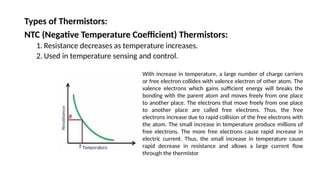
NTC (Negative Temperature Coefficient) Thermistors:
1. Resistance decreases as temperature increases.
2. Used in temperature sensing and control.
With increase in temperature, a large number of charge carriers
or free electron collides with valence electron of other atom. The
valence electrons which gains sufficient energy will breaks the
bonding with the parent atom and moves freely from one place
to another place. The electrons that move freely from one place
to another place are called free electrons. Thus, the free
electrons increase due to rapid collision of the free electrons with
the atom. The small increase in temperature produce millions of
free electrons. The more free electrons cause rapid increase in
electric current. Thus, the small increase in temperature cause
rapid decrease in resistance and allows a large current flow
through the thermistor
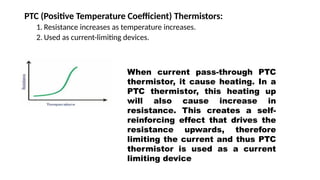
PTC (Positive Temperature Coefficient) Thermistors:
1. Resistance increases as temperature increases.
2. Used as current-limiting devices.
When current pass-through PTC
thermistor, it cause heating. In a
PTC thermistor, this heating up
will also cause increase in
resistance. This creates a self-
reinforcing effect that drives the
resistance upwards, therefore
limiting the current and thus PTC
thermistor is used as a current
limiting device
Applications:
1.Temperature Measurement and Control: Thermistors are used in
devices like digital thermometers, HVAC systems, and appliances to
sense temperature.
2.Overcurrent Protection: PTC thermistors are used in circuits to limit
current and prevent damage by acting as resettable fuses.
A thermocouple is a temperature measurement device that consists of two dissimilar metal wires joined at
one end, forming a junction. When the junction is exposed to a change in temperature, it generates a small
voltage due to the Seebeck effect, which can be measured to determine the temperature.
Working Principle:
The Seebeck effect is the principle that underpins thermocouple operation. When two different metals are
joined at one point (called the hot junction) and their free ends (called the cold junction) are kept at
different temperatures, a voltage is produced due to the temperature difference between these junctions.
The voltage produced is proportional to the temperature difference, and each metal combination has a
characteristic voltage-temperature relationship.
• Peltier-effect - This Peltier effect is opposite to the Seebeck effect.
This effect states that the difference of the temperature can be
formed among any two dissimilar conductors by applying the
potential variation among them. This effect is the reverse of the
Seebeck effect.
• Thompson-effect The evolution or absorption of heat when an
electric current passes through a circuit composed of a single
material that has a temperature difference along its length
Construction of a Thermocouple
A thermocouple is made up of two dissimilar metal wires joined at one
end, forming the hot junction. The other end, where the temperature
is measured, is known as the cold junction. The construction of the
thermocouple can vary based on the type of junction and the specific
application it serves. The three primary types of junctions are:
Ungrounded Junction:
In this type, the thermocouple wires are completely insulated from the
protective sheath (cover).
Applications: Used in high-pressure environments.
Advantages: This design reduces the effect of stray magnetic fields,
improving measurement accuracy in such conditions.
Grounded Junction:
Here, the thermocouple wires are physically connected to the protective cover.
Applications: Commonly used in environments where noise reduction is essential,
such as acidic atmospheres.
Advantages: Provides better protection against electrical noise and interference.
Exposed Junction:
In this design, the junction is exposed, not covered by a sheath.
Applications: Used in applications where a fast response to temperature changes is
required, like measuring gas temperatures.
Advantages: Offers a quicker response time to changes in temperature due to direct contact
with the medium being measured.
Applications of Thermocouples:
1.Temperature Sensors: Widely used in homes, offices, and businesses to monitor
heating and cooling systems.
2.Industrial Uses: Employed in industries to monitor the temperature of metals
during processes like iron and steel production.

SENSOR. .n

  • 1.
    SENSOR •A sensor isa device that detects and responds to physical inputs like heat, light, motion, moisture, and pressure from the environment. •It converts these inputs into signals for display or data processing. Example: Used in IoT for monitoring homes, cars, airplanes, etc. Role of Sensors in IoT •Sensors are key components of IoT. •Data collection and monitoring of various environments. •Applications in homes, vehicles, and industrial processes.
  • 2.
    A "transducer" isa device that converts one form of energy into another. In the context of engineering and technology, transducers are commonly used to convert physical quantities (such as temperature, pressure, or sound) into electrical signals, or vice versa. For example, a microphone is a transducer that converts sound waves into electrical signals, and a loudspeaker does the reverse by converting electrical signals into sound. Input and Output: Transducers receive input energy (mechanical, thermal, acoustic, etc.) and convert it to a different form, usually electrical. Types: • Active transducers generate output without external power, like piezoelectric sensors. • Passive transducers require external power to operate, like resistive sensors. Examples of transducer •Microphones (sound to electrical) •Thermocouples (heat to electrical) •Photodiodes (light to electrical) •Loudspeakers (electrical to sound)
  • 3.
    Types of Sensors ActiveSensors Active sensors emit their own radiation to measure the environment. Examples: • Radar: Measures distance, speed, and size using radio waves. • Lidar: Uses lasers to detect distances. • Sonar: Uses sound waves underwater for navigation. • Infrared Sensors: Emit IR radiation for distance measurement. Passive Sensors • Passive sensors detect natural radiation emitted or reflected by the target. • Examples: Optical Cameras: Capture visible light and infrared for images. Infrared Sensors: Detect heat emitted from objects. Microwave Radiometers: Used in weather monitoring.
  • 4.
    Importance of Calibration: •Accuracy: Ensures that sensor readings are correct and consistent with real-world values. • Error Reduction: Minimizes systematic errors caused by sensor drift, environmental factors, or aging of the sensor. • Reliability: Guarantees that the sensor provides trustworthy data over time.
  • 5.
    Calibration in sensorsis the process of adjusting and fine-tuning a sensor's output to ensure accurate and reliable measurements. This involves comparing the sensor's output with a known reference or standard and then making necessary adjustments to minimize errors. Proper calibration is crucial to maintaining the accuracy and precision of sensor-based systems, especially in applications like scientific measurements, industrial automation, healthcare devices, and environmental monitoring. Steps in Calibration: 1.Reference Measurement: Use a standard or reference instrument that provides a known, accurate value of the quantity being measured. 2.Sensor Output Comparison: Compare the sensor's output with the reference value under identical conditions. 3.Adjustment or Correction: Adjust the sensor or apply a correction factor so that its output matches or closely aligns with the reference. 4.Repeatability Check: Test the sensor multiple times under different conditions to ensure that it consistently produces accurate results after calibration.
  • 6.
    Factors Affecting Calibration: •Environmental conditions: Temperature, humidity, and pressure can influence sensor performance and the need for recalibration. • Sensor Drift: Over time, sensors may degrade or drift due to factors like aging, contamination, or wear, requiring periodic recalibration. • Type of Sensor: Some sensors (e.g., pressure, temperature, or pH sensors) may need more frequent calibration than others, depending on their design and use.
  • 7.
    Example in Practice: Temperaturesensor: 1.The sensor is placed in a controlled temperature environment (e.g., a water bath at 50°C). 2.A highly accurate thermometer serves as the reference. 3.The temperature sensor's reading is compared to the thermometer. 4.If the sensor shows 48°C, calibration would involve adjusting the sensor or applying a correction factor to ensure it reads 50°C.
  • 8.
    Components of aSensor 1.Sensing Element: Directly interacts with physical property (e.g., temperature, light). 2.Transducer: Converts physical signals into electrical ones. 3.Signal Conditioning Circuit: Amplifies or filters signals for accurate data. 4.Output Interface: Transmits data to external systems (analog, digital, or wireless). 5.Power Supply: Provides energy for sensor operation. 6.Housing/Enclosure: Protects the sensor from environmental factors. 7.Connectors and Wiring: Allow integration into larger systems.
  • 9.
    Applications of Sensorsin Industry Automation: Sensors alert operators to system failures, reducing downtime. Quality Control: Ensures precision in manufacturing. Labor Efficiency: Reduces the need for skilled labor in monitoring and control.
  • 10.
    Temperature Sensor Measures: Changesin temperature. Examples: Thermocouples, RTDs (Resistance Temperature Detectors), Thermistors. Pressure Sensor Measures: Changes in pressure. Examples: Piezoelectric sensors, capacitive sensors Proximity Sensor Detects: The presence or absence of an object without physical contact. Examples: Capacitive sensors, inductive sensors, ultrasonic sensors.
  • 11.
    Humidity Sensor Measures: Moisturein air or gases. Examples: Hygrometers, humidity-sensitive resistors. Motion Sensor Detects: Movement or change in object position. Examples: Accelerometers, gyroscope sensors. Light Sensor (Photodetector) Measures: Light intensity. Examples: Photodiodes, phototransistors. Gas Sensor Measures: Concentration of gases like carbon dioxide, methane. Examples: Carbon monoxide sensors, methane sensors.
  • 12.
    Image Sensor Converts: Opticalimages into electrical signals. Examples: CCD (Charge-Coupled Device), CMOS (Complementary Metal-Oxide Semiconductor). IR Sensor (Infrared Sensor) Detects: Infrared radiation. Examples: Infrared motion sensors, temperature sensors. Ultrasonic Sensor Uses: Ultrasonic waves to detect objects or measure distances. Applications: Robotics, industrial automation. Touch Sensor Detects: Physical touch or pressure. Examples: Capacitive touch sensors, resistive touch sensors.
  • 13.
    Biometric Sensor Measures: Uniquephysical or behavioral traits for identification. Examples: Fingerprint sensors, iris scanners. Force Sensor Measures: Force or pressure applied. Examples: Piezoelectric force sensors, strain gauge sensors. Sound Sensor Measures: Acoustic signals. Examples: Microphones, sound level sensors. Water Level Sensor Detects: Liquid levels in containers or tanks. Applications: Industrial and environmental monitoring.
  • 14.
    Temperature Sensors Introduction: Temperaturesensors are devices that measure heat or cold and convert it into electrical signals. They are essential in daily appliances such as water heaters, thermometers, refrigerators, and microwaves. These sensors come in various types and function using different principles to measure temperature accurately. Types of Temperature Sensors: 1. Thermocouples 2. RTDs (Resistance Temperature Detectors) 3. Thermistors 4. Thermostats 5. Semiconductor Temperature Sensors
  • 15.
    Thermistors: A thermistor isa type of resistor whose resistance changes with temperature. They are sturdy, affordable, and used for precise temperature measurements but are not reliable in extreme temperatures. Working Principle: • The resistance of a thermistor changes with its temperature. However, the change is non-linear. • The resistance can be measured with an ohmmeter, and by knowing how resistance relates to temperature, the temperature can be determined.
  • 16.
    Types of Thermistors: NTC(Negative Temperature Coefficient) Thermistors: 1. Resistance decreases as temperature increases. 2. Used in temperature sensing and control. With increase in temperature, a large number of charge carriers or free electron collides with valence electron of other atom. The valence electrons which gains sufficient energy will breaks the bonding with the parent atom and moves freely from one place to another place. The electrons that move freely from one place to another place are called free electrons. Thus, the free electrons increase due to rapid collision of the free electrons with the atom. The small increase in temperature produce millions of free electrons. The more free electrons cause rapid increase in electric current. Thus, the small increase in temperature cause rapid decrease in resistance and allows a large current flow through the thermistor
  • 17.
    PTC (Positive TemperatureCoefficient) Thermistors: 1. Resistance increases as temperature increases. 2. Used as current-limiting devices. When current pass-through PTC thermistor, it cause heating. In a PTC thermistor, this heating up will also cause increase in resistance. This creates a self- reinforcing effect that drives the resistance upwards, therefore limiting the current and thus PTC thermistor is used as a current limiting device
  • 18.
    Applications: 1.Temperature Measurement andControl: Thermistors are used in devices like digital thermometers, HVAC systems, and appliances to sense temperature. 2.Overcurrent Protection: PTC thermistors are used in circuits to limit current and prevent damage by acting as resettable fuses. A thermocouple is a temperature measurement device that consists of two dissimilar metal wires joined at one end, forming a junction. When the junction is exposed to a change in temperature, it generates a small voltage due to the Seebeck effect, which can be measured to determine the temperature. Working Principle: The Seebeck effect is the principle that underpins thermocouple operation. When two different metals are joined at one point (called the hot junction) and their free ends (called the cold junction) are kept at different temperatures, a voltage is produced due to the temperature difference between these junctions. The voltage produced is proportional to the temperature difference, and each metal combination has a characteristic voltage-temperature relationship.
  • 19.
    • Peltier-effect -This Peltier effect is opposite to the Seebeck effect. This effect states that the difference of the temperature can be formed among any two dissimilar conductors by applying the potential variation among them. This effect is the reverse of the Seebeck effect. • Thompson-effect The evolution or absorption of heat when an electric current passes through a circuit composed of a single material that has a temperature difference along its length
  • 20.
    Construction of aThermocouple A thermocouple is made up of two dissimilar metal wires joined at one end, forming the hot junction. The other end, where the temperature is measured, is known as the cold junction. The construction of the thermocouple can vary based on the type of junction and the specific application it serves. The three primary types of junctions are: Ungrounded Junction: In this type, the thermocouple wires are completely insulated from the protective sheath (cover). Applications: Used in high-pressure environments. Advantages: This design reduces the effect of stray magnetic fields, improving measurement accuracy in such conditions.
  • 21.
    Grounded Junction: Here, thethermocouple wires are physically connected to the protective cover. Applications: Commonly used in environments where noise reduction is essential, such as acidic atmospheres. Advantages: Provides better protection against electrical noise and interference. Exposed Junction: In this design, the junction is exposed, not covered by a sheath. Applications: Used in applications where a fast response to temperature changes is required, like measuring gas temperatures. Advantages: Offers a quicker response time to changes in temperature due to direct contact with the medium being measured. Applications of Thermocouples: 1.Temperature Sensors: Widely used in homes, offices, and businesses to monitor heating and cooling systems. 2.Industrial Uses: Employed in industries to monitor the temperature of metals during processes like iron and steel production.