




Adult learning (Andragogy)
Dr Lokendra Sharma
Professor Pharmacology
SMS Medical College
Jaipur
10/4/2017 Lokendra Sharma
WHAT ARE THE
LEARNING
OBJECTIVES ?.
10/4/2017 Lokendra Sharma
Objectives ?
 Definition of Learning
 Difference between Teaching & Learning
 Principles of Learning
 Principles of Adult learning
 How are learning theories
connected with Medical Education
10/4/2017 Lokendra Sharma
Adult Learning
• Life long learning
• Medical education is a continuous life time
commitment to learning while working
• Art science of helping adult learning
• MCI Incorporate ALP in medical education as
innovation in medical education
10/4/2017 Lokendra Sharma
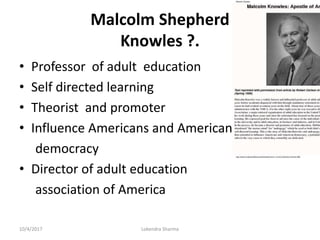
Malcolm Shepherd
Knowles ?.
• Professor of adult education
• Self directed learning
• Theorist and promoter
• Influence Americans and American
democracy
• Director of adult education
association of America
10/4/2017 Lokendra Sharma
Definition of Learning
• Learning is the life long process of
transforming information and
• Experience into knowledge, skills
• Behaviors, and
• Attitudes
10/4/2017 Lokendra Sharma
What about Learning theories
?
10/4/2017 Lokendra Sharma
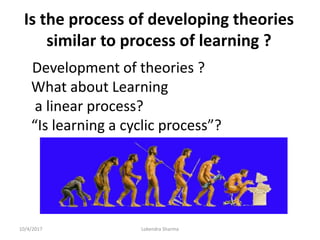
Is the process of developing theories
similar to process of learning ?
Development of theories ?
What about Learning
a linear process?
“Is learning a cyclic process”?
10/4/2017 Lokendra Sharma
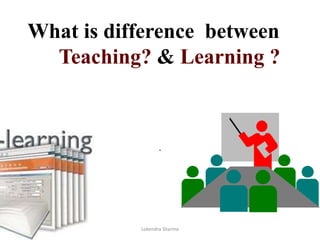
What is difference between
Teaching? & Learning ?
.
10/4/2017 Lokendra Sharma
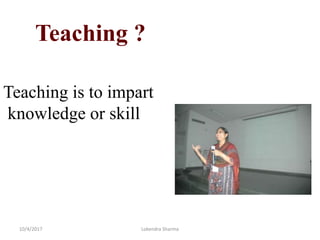
Teaching ?
Teaching is to impart
knowledge or skill
10/4/2017 Lokendra Sharma
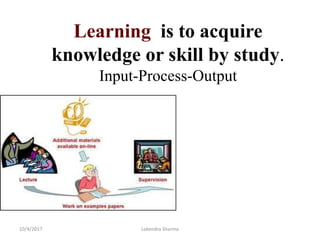
Learning is to acquire
knowledge or skill by study.
Input-Process-Output
10/4/2017 Lokendra Sharma
.
• What difference do you see in
School teaching &
• The undergraduate/postgraduate
teaching
10/4/2017 Lokendra Sharma
.Childhood
Learning ?
Mandatory
Time and
schedule is
structured
Usually free
Repetition
 Testing as feedback
Adult
learning ?
Voluntary
Students mange
their own time
Expensive
Conceptual
Contextual
10/4/2017 Lokendra Sharma
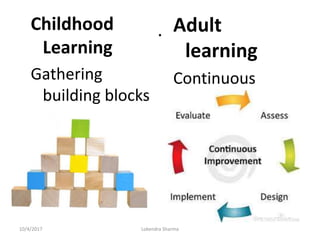
.Childhood
Learning
Gathering
building blocks
Adult
learning
Continuous
10/4/2017 Lokendra Sharma
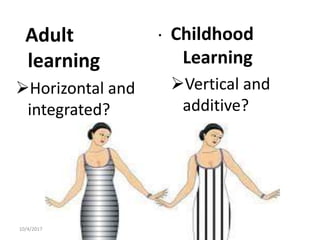
. Childhood
Learning
Vertical and
additive?
Adult
learning
Horizontal and
integrated?
10/4/2017 Lokendra Sharma
Teaching-Learning (TL)
What & how students learn
Why some of them don’t learn
When do they learn better
Purpose of teaching is not mere passing on
information but develop life long learning
habit
“Making it an enjoyable process”
10/4/2017 Lokendra Sharma
Learning
Quantitative increase in knowledge.
Acquiring information or ‘knowing a
lot’.
 Memorizing.
 Storing information that can be
reproduced.
Acquiring facts, skills, and methods that
can be retained and used as necessary.
10/4/2017 Lokendra Sharma
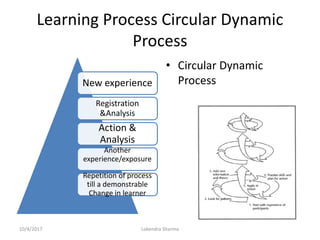
Learning Process Circular Dynamic
Process
New experience
Registration
&Analysis
Action &
Analysis
Another
experience/exposure
Repetition of process
till a demonstrable
Change in learner
• Circular Dynamic
Process
10/4/2017 Lokendra Sharma
“A teacher
can never
truly teach,
unless he is
still learning
himself
”
10/4/2017 Lokendra Sharma
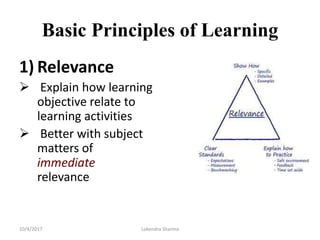
Basic Principles of Learning
1) Relevance
 Explain how learning
objective relate to
learning activities
 Better with subject
matters of
immediate
relevance
10/4/2017 Lokendra Sharma
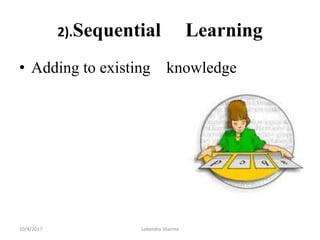
2).Sequential Learning
• Adding to existing knowledge
10/4/2017 Lokendra Sharma
3) Keep it interesting
• Simplecomplex
• Make it contextual
• More Photo/images
/ videos
10/4/2017 Lokendra Sharma
4) Active Involvement
• learner (self)
• Eg. Small group discussion,
interactivity in
large group etc
10/4/2017 Lokendra Sharma
5) Feedback Constructive Sandwich
feedback
• Establish a climate conducive to feedback and
learning
10/4/2017 Lokendra Sharma
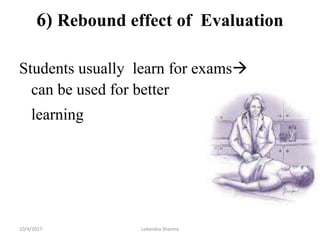
6) Rebound effect of Evaluation
Students usually learn for exams
can be used for better
learning
10/4/2017 Lokendra Sharma
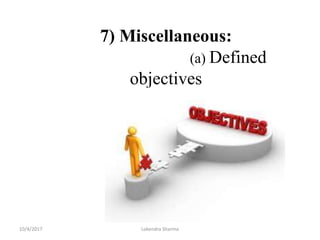
7) Miscellaneous:
(a) Defined
objectives
10/4/2017 Lokendra Sharma
7) Miscellaneous:
(b)Judicious use of AV aids
10/4/2017 Lokendra Sharma
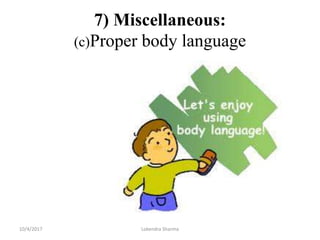
7) Miscellaneous:
(c)Proper body language
10/4/2017 Lokendra Sharma
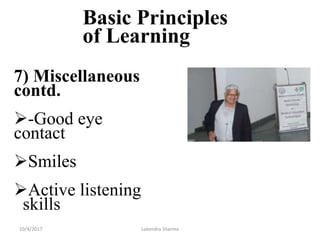
Basic Principles
of Learning
7) Miscellaneous
contd.
-Good eye
contact
Smiles
Active listening
skills
10/4/2017 Lokendra Sharma
Assumption about adult learning
• Independent and self directing
• Great deal of experience
• Integrate with demand of there every day life
• Immediate problem centered approaches
• Learn by internal motivated drive
10/4/2017 Lokendra Sharma
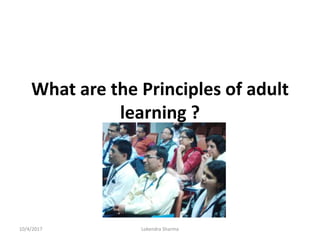
What are the Principles of adult
learning ?
.
10/4/2017 Lokendra Sharma
1. Adult learners are autonomous and
self-directed.
 Involve participants, the accept
responsibility for there own learning
 Serve as facilitator.
 Determine interests of learners.
 Largely within learners’ control
2. Adult learners have a foundation of
life experiences and knowledge.
 Recognize expertise of
participants/Student
 Encourage participants /Student
to share their experiences and
knowledge.
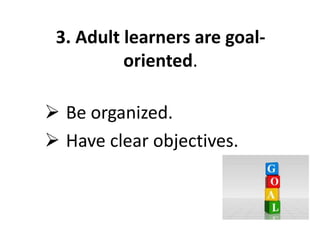
3. Adult learners are goal-
oriented.
 Be organized.
 Have clear objectives.
4. Adult learners are
relevancy-oriented.
 Explain how learning /training
objectives relate to training
activities.
5. Adult learners are practical.
Show relevance of
training to
job/practical work.
6. Adult learners need to
be respected.
 Acknowledge the wealth of
knowledge and experiences the
participants /student bring to the
training.
 Treat the participants as equals
rather than subordinates.
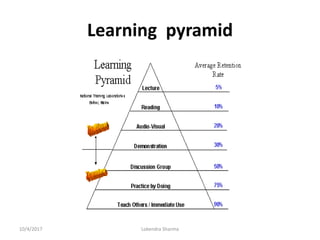
Learning pyramid
10/4/2017 Lokendra Sharma
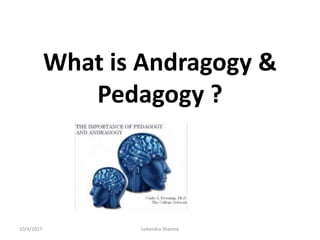
What is Andragogy &
Pedagogy ?
.
10/4/2017 Lokendra Sharma
Andragogy Vs Pedagogy
The art and science of teaching
Adults Vs Child
Process-based Vs Content-
based
10/4/2017 Lokendra Sharma
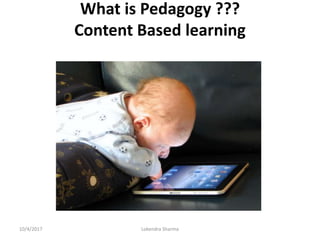
What is Pedagogy ???
Content Based learning
10/4/2017 Lokendra Sharma
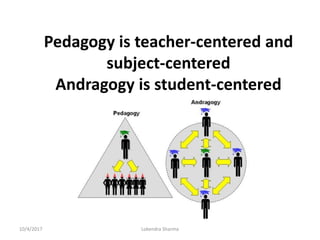
Pedagogy is teacher-centered and
subject-centered
Andragogy is student-centered
10/4/2017 Lokendra Sharma
Conclusion: REMEMBER our
students are ADULTS
How to incorporate adult learning principles effectively:
Adults…
 have plenty of past experience.
 have variable educational orientation
 need to have their abilities and achievements
honoured
10/4/2017 Lokendra Sharma
REMEMBER our students are
ADULTS
 do best in an environment where they feel safe,
accepted, and respected
 like to share in the setting learning objectives
 like to have choice
 like to solve problems
 like to apply what they learn to real situations
 want and need feedback
10/4/2017 Lokendra Sharma
Good teaching practices
• Intended as guidelines for
 Faculty members,
 Students, and
 Administrators “To improve teaching and learning”
10/4/2017 Lokendra Sharma
Basic principles of good
teaching practices
 Encourage contact between students and faculty
Develop reciprocity and cooperation among students
 Encourage active learning
Give prompt feedback
Emphasize task on time
Communicate high expectations
Respect diverse talents and ways of learning
10/4/2017 Lokendra Sharma
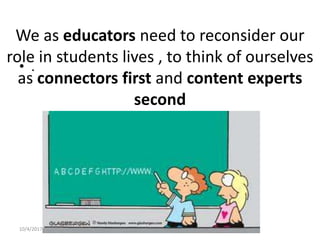
We as educators need to reconsider our
role in students lives , to think of ourselves
as connectors first and content experts
second
• .
10/4/2017 Lokendra Sharma
Thank You
Dr Lokendra Sharma

Adult learning

  • 1.
    Adult learning (Andragogy) DrLokendra Sharma Professor Pharmacology SMS Medical College Jaipur 10/4/2017 Lokendra Sharma
  • 2.
    WHAT ARE THE LEARNING OBJECTIVES?. 10/4/2017 Lokendra Sharma
  • 3.
    Objectives ?  Definitionof Learning  Difference between Teaching & Learning  Principles of Learning  Principles of Adult learning  How are learning theories connected with Medical Education 10/4/2017 Lokendra Sharma
  • 4.
    Adult Learning • Lifelong learning • Medical education is a continuous life time commitment to learning while working • Art science of helping adult learning • MCI Incorporate ALP in medical education as innovation in medical education 10/4/2017 Lokendra Sharma
  • 5.
    Malcolm Shepherd Knowles ?. •Professor of adult education • Self directed learning • Theorist and promoter • Influence Americans and American democracy • Director of adult education association of America 10/4/2017 Lokendra Sharma
  • 6.
    Definition of Learning •Learning is the life long process of transforming information and • Experience into knowledge, skills • Behaviors, and • Attitudes 10/4/2017 Lokendra Sharma
  • 7.
    What about Learningtheories ? 10/4/2017 Lokendra Sharma
  • 8.
    Is the processof developing theories similar to process of learning ? Development of theories ? What about Learning a linear process? “Is learning a cyclic process”? 10/4/2017 Lokendra Sharma
  • 9.
    What is differencebetween Teaching? & Learning ? . 10/4/2017 Lokendra Sharma
  • 10.
    Teaching ? Teaching isto impart knowledge or skill 10/4/2017 Lokendra Sharma
  • 11.
    Learning is toacquire knowledge or skill by study. Input-Process-Output 10/4/2017 Lokendra Sharma
  • 12.
    . • What differencedo you see in School teaching & • The undergraduate/postgraduate teaching 10/4/2017 Lokendra Sharma
  • 13.
  • 14.
    .Childhood Learning ? Mandatory Time and scheduleis structured Usually free Repetition  Testing as feedback Adult learning ? Voluntary Students mange their own time Expensive Conceptual Contextual 10/4/2017 Lokendra Sharma
  • 15.
  • 16.
  • 17.
    Teaching-Learning (TL) What &how students learn Why some of them don’t learn When do they learn better Purpose of teaching is not mere passing on information but develop life long learning habit “Making it an enjoyable process” 10/4/2017 Lokendra Sharma
  • 18.
    Learning Quantitative increase inknowledge. Acquiring information or ‘knowing a lot’.  Memorizing.  Storing information that can be reproduced. Acquiring facts, skills, and methods that can be retained and used as necessary. 10/4/2017 Lokendra Sharma
  • 19.
    Learning Process CircularDynamic Process New experience Registration &Analysis Action & Analysis Another experience/exposure Repetition of process till a demonstrable Change in learner • Circular Dynamic Process 10/4/2017 Lokendra Sharma
  • 20.
    “A teacher can never trulyteach, unless he is still learning himself ” 10/4/2017 Lokendra Sharma
  • 21.
  • 22.
    Basic Principles ofLearning 1) Relevance  Explain how learning objective relate to learning activities  Better with subject matters of immediate relevance 10/4/2017 Lokendra Sharma
  • 23.
    2).Sequential Learning • Addingto existing knowledge 10/4/2017 Lokendra Sharma
  • 24.
    3) Keep itinteresting • Simplecomplex • Make it contextual • More Photo/images / videos 10/4/2017 Lokendra Sharma
  • 25.
    4) Active Involvement •learner (self) • Eg. Small group discussion, interactivity in large group etc 10/4/2017 Lokendra Sharma
  • 26.
    5) Feedback ConstructiveSandwich feedback • Establish a climate conducive to feedback and learning 10/4/2017 Lokendra Sharma
  • 27.
    6) Rebound effectof Evaluation Students usually learn for exams can be used for better learning 10/4/2017 Lokendra Sharma
  • 28.
  • 29.
    7) Miscellaneous: (b)Judicious useof AV aids 10/4/2017 Lokendra Sharma
  • 30.
    7) Miscellaneous: (c)Proper bodylanguage 10/4/2017 Lokendra Sharma
  • 31.
    Basic Principles of Learning 7)Miscellaneous contd. -Good eye contact Smiles Active listening skills 10/4/2017 Lokendra Sharma
  • 32.
    Assumption about adultlearning • Independent and self directing • Great deal of experience • Integrate with demand of there every day life • Immediate problem centered approaches • Learn by internal motivated drive 10/4/2017 Lokendra Sharma
  • 33.
  • 34.
    What are thePrinciples of adult learning ? . 10/4/2017 Lokendra Sharma
  • 35.
    1. Adult learnersare autonomous and self-directed.  Involve participants, the accept responsibility for there own learning  Serve as facilitator.  Determine interests of learners.  Largely within learners’ control
  • 36.
    2. Adult learnershave a foundation of life experiences and knowledge.  Recognize expertise of participants/Student  Encourage participants /Student to share their experiences and knowledge.
  • 37.
    3. Adult learnersare goal- oriented.  Be organized.  Have clear objectives.
  • 38.
    4. Adult learnersare relevancy-oriented.  Explain how learning /training objectives relate to training activities.
  • 39.
    5. Adult learnersare practical. Show relevance of training to job/practical work.
  • 40.
    6. Adult learnersneed to be respected.  Acknowledge the wealth of knowledge and experiences the participants /student bring to the training.  Treat the participants as equals rather than subordinates.
  • 41.
  • 42.
    What is Andragogy& Pedagogy ? . 10/4/2017 Lokendra Sharma
  • 43.
    Andragogy Vs Pedagogy Theart and science of teaching Adults Vs Child Process-based Vs Content- based 10/4/2017 Lokendra Sharma
  • 44.
    What is Pedagogy??? Content Based learning 10/4/2017 Lokendra Sharma
  • 45.
    Pedagogy is teacher-centeredand subject-centered Andragogy is student-centered 10/4/2017 Lokendra Sharma
  • 46.
    Conclusion: REMEMBER our studentsare ADULTS How to incorporate adult learning principles effectively: Adults…  have plenty of past experience.  have variable educational orientation  need to have their abilities and achievements honoured 10/4/2017 Lokendra Sharma
  • 47.
    REMEMBER our studentsare ADULTS  do best in an environment where they feel safe, accepted, and respected  like to share in the setting learning objectives  like to have choice  like to solve problems  like to apply what they learn to real situations  want and need feedback 10/4/2017 Lokendra Sharma
  • 48.
    Good teaching practices •Intended as guidelines for  Faculty members,  Students, and  Administrators “To improve teaching and learning” 10/4/2017 Lokendra Sharma
  • 49.
    Basic principles ofgood teaching practices  Encourage contact between students and faculty Develop reciprocity and cooperation among students  Encourage active learning Give prompt feedback Emphasize task on time Communicate high expectations Respect diverse talents and ways of learning 10/4/2017 Lokendra Sharma
  • 50.
    We as educatorsneed to reconsider our role in students lives , to think of ourselves as connectors first and content experts second • . 10/4/2017 Lokendra Sharma
  • 51.