AI in Medical Education
An evolving Paradigm
By
Dr Lokendra Sharma
Founder and Ex-Principal , Alwar Medical College
Professor and Head, Dept. Of Pharmacology,RUHS-CMS
AI technology has
the potential to
transform medical
education
Benefits of using
AI in medical
education
Introduction to AI in Medical Education
Challenges and
limitations of AI in
medical
education
AI technology has the potential to transform medical education
This presentation explores how artificial intelligence is shaping medical
education and revolutionizing patient care.
It covers personalized learning, virtual patients and simulations,
medical imaging analysis, and data-driven insights.
Join us to learn how AI is empowering future healthcare professionals
with advanced tools and insights.
Introduction to AI in Medical Education
Imagine a medical
student, using an
AI-driven platform.
This platform
analyzes their
learning patterns,
adapting lessons
and quizzes to
his/her pace.
Personalized Learning
As the student
progresses, the
system refines its
recommendations,
optimizing his/her
understanding and
retention of
complex medical
concepts.
AI-driven
assessments adapt
to a student's
performance,
challenging them
with appropriate
questions.
Immediate
feedback helps
learners identify
areas for
improvement.
Adaptive Assessments
This approach
encourages active
engagement with
the material.
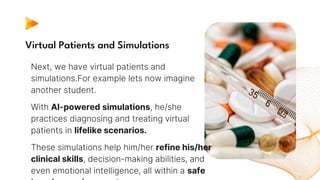
Virtual Patients and Simulations
Next, we have virtual patients and
simulations.For example lets now imagine
another student.
With AI-powered simulations, he/she
practices diagnosing and treating virtual
patients in lifelike scenarios.
These simulations help him/her refine his/her
clinical skills, decision-making abilities, and
even emotional intelligence, all within a safe
Medical Imaging Analysis
AI algorithms excel at interpreting X-rays, MRIs, and
CT scans.
A medical student, benefits from this technology by
gaining exposure to a broad range of cases.
They will learn to identify anomalies and correlate them
with diagnoses, preparing them for real-world patient
encounters.
Data-Driven
Insights
• As a future doctor, access to
AI-powered databases to
study real-world case studies
will be transformative .
• AI extracts valuable insights
from patient records, helping
to understand treatment
outcomes and trends.
• This evidence-based approach
will guide decision-making
process.
01
02
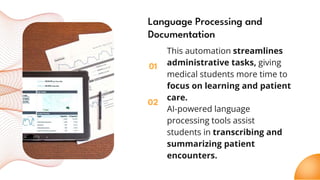
Language Processing and
Documentation
This automation streamlines
administrative tasks, giving
medical students more time to
focus on learning and patient
care.
AI-powered language
processing tools assist
students in transcribing and
summarizing patient
encounters.
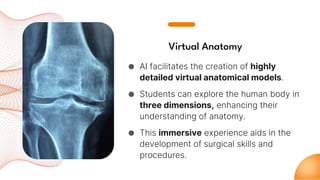
Virtual Anatomy
● AI facilitates the creation of highly
detailed virtual anatomical models.
● Students can explore the human body in
three dimensions, enhancing their
understanding of anatomy.
● This immersive experience aids in the
development of surgical skills and
procedures.
Telemedicine and Remote Learning
● AI enables telemedicine
experiences and remote learning
opportunities.
● Medical students can participate
in virtual clinical rotations,
consultations, and surgeries.
● This expands their exposure to
diverse medical scenarios.
IBM Watson for Oncology ?
01
02
03
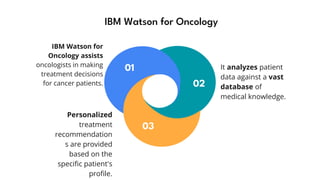
It analyzes patient
data against a vast
database of
medical knowledge.
IBM Watson for Oncology
IBM Watson for
Oncology assists
oncologists in making
treatment decisions
for cancer patients.
Personalized
treatment
recommendation
s are provided
based on the
specific patient's
profile.
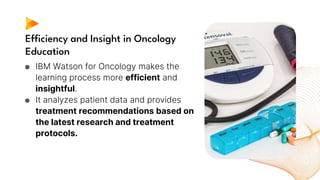
Efficiency and Insight in Oncology
Education
● IBM Watson for Oncology makes the
learning process more efficient and
insightful.
● It analyzes patient data and provides
treatment recommendations based on
the latest research and treatment
protocols.
AI in Deep Genomics ?
Some Notable Real World AI
Applications already in use
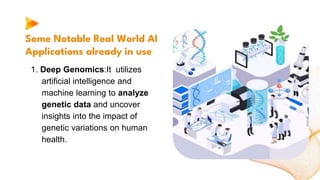
1. Deep Genomics:It utilizes
artificial intelligence and
machine learning to analyze
genetic data and uncover
insights into the impact of
genetic variations on human
health.
Some Notable Real World AI
Applications already in use
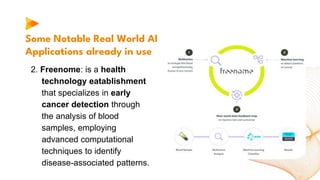
2. Freenome: is a health
technology eatablishment
that specializes in early
cancer detection through
the analysis of blood
samples, employing
advanced computational
techniques to identify
disease-associated patterns.
Some Notable Real World AI
Applications already in use
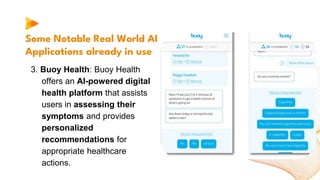
3. Buoy Health: Buoy Health
offers an AI-powered digital
health platform that assists
users in assessing their
symptoms and provides
personalized
recommendations for
appropriate healthcare
actions.
Path AI ?
Some Notable Real World AI
Applications already in use
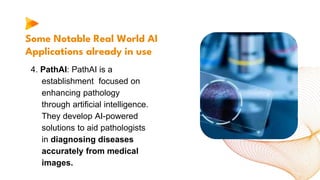
4. PathAI: PathAI is a
establishment focused on
enhancing pathology
through artificial intelligence.
They develop AI-powered
solutions to aid pathologists
in diagnosing diseases
accurately from medical
images.
Augmadix ?
Some Notable Real World AI
Applications already in use
5. Augmedix: Augmedix is a
healthcare technology company
that streamlines doctor-patient
interactions by using wearable
technology to automatically
document medical visits and
create accurate electronic
health records.
Niramai?
Some Notable Real World AI
Applications already in use
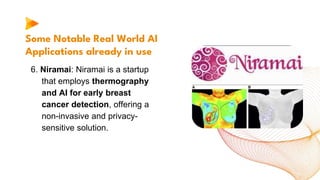
6. Niramai: Niramai is a startup
that employs thermography
and AI for early breast
cancer detection, offering a
non-invasive and privacy-
sensitive solution.
Tricog ?
Some Notable Real World AI
Applications already in use
7. Tricog: Tricog is a healthcare
technology establishment that has
developed an AI-driven platform to
help doctors diagnose and treat
cardiovascular diseases more
effectively by quickly analyzing
ECG results.
HealthifyMe ?
Some Notable Real World AI
Applications already in use
8. HealthifyMe: HealthifyMe is a
wellness and fitness app that
employs AI to offer personalized
diet, fitness, and weight
management plans, making
healthy living more accessible and
achievable.
Qure.ai ?
Some Notable Real World AI
Applications already in use
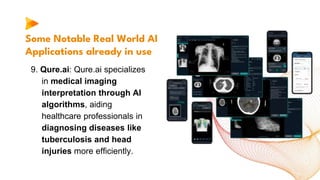
9. Qure.ai: Qure.ai specializes
in medical imaging
interpretation through AI
algorithms, aiding
healthcare professionals in
diagnosing diseases like
tuberculosis and head
injuries more efficiently.
Med-PaLM2 ?
Some Notable Real World AI
Applications already in use
• 10. Med-PaLM2- Med-PaLM is a large
language model (LLM) designed to provide
high quality answers to medical questions.
• Med-PaLM harnesses the power of Google’s
large language models, which we have aligned
to the medical domain and evaluated using
medical exams, medical research, and
consumer queries.
• The first version of Med-PaLM, preprinted in late
2022 and published in Nature in July 2023,
was the first AI system to surpass the pass
mark on US Medical License Exam (USMLE)
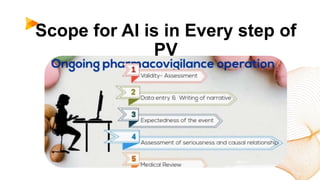
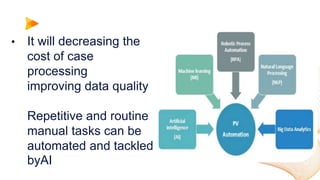
Scope for AI is in Every step of
PV
• It will decreasing the
cost of case
processing
improving data quality
Repetitive and routine
manual tasks can be
automated and tackled
byAI
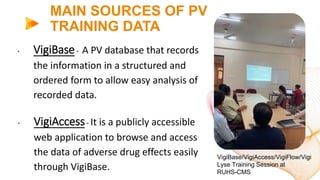
MAIN SOURCES OF PV
TRAINING DATA
• VigiBase- A PV database that records
the information in a structured and
ordered form to allow easy analysis of
recorded data.
This system is related to medical and drug classification
• VigiAccess- It is a publicly accessible
web application to browse and access
the data of adverse drug effects easily
through VigiBase.
VigiBase/VigiAccess/VigiFlow/Vigi
Lyse Training Session at
RUHS-CMS
MAIN SOURCES OF PV
TRAINING DATA
VigiLyze- online resource that provides
a clear and quick review of VigiBase which
can be explored online for further analysis
VigiFlow- web-based management system
for international drug monitoring by:
• Collection
• Processing and Sharing of data
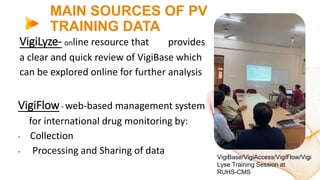
VigiBase/VigiAccess/VigiFlow/Vigi
Lyse Training Session at
RUHS-CMS
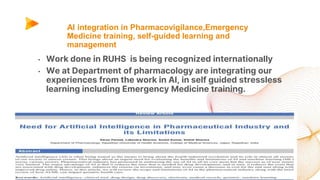
AI integration in Pharmacovigilance,Emergency
Medicine training, self-guided learning and
management
• Work done in RUHS is being recognized internationally
• We at Department of pharmacology are integrating our
experiences from the work in AI, in self guided stressless
learning including Emergency Medicine training.
01
02
03
Future of AI in Medical
Education
Collaborative opportunities for
AI and educators in medical
education
Advancements in AI
technology for medical
education
Integration of AI with
traditional teaching methods
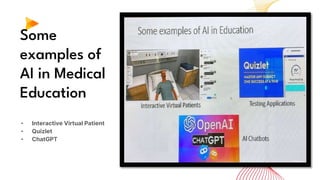
Some
examples of
AI in Medical
Education
• Interactive Virtual Patient
• Quizlet
• ChatGPT
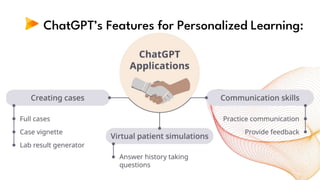
ChatGPT’s Features for Personalized Learning:
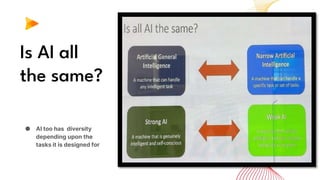
Is AI all
the same?
● AI too has diversity
depending upon the
tasks it is designed for
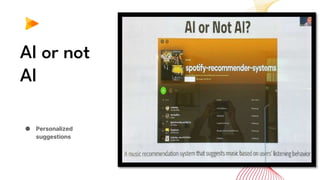
AI or not
AI
● Personalized
suggestions
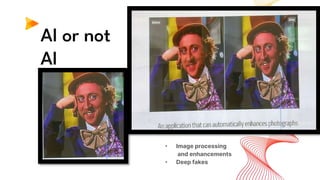
AI or not
AI
• Image processing
and enhancements
• Deep fakes
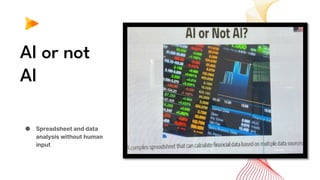
AI or not
AI
● Spreadsheet and data
analysis without human
input
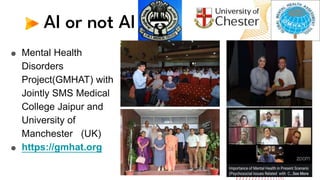
AI or not AI
● Mental Health
Disorders
Project(GMHAT) with
Jointly SMS Medical
College Jaipur and
University of
Manchester (UK)
● https://gmhat.org
01
02
03
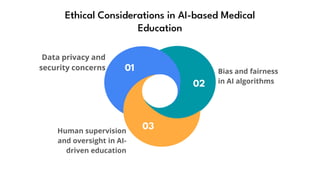
Bias and fairness
in AI algorithms
Ethical Considerations in AI-based Medical
Education
Data privacy and
security concerns
Human supervision
and oversight in AI-
driven education
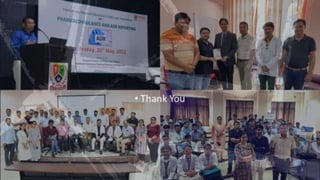
Thank you. Please feel free to ask any questions. 😄

Artificial intelligence(AI) in Medical education

  • 1.
    AI in MedicalEducation An evolving Paradigm By Dr Lokendra Sharma Founder and Ex-Principal , Alwar Medical College Professor and Head, Dept. Of Pharmacology,RUHS-CMS
  • 2.
    AI technology has thepotential to transform medical education Benefits of using AI in medical education Introduction to AI in Medical Education Challenges and limitations of AI in medical education
  • 3.
    AI technology hasthe potential to transform medical education This presentation explores how artificial intelligence is shaping medical education and revolutionizing patient care. It covers personalized learning, virtual patients and simulations, medical imaging analysis, and data-driven insights. Join us to learn how AI is empowering future healthcare professionals with advanced tools and insights. Introduction to AI in Medical Education
  • 4.
    Imagine a medical student,using an AI-driven platform. This platform analyzes their learning patterns, adapting lessons and quizzes to his/her pace. Personalized Learning As the student progresses, the system refines its recommendations, optimizing his/her understanding and retention of complex medical concepts.
  • 5.
    AI-driven assessments adapt to astudent's performance, challenging them with appropriate questions. Immediate feedback helps learners identify areas for improvement. Adaptive Assessments This approach encourages active engagement with the material.
  • 6.
    Virtual Patients andSimulations Next, we have virtual patients and simulations.For example lets now imagine another student. With AI-powered simulations, he/she practices diagnosing and treating virtual patients in lifelike scenarios. These simulations help him/her refine his/her clinical skills, decision-making abilities, and even emotional intelligence, all within a safe
  • 7.
    Medical Imaging Analysis AIalgorithms excel at interpreting X-rays, MRIs, and CT scans. A medical student, benefits from this technology by gaining exposure to a broad range of cases. They will learn to identify anomalies and correlate them with diagnoses, preparing them for real-world patient encounters.
  • 8.
    Data-Driven Insights • As afuture doctor, access to AI-powered databases to study real-world case studies will be transformative . • AI extracts valuable insights from patient records, helping to understand treatment outcomes and trends. • This evidence-based approach will guide decision-making process.
  • 9.
    01 02 Language Processing and Documentation Thisautomation streamlines administrative tasks, giving medical students more time to focus on learning and patient care. AI-powered language processing tools assist students in transcribing and summarizing patient encounters.
  • 10.
    Virtual Anatomy ● AIfacilitates the creation of highly detailed virtual anatomical models. ● Students can explore the human body in three dimensions, enhancing their understanding of anatomy. ● This immersive experience aids in the development of surgical skills and procedures.
  • 11.
    Telemedicine and RemoteLearning ● AI enables telemedicine experiences and remote learning opportunities. ● Medical students can participate in virtual clinical rotations, consultations, and surgeries. ● This expands their exposure to diverse medical scenarios.
  • 12.
    IBM Watson forOncology ?
  • 13.
    01 02 03 It analyzes patient dataagainst a vast database of medical knowledge. IBM Watson for Oncology IBM Watson for Oncology assists oncologists in making treatment decisions for cancer patients. Personalized treatment recommendation s are provided based on the specific patient's profile.
  • 14.
    Efficiency and Insightin Oncology Education ● IBM Watson for Oncology makes the learning process more efficient and insightful. ● It analyzes patient data and provides treatment recommendations based on the latest research and treatment protocols.
  • 15.
    AI in DeepGenomics ?
  • 16.
    Some Notable RealWorld AI Applications already in use 1. Deep Genomics:It utilizes artificial intelligence and machine learning to analyze genetic data and uncover insights into the impact of genetic variations on human health.
  • 17.
    Some Notable RealWorld AI Applications already in use 2. Freenome: is a health technology eatablishment that specializes in early cancer detection through the analysis of blood samples, employing advanced computational techniques to identify disease-associated patterns.
  • 18.
    Some Notable RealWorld AI Applications already in use 3. Buoy Health: Buoy Health offers an AI-powered digital health platform that assists users in assessing their symptoms and provides personalized recommendations for appropriate healthcare actions.
  • 19.
  • 20.
    Some Notable RealWorld AI Applications already in use 4. PathAI: PathAI is a establishment focused on enhancing pathology through artificial intelligence. They develop AI-powered solutions to aid pathologists in diagnosing diseases accurately from medical images.
  • 21.
  • 22.
    Some Notable RealWorld AI Applications already in use 5. Augmedix: Augmedix is a healthcare technology company that streamlines doctor-patient interactions by using wearable technology to automatically document medical visits and create accurate electronic health records.
  • 23.
  • 24.
    Some Notable RealWorld AI Applications already in use 6. Niramai: Niramai is a startup that employs thermography and AI for early breast cancer detection, offering a non-invasive and privacy- sensitive solution.
  • 25.
  • 26.
    Some Notable RealWorld AI Applications already in use 7. Tricog: Tricog is a healthcare technology establishment that has developed an AI-driven platform to help doctors diagnose and treat cardiovascular diseases more effectively by quickly analyzing ECG results.
  • 27.
  • 28.
    Some Notable RealWorld AI Applications already in use 8. HealthifyMe: HealthifyMe is a wellness and fitness app that employs AI to offer personalized diet, fitness, and weight management plans, making healthy living more accessible and achievable.
  • 29.
  • 30.
    Some Notable RealWorld AI Applications already in use 9. Qure.ai: Qure.ai specializes in medical imaging interpretation through AI algorithms, aiding healthcare professionals in diagnosing diseases like tuberculosis and head injuries more efficiently.
  • 31.
  • 32.
    Some Notable RealWorld AI Applications already in use • 10. Med-PaLM2- Med-PaLM is a large language model (LLM) designed to provide high quality answers to medical questions. • Med-PaLM harnesses the power of Google’s large language models, which we have aligned to the medical domain and evaluated using medical exams, medical research, and consumer queries. • The first version of Med-PaLM, preprinted in late 2022 and published in Nature in July 2023, was the first AI system to surpass the pass mark on US Medical License Exam (USMLE)
  • 35.
    Scope for AIis in Every step of PV
  • 36.
    • It willdecreasing the cost of case processing improving data quality Repetitive and routine manual tasks can be automated and tackled byAI
  • 37.
    MAIN SOURCES OFPV TRAINING DATA • VigiBase- A PV database that records the information in a structured and ordered form to allow easy analysis of recorded data. This system is related to medical and drug classification • VigiAccess- It is a publicly accessible web application to browse and access the data of adverse drug effects easily through VigiBase. VigiBase/VigiAccess/VigiFlow/Vigi Lyse Training Session at RUHS-CMS
  • 38.
    MAIN SOURCES OFPV TRAINING DATA VigiLyze- online resource that provides a clear and quick review of VigiBase which can be explored online for further analysis VigiFlow- web-based management system for international drug monitoring by: • Collection • Processing and Sharing of data VigiBase/VigiAccess/VigiFlow/Vigi Lyse Training Session at RUHS-CMS
  • 39.
    AI integration inPharmacovigilance,Emergency Medicine training, self-guided learning and management • Work done in RUHS is being recognized internationally • We at Department of pharmacology are integrating our experiences from the work in AI, in self guided stressless learning including Emergency Medicine training.
  • 40.
    01 02 03 Future of AIin Medical Education Collaborative opportunities for AI and educators in medical education Advancements in AI technology for medical education Integration of AI with traditional teaching methods
  • 41.
    Some examples of AI inMedical Education • Interactive Virtual Patient • Quizlet • ChatGPT
  • 42.
    ChatGPT’s Features forPersonalized Learning:
  • 43.
    Is AI all thesame? ● AI too has diversity depending upon the tasks it is designed for
  • 44.
    AI or not AI ●Personalized suggestions
  • 45.
    AI or not AI •Image processing and enhancements • Deep fakes
  • 46.
    AI or not AI ●Spreadsheet and data analysis without human input
  • 47.
    AI or notAI ● Mental Health Disorders Project(GMHAT) with Jointly SMS Medical College Jaipur and University of Manchester (UK) ● https://gmhat.org
  • 48.
    01 02 03 Bias and fairness inAI algorithms Ethical Considerations in AI-based Medical Education Data privacy and security concerns Human supervision and oversight in AI- driven education
  • 49.
    Thank you. Pleasefeel free to ask any questions. 😄

Editor's Notes

  • #2 Entered text Artificial Intelligence in Medical Education Good day, everyone! Welcome to today’s online lecture on “Exploring Artificial Intelligence in Medical Education: Revolutionizing Learning and Patient Care.” I’m your host Dr Lokendra Sharma, and over the next 10 minutes, we will delve into the exciting world where technology meets medicine. Let’s begin!
  • #14 One of the most notable applications of AI in medical education and practice is IBM Watson for Oncology. This AI-powered system has been developed in collaboration with Memorial Sloan Kettering Cancer Center and is designed to assist oncologists in making informed treatment decisions for cancer patients.
  • #17 Deep Genomics: Deep Genomics is a biotechnology company that utilizes artificial intelligence and machine learning to analyze genetic data and uncover insights into the impact of genetic variations on human health.
  • #41 In conclusion, Artificial Intelligence is reshaping the landscape of medical education by fostering personalized learning, providing realistic simulations, aiding in medical image analysis, offering data-driven insights, assisting with documentation, enhancing anatomical understanding, enabling adaptive assessments, and facilitating remote learning experiences. As we embrace the potential of AI, it is important to remember that while technology can enhance education, the core values of empathy, compassion, and ethical decision-making remain central to the practice of medicine. As future healthcare professionals, let us harness the power of AI to continually elevate our knowledge and skills, while always keeping patient well-being and ethical considerations at the forefront of our minds. Thank you for your time, and let’s embark on this remarkable journey where AI and medical education converge to shape a brighter future for healthcare.