 Anyone who stops learning is old, whether at twenty or
eighty. Anyone who keeps learning stays young.
Henry Ford
Think back to the past 60 days. What is one
thing you learned?
 Perhaps you learned to play chess because you
always wanted to learn to play the game.
 Perhaps you had a flat tire on the way home, and
you had to learn to change the tire because you
had to do it. You didn’t want to, but you had no
choice.
 If you’re like most adults, you learn to do most
things as an adult because
you want to learn it
Or
you need to learn it.
Objectives
 By the end of this session ,participants will be
able to:
Define adult learning/Andragogy
Define pedagogy
Differentiate between pedagogy and Andragogy
Apply adult learning principles in training adults
What is adult learning?
What else can we call it?
Andragogy
 The term “Andragogy” was coined by researchers of
adult learning in order to contrast their beliefs
about learning to the pedagogical model.
 Malcolm Knowles first introduced the concept in the
US in 1968.
 The concept of Andragogy implies self-directedness
and an active student role, as well as solution-
centered activities.
 It was derived from the Greek word“aner” (with the
stem andr-) meaning “man, not boy.”
What is pedagogy
?
pedagogy
The term “pedagogy” was derived from the Greek
words “paid” (meaning “child”) and“agogus” (meaning
“leading”).
Thus, it is defined as the art and science of teaching
children.
Can you mention only one
example on pedagogical
learning
?
children’s formal learning is usually led by
someone else and is based on their learning
specific tasks to prepare them to learn additional,
more complicated tasks.
For example, you learned to count to 100 in
kindergarten, so that you could learn to add and
subtract in first grade, so that you could learn to
multiply and divide in third grade, so that you
could learn algebra in eighth grade, so that you
could learn trigonometry in high school, so that
you could learn calculus in college.
What are the differences between
the two concepts ; pedagogy and
Andragogy
?
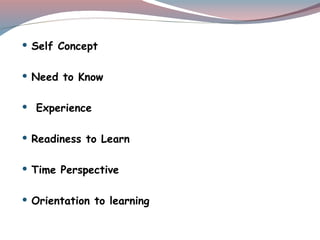
 Self Concept
 Need to Know
 Experience
 Readiness to Learn
 Time Perspective
 Orientation to learning
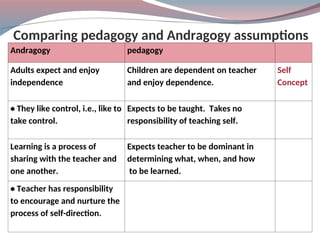
Comparing pedagogy and Andragogy assumptions
pedagogy
Andragogy
Self
Concept
Children are dependent on teacher
and enjoy dependence.
Adults expect and enjoy
independence
Expects to be taught. Takes no
responsibility of teaching self.
• They like control, i.e., like to
take control.
Expects teacher to be dominant in
determining what, when, and how
to be learned.
Learning is a process of
sharing with the teacher and
one another.
• Teacher has responsibility
to encourage and nurture the
process of self-direction.
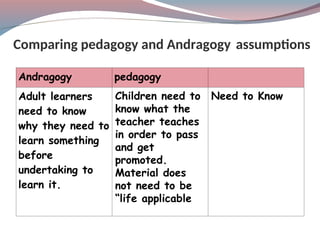
Comparing pedagogy and Andragogy assumptions
pedagogy
Andragogy
Need to Know
Children need to
know what the
teacher teaches
in order to pass
and get
promoted.
Material does
not need to be
“life applicable
Adult learners
need to know
why they need to
learn something
before
undertaking to
learn it.
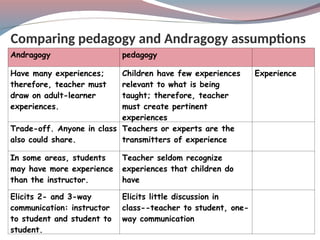
Comparing pedagogy and Andragogy assumptions
pedagogy
Andragogy
Experience
Children have few experiences
relevant to what is being
taught; therefore, teacher
must create pertinent
experiences
Have many experiences;
therefore, teacher must
draw on adult-learner
experiences.
Teachers or experts are the
transmitters of experience
Trade-off. Anyone in class
also could share.
Teacher seldom recognize
experiences that children do
have
In some areas, students
may have more experience
than the instructor.
Elicits little discussion in
class--teacher to student, one-
way communication
Elicits 2- and 3-way
communication: instructor
to student and student to
student.
Comparing pedagogy and Andragogy assumptions
pedagogy
Andragogy
Readiness to Learn
Children are not
necessarily ready to
learn. Teacher must
decide when it is time
to learn specific skills
or knowledge and tries
to create motivation.
Adults normally come
to class motivated and
ready to learn,
because they’ve
chosen the training.
We impose uniform
curricula on children
by classes and age
groups
Adults learn in order
to cope with real-life
tasks
Adults do not group by
age, sex, but by
experience.
Comparing pedagogy and Andragogy assumptions
pedagogy
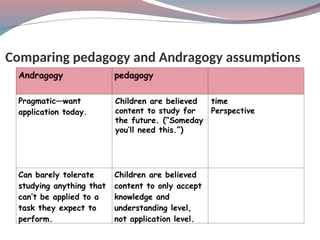
Andragogy
time
Perspective
Children are believed
content to study for
the future. (“Someday
you’ll need this.”)
Pragmatic—want
application today.
Children are believed
content to only accept
knowledge and
understanding level,
not application level.
Can barely tolerate
studying anything that
can’t be applied to a
task they expect to
perform.
Comparing pedagogy and Andragogy assumptions
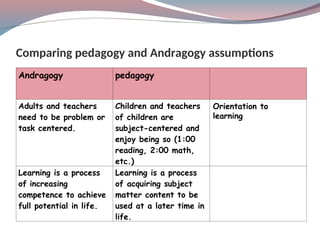
pedagogy
Andragogy
Orientation to
learning
Children and teachers
of children are
subject-centered and
enjoy being so (1:00
reading, 2:00 math,
etc.)
Adults and teachers
need to be problem or
task centered.
Learning is a process
of acquiring subject
matter content to be
used at a later time in
life.
Learning is a process
of increasing
competence to achieve
full potential in life.
Who is Malcolm Knowles
?
 Malcolm Knowles is considered the father of adult
learning theory. Because
 pedagogy is defined as the art and science of
teaching children, European adult educators coined
the word Andragogy to identify the growing body
of knowledge about adult learning.
 It was Dr. Knowles’ highly readable book, The
Adult Learner: A Neglected Species, published in
1973, that took the topic from theoretical to
practical.
How can we apply adult
learning principles in
training adults
?
Trainers and adult educators began to
implement practical applications based on Dr.
Knowles’ six assumptions
• Adults have a need to know why they should
learn something before investing time in a
learning event.
• Trainers must ensure that the learners
know the purpose for training as early as
possible.
• Adults enter any learning situation with an image of
themselves as self directing, responsible grown-ups.
• Trainers must help adults identify their needs and
direct their own learning experience.
 Adults come to a learning opportunity with a
wealth of experience and a great deal to
contribute.
 Trainers are successful when they identify ways
to build on and make use of adults’ hard-earned
experience.
 Adults have a strong readiness to learn those
things that help them cope with daily life
effectively.
 Training that relates directly to situations adults
face is viewed as relevant
 Adults are willing to devote energy to learning
those things that they believe help them perform
a task or solve a problem.
 Trainers who determine needs and interests and
develop content in response to these needs are
most helpful to adult learners.
 Adults are more responsive to internal
motivators such as increased self-esteem than
external motivators such as higher salaries.
 Trainers can ensure that this internal motivation
is not blocked by barriers such as a poor self-
concept or time constraints by creating a safe
learning climate.
What can a trainer do to
apply adult learning
effectively
?
How can a trainee make the
best use of adult learning or
training
?
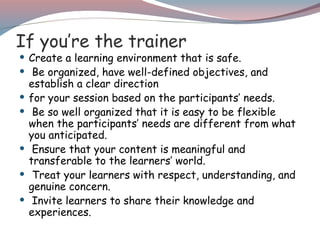
If you’re the trainer
 Create a learning environment that is safe.
 Be organized, have well-defined objectives, and
establish a clear direction
 for your session based on the participants’ needs.
 Be so well organized that it is easy to be flexible
when the participants’ needs are different from what
you anticipated.
 Ensure that your content is meaningful and
transferable to the learners’ world.
 Treat your learners with respect, understanding, and
genuine concern.
 Invite learners to share their knowledge and
experiences.
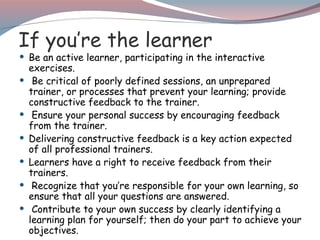
If you’re the learner
 Be an active learner, participating in the interactive
exercises.
 Be critical of poorly defined sessions, an unprepared
trainer, or processes that prevent your learning; provide
constructive feedback to the trainer.
 Ensure your personal success by encouraging feedback
from the trainer.
 Delivering constructive feedback is a key action expected
of all professional trainers.
 Learners have a right to receive feedback from their
trainers.
 Recognize that you’re responsible for your own learning, so
ensure that all your questions are answered.
 Contribute to your own success by clearly identifying a
learning plan for yourself; then do your part to achieve your
objectives.
Success is not final, failure is
not fatal: it is the courage to
continue that counts.
~ Winston Churchill

adultlearning3-110604051319-phpapp01.ppt

  • 2.
     Anyone whostops learning is old, whether at twenty or eighty. Anyone who keeps learning stays young. Henry Ford
  • 3.
    Think back tothe past 60 days. What is one thing you learned?
  • 4.
     Perhaps youlearned to play chess because you always wanted to learn to play the game.  Perhaps you had a flat tire on the way home, and you had to learn to change the tire because you had to do it. You didn’t want to, but you had no choice.  If you’re like most adults, you learn to do most things as an adult because
  • 5.
    you want tolearn it Or you need to learn it.
  • 6.
    Objectives  By theend of this session ,participants will be able to: Define adult learning/Andragogy Define pedagogy Differentiate between pedagogy and Andragogy Apply adult learning principles in training adults
  • 7.
    What is adultlearning? What else can we call it?
  • 8.
    Andragogy  The term“Andragogy” was coined by researchers of adult learning in order to contrast their beliefs about learning to the pedagogical model.  Malcolm Knowles first introduced the concept in the US in 1968.  The concept of Andragogy implies self-directedness and an active student role, as well as solution- centered activities.  It was derived from the Greek word“aner” (with the stem andr-) meaning “man, not boy.”
  • 9.
  • 10.
    pedagogy The term “pedagogy”was derived from the Greek words “paid” (meaning “child”) and“agogus” (meaning “leading”). Thus, it is defined as the art and science of teaching children.
  • 11.
    Can you mentiononly one example on pedagogical learning ?
  • 12.
    children’s formal learningis usually led by someone else and is based on their learning specific tasks to prepare them to learn additional, more complicated tasks. For example, you learned to count to 100 in kindergarten, so that you could learn to add and subtract in first grade, so that you could learn to multiply and divide in third grade, so that you could learn algebra in eighth grade, so that you could learn trigonometry in high school, so that you could learn calculus in college.
  • 13.
    What are thedifferences between the two concepts ; pedagogy and Andragogy ?
  • 14.
     Self Concept Need to Know  Experience  Readiness to Learn  Time Perspective  Orientation to learning
  • 15.
    Comparing pedagogy andAndragogy assumptions pedagogy Andragogy Self Concept Children are dependent on teacher and enjoy dependence. Adults expect and enjoy independence Expects to be taught. Takes no responsibility of teaching self. • They like control, i.e., like to take control. Expects teacher to be dominant in determining what, when, and how to be learned. Learning is a process of sharing with the teacher and one another. • Teacher has responsibility to encourage and nurture the process of self-direction.
  • 16.
    Comparing pedagogy andAndragogy assumptions pedagogy Andragogy Need to Know Children need to know what the teacher teaches in order to pass and get promoted. Material does not need to be “life applicable Adult learners need to know why they need to learn something before undertaking to learn it.
  • 17.
    Comparing pedagogy andAndragogy assumptions pedagogy Andragogy Experience Children have few experiences relevant to what is being taught; therefore, teacher must create pertinent experiences Have many experiences; therefore, teacher must draw on adult-learner experiences. Teachers or experts are the transmitters of experience Trade-off. Anyone in class also could share. Teacher seldom recognize experiences that children do have In some areas, students may have more experience than the instructor. Elicits little discussion in class--teacher to student, one- way communication Elicits 2- and 3-way communication: instructor to student and student to student.
  • 18.
    Comparing pedagogy andAndragogy assumptions pedagogy Andragogy Readiness to Learn Children are not necessarily ready to learn. Teacher must decide when it is time to learn specific skills or knowledge and tries to create motivation. Adults normally come to class motivated and ready to learn, because they’ve chosen the training. We impose uniform curricula on children by classes and age groups Adults learn in order to cope with real-life tasks Adults do not group by age, sex, but by experience.
  • 19.
    Comparing pedagogy andAndragogy assumptions pedagogy Andragogy time Perspective Children are believed content to study for the future. (“Someday you’ll need this.”) Pragmatic—want application today. Children are believed content to only accept knowledge and understanding level, not application level. Can barely tolerate studying anything that can’t be applied to a task they expect to perform.
  • 20.
    Comparing pedagogy andAndragogy assumptions pedagogy Andragogy Orientation to learning Children and teachers of children are subject-centered and enjoy being so (1:00 reading, 2:00 math, etc.) Adults and teachers need to be problem or task centered. Learning is a process of acquiring subject matter content to be used at a later time in life. Learning is a process of increasing competence to achieve full potential in life.
  • 21.
    Who is MalcolmKnowles ?
  • 22.
     Malcolm Knowlesis considered the father of adult learning theory. Because  pedagogy is defined as the art and science of teaching children, European adult educators coined the word Andragogy to identify the growing body of knowledge about adult learning.  It was Dr. Knowles’ highly readable book, The Adult Learner: A Neglected Species, published in 1973, that took the topic from theoretical to practical.
  • 23.
    How can weapply adult learning principles in training adults ?
  • 24.
    Trainers and adulteducators began to implement practical applications based on Dr. Knowles’ six assumptions • Adults have a need to know why they should learn something before investing time in a learning event. • Trainers must ensure that the learners know the purpose for training as early as possible.
  • 25.
    • Adults enterany learning situation with an image of themselves as self directing, responsible grown-ups. • Trainers must help adults identify their needs and direct their own learning experience.
  • 26.
     Adults cometo a learning opportunity with a wealth of experience and a great deal to contribute.  Trainers are successful when they identify ways to build on and make use of adults’ hard-earned experience.
  • 27.
     Adults havea strong readiness to learn those things that help them cope with daily life effectively.  Training that relates directly to situations adults face is viewed as relevant
  • 28.
     Adults arewilling to devote energy to learning those things that they believe help them perform a task or solve a problem.  Trainers who determine needs and interests and develop content in response to these needs are most helpful to adult learners.
  • 29.
     Adults aremore responsive to internal motivators such as increased self-esteem than external motivators such as higher salaries.  Trainers can ensure that this internal motivation is not blocked by barriers such as a poor self- concept or time constraints by creating a safe learning climate.
  • 30.
    What can atrainer do to apply adult learning effectively ?
  • 31.
    How can atrainee make the best use of adult learning or training ?
  • 32.
    If you’re thetrainer  Create a learning environment that is safe.  Be organized, have well-defined objectives, and establish a clear direction  for your session based on the participants’ needs.  Be so well organized that it is easy to be flexible when the participants’ needs are different from what you anticipated.  Ensure that your content is meaningful and transferable to the learners’ world.  Treat your learners with respect, understanding, and genuine concern.  Invite learners to share their knowledge and experiences.
  • 33.
    If you’re thelearner  Be an active learner, participating in the interactive exercises.  Be critical of poorly defined sessions, an unprepared trainer, or processes that prevent your learning; provide constructive feedback to the trainer.  Ensure your personal success by encouraging feedback from the trainer.  Delivering constructive feedback is a key action expected of all professional trainers.  Learners have a right to receive feedback from their trainers.  Recognize that you’re responsible for your own learning, so ensure that all your questions are answered.  Contribute to your own success by clearly identifying a learning plan for yourself; then do your part to achieve your objectives.
  • 34.
    Success is notfinal, failure is not fatal: it is the courage to continue that counts. ~ Winston Churchill