I R E N E I A N C U
K E R R Y - A N N P A I S I B L E
M I K E B A R N E S
What Makes Us All Different
Learners?
Andragogy
Online Lesson 1/4
Todays Topics:
 What is Andragogy?
 Where did the term come from?
 What is associated with the theory?
 Where do we go from here?
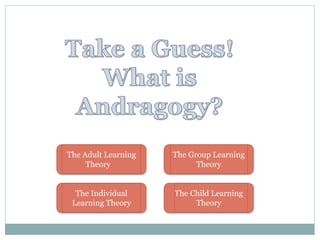
The Adult Learning
Theory
The Individual
Learning Theory
The Child Learning
Theory
The Group Learning
Theory
What is
Andragogy?
The Adult Learning Theory
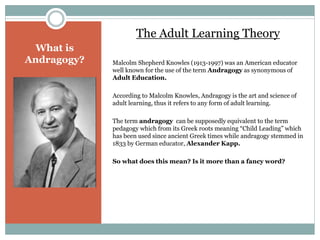
Malcolm Shepherd Knowles (1913-1997) was an American educator
well known for the use of the term Andragogy as synonymous of
Adult Education.
According to Malcolm Knowles, Andragogy is the art and science of
adult learning, thus it refers to any form of adult learning.
The term andragogy can be supposedly equivalent to the term
pedagogy which from its Greek roots meaning “Child Leading” which
has been used since ancient Greek times while andragogy stemmed in
1833 by German educator, Alexander Kapp.
So what does this mean? Is it more than a fancy word?
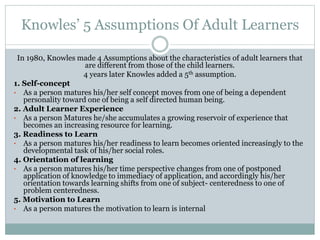
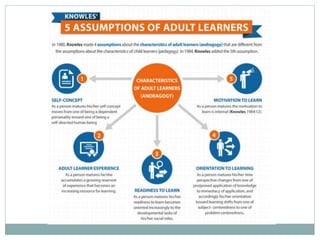
Knowles’ 5 Assumptions Of Adult Learners
In 1980, Knowles made 4 Assumptions about the characteristics of adult learners that
are different from those of the child learners.
4 years later Knowles added a 5th assumption.
1. Self-concept
• As a person matures his/her self concept moves from one of being a dependent
personality toward one of being a self directed human being.
2. Adult Learner Experience
• As a person Matures he/she accumulates a growing reservoir of experience that
becomes an increasing resource for learning.
3. Readiness to Learn
• As a person matures his/her readiness to learn becomes oriented increasingly to the
developmental task of his/her social roles.
4. Orientation of learning
• As a person matures his/her time perspective changes from one of postponed
application of knowledge to immediacy of application, and accordingly his/her
orientation towards learning shifts from one of subject- centeredness to one of
problem centeredness.
5. Motivation to Learn
• As a person matures the motivation to learn is internal
N O W T H A T ’ S D E T A I L E D !
N O W H O W D O W E K N O W W H A T A D U L T
L E A R N E R S N E E D ?
WOW!
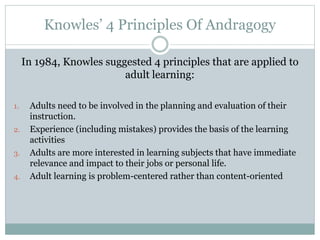
Knowles’ 4 Principles Of Andragogy
In 1984, Knowles suggested 4 principles that are applied to
adult learning:
1. Adults need to be involved in the planning and evaluation of their
instruction.
2. Experience (including mistakes) provides the basis of the learning
activities
3. Adults are more interested in learning subjects that have immediate
relevance and impact to their jobs or personal life.
4. Adult learning is problem-centered rather than content-oriented
That’s GREAT! … but what does this mean?
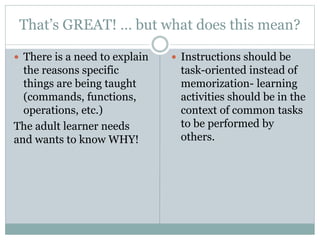
 There is a need to explain
the reasons specific
things are being taught
(commands, functions,
operations, etc.)
The adult learner needs
and wants to know WHY!
 Instructions should be
task-oriented instead of
memorization- learning
activities should be in the
context of common tasks
to be performed by
others.
More Tips Please!
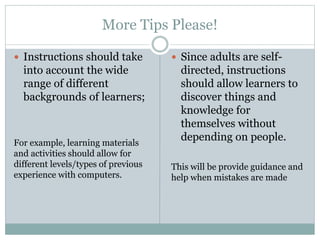
 Instructions should take
into account the wide
range of different
backgrounds of learners;
For example, learning materials
and activities should allow for
different levels/types of previous
experience with computers.
 Since adults are self-
directed, instructions
should allow learners to
discover things and
knowledge for
themselves without
depending on people.
This will be provide guidance and
help when mistakes are made
Quiz Time!
1. The 5th and last characteristic of adult learning is
Motivation to Learn
As a person matures the motivation to learn is internal versus external
Question 2
Adults don’t really like to be apart of the planning and evaluation of
their instruction.
Question 3
Instructions should be task-oriented instead of memorization.
Question 4
As we mature we use experiences
accumulated as resources for learning .
T H I S C O N C L U D E S T H E I N T R O D U C T O R Y
S E C T I O N O F T H E A D U L T L E A R N I N G C H A P T E R
F O R F U R T H E R I N F O R M A T I O N P L E A S E E M A I L
T H E A D M I N I S T R A T O R S O T H E R W I S E
C O N G R A T U L A T I O N S A N D G O O D L U C K W I T H
T H E R E M A I N D E R O F T H E S E C T I O N S
End of section 1/4

Andragogy

  • 1.
    I R EN E I A N C U K E R R Y - A N N P A I S I B L E M I K E B A R N E S What Makes Us All Different Learners? Andragogy Online Lesson 1/4
  • 2.
    Todays Topics:  Whatis Andragogy?  Where did the term come from?  What is associated with the theory?  Where do we go from here?
  • 3.
    The Adult Learning Theory TheIndividual Learning Theory The Child Learning Theory The Group Learning Theory
  • 6.
    What is Andragogy? The AdultLearning Theory Malcolm Shepherd Knowles (1913-1997) was an American educator well known for the use of the term Andragogy as synonymous of Adult Education. According to Malcolm Knowles, Andragogy is the art and science of adult learning, thus it refers to any form of adult learning. The term andragogy can be supposedly equivalent to the term pedagogy which from its Greek roots meaning “Child Leading” which has been used since ancient Greek times while andragogy stemmed in 1833 by German educator, Alexander Kapp. So what does this mean? Is it more than a fancy word?
  • 7.
    Knowles’ 5 AssumptionsOf Adult Learners In 1980, Knowles made 4 Assumptions about the characteristics of adult learners that are different from those of the child learners. 4 years later Knowles added a 5th assumption. 1. Self-concept • As a person matures his/her self concept moves from one of being a dependent personality toward one of being a self directed human being. 2. Adult Learner Experience • As a person Matures he/she accumulates a growing reservoir of experience that becomes an increasing resource for learning. 3. Readiness to Learn • As a person matures his/her readiness to learn becomes oriented increasingly to the developmental task of his/her social roles. 4. Orientation of learning • As a person matures his/her time perspective changes from one of postponed application of knowledge to immediacy of application, and accordingly his/her orientation towards learning shifts from one of subject- centeredness to one of problem centeredness. 5. Motivation to Learn • As a person matures the motivation to learn is internal
  • 9.
    N O WT H A T ’ S D E T A I L E D ! N O W H O W D O W E K N O W W H A T A D U L T L E A R N E R S N E E D ? WOW!
  • 10.
    Knowles’ 4 PrinciplesOf Andragogy In 1984, Knowles suggested 4 principles that are applied to adult learning: 1. Adults need to be involved in the planning and evaluation of their instruction. 2. Experience (including mistakes) provides the basis of the learning activities 3. Adults are more interested in learning subjects that have immediate relevance and impact to their jobs or personal life. 4. Adult learning is problem-centered rather than content-oriented
  • 11.
    That’s GREAT! …but what does this mean?  There is a need to explain the reasons specific things are being taught (commands, functions, operations, etc.) The adult learner needs and wants to know WHY!  Instructions should be task-oriented instead of memorization- learning activities should be in the context of common tasks to be performed by others.
  • 12.
    More Tips Please! Instructions should take into account the wide range of different backgrounds of learners; For example, learning materials and activities should allow for different levels/types of previous experience with computers.  Since adults are self- directed, instructions should allow learners to discover things and knowledge for themselves without depending on people. This will be provide guidance and help when mistakes are made
  • 13.
    Quiz Time! 1. The5th and last characteristic of adult learning is Motivation to Learn As a person matures the motivation to learn is internal versus external
  • 16.
    Question 2 Adults don’treally like to be apart of the planning and evaluation of their instruction.
  • 19.
    Question 3 Instructions shouldbe task-oriented instead of memorization.
  • 22.
    Question 4 As wemature we use experiences accumulated as resources for learning .
  • 25.
    T H IS C O N C L U D E S T H E I N T R O D U C T O R Y S E C T I O N O F T H E A D U L T L E A R N I N G C H A P T E R F O R F U R T H E R I N F O R M A T I O N P L E A S E E M A I L T H E A D M I N I S T R A T O R S O T H E R W I S E C O N G R A T U L A T I O N S A N D G O O D L U C K W I T H T H E R E M A I N D E R O F T H E S E C T I O N S End of section 1/4