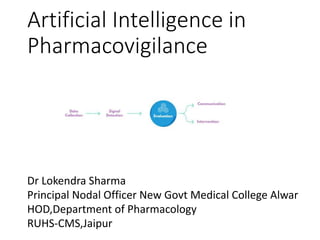
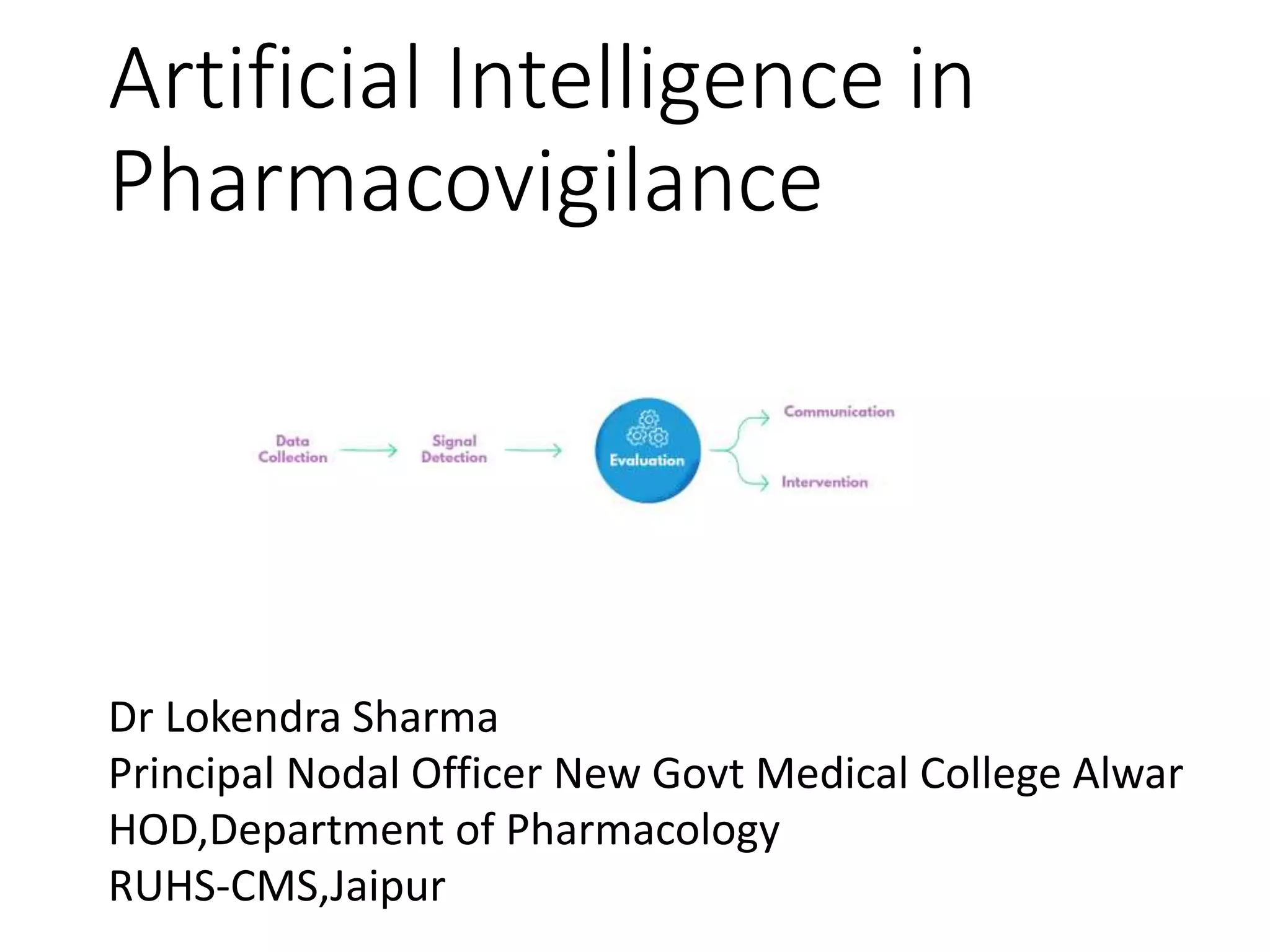
Artificial Intelligence in
Pharmacovigilance
Dr Lokendra Sharma
Principal Nodal Officer New Govt Medical College Alwar
HOD,Department of Pharmacology
RUHS-CMS,Jaipur
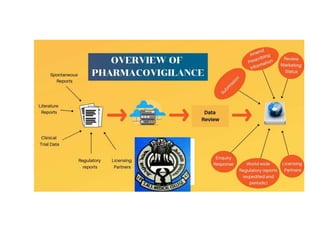
What Is Pharmacovigilance?
• Pharmacovigilance Is The Study Of Two Primary
Outcomes In The Pharmaceutical Industry: Safety And
Efficacy.
• Essentially, it asks does a drug work and is it safe?
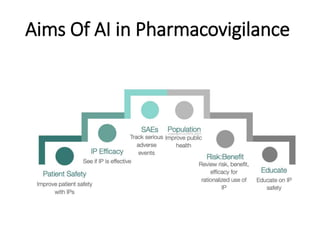
Aims Of AI in Pharmacovigilance
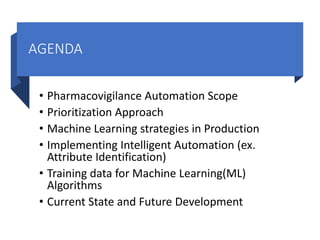
AGENDA
• Pharmacovigilance Automation Scope
• Prioritization Approach
• Machine Learning strategies in Production
• Implementing Intelligent Automation (ex.
Attribute Identification)
• Training data for Machine Learning(ML)
Algorithms
• Current State and Future Development
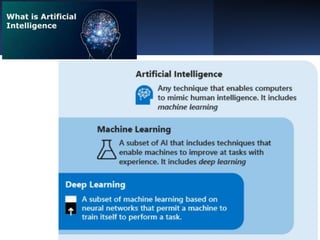
AI Definition Contd…
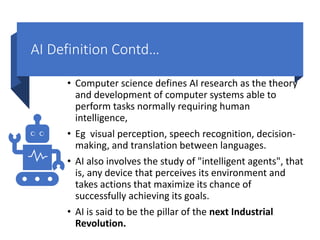
• Computer science defines AI research as the theory
and development of computer systems able to
perform tasks normally requiring human
intelligence,
• Eg visual perception, speech recognition, decision-
making, and translation between languages.
• AI also involves the study of "intelligent agents", that
is, any device that perceives its environment and
takes actions that maximize its chance of
successfully achieving its goals.
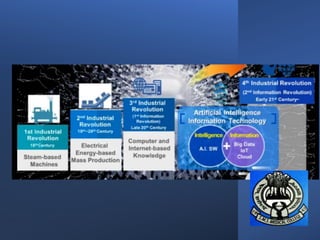
• AI is said to be the pillar of the next Industrial
Revolution.
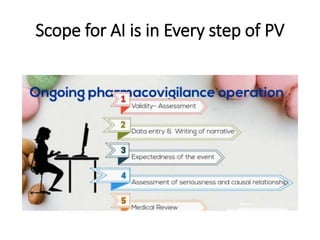
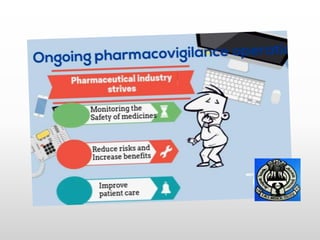
Scope for AI is in Every step of PV
ADR reports are numerically increasing day by day as a result of a number of
factors including : increased number of products,more robust ADR reporting
systems etc.A Adverse event reporting System
This presents a major challenge of processing this ever increasing data.And this is where
AI can help tremendously.of adverse event reports)
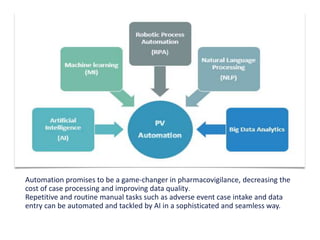
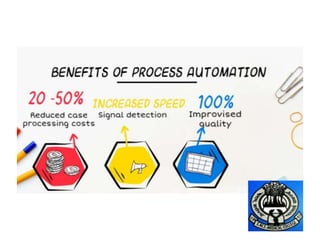
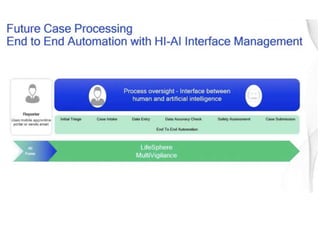
Automation promises to be a game-changer in pharmacovigilance, decreasing the
cost of case processing and improving data quality.
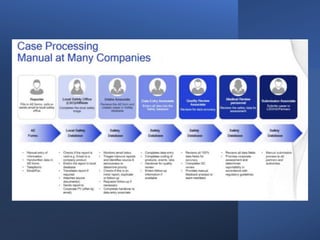
Repetitive and routine manual tasks such as adverse event case intake and data
entry can be automated and tackled by AI in a sophisticated and seamless way.
Training Data
Requirements
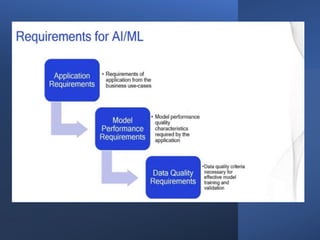
• Good training quality
reduces the number of
training datasets needed
• Reduces the number of
model interations needed
• Pharmacovigilance: data
cleaning and annotation
is particularly needed
when:
• Limited in quantity
• Rich in non-essential data
elements
• Such as
• Signal detection
and evaluation
• PV agreements
• Aggregate reports
• Literature reports
What about
ICSR
Training
Data?
• There are categories in AI in
ICSR (Individual Case Safety
Report)processing:
• Adverse event database:
training data of varying
quality but in abundance
• ICSR data can be used
directly for ML algorithm
training
• There are two types of ICSR
data: structured and
unstructured, and insertion
of this data is done to
facilitate AI in decision
making.
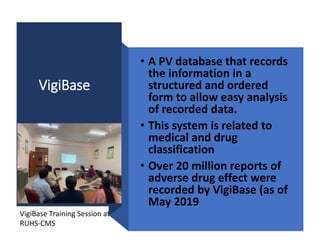
VigiBase
• A PV database that records
the information in a
structured and ordered
form to allow easy analysis
of recorded data.
• This system is related to
medical and drug
classification
• Over 20 million reports of
adverse drug effect were
recorded by VigiBase (as of
May 2019
VigiBase Training Session at
RUHS-CMS
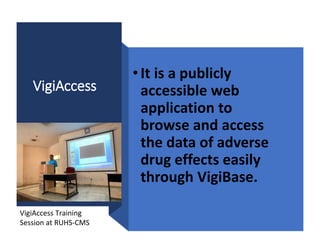
VigiAccess
•It is a publicly
accessible web
application to
browse and access
the data of adverse
drug effects easily
through VigiBase.
VigiAccess Training
Session at RUHS-CMS
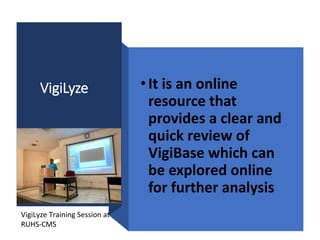
VigiLyze •It is an online
resource that
provides a clear and
quick review of
VigiBase which can
be explored online
for further analysis
VigiLyze Training Session at
RUHS-CMS
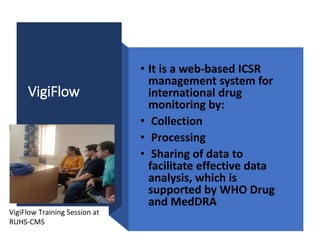
VigiFlow
• It is a web-based ICSR
management system for
international drug
monitoring by:
• Collection
• Processing
• Sharing of data to
facilitate effective data
analysis, which is
supported by WHO Drug
and MedDRA
VigiFlow Training Session at
RUHS-CMS
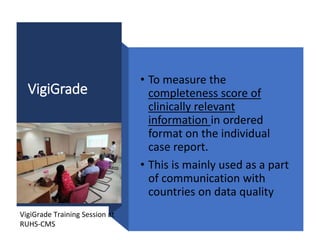
VigiGrade
• To measure the
completeness score of
clinically relevant
information in ordered
format on the individual
case report.
• This is mainly used as a part
of communication with
countries on data quality
VigiGrade Training Session at
RUHS-CMS
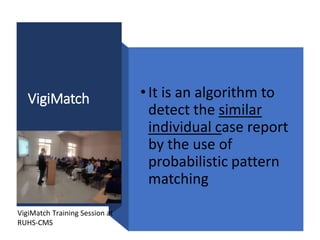
VigiMatch •It is an algorithm to
detect the similar
individual case report
by the use of
probabilistic pattern
matching
VigiMatch Training Session at
RUHS-CMS
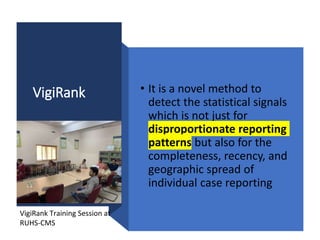
VigiRank • It is a novel method to
detect the statistical signals
which is not just for
disproportionate reporting
patterns but also for the
completeness, recency, and
geographic spread of
individual case reporting
VigiRank Training Session at
RUHS-CMS
Benefits of
Artificial
Intelligence in
Pharmacovigilanc
e
• The most important
benefits of AI are reduced
cycle times.
• Due to this method, the
processing is spontaneous
• Improve the quality and
accuracy of the
information
• AI can handle or manage
diverse types of incoming
data formats
Benefits of
Artificial
Intelligence in
Pharmacovigilanc
e
•It can be used for the
identification of ADRs
• AI is useful to reduce
the burden and time of
case processing
• AI tools extract the
information from the
adverse drug event
form and evaluate the
case validity without
the workforce.
Potential
challenges
• Costs issues
• Ethical issues
• Reluctance among medical
practitioners to adopt AI
• Fear of replacing humans
• Data Privacy and security
• Mobile health applications and
devices that use AI
• Lack of interoperability
between AI solutions
• Data exchange
Potential
challenges
• Need for continuous training by
data from clinical studies
• Incentives for sharing data on the
system for further development and
improvement of the system.
Nevertheless,
• All the parties in the healthcare
system, the physicians, the
pharmaceutical companies and the
patients, have greater incentives to
compile and exchange information
• State and federal regulations
• Rapid process of software updates
commonly used to improve existing
products and services
Future
Indian
Scenario
• Collaboration between medical
and technical institutions
• Government funding – more
intelligent and result oriented
• Current status of medical
records
• Laboratories and clinics need to
collaborate to accelerate the
implementation of electronic
health records
• Data need to be captured in real-
time, and institutions should
promote their transformation
into intelligible processes
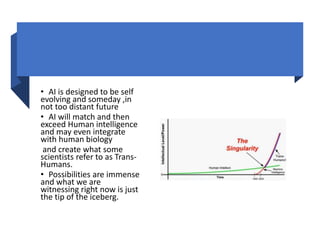
• AI is designed to be self
evolving and someday ,in
not too distant future
• AI will match and then
exceed Human intelligence
and may even integrate
with human biology
and create what some
scientists refer to as Trans-
Humans.
• Possibilities are immense
and what we are
witnessing right now is just
the tip of the iceberg.
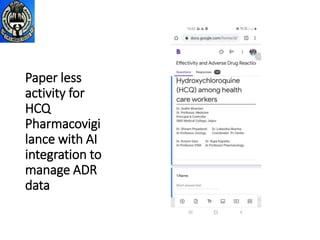
Paper less
activity for
HCQ
Pharmacovigi
lance with AI
integration to
manage ADR
data
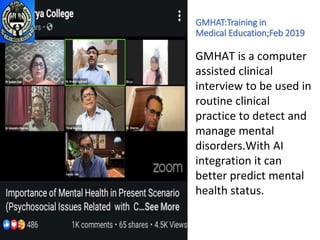
GMHAT:Training in
Medical Education;Feb 2019
GMHAT is a computer
assisted clinical
interview to be used in
routine clinical
practice to detect and
manage mental
disorders.With AI
integration it can
better predict mental
health status.
Research Projects
[15]& GMHAT
1. Mental health assessment by medical
students of Batch 2016
using GMHAT.
2. Mental health assessment by medical
undergraduate of Batch 2017
students using GMHAT.
3.Assessment of Mental health of
participants by MBBS Batch 2018 by
using
GMHAT.
4. To assess and compare the effect of
traditional teaching with Integrated
teaching in MBBS students with the
help of GMHAT this also
included in teaching timetable.
5. Use GMHAT By Postgraduate students
in there training & thesis work on Cancer,
HIV, TB, Diabetes and Osteoarthritis
patients.
Mental Health
Disorders Project
with Jointly SMS
Medical College
Jaipur and
University of
Manchester (UK)
Role of
Telegram/
Whats app
in GMHAT
Training
i. Cloud-based
instant messaging
ii. Available for
Android, iOS,
Windows Phone,
Windows, macOS
and GNU/Linux
Covid and Psychosocial Issues related Awareness
Initiative with potential role of AI in identifying early
signs of psychological stress; May 23,2020
Online Activities in Present situation by different college for Psychosocial support
https://www.youtube.com/channel/UCzW3nd0RQZ6sU-bzKb2eEdQ?view_as=subscriber
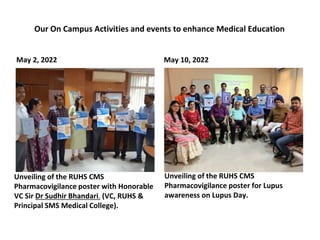
May 2, 2022
Unveiling of the RUHS CMS
Pharmacovigilance poster with Honorable
VC Sir Dr Sudhir Bhandari. (VC, RUHS &
Principal SMS Medical College).
May 10, 2022
Unveiling of the RUHS CMS
Pharmacovigilance poster for Lupus
awareness on Lupus Day.
Our On Campus Activities and events to enhance Medical Education
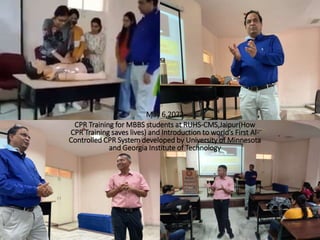
May 6,2022
CPR Training for MBBS students at RUHS-CMS,Jaipur(How
CPR Training saves lives) and Introduction to world’s First AI-
Controlled CPR System developed by University of Minnesota
and Georgia Institute of Technology
•
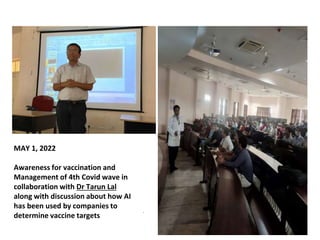
MAY 1, 2022
Awareness for vaccination and
Management of 4th Covid wave in
collaboration with Dr Tarun Lal
along with discussion about how AI
has been used by companies to
determine vaccine targets
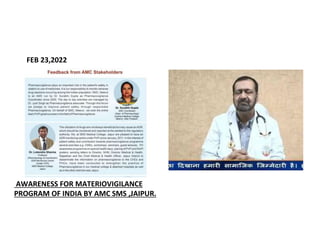
AWARENESS FOR MATERIOVIGILANCE
PROGRAM OF INDIA BY AMC SMS ,JAIPUR.
FEB 23,2022
Thank You
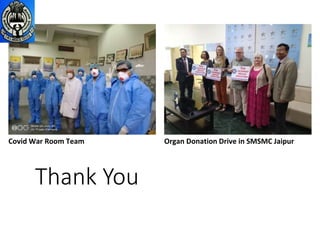
Organ Donation Drive in SMSMC Jaipur
Covid War Room Team

Artificial intelligence in Pharmacovigilance

  • 1.
    Artificial Intelligence in Pharmacovigilance DrLokendra Sharma Principal Nodal Officer New Govt Medical College Alwar HOD,Department of Pharmacology RUHS-CMS,Jaipur
  • 2.
    What Is Pharmacovigilance? •Pharmacovigilance Is The Study Of Two Primary Outcomes In The Pharmaceutical Industry: Safety And Efficacy. • Essentially, it asks does a drug work and is it safe?
  • 3.
    Aims Of AIin Pharmacovigilance
  • 5.
    AGENDA • Pharmacovigilance AutomationScope • Prioritization Approach • Machine Learning strategies in Production • Implementing Intelligent Automation (ex. Attribute Identification) • Training data for Machine Learning(ML) Algorithms • Current State and Future Development
  • 7.
    AI Definition Contd… •Computer science defines AI research as the theory and development of computer systems able to perform tasks normally requiring human intelligence, • Eg visual perception, speech recognition, decision- making, and translation between languages. • AI also involves the study of "intelligent agents", that is, any device that perceives its environment and takes actions that maximize its chance of successfully achieving its goals. • AI is said to be the pillar of the next Industrial Revolution.
  • 9.
    Scope for AIis in Every step of PV
  • 11.
    ADR reports arenumerically increasing day by day as a result of a number of factors including : increased number of products,more robust ADR reporting systems etc.A Adverse event reporting System This presents a major challenge of processing this ever increasing data.And this is where AI can help tremendously.of adverse event reports)
  • 12.
    Automation promises tobe a game-changer in pharmacovigilance, decreasing the cost of case processing and improving data quality. Repetitive and routine manual tasks such as adverse event case intake and data entry can be automated and tackled by AI in a sophisticated and seamless way.
  • 17.
    Training Data Requirements • Goodtraining quality reduces the number of training datasets needed • Reduces the number of model interations needed • Pharmacovigilance: data cleaning and annotation is particularly needed when: • Limited in quantity • Rich in non-essential data elements • Such as • Signal detection and evaluation • PV agreements • Aggregate reports • Literature reports
  • 18.
    What about ICSR Training Data? • Thereare categories in AI in ICSR (Individual Case Safety Report)processing: • Adverse event database: training data of varying quality but in abundance • ICSR data can be used directly for ML algorithm training • There are two types of ICSR data: structured and unstructured, and insertion of this data is done to facilitate AI in decision making.
  • 19.
    VigiBase • A PVdatabase that records the information in a structured and ordered form to allow easy analysis of recorded data. • This system is related to medical and drug classification • Over 20 million reports of adverse drug effect were recorded by VigiBase (as of May 2019 VigiBase Training Session at RUHS-CMS
  • 20.
    VigiAccess •It is apublicly accessible web application to browse and access the data of adverse drug effects easily through VigiBase. VigiAccess Training Session at RUHS-CMS
  • 21.
    VigiLyze •It isan online resource that provides a clear and quick review of VigiBase which can be explored online for further analysis VigiLyze Training Session at RUHS-CMS
  • 22.
    VigiFlow • It isa web-based ICSR management system for international drug monitoring by: • Collection • Processing • Sharing of data to facilitate effective data analysis, which is supported by WHO Drug and MedDRA VigiFlow Training Session at RUHS-CMS
  • 23.
    VigiGrade • To measurethe completeness score of clinically relevant information in ordered format on the individual case report. • This is mainly used as a part of communication with countries on data quality VigiGrade Training Session at RUHS-CMS
  • 24.
    VigiMatch •It isan algorithm to detect the similar individual case report by the use of probabilistic pattern matching VigiMatch Training Session at RUHS-CMS
  • 25.
    VigiRank • Itis a novel method to detect the statistical signals which is not just for disproportionate reporting patterns but also for the completeness, recency, and geographic spread of individual case reporting VigiRank Training Session at RUHS-CMS
  • 26.
    Benefits of Artificial Intelligence in Pharmacovigilanc e •The most important benefits of AI are reduced cycle times. • Due to this method, the processing is spontaneous • Improve the quality and accuracy of the information • AI can handle or manage diverse types of incoming data formats
  • 27.
    Benefits of Artificial Intelligence in Pharmacovigilanc e •Itcan be used for the identification of ADRs • AI is useful to reduce the burden and time of case processing • AI tools extract the information from the adverse drug event form and evaluate the case validity without the workforce.
  • 28.
    Potential challenges • Costs issues •Ethical issues • Reluctance among medical practitioners to adopt AI • Fear of replacing humans • Data Privacy and security • Mobile health applications and devices that use AI • Lack of interoperability between AI solutions • Data exchange
  • 29.
    Potential challenges • Need forcontinuous training by data from clinical studies • Incentives for sharing data on the system for further development and improvement of the system. Nevertheless, • All the parties in the healthcare system, the physicians, the pharmaceutical companies and the patients, have greater incentives to compile and exchange information • State and federal regulations • Rapid process of software updates commonly used to improve existing products and services
  • 30.
    Future Indian Scenario • Collaboration betweenmedical and technical institutions • Government funding – more intelligent and result oriented • Current status of medical records • Laboratories and clinics need to collaborate to accelerate the implementation of electronic health records • Data need to be captured in real- time, and institutions should promote their transformation into intelligible processes
  • 31.
    • AI isdesigned to be self evolving and someday ,in not too distant future • AI will match and then exceed Human intelligence and may even integrate with human biology and create what some scientists refer to as Trans- Humans. • Possibilities are immense and what we are witnessing right now is just the tip of the iceberg.
  • 32.
    Paper less activity for HCQ Pharmacovigi lancewith AI integration to manage ADR data
  • 33.
    GMHAT:Training in Medical Education;Feb2019 GMHAT is a computer assisted clinical interview to be used in routine clinical practice to detect and manage mental disorders.With AI integration it can better predict mental health status.
  • 34.
    Research Projects [15]& GMHAT 1.Mental health assessment by medical students of Batch 2016 using GMHAT. 2. Mental health assessment by medical undergraduate of Batch 2017 students using GMHAT. 3.Assessment of Mental health of participants by MBBS Batch 2018 by using GMHAT. 4. To assess and compare the effect of traditional teaching with Integrated teaching in MBBS students with the help of GMHAT this also included in teaching timetable. 5. Use GMHAT By Postgraduate students in there training & thesis work on Cancer, HIV, TB, Diabetes and Osteoarthritis patients.
  • 35.
    Mental Health Disorders Project withJointly SMS Medical College Jaipur and University of Manchester (UK)
  • 36.
    Role of Telegram/ Whats app inGMHAT Training i. Cloud-based instant messaging ii. Available for Android, iOS, Windows Phone, Windows, macOS and GNU/Linux
  • 37.
    Covid and PsychosocialIssues related Awareness Initiative with potential role of AI in identifying early signs of psychological stress; May 23,2020 Online Activities in Present situation by different college for Psychosocial support https://www.youtube.com/channel/UCzW3nd0RQZ6sU-bzKb2eEdQ?view_as=subscriber
  • 38.
    May 2, 2022 Unveilingof the RUHS CMS Pharmacovigilance poster with Honorable VC Sir Dr Sudhir Bhandari. (VC, RUHS & Principal SMS Medical College). May 10, 2022 Unveiling of the RUHS CMS Pharmacovigilance poster for Lupus awareness on Lupus Day. Our On Campus Activities and events to enhance Medical Education
  • 39.
    May 6,2022 CPR Trainingfor MBBS students at RUHS-CMS,Jaipur(How CPR Training saves lives) and Introduction to world’s First AI- Controlled CPR System developed by University of Minnesota and Georgia Institute of Technology
  • 40.
    • MAY 1, 2022 Awarenessfor vaccination and Management of 4th Covid wave in collaboration with Dr Tarun Lal along with discussion about how AI has been used by companies to determine vaccine targets
  • 42.
    AWARENESS FOR MATERIOVIGILANCE PROGRAMOF INDIA BY AMC SMS ,JAIPUR. FEB 23,2022
  • 43.
    Thank You Organ DonationDrive in SMSMC Jaipur Covid War Room Team

Editor's Notes

  • #4 Ip intellectual property
  • #8 Computer science defines AI research as the theory and development of computer systems able to perform tasks normally requiring human intelligence, such as visual perception, speech recognition, decision-making, and translation between languages. AI also involves the study of "intelligent agents", that is, any device that perceives its environment and takes actions that maximize its chance of successfully achieving its goals. AI is said to be the pillar of the next Industrial Revolution.
  • #18 Good training quality reduces the number of training datasets needed Reduces the number of model iterations needed Pharmacovigilance: data cleaning and annotation is particularly needed when: Limited in quantity Rich in non-essential data elements Such as Signal detection and evaluation PV agreements Aggregate reports Literature reports
  • #19 Annotatin surrogate: data elements from original ICSR report captured in the database
  • #29 DeIntegrationvelopment costs issues Ethical issues Reluctance among medical practitioners to adopt AI Fear of replacing humans Data Privacy and security Mobile health applications and devices that use AI Lack of interoperability between AI solutions Data exchange DeIntegrationvelopment costs issues
  • #30 Need for continuous training by data from clinical studies Incentives for sharing data on the system for further development and improvement of the system. Nevertheless, All the parties in the healthcare system, the physicians, the pharmaceutical companies and the patients, have greater incentives to compile and exchange information State and federal regulations Rapid and iterative process of software updates commonly used to improve existing products and services
  • #31 Collaboration between medical and technical institutions Government funding – more intelligent and result oriented rather than you pat – i pat Scientific mafia or scientist Mafia Current status of medical records Laboratories and clinics need to collaborate to accelerate the implementation of electronic health records Data need to be captured in real-time, and institutions should promote their transformation into intelligible processes
  • #32 AI is designed to be self evolving and someday ,in not too distant future AI will match and then exceed Human intelligence and may even integrate with human biology and create what some scientists refer to as Trans-Humans. Possibilities are immense and what we are witnessing right now is just the tip of the iceberg.
  • #37 Voice over IP service. Users can send messages and exchange photos, videos, stickers, audio and files of any type