Planning,
preparing and
structuring a
small group
teaching session
DR Naila Awal
Assistant Professor
Objective
• Provide an overview of the key theoretical principles in structure, lesson
planning, different formats of small group teaching, delivery and
provision of effective feedback to learners.
• Introduce the central concepts of planning and preparing a small group
teaching session.
• Structured approach to ensure the success of any small group teaching
session; preparation and planning are key elements in ensuring the
session is systematic and effective .
Planning of small group teaching
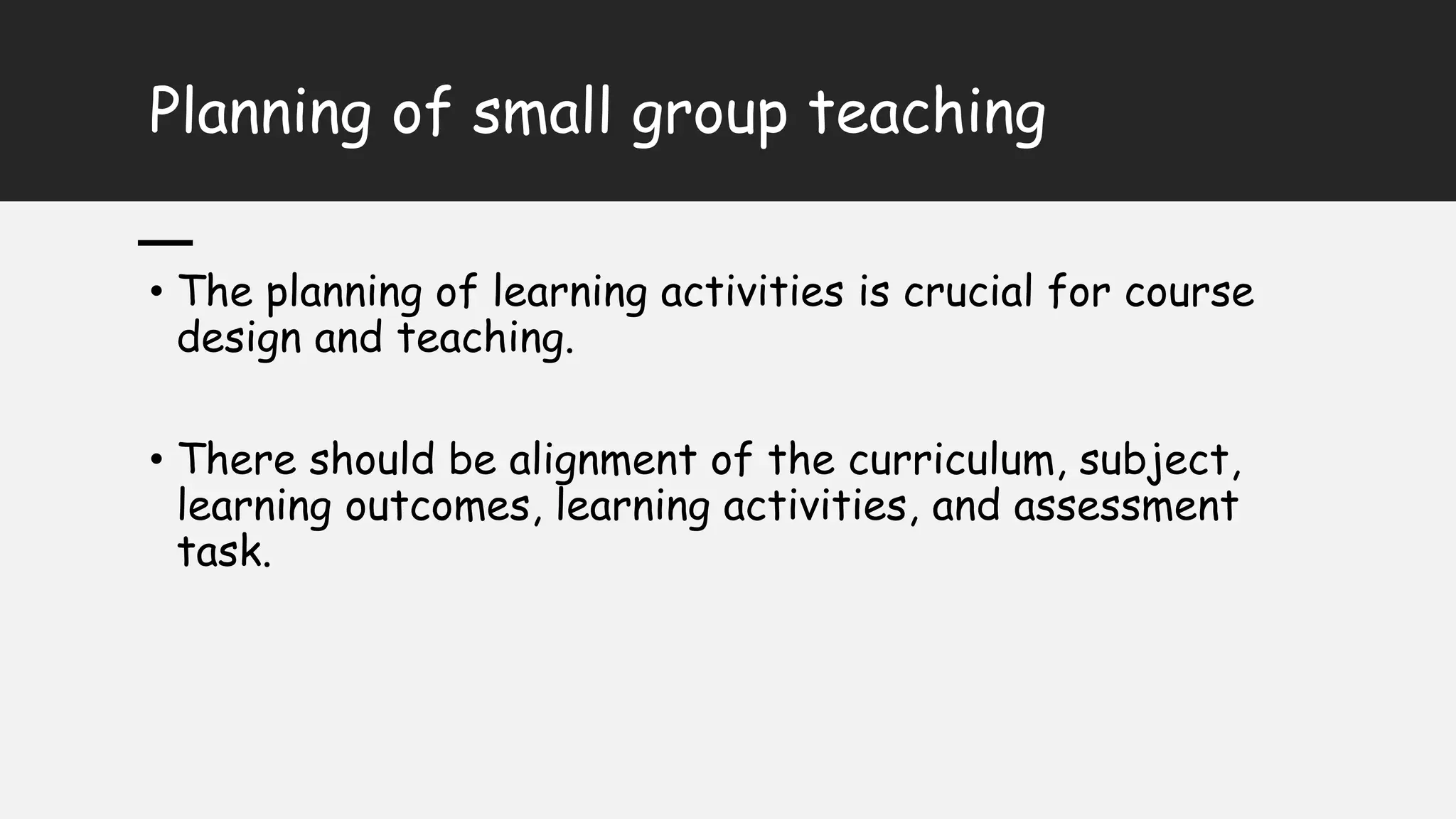
• The planning of learning activities is crucial for course
design and teaching.
• There should be alignment of the curriculum, subject,
learning outcomes, learning activities, and assessment
task.
5
4
3
2
1
Engage and guide the students
to reach their goal
Model thinking and learning
strategies
Practice skills and build on
prior knowledge
Learn from various sources
(including peers)
Receive feedback
Planning of small group …….
• The learning activities should be-
Planning of small group ……….
Bloom’s taxonomy
• useful structure for lesson
design
• classify lesson objectives into
6 categories that are
arranged in a hierarchy from
simple to complex
Lesson design for Hernia
create
Evaluating
Analyzing
Applying
Understanding
Remembering
Anatomy, types, stages, or treatment
approaches of hernias
etiology, pathophysiology, predisposing factors,
complications, indications of treatment approaches
Apply knowledge to diagnose, repair, or prevent
complications of hernias
Diagnostic value of imagining, different techniques to
repair
alternative hernia treatment options in complex situations
e.g: patients with ascites or approaches for unexpected
findings such as malignancies.
new approach to repair hernias
Higher level of
thinking
lower level of thinking
Lesson design for Sub cutaneous abscess
Create
Evaluating
Analyzing
Applying
Understanding
Remembering
Definition, clinical criteria, and
description of an abscess
etiology, pathophysiology, evolution,&
clinical presentation of an abscess.
Apply knowledge to diagnose, confirm, &
propose management of an abscess.
Diagnostic value of imagining, or
the evidence supporting treatment approaches
Create new knowledge (early diagnostic tests, less invasive
treatment approaches, alternative tools for intervention).
Evaluate the validity and reliability of the knowledge
used to diagnose abscesses in various settings
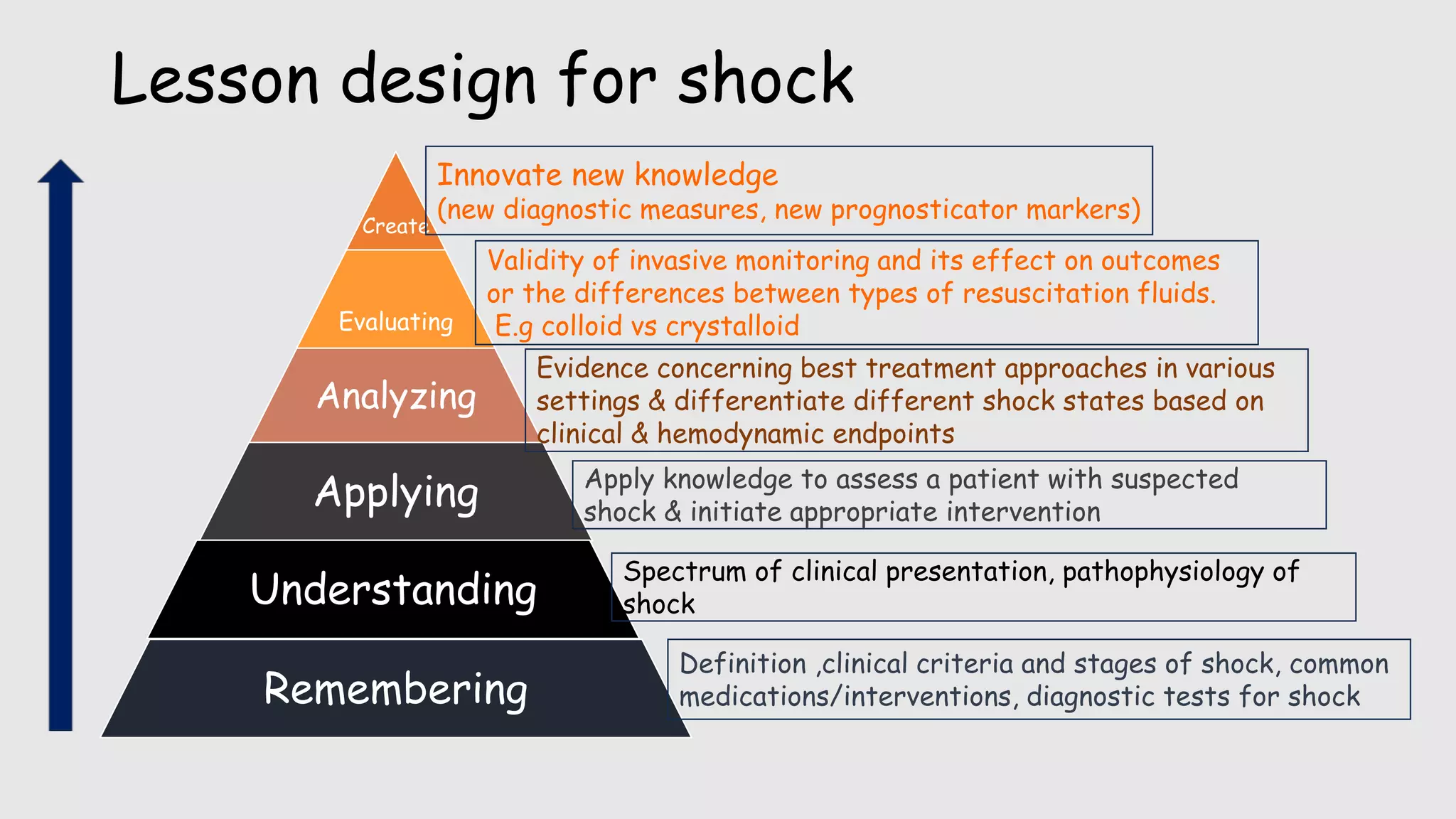
Lesson design for shock
Create
Evaluating
Analyzing
Applying
Understanding
Remembering
Definition ,clinical criteria and stages of shock, common
medications/interventions, diagnostic tests for shock
Spectrum of clinical presentation, pathophysiology of
shock
Apply knowledge to assess a patient with suspected
shock & initiate appropriate intervention
Evidence concerning best treatment approaches in various
settings & differentiate different shock states based on
clinical & hemodynamic endpoints
Validity of invasive monitoring and its effect on outcomes
or the differences between types of resuscitation fluids.
E.g colloid vs crystalloid
Innovate new knowledge
(new diagnostic measures, new prognosticator markers)
Planning of small group ……….
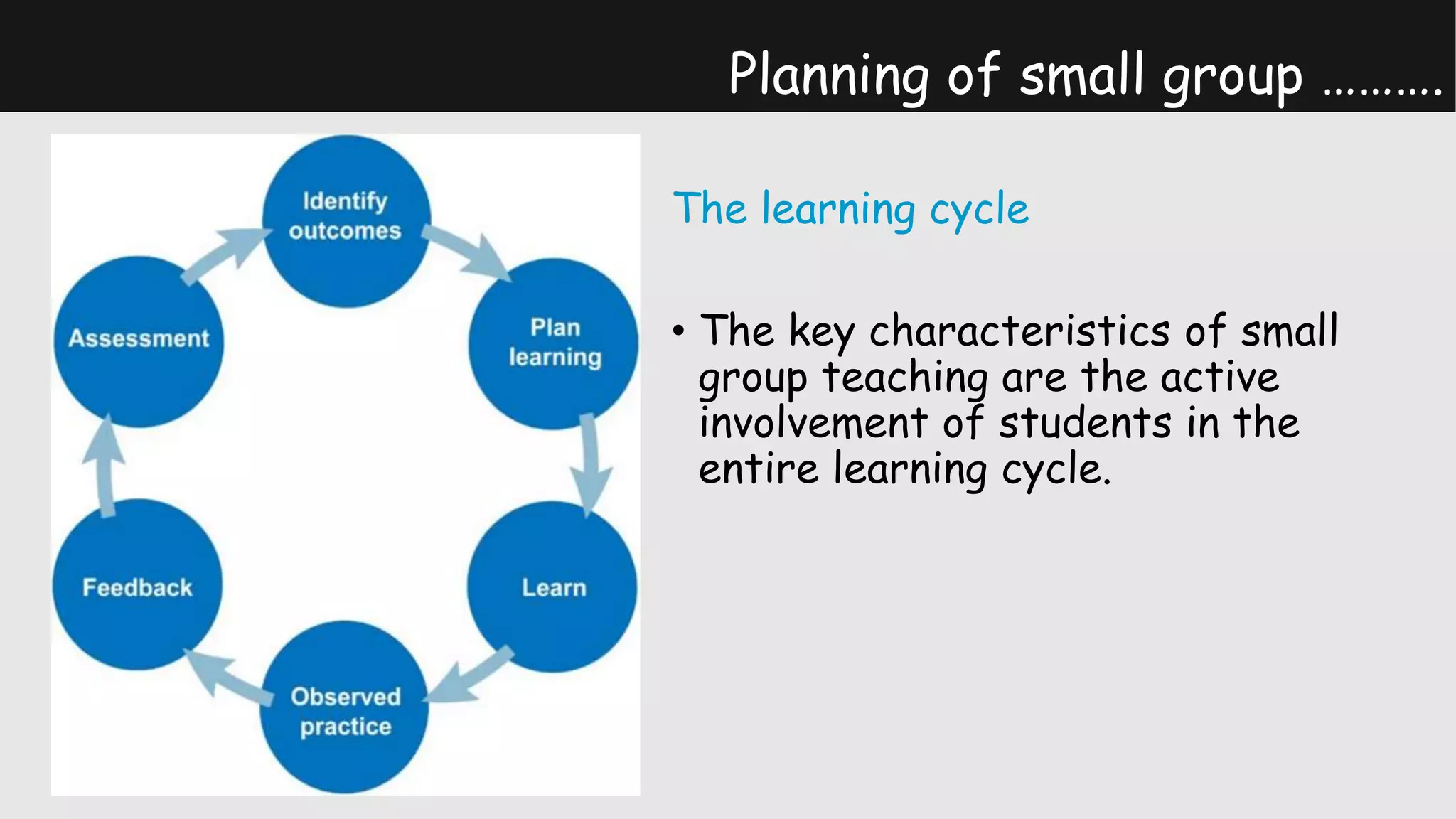
The learning cycle
• The key characteristics of small
group teaching are the active
involvement of students in the
entire learning cycle.
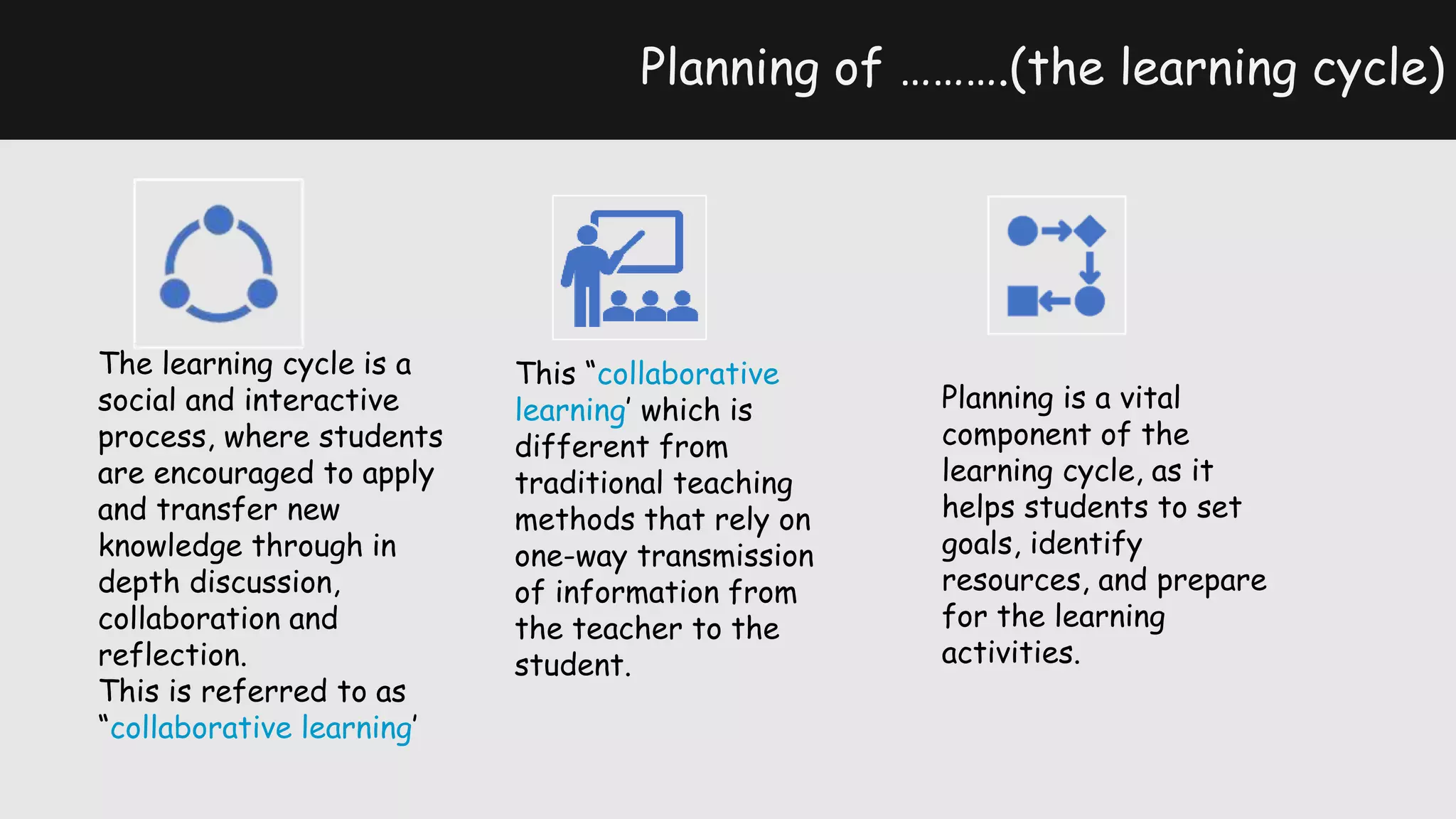
Planning of ……….(the learning cycle)
The learning cycle is a
social and interactive
process, where students
are encouraged to apply
and transfer new
knowledge through in
depth discussion,
collaboration and
reflection.
This is referred to as
“collaborative learning’
This “collaborative
learning’ which is
different from
traditional teaching
methods that rely on
one-way transmission
of information from
the teacher to the
student.
Planning is a vital
component of the
learning cycle, as it
helps students to set
goals, identify
resources, and prepare
for the learning
activities.
Planning of a teaching session……….
‘Outcomes-Activity-Summary’ (OAS) method can be applied as
a structure for initial planning, both in the
• classroom setting (case-based learning) or
• clinical context (bedside teaching) .
Planning of a teaching session….
(OAS method)
Proposed OAS (Outcomes-Activity-Summary’)method for lesson
planning and teaching
O OUTCOMES
• Consider the background knowledge of students
• Consider what we want the students to learn, understand, and
be able to do by the end of the session
• Establish lesson goals and outcomes prior to the session
• Share the learning outcomes with students at the start of the
session
• Allow the students input towards the learning outcomes
Planning of a teaching session….
(OAS method)
Outcomes-Activity-Summary’(OAS)
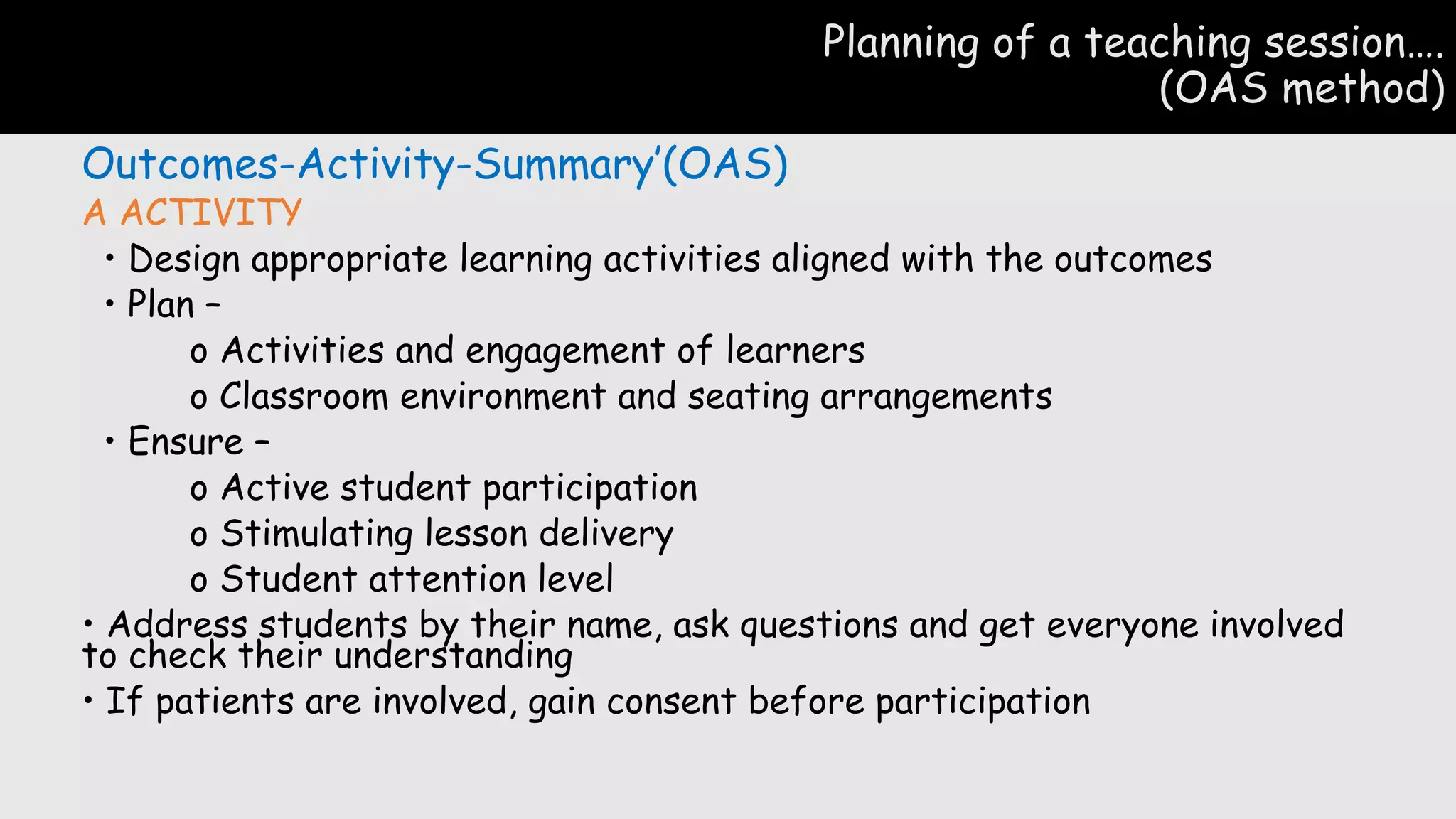
A ACTIVITY
• Design appropriate learning activities aligned with the outcomes
• Plan –
o Activities and engagement of learners
o Classroom environment and seating arrangements
• Ensure –
o Active student participation
o Stimulating lesson delivery
o Student attention level
• Address students by their name, ask questions and get everyone involved
to check their understanding
• If patients are involved, gain consent before participation
Structuring a teaching session….
OAS method
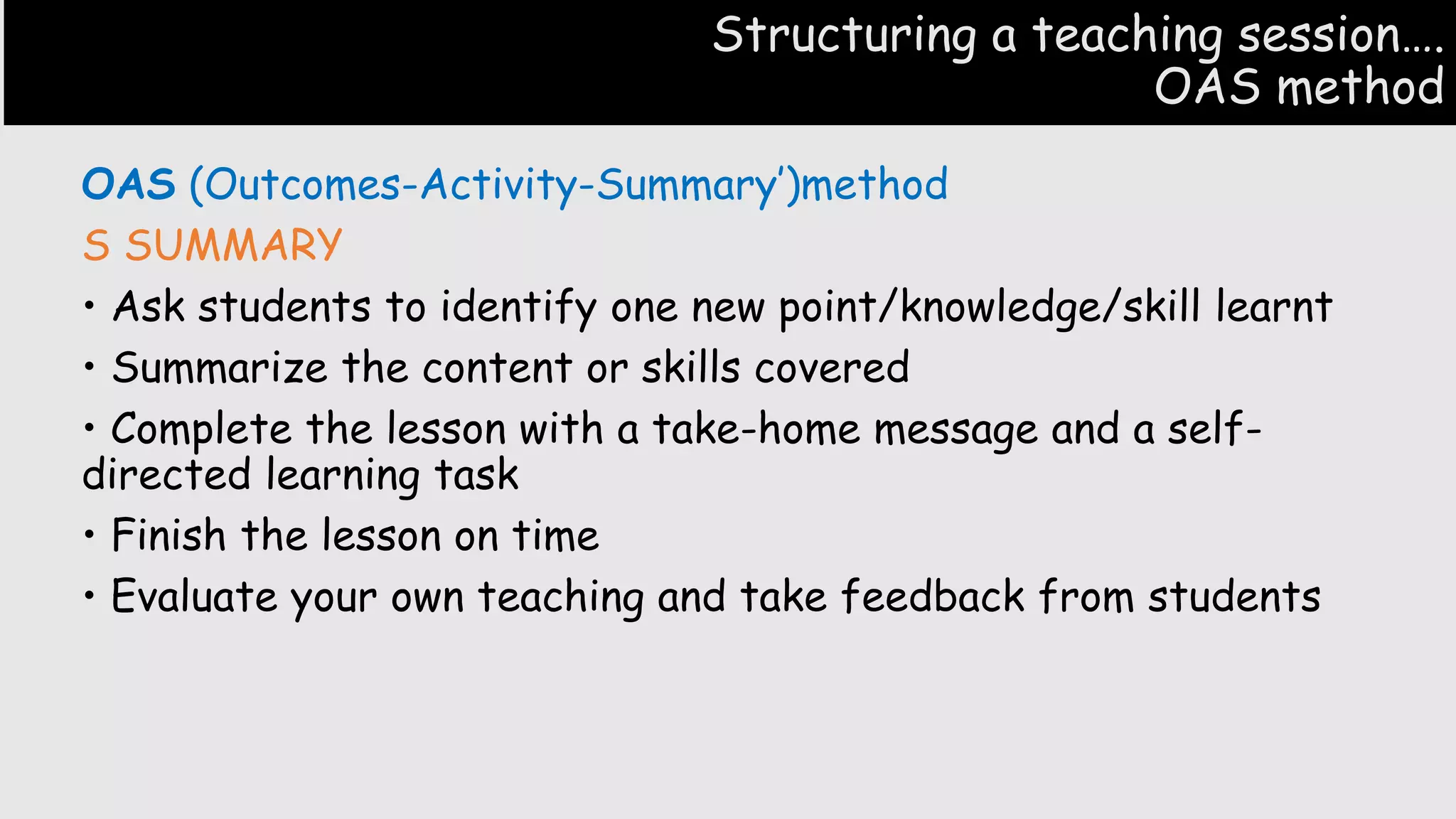
OAS (Outcomes-Activity-Summary’)method
S SUMMARY
• Ask students to identify one new point/knowledge/skill learnt
• Summarize the content or skills covered
• Complete the lesson with a take-home message and a self-
directed learning task
• Finish the lesson on time
• Evaluate your own teaching and take feedback from students
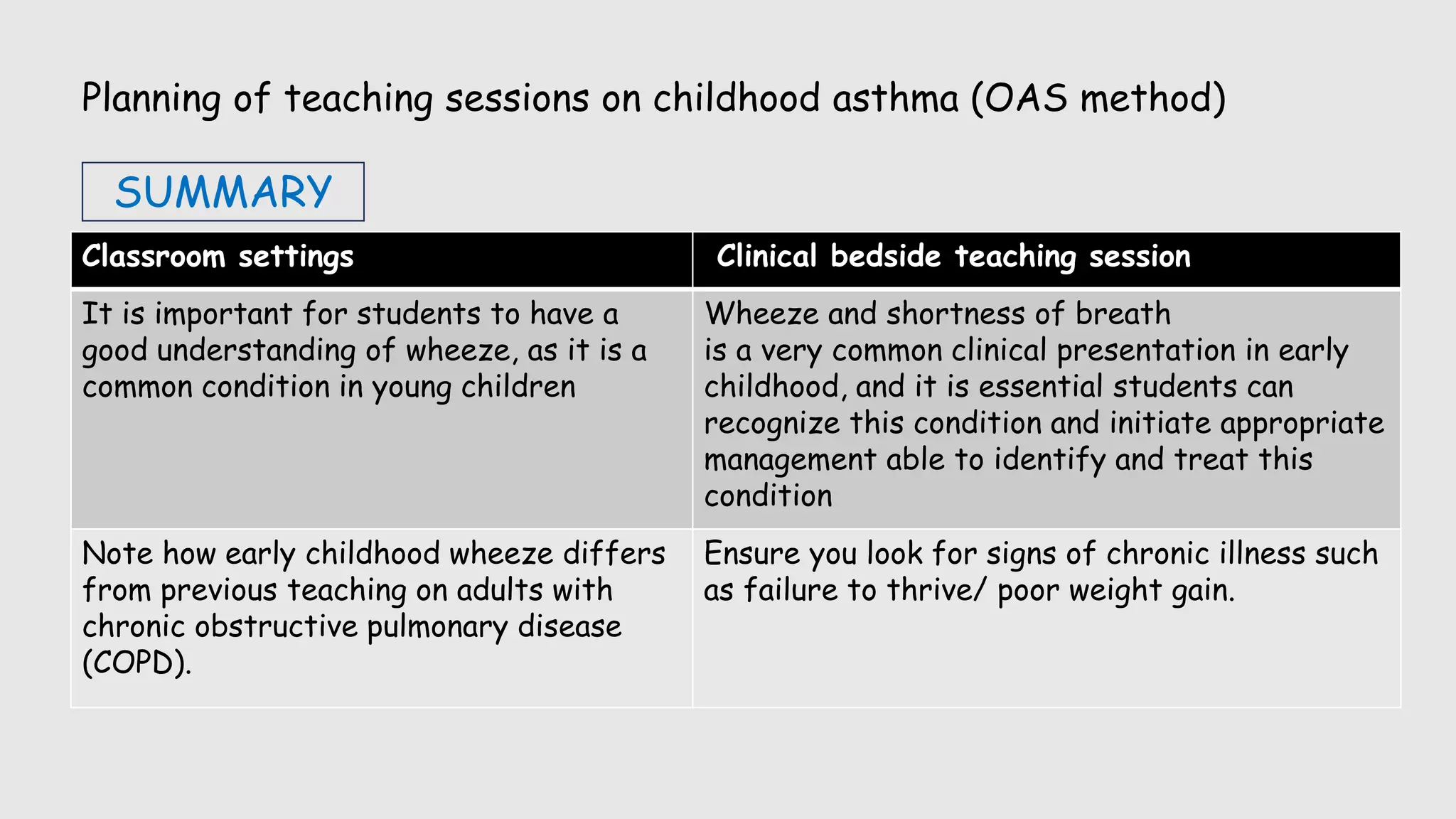
Planning of teaching sessions on childhood asthma (OAS method)
Classroom settings Clinical bedside teaching session
Identify & describe the mechanisms of
wheezing
Recognize the difference between
wheeze and stridor
Demonstrate the basic understanding of
the pathophysiology of asthma
Identify signs of breathing difficulty
Identify different types of wheezing in
early childhood
Distinguish normal breath sounds
from wheeze
List risk factors for development of
asthma
Realize that young children may not cooperate
(or may be impossible) to examine clinically
Recognize the indications and limitations
of lung function testing in airway
obstruction, especially in young children
Be aware that parents may not want students
to examine their child.
Outline the principles of asthma
management.
Outcome
Classroom settings Clinical bedside teaching session
Prior to the session, students will be
assigned some reading material
(eg. a journal article)
• structured history from the parent
• examine for signs of breathing difficulty & auscultate
the chest for abnormal breath sounds.
A real-life case will be presented providing
history, physical and investigations.
• Some objectives may not be met due to the lack of
suitable patients(a co-operative wheezing child)
• Alternative teaching methods (role play )may be used
instead
Students will work in their group to:
− make a diagnosis based on the history,
physical and investigations
−draw a flow chart showing how the patient’s
signs and symptoms are related to the
underlying mechanisms that cause the
diagnosis.
− create a management plan (a table with
goals, options and qualifying factors)
Flexibility with bedside teaching activities is essential, as
parents may not consent to being utilized in teaching.
Tutors must be very aware of any sign of discomfort by
patient and/or parents and discontinue the bedside
teaching.
Be aware that parents may not want students to examine
their child.
Activity
Planning of teaching sessions on childhood asthma (OAS method)
Classroom settings Clinical bedside teaching session
It is important for students to have a
good understanding of wheeze, as it is a
common condition in young children
Wheeze and shortness of breath
is a very common clinical presentation in early
childhood, and it is essential students can
recognize this condition and initiate appropriate
management able to identify and treat this
condition
Note how early childhood wheeze differs
from previous teaching on adults with
chronic obstructive pulmonary disease
(COPD).
Ensure you look for signs of chronic illness such
as failure to thrive/ poor weight gain.
SUMMARY
Preparing and Structuring a teaching session
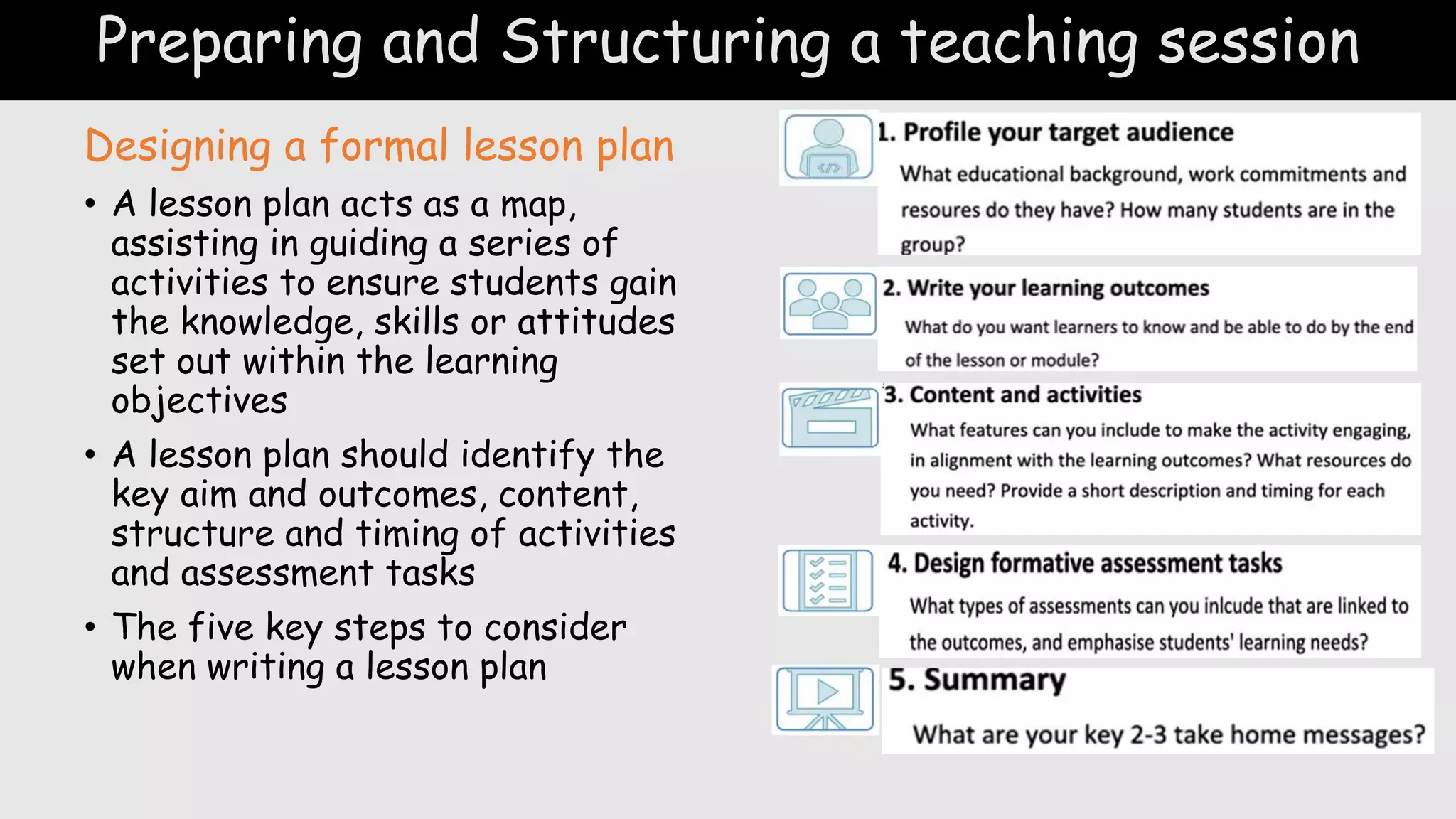
Designing a formal lesson plan
• A lesson plan acts as a map,
assisting in guiding a series of
activities to ensure students gain
the knowledge, skills or attitudes
set out within the learning
objectives
• A lesson plan should identify the
key aim and outcomes, content,
structure and timing of activities
and assessment tasks
• The five key steps to consider
when writing a lesson plan
Preparing and Structuring ....
(Designing a formal lesson plan)
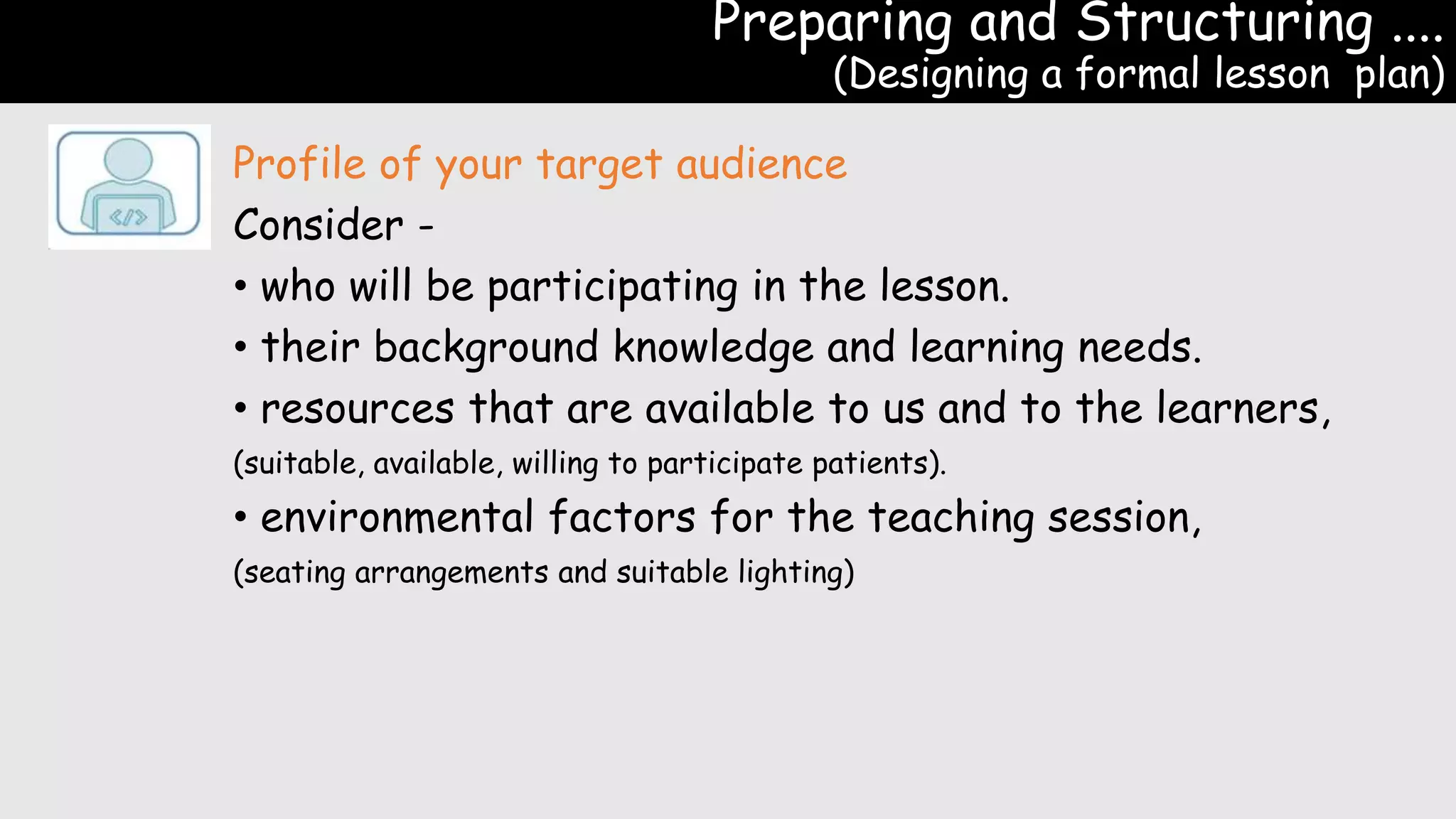
Profile of your target audience
Consider -
• who will be participating in the lesson.
• their background knowledge and learning needs.
• resources that are available to us and to the learners,
(suitable, available, willing to participate patients).
• environmental factors for the teaching session,
(seating arrangements and suitable lighting)
Preparing and Structuring ....
(Designing a formal lesson plan)
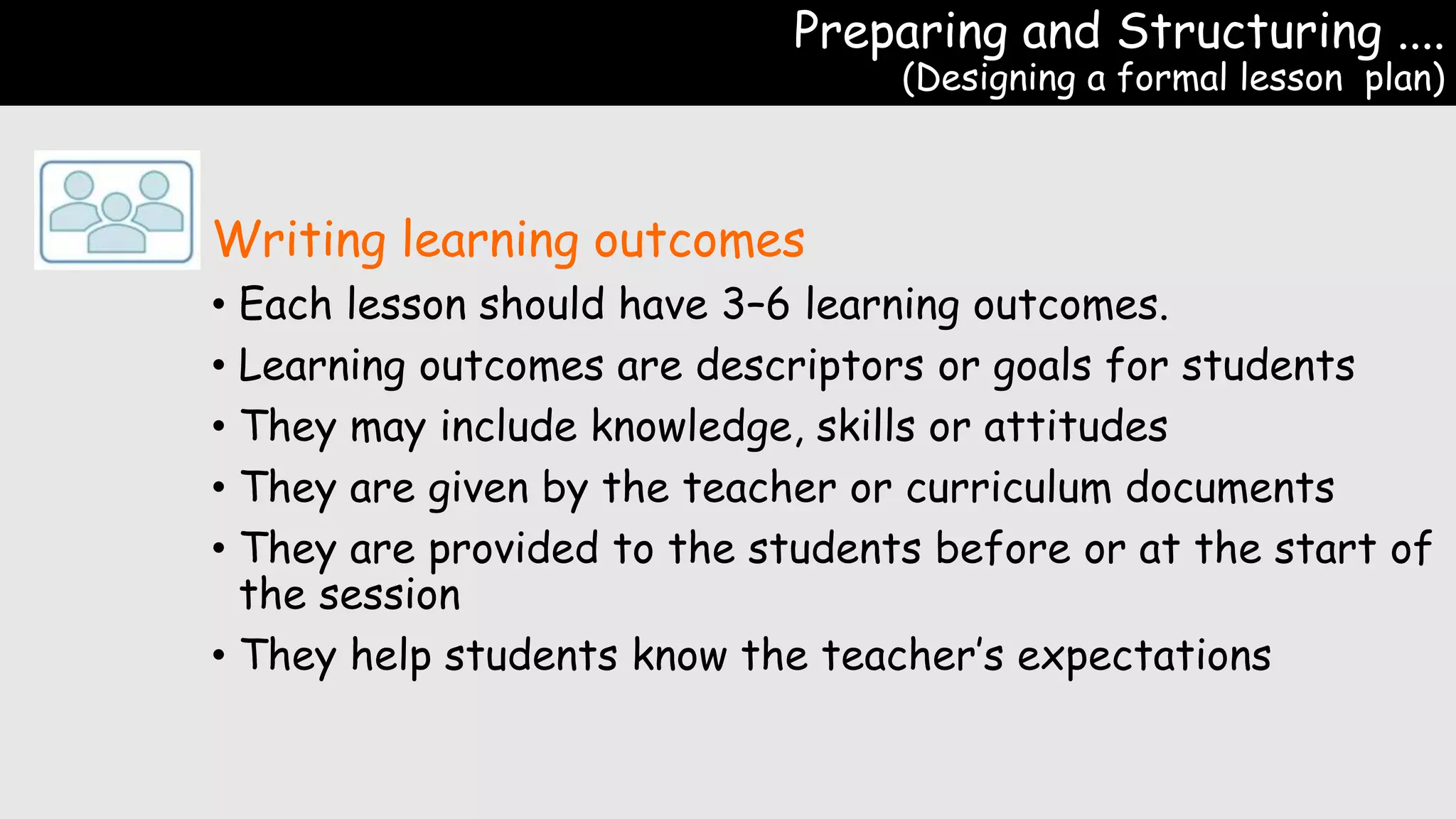
Writing learning outcomes
• Each lesson should have 3–6 learning outcomes.
• Learning outcomes are descriptors or goals for students
• They may include knowledge, skills or attitudes
• They are given by the teacher or curriculum documents
• They are provided to the students before or at the start of
the session
• They help students know the teacher’s expectations
Preparing and Structuring ....
(Designing a formal lesson plan)
Content and Activity
• Interaction between teacher and learners is important
• Use dialogue and activities to teach learners in a brief,
relevant, and interactive way
• Address students by names and questions to check
understanding
• Use different types of content in learning (simulations, polls,
quizzes, videos, scenarios, animations, audio, images, slides, and PDFs)
• Prepare the learning materials, organize the small
groups, explain the learning activities, and give timing
guidelines
Preparing and Structuring ....
(Designing a formal lesson plan)
Assessment
• Formative assessment provides a key driving force for
learning .
• Use
- effective questioning and assessment to keep learners active.
- different types of questions from low to high level,
engage the learner in problem-solving and critical thinking .
- formative assessment tasks with feedback.
It helps learners to improve their understanding
-feedback to promote self-regulated learning, where students
monitor their own goals and strategies
Preparing and Structuring ....
(Designing a formal lesson plan)
Summary
• Briefly summarize what has been covered in the session
and make links to previous learning.
• Ask students to identify the most important point/s,
knowledge or skill/s that they have learnt during the
session.
• Give 2/3 take-home messages and advice on self-
learning task.
• Make sure end on time
Preparing and Structuring ....
(Types of small group teaching)
Types of small group teaching
• Popular methods for small group teaching in classroom
setting are
problem-based learning (PBL),
case-based learning (CBL) and
team-based learning (TBL),
• Common features of all three methods:
o Active learning with peer interaction and feedback
o Use of relevant and authentic clinical cases
o Activation of prior knowledge and application of new knowledge to solve clinical
problems.
Preparing and Structuring ....
(Types of small group teaching)
Problem-based learning (PBL)
• Group activity (6 - 10 students per group)
• Guided learning format
• Each students in the group learns & communicate
• Teacher only facilitate the learning
• A problem-based case is presented to the group by
professor
Preparing and Structuring ....
(Examples of problem base …)
Problem-based learning (PBL)
• A 37-year-old lady , an office worker and
teaches swimming part time came with the
complains of chest pain and shortness of
breath.
• The symptoms have been happening more
often and seems to be gradually worse.
• On previous evening, she was suffering from
breathing difficulty during swimming
competition , that she could barely walk
source :https://www.slideshare.net/soharashed/problem-based-learning-in-medical-education
Preparing and Structuring ....
(Examples of problem base …)
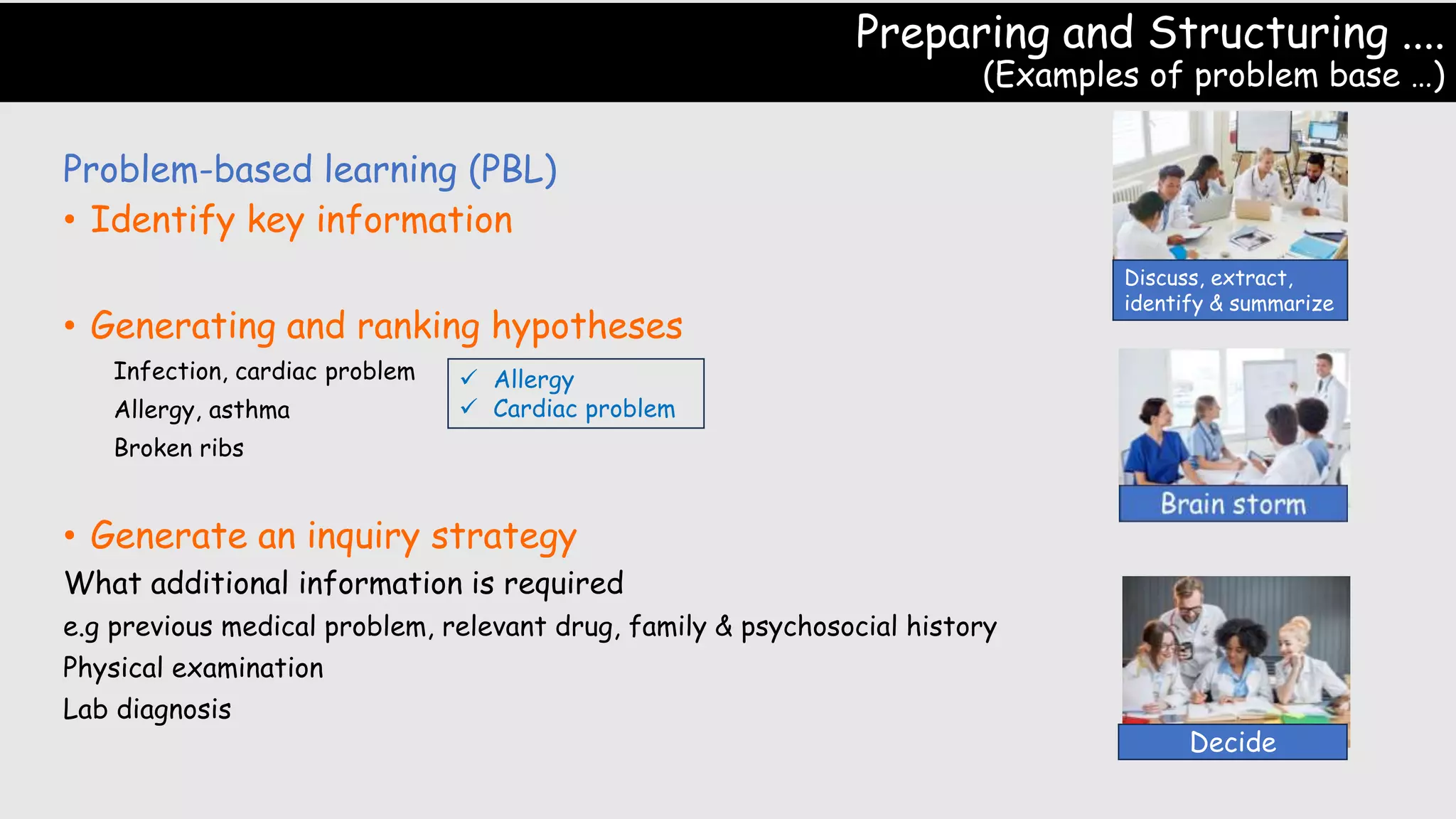
Problem-based learning (PBL)
• Identify key information
• Generating and ranking hypotheses
Infection, cardiac problem
Allergy, asthma
Broken ribs
• Generate an inquiry strategy
What additional information is required
e.g previous medical problem, relevant drug, family & psychosocial history
Physical examination
Lab diagnosis
 Allergy
 Cardiac problem
Discuss, extract,
identify & summarize
Decide
Preparing and Structuring ....
(Examples of problem base …)
• Additional information
The doctor discovers that her
symptoms are precipitated by
physical exertion, particularly in cold
environments. She also have wheeze,
dry cough in absence of hemoptysis.
 She has no recent history of
trauma or cardiac disease but
reports childhood eczema.
She is a heavy smoking.
She is on oral contraceptives but
no other medications.
Preparing and Structuring ....
(Examples of problem base …)
• Students must explain how their chosen hypothesis (e.g. allergy) and the
mechanism that causes the symptoms.
• They should also identify what they already know and what they need
to learn more about to enhance their understanding of the underlying
mechanisms and their problem-solving skills
ex. Students may identify gaps in their knowledge of the mechanism of breathing,
airway anatomy, mechanism of oxygen delivery to tissues or mechanism of pain
perception.
Preparing and Structuring ....
(Types of small group teaching)
Case-based learning (CBL)
• Group activity (6 - 10 students per group)
• Inquiry based learning format
• Students use questions to explore a clinical case.
• CBL is less time consuming and more structured than PBL.
Preparing and Structuring ....
(Example of case based….)
• A 72-year-old woman was suffering from recurrent UTIs with
flank pain, fever and weight loss. Her urine analysis reveals pyuria.
CT scan revealed a markedly enlarged kidney with dilated calyces
and staghorn calculi and the gross examination showed an enlarged
kidney, dilated pelvicalyceal system with diffuse fibrosis. The
histological examination revealed replacement of normal renal
parenchyma with foamy histiocytes, multinucleated giant cells and
scattered inflammatory cells.
• What is your diagnosis?
• What infection is commonly associated with this disease?
• This disease occasionally mimics what other lesions?
Picture courtesy: webpathology and radiopaedia.org/
Preparing and Structuring ....
(Team based learning)
Team based learning
• one content expert facilitate many small groups (12 groups of 6 students) in
one room
• ‘Flipped classroom’ technique
• TBL has a sequence of steps, such as:
Pre-class preparation
In-class individual test and team-test
Immediate feedback
Problem-solving activities
Preparing and Structuring ....
(small group teaching for large..)
Small-Group Learning Techniques
for Large Classes
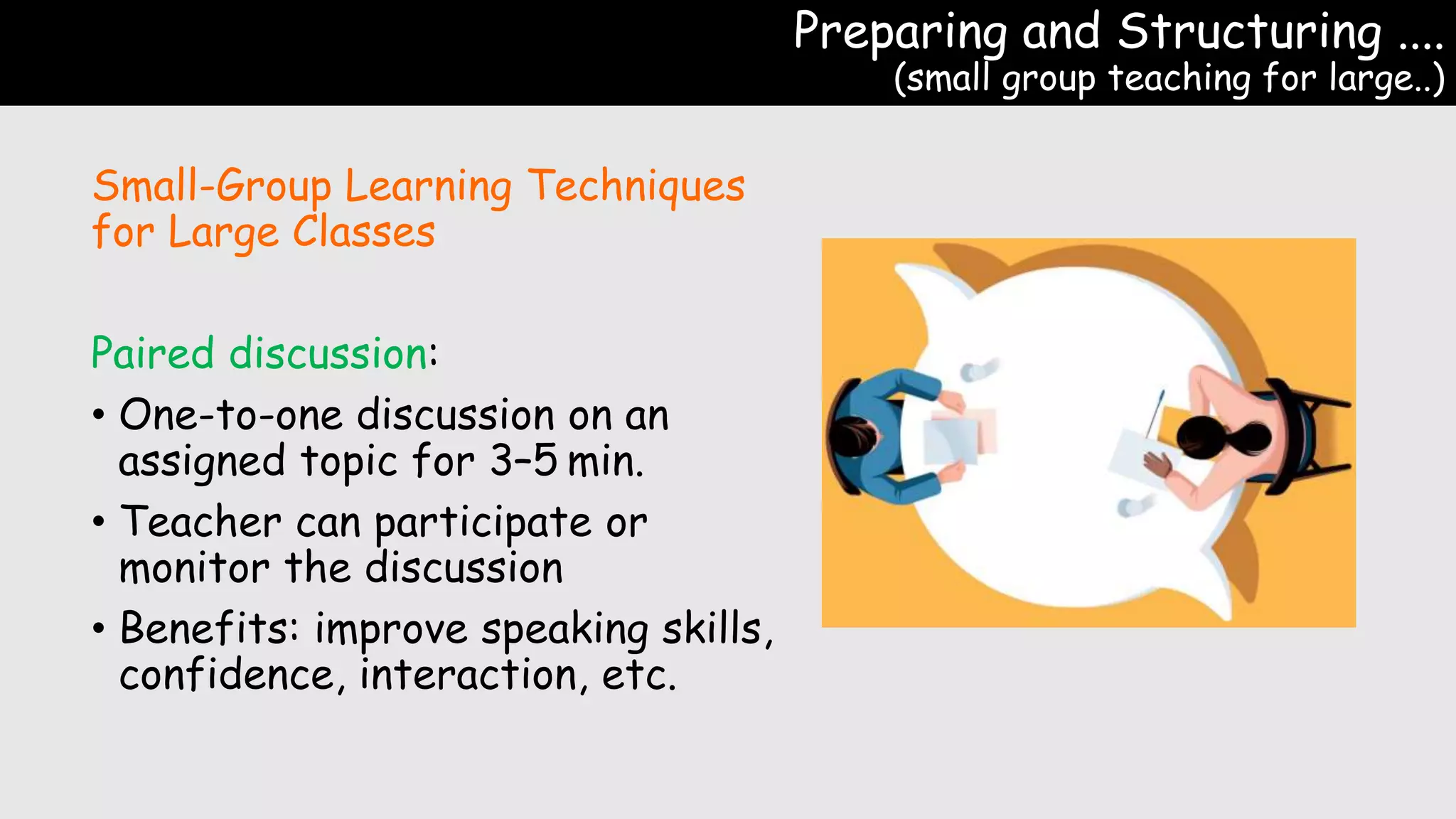
Paired discussion:
• One-to-one discussion on an
assigned topic for 3–5 min.
• Teacher can participate or
monitor the discussion
• Benefits: improve speaking skills,
confidence, interaction, etc.
Preparing and Structuring ....
(small group teaching for large..)
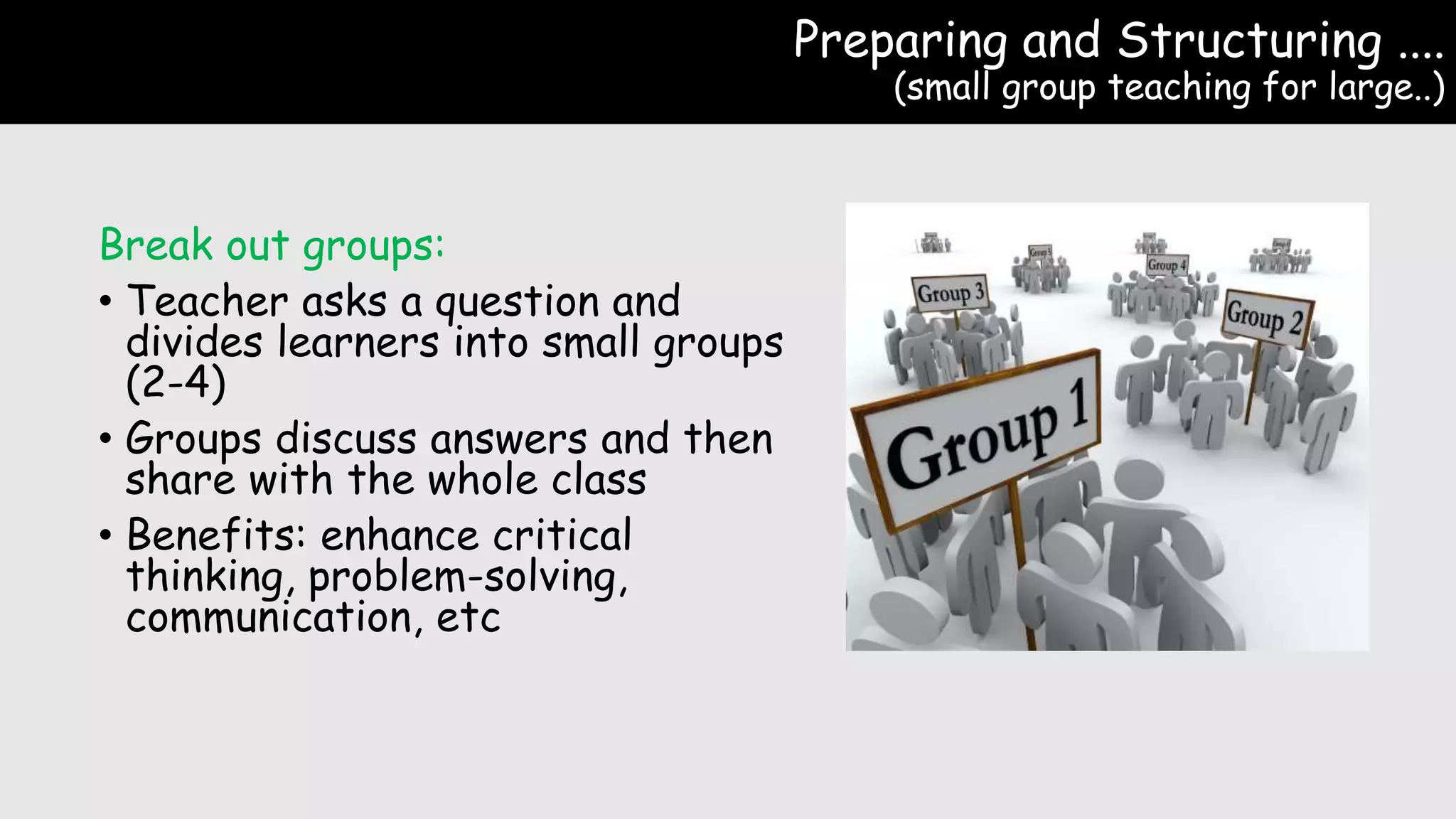
Break out groups:
• Teacher asks a question and
divides learners into small groups
(2-4)
• Groups discuss answers and then
share with the whole class
• Benefits: enhance critical
thinking, problem-solving,
communication, etc
Preparing and Structuring ....
(small group teaching for large..)
Creation of
posters/drawings:
• e.g a mechanistic
flow chart to
describe the
pathophysiology of
the disease process
Courtesy: Calgary guide
Preparing and Structuring ....
(small group teaching for large..)
Group round: generates interest in a topic with
• Each learner have one minute to give their response on a
topic.
• Participation order is random, and learners can skip once
• Goal : to make each response more succinct, clearer, and
more accurate than the previous one.
• Example:
Preparing and Structuring ....
(example of group round..)
• Topic: Euthanasia (the practice of intentionally ending a life to
relieve pain and suffering) and its ethical implications
• Purpose: To examine euthanasia from various
viewpoints, to enhance critical thinking and
communication skills
• Rules:
o Each participant has 1 minute to state: ‘Is euthanasia morally
acceptable?’
o Each participant should justify their position with at least one
reason or example
o Participants can agree, disagree, be neutral, or conditional on
euthanasia
o The order of participation is random, and participants can skip
once
o The discussion lasts for 15 minutes
Preparing and Structuring ....
(small group teaching for large..)
Brainstorming:
• Produce many creative solutions in a short period of time.
• Helps learners recall knowledge and interact with others
• Pathological example: A question related to study of diseases, causes,
effects, and treatments
o How to diagnose this disease more accurately and quickly?
o What are the risk factors for this disease?
o How to prevent or reduce this disease transmission?
o What are the best practices or guidelines for this disease treatment?
o How to improve the quality of life or outcomes for this disease patients?
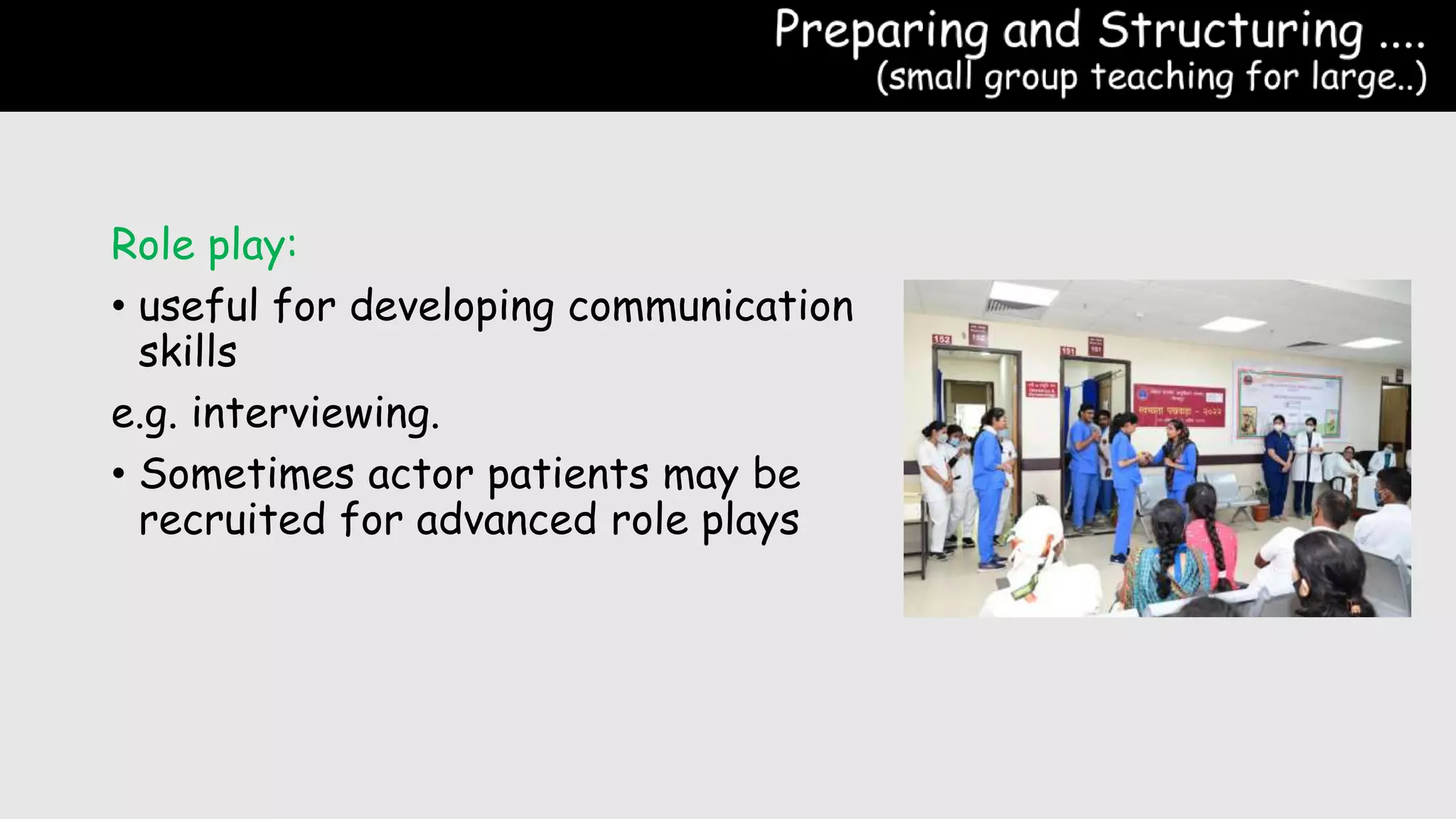
Role play:
• useful for developing communication
skills
e.g. interviewing.
• Sometimes actor patients may be
recruited for advanced role plays
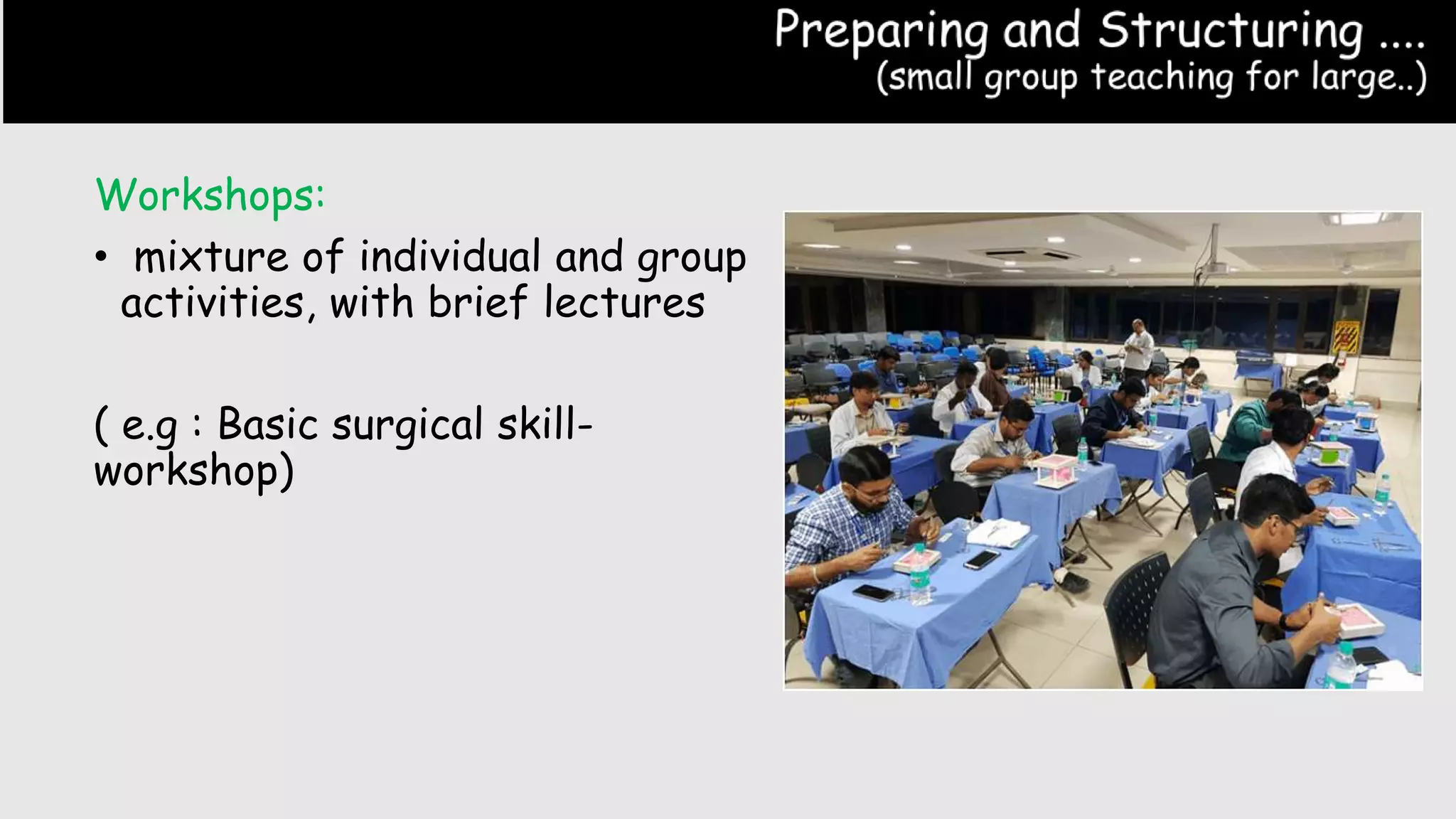
Workshops:
• mixture of individual and group
activities, with brief lectures
( e.g : Basic surgical skill-
workshop)
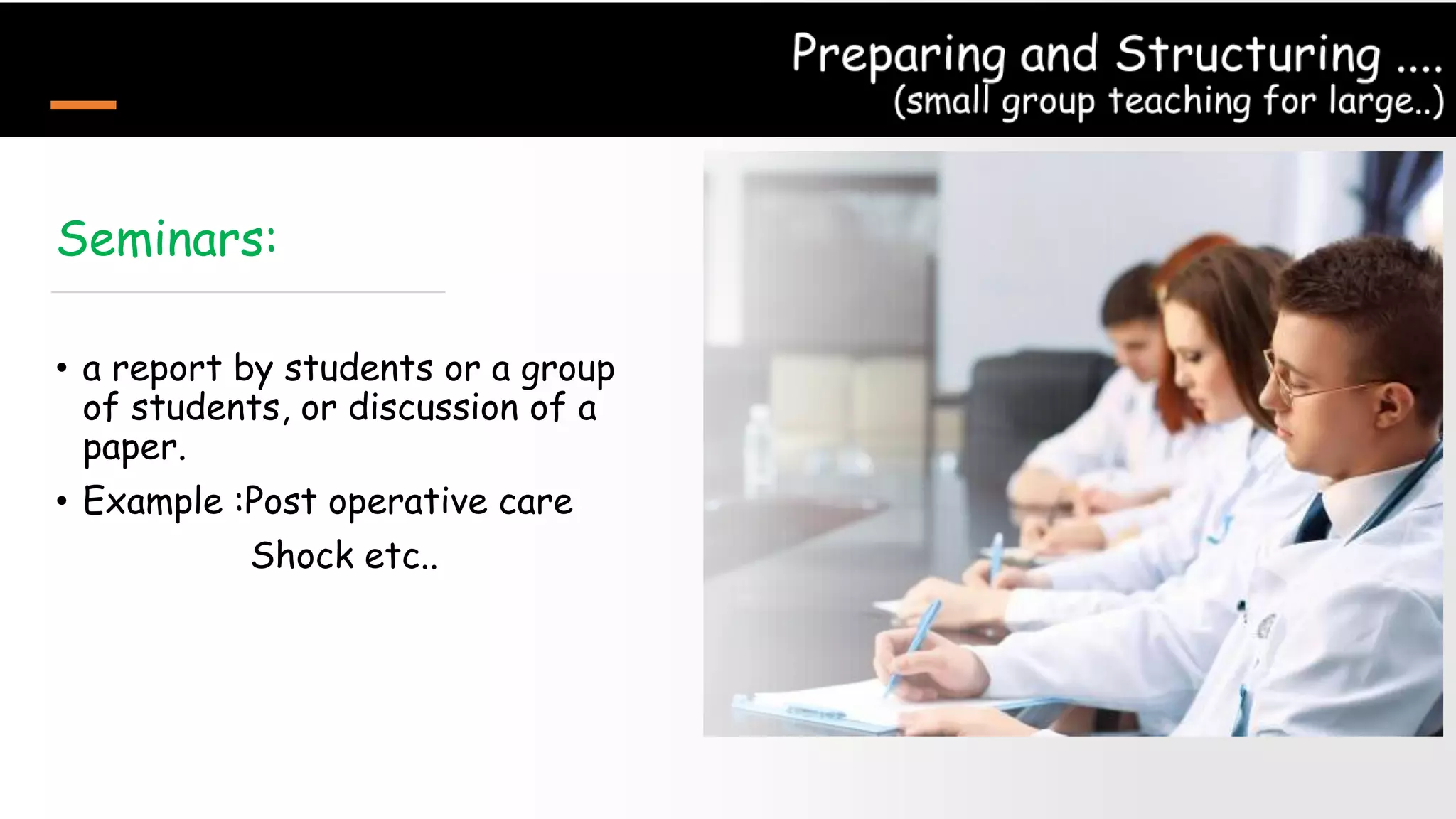
Seminars:
• a report by students or a group
of students, or discussion of a
paper.
• Example :Post operative care
Shock etc..
Preparing and Structuring ....
Practices of small group learning in the clinical
settings
Small group teaching and learning formats in the hospital
setting include-
• Bedside teaching
• Clinical tutorials
• Student-led tutorials
• SCORPIOs (Structured, Clinical, Objective References, Problem-
based, Integrated and Organized).
Preparing and Structuring ....
(Practices of small group ….)
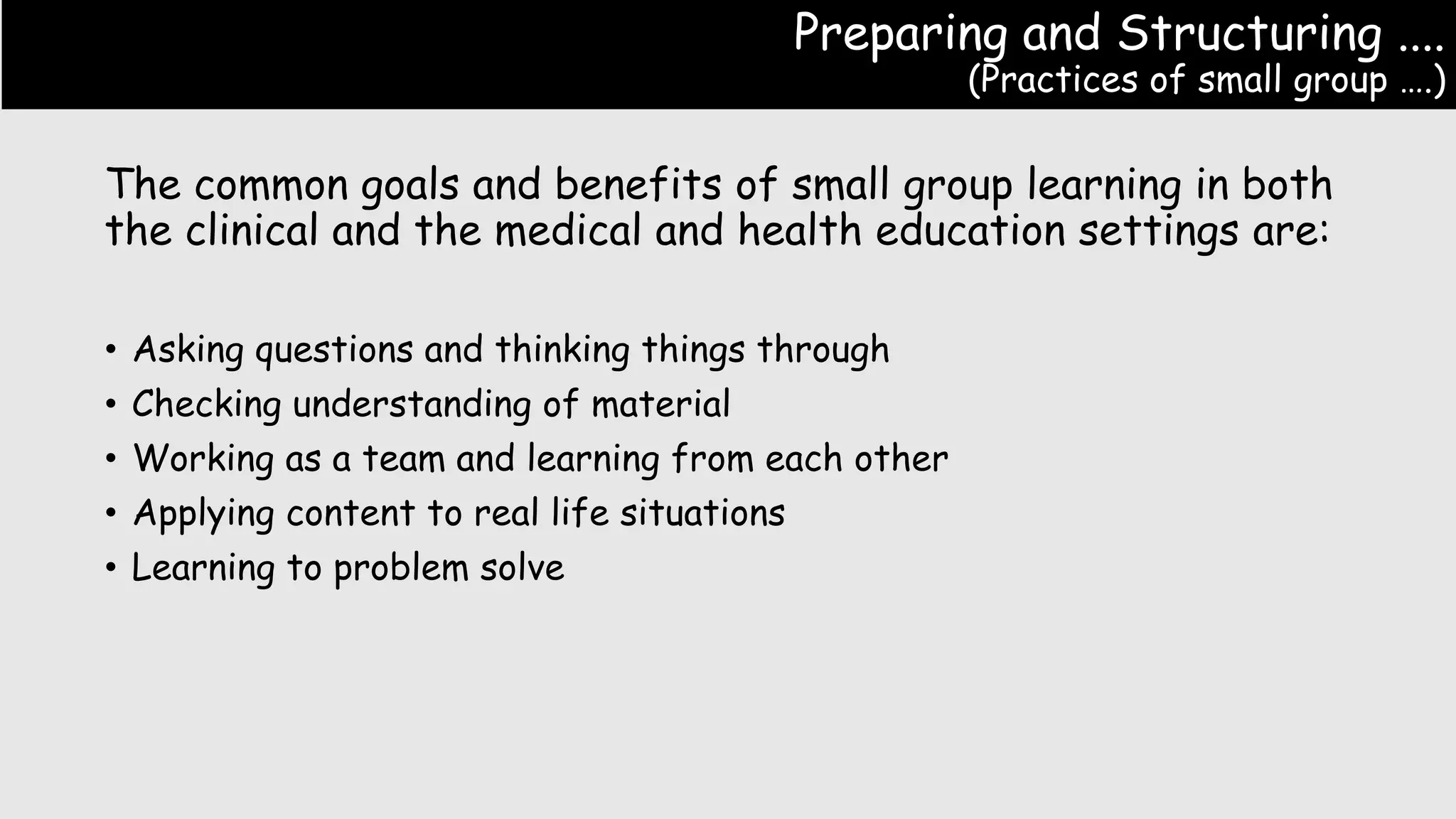
The common goals and benefits of small group learning in both
the clinical and the medical and health education settings are:
• Asking questions and thinking things through
• Checking understanding of material
• Working as a team and learning from each other
• Applying content to real life situations
• Learning to problem solve
Preparing and Structuring ....
(Learning environment and seating….)
Learning environment and seating
arrangements
Lecture style seating:
• Formal seating arrangement
• Facilitator leads the group
• Front facing chairs in rows the of the room
• Limit group interaction.
Preparing and Structuring ....
(Learning environment and seating….)
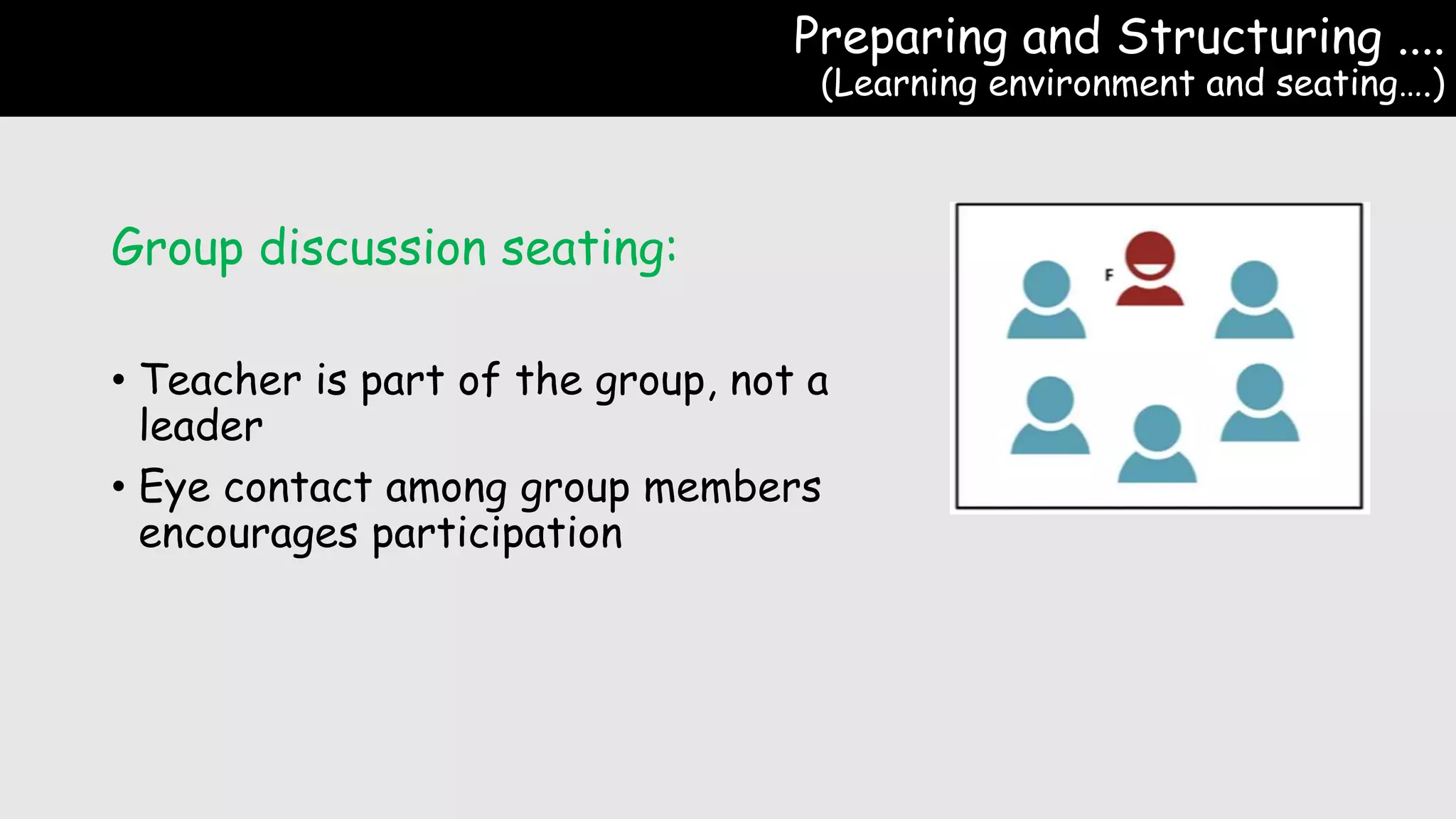
Group discussion seating:
• Teacher is part of the group, not a
leader
• Eye contact among group members
encourages participation
Preparing and Structuring ....
(Learning environment and seating….)
Discussion table seating:
• Facilitator is within the group of
learners, but table may limit movement
• Provides space for working with
papers/resources
• Encourages relaxed discussion among all
members,
• Eye contact from teacher may be
limited with some seating arrangements
Feedback in the small group teaching setting
• Feedback is important for learning because it-
o Gives learners information on their progress and areas to work on
o Motivate learners
o Reinforces learning, and
o promotes self-reflection
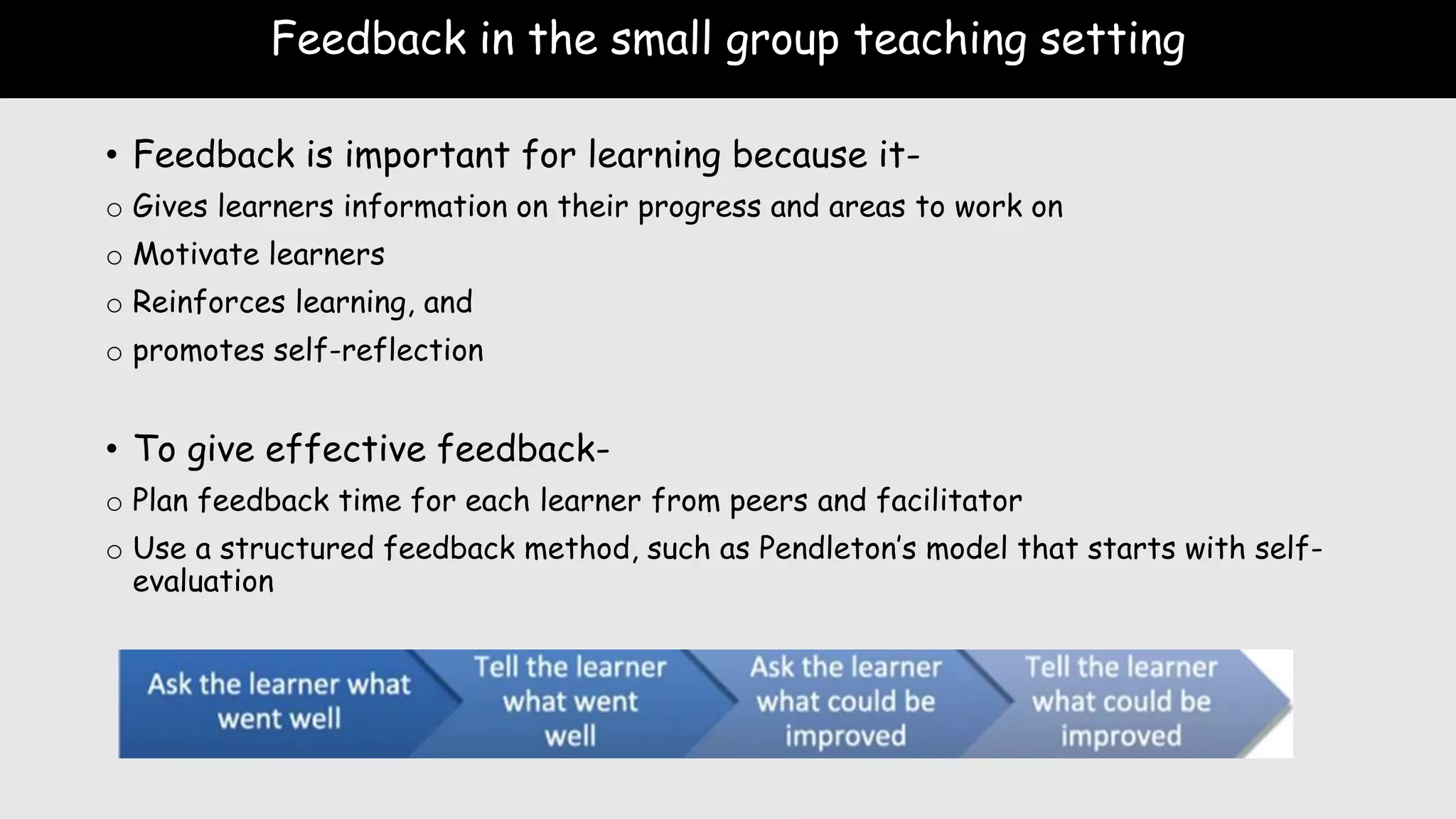
• To give effective feedback-
o Plan feedback time for each learner from peers and facilitator
o Use a structured feedback method, such as Pendleton’s model that starts with self-
evaluation
Conclusion
• Small group teaching is a popular and effective method of
engaging students in active learning, communication,
teamwork, and peer discussion.
• To plan a successful small group teaching session, teachers
need to align the learning outcomes, activities, and
assessment tasks with the curriculum and subject.
• Teachers also need to use a structured approach for lesson
design, delivery, and feedback, such as Bloom’s taxonomy
and Pendleton’s model.
Sources:
• https://bmcmededuc.biomedcentral.com/articles/10.1186/s12909-020-02281-4
• https://www.researchgate.net/publication/353710822_Applying_Bloom%27s_taxon
omy_in_clinical_surgery_Practical_examples
Thank you for
watching 

Planning, sturcturing and Preparing small group teaching in Medical education.pptx

  • 2.
    Planning, preparing and structuring a smallgroup teaching session DR Naila Awal Assistant Professor
  • 3.
    Objective • Provide anoverview of the key theoretical principles in structure, lesson planning, different formats of small group teaching, delivery and provision of effective feedback to learners. • Introduce the central concepts of planning and preparing a small group teaching session. • Structured approach to ensure the success of any small group teaching session; preparation and planning are key elements in ensuring the session is systematic and effective .
  • 4.
    Planning of smallgroup teaching • The planning of learning activities is crucial for course design and teaching. • There should be alignment of the curriculum, subject, learning outcomes, learning activities, and assessment task.
  • 5.
    5 4 3 2 1 Engage and guidethe students to reach their goal Model thinking and learning strategies Practice skills and build on prior knowledge Learn from various sources (including peers) Receive feedback Planning of small group ……. • The learning activities should be-
  • 6.
    Planning of smallgroup ………. Bloom’s taxonomy • useful structure for lesson design • classify lesson objectives into 6 categories that are arranged in a hierarchy from simple to complex
  • 7.
    Lesson design forHernia create Evaluating Analyzing Applying Understanding Remembering Anatomy, types, stages, or treatment approaches of hernias etiology, pathophysiology, predisposing factors, complications, indications of treatment approaches Apply knowledge to diagnose, repair, or prevent complications of hernias Diagnostic value of imagining, different techniques to repair alternative hernia treatment options in complex situations e.g: patients with ascites or approaches for unexpected findings such as malignancies. new approach to repair hernias Higher level of thinking lower level of thinking
  • 8.
    Lesson design forSub cutaneous abscess Create Evaluating Analyzing Applying Understanding Remembering Definition, clinical criteria, and description of an abscess etiology, pathophysiology, evolution,& clinical presentation of an abscess. Apply knowledge to diagnose, confirm, & propose management of an abscess. Diagnostic value of imagining, or the evidence supporting treatment approaches Create new knowledge (early diagnostic tests, less invasive treatment approaches, alternative tools for intervention). Evaluate the validity and reliability of the knowledge used to diagnose abscesses in various settings
  • 9.
    Lesson design forshock Create Evaluating Analyzing Applying Understanding Remembering Definition ,clinical criteria and stages of shock, common medications/interventions, diagnostic tests for shock Spectrum of clinical presentation, pathophysiology of shock Apply knowledge to assess a patient with suspected shock & initiate appropriate intervention Evidence concerning best treatment approaches in various settings & differentiate different shock states based on clinical & hemodynamic endpoints Validity of invasive monitoring and its effect on outcomes or the differences between types of resuscitation fluids. E.g colloid vs crystalloid Innovate new knowledge (new diagnostic measures, new prognosticator markers)
  • 10.
    Planning of smallgroup ………. The learning cycle • The key characteristics of small group teaching are the active involvement of students in the entire learning cycle.
  • 11.
    Planning of ……….(thelearning cycle) The learning cycle is a social and interactive process, where students are encouraged to apply and transfer new knowledge through in depth discussion, collaboration and reflection. This is referred to as “collaborative learning’ This “collaborative learning’ which is different from traditional teaching methods that rely on one-way transmission of information from the teacher to the student. Planning is a vital component of the learning cycle, as it helps students to set goals, identify resources, and prepare for the learning activities.
  • 12.
    Planning of ateaching session………. ‘Outcomes-Activity-Summary’ (OAS) method can be applied as a structure for initial planning, both in the • classroom setting (case-based learning) or • clinical context (bedside teaching) .
  • 13.
    Planning of ateaching session…. (OAS method) Proposed OAS (Outcomes-Activity-Summary’)method for lesson planning and teaching O OUTCOMES • Consider the background knowledge of students • Consider what we want the students to learn, understand, and be able to do by the end of the session • Establish lesson goals and outcomes prior to the session • Share the learning outcomes with students at the start of the session • Allow the students input towards the learning outcomes
  • 14.
    Planning of ateaching session…. (OAS method) Outcomes-Activity-Summary’(OAS) A ACTIVITY • Design appropriate learning activities aligned with the outcomes • Plan – o Activities and engagement of learners o Classroom environment and seating arrangements • Ensure – o Active student participation o Stimulating lesson delivery o Student attention level • Address students by their name, ask questions and get everyone involved to check their understanding • If patients are involved, gain consent before participation
  • 15.
    Structuring a teachingsession…. OAS method OAS (Outcomes-Activity-Summary’)method S SUMMARY • Ask students to identify one new point/knowledge/skill learnt • Summarize the content or skills covered • Complete the lesson with a take-home message and a self- directed learning task • Finish the lesson on time • Evaluate your own teaching and take feedback from students
  • 16.
    Planning of teachingsessions on childhood asthma (OAS method) Classroom settings Clinical bedside teaching session Identify & describe the mechanisms of wheezing Recognize the difference between wheeze and stridor Demonstrate the basic understanding of the pathophysiology of asthma Identify signs of breathing difficulty Identify different types of wheezing in early childhood Distinguish normal breath sounds from wheeze List risk factors for development of asthma Realize that young children may not cooperate (or may be impossible) to examine clinically Recognize the indications and limitations of lung function testing in airway obstruction, especially in young children Be aware that parents may not want students to examine their child. Outline the principles of asthma management. Outcome
  • 17.
    Classroom settings Clinicalbedside teaching session Prior to the session, students will be assigned some reading material (eg. a journal article) • structured history from the parent • examine for signs of breathing difficulty & auscultate the chest for abnormal breath sounds. A real-life case will be presented providing history, physical and investigations. • Some objectives may not be met due to the lack of suitable patients(a co-operative wheezing child) • Alternative teaching methods (role play )may be used instead Students will work in their group to: − make a diagnosis based on the history, physical and investigations −draw a flow chart showing how the patient’s signs and symptoms are related to the underlying mechanisms that cause the diagnosis. − create a management plan (a table with goals, options and qualifying factors) Flexibility with bedside teaching activities is essential, as parents may not consent to being utilized in teaching. Tutors must be very aware of any sign of discomfort by patient and/or parents and discontinue the bedside teaching. Be aware that parents may not want students to examine their child. Activity Planning of teaching sessions on childhood asthma (OAS method)
  • 18.
    Planning of teachingsessions on childhood asthma (OAS method) Classroom settings Clinical bedside teaching session It is important for students to have a good understanding of wheeze, as it is a common condition in young children Wheeze and shortness of breath is a very common clinical presentation in early childhood, and it is essential students can recognize this condition and initiate appropriate management able to identify and treat this condition Note how early childhood wheeze differs from previous teaching on adults with chronic obstructive pulmonary disease (COPD). Ensure you look for signs of chronic illness such as failure to thrive/ poor weight gain. SUMMARY
  • 19.
    Preparing and Structuringa teaching session Designing a formal lesson plan • A lesson plan acts as a map, assisting in guiding a series of activities to ensure students gain the knowledge, skills or attitudes set out within the learning objectives • A lesson plan should identify the key aim and outcomes, content, structure and timing of activities and assessment tasks • The five key steps to consider when writing a lesson plan
  • 20.
    Preparing and Structuring.... (Designing a formal lesson plan) Profile of your target audience Consider - • who will be participating in the lesson. • their background knowledge and learning needs. • resources that are available to us and to the learners, (suitable, available, willing to participate patients). • environmental factors for the teaching session, (seating arrangements and suitable lighting)
  • 21.
    Preparing and Structuring.... (Designing a formal lesson plan) Writing learning outcomes • Each lesson should have 3–6 learning outcomes. • Learning outcomes are descriptors or goals for students • They may include knowledge, skills or attitudes • They are given by the teacher or curriculum documents • They are provided to the students before or at the start of the session • They help students know the teacher’s expectations
  • 22.
    Preparing and Structuring.... (Designing a formal lesson plan) Content and Activity • Interaction between teacher and learners is important • Use dialogue and activities to teach learners in a brief, relevant, and interactive way • Address students by names and questions to check understanding • Use different types of content in learning (simulations, polls, quizzes, videos, scenarios, animations, audio, images, slides, and PDFs) • Prepare the learning materials, organize the small groups, explain the learning activities, and give timing guidelines
  • 23.
    Preparing and Structuring.... (Designing a formal lesson plan) Assessment • Formative assessment provides a key driving force for learning . • Use - effective questioning and assessment to keep learners active. - different types of questions from low to high level, engage the learner in problem-solving and critical thinking . - formative assessment tasks with feedback. It helps learners to improve their understanding -feedback to promote self-regulated learning, where students monitor their own goals and strategies
  • 24.
    Preparing and Structuring.... (Designing a formal lesson plan) Summary • Briefly summarize what has been covered in the session and make links to previous learning. • Ask students to identify the most important point/s, knowledge or skill/s that they have learnt during the session. • Give 2/3 take-home messages and advice on self- learning task. • Make sure end on time
  • 25.
    Preparing and Structuring.... (Types of small group teaching) Types of small group teaching • Popular methods for small group teaching in classroom setting are problem-based learning (PBL), case-based learning (CBL) and team-based learning (TBL), • Common features of all three methods: o Active learning with peer interaction and feedback o Use of relevant and authentic clinical cases o Activation of prior knowledge and application of new knowledge to solve clinical problems.
  • 26.
    Preparing and Structuring.... (Types of small group teaching) Problem-based learning (PBL) • Group activity (6 - 10 students per group) • Guided learning format • Each students in the group learns & communicate • Teacher only facilitate the learning • A problem-based case is presented to the group by professor
  • 27.
    Preparing and Structuring.... (Examples of problem base …) Problem-based learning (PBL) • A 37-year-old lady , an office worker and teaches swimming part time came with the complains of chest pain and shortness of breath. • The symptoms have been happening more often and seems to be gradually worse. • On previous evening, she was suffering from breathing difficulty during swimming competition , that she could barely walk source :https://www.slideshare.net/soharashed/problem-based-learning-in-medical-education
  • 28.
    Preparing and Structuring.... (Examples of problem base …) Problem-based learning (PBL) • Identify key information • Generating and ranking hypotheses Infection, cardiac problem Allergy, asthma Broken ribs • Generate an inquiry strategy What additional information is required e.g previous medical problem, relevant drug, family & psychosocial history Physical examination Lab diagnosis  Allergy  Cardiac problem Discuss, extract, identify & summarize Decide
  • 29.
    Preparing and Structuring.... (Examples of problem base …) • Additional information The doctor discovers that her symptoms are precipitated by physical exertion, particularly in cold environments. She also have wheeze, dry cough in absence of hemoptysis.  She has no recent history of trauma or cardiac disease but reports childhood eczema. She is a heavy smoking. She is on oral contraceptives but no other medications.
  • 30.
    Preparing and Structuring.... (Examples of problem base …) • Students must explain how their chosen hypothesis (e.g. allergy) and the mechanism that causes the symptoms. • They should also identify what they already know and what they need to learn more about to enhance their understanding of the underlying mechanisms and their problem-solving skills ex. Students may identify gaps in their knowledge of the mechanism of breathing, airway anatomy, mechanism of oxygen delivery to tissues or mechanism of pain perception.
  • 31.
    Preparing and Structuring.... (Types of small group teaching) Case-based learning (CBL) • Group activity (6 - 10 students per group) • Inquiry based learning format • Students use questions to explore a clinical case. • CBL is less time consuming and more structured than PBL.
  • 32.
    Preparing and Structuring.... (Example of case based….) • A 72-year-old woman was suffering from recurrent UTIs with flank pain, fever and weight loss. Her urine analysis reveals pyuria. CT scan revealed a markedly enlarged kidney with dilated calyces and staghorn calculi and the gross examination showed an enlarged kidney, dilated pelvicalyceal system with diffuse fibrosis. The histological examination revealed replacement of normal renal parenchyma with foamy histiocytes, multinucleated giant cells and scattered inflammatory cells. • What is your diagnosis? • What infection is commonly associated with this disease? • This disease occasionally mimics what other lesions? Picture courtesy: webpathology and radiopaedia.org/
  • 33.
    Preparing and Structuring.... (Team based learning) Team based learning • one content expert facilitate many small groups (12 groups of 6 students) in one room • ‘Flipped classroom’ technique • TBL has a sequence of steps, such as: Pre-class preparation In-class individual test and team-test Immediate feedback Problem-solving activities
  • 34.
    Preparing and Structuring.... (small group teaching for large..) Small-Group Learning Techniques for Large Classes Paired discussion: • One-to-one discussion on an assigned topic for 3–5 min. • Teacher can participate or monitor the discussion • Benefits: improve speaking skills, confidence, interaction, etc.
  • 35.
    Preparing and Structuring.... (small group teaching for large..) Break out groups: • Teacher asks a question and divides learners into small groups (2-4) • Groups discuss answers and then share with the whole class • Benefits: enhance critical thinking, problem-solving, communication, etc
  • 36.
    Preparing and Structuring.... (small group teaching for large..) Creation of posters/drawings: • e.g a mechanistic flow chart to describe the pathophysiology of the disease process Courtesy: Calgary guide
  • 37.
    Preparing and Structuring.... (small group teaching for large..) Group round: generates interest in a topic with • Each learner have one minute to give their response on a topic. • Participation order is random, and learners can skip once • Goal : to make each response more succinct, clearer, and more accurate than the previous one. • Example:
  • 38.
    Preparing and Structuring.... (example of group round..) • Topic: Euthanasia (the practice of intentionally ending a life to relieve pain and suffering) and its ethical implications • Purpose: To examine euthanasia from various viewpoints, to enhance critical thinking and communication skills • Rules: o Each participant has 1 minute to state: ‘Is euthanasia morally acceptable?’ o Each participant should justify their position with at least one reason or example o Participants can agree, disagree, be neutral, or conditional on euthanasia o The order of participation is random, and participants can skip once o The discussion lasts for 15 minutes
  • 39.
    Preparing and Structuring.... (small group teaching for large..) Brainstorming: • Produce many creative solutions in a short period of time. • Helps learners recall knowledge and interact with others • Pathological example: A question related to study of diseases, causes, effects, and treatments o How to diagnose this disease more accurately and quickly? o What are the risk factors for this disease? o How to prevent or reduce this disease transmission? o What are the best practices or guidelines for this disease treatment? o How to improve the quality of life or outcomes for this disease patients?
  • 40.
    Role play: • usefulfor developing communication skills e.g. interviewing. • Sometimes actor patients may be recruited for advanced role plays
  • 41.
    Workshops: • mixture ofindividual and group activities, with brief lectures ( e.g : Basic surgical skill- workshop)
  • 42.
    Seminars: • a reportby students or a group of students, or discussion of a paper. • Example :Post operative care Shock etc..
  • 43.
    Preparing and Structuring.... Practices of small group learning in the clinical settings Small group teaching and learning formats in the hospital setting include- • Bedside teaching • Clinical tutorials • Student-led tutorials • SCORPIOs (Structured, Clinical, Objective References, Problem- based, Integrated and Organized).
  • 44.
    Preparing and Structuring.... (Practices of small group ….) The common goals and benefits of small group learning in both the clinical and the medical and health education settings are: • Asking questions and thinking things through • Checking understanding of material • Working as a team and learning from each other • Applying content to real life situations • Learning to problem solve
  • 45.
    Preparing and Structuring.... (Learning environment and seating….) Learning environment and seating arrangements Lecture style seating: • Formal seating arrangement • Facilitator leads the group • Front facing chairs in rows the of the room • Limit group interaction.
  • 46.
    Preparing and Structuring.... (Learning environment and seating….) Group discussion seating: • Teacher is part of the group, not a leader • Eye contact among group members encourages participation
  • 47.
    Preparing and Structuring.... (Learning environment and seating….) Discussion table seating: • Facilitator is within the group of learners, but table may limit movement • Provides space for working with papers/resources • Encourages relaxed discussion among all members, • Eye contact from teacher may be limited with some seating arrangements
  • 48.
    Feedback in thesmall group teaching setting • Feedback is important for learning because it- o Gives learners information on their progress and areas to work on o Motivate learners o Reinforces learning, and o promotes self-reflection • To give effective feedback- o Plan feedback time for each learner from peers and facilitator o Use a structured feedback method, such as Pendleton’s model that starts with self- evaluation
  • 49.
    Conclusion • Small groupteaching is a popular and effective method of engaging students in active learning, communication, teamwork, and peer discussion. • To plan a successful small group teaching session, teachers need to align the learning outcomes, activities, and assessment tasks with the curriculum and subject. • Teachers also need to use a structured approach for lesson design, delivery, and feedback, such as Bloom’s taxonomy and Pendleton’s model.
  • 50.
  • 51.