William Stallings
Computer Organization
and Architecture
8th Edition


Chapter 11
Instruction Sets:
Addressing Modes and Formats
Addressing Modes
•   Immediate
•   Direct
•   Indirect
•   Register
•   Register Indirect
•   Displacement (Indexed)
•   Stack
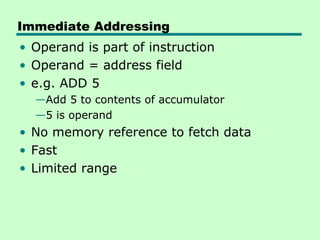
Immediate Addressing
• Operand is part of instruction
• Operand = address field
• e.g. ADD 5
  —Add 5 to contents of accumulator
  —5 is operand
• No memory reference to fetch data
• Fast
• Limited range
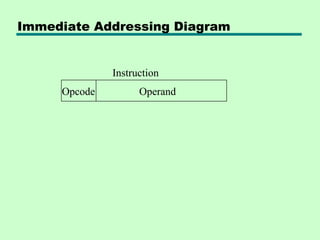
Immediate Addressing Diagram


              Instruction
     Opcode         Operand
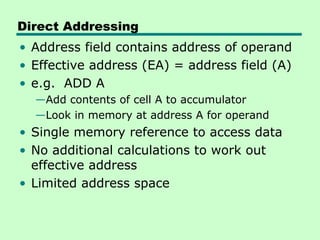
Direct Addressing
• Address field contains address of operand
• Effective address (EA) = address field (A)
• e.g. ADD A
  —Add contents of cell A to accumulator
  —Look in memory at address A for operand
• Single memory reference to access data
• No additional calculations to work out
  effective address
• Limited address space
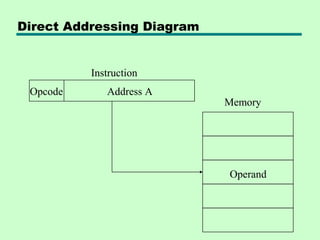
Direct Addressing Diagram


          Instruction
 Opcode      Address A
                            Memory


                            Operand
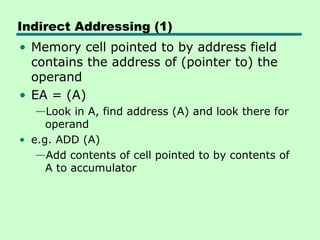
Indirect Addressing (1)
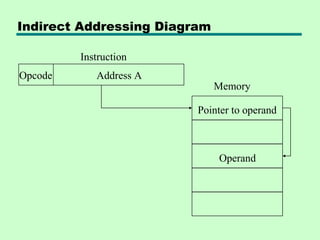
• Memory cell pointed to by address field
  contains the address of (pointer to) the
  operand
• EA = (A)
   —Look in A, find address (A) and look there for
     operand
• e.g. ADD (A)
   —Add contents of cell pointed to by contents of
     A to accumulator
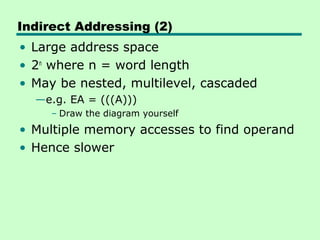
Indirect Addressing (2)
• Large address space
• 2n where n = word length
• May be nested, multilevel, cascaded
  —e.g. EA = (((A)))
     – Draw the diagram yourself
• Multiple memory accesses to find operand
• Hence slower
Indirect Addressing Diagram

         Instruction
Opcode      Address A
                              Memory

                         Pointer to operand


                              Operand
Register Addressing (1)
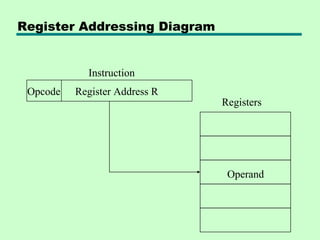
• Operand is held in register named in
  address filed
• EA = R
• Limited number of registers
• Very small address field needed
  —Shorter instructions
  —Faster instruction fetch
Register Addressing (2)
•   No memory access
•   Very fast execution
•   Very limited address space
•   Multiple registers helps performance
    —Requires good assembly programming or
     compiler writing
    —N.B. C programming
       – register int a;
• c.f. Direct addressing
Register Addressing Diagram


            Instruction
 Opcode   Register Address R
                               Registers


                                Operand
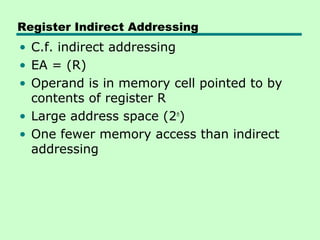
Register Indirect Addressing
• C.f. indirect addressing
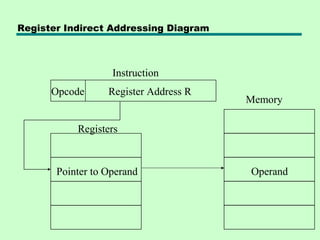
• EA = (R)
• Operand is in memory cell pointed to by
  contents of register R
• Large address space (2n)
• One fewer memory access than indirect
  addressing
Register Indirect Addressing Diagram


                   Instruction
      Opcode      Register Address R
                                       Memory

           Registers


       Pointer to Operand              Operand
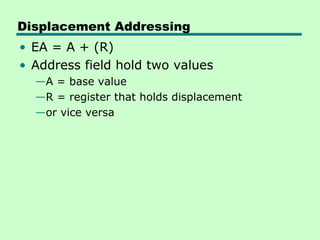
Displacement Addressing
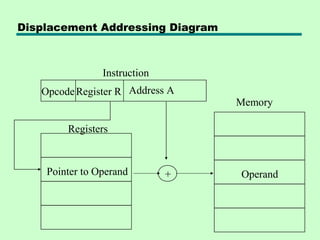
• EA = A + (R)
• Address field hold two values
  —A = base value
  —R = register that holds displacement
  —or vice versa
Displacement Addressing Diagram


                Instruction
   Opcode Register R Address A
                                  Memory

        Registers


    Pointer to Operand        +   Operand
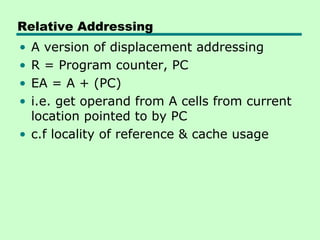
Relative Addressing
• A version of displacement addressing
• R = Program counter, PC
• EA = A + (PC)
• i.e. get operand from A cells from current
  location pointed to by PC
• c.f locality of reference & cache usage
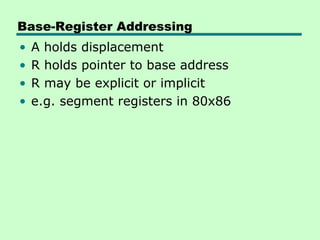
Base-Register Addressing
•   A holds displacement
•   R holds pointer to base address
•   R may be explicit or implicit
•   e.g. segment registers in 80x86
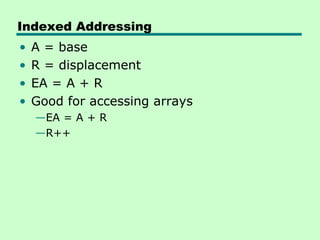
Indexed Addressing
•   A = base
•   R = displacement
•   EA = A + R
•   Good for accessing arrays
    —EA = A + R
    —R++
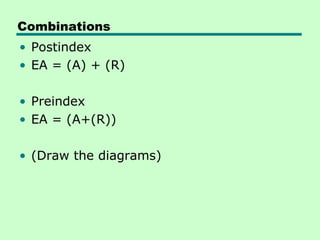
Combinations
• Postindex
• EA = (A) + (R)

• Preindex
• EA = (A+(R))

• (Draw the diagrams)
Stack Addressing
• Operand is (implicitly) on top of stack
• e.g.
  —ADD    Pop top two items from stack
          and add
x86 Addressing Modes
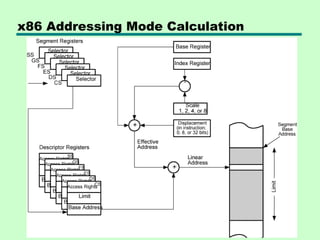
• Virtual or effective address is offset into segment
   — Starting address plus offset gives linear address
   — This goes through page translation if paging enabled
• 12 addressing modes available
   — Immediate
   — Register operand
   — Displacement
   — Base
   — Base with displacement
   — Scaled index with displacement
   — Base with index and displacement
   — Base scaled index with displacement
   — Relative
x86 Addressing Mode Calculation
ARM Addressing Modes
Load/Store
• Only instructions that reference memory
• Indirectly through base register plus offset
• Offset
   — Offset added to or subtracted from base register contents to
     form the memory address
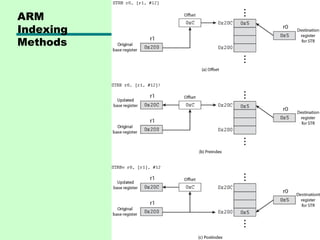
• Preindex
   — Memory address is formed as for offset addressing
   — Memory address also written back to base register
   — So base register value incremented or decremented by offset
     value
• Postindex
   — Memory address is base register value
   — Offset added or subtracted
     Result written back to base register
• Base register acts as index register for preindex and
  postindex addressing
• Offset either immediate value in instruction or another
  register
• If register scaled register addressing available
   — Offset register value scaled by shift operator
   — Instruction specifies shift size
ARM
Indexing
Methods
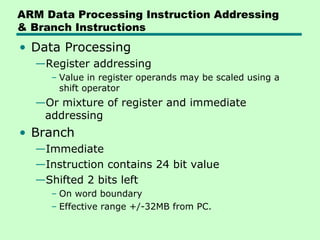
ARM Data Processing Instruction Addressing
& Branch Instructions
• Data Processing
  —Register addressing
     – Value in register operands may be scaled using a
       shift operator
  —Or mixture of register and immediate
   addressing
• Branch
  —Immediate
  —Instruction contains 24 bit value
  —Shifted 2 bits left
     – On word boundary
     – Effective range +/-32MB from PC.
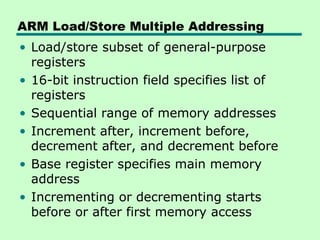
ARM Load/Store Multiple Addressing
• Load/store subset of general-purpose
  registers
• 16-bit instruction field specifies list of
  registers
• Sequential range of memory addresses
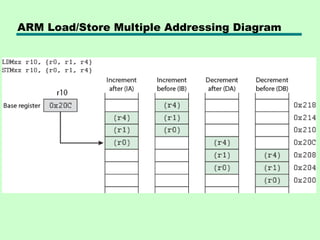
• Increment after, increment before,
  decrement after, and decrement before
• Base register specifies main memory
  address
• Incrementing or decrementing starts
  before or after first memory access
ARM Load/Store Multiple Addressing Diagram
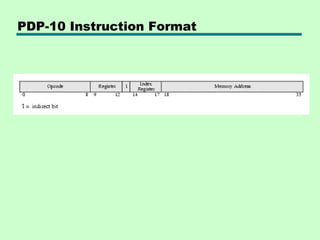
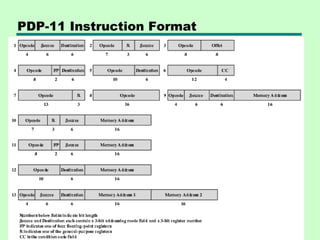
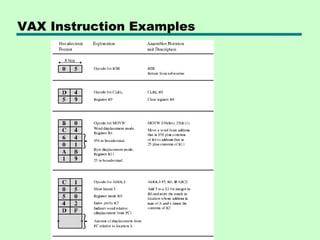
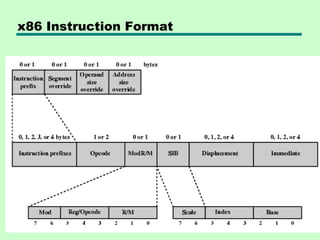
Instruction Formats
•   Layout of bits in an instruction
•   Includes opcode
•   Includes (implicit or explicit) operand(s)
•   Usually more than one instruction format
    in an instruction set
Instruction Length
• Affected by and affects:
  —Memory size
  —Memory organization
  —Bus structure
  —CPU complexity
  —CPU speed
• Trade off between powerful instruction
  repertoire and saving space
Allocation of Bits
•   Number of addressing modes
•   Number of operands
•   Register versus memory
•   Number of register sets
•   Address range
•   Address granularity
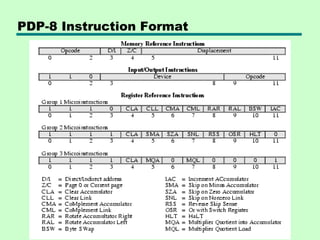
PDP-8 Instruction Format
PDP-10 Instruction Format
PDP-11 Instruction Format
VAX Instruction Examples
x86 Instruction Format
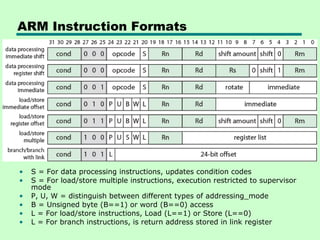
ARM Instruction Formats


•   S = For data processing instructions, updates condition codes
•   S = For load/store multiple instructions, execution restricted to supervisor
    mode
•   P, U, W = distinguish between different types of addressing_mode
•   B = Unsigned byte (B==1) or word (B==0) access
•   L = For load/store instructions, Load (L==1) or Store (L==0)
•   L = For branch instructions, is return address stored in link register
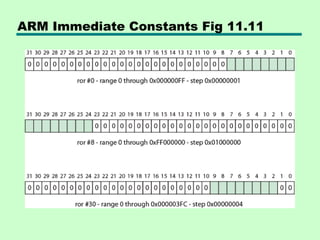
ARM Immediate Constants Fig 11.11
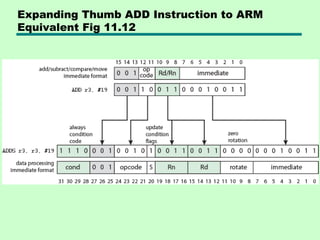
Thumb Instruction Set
• Re-encoded subset of ARM instruction set
• Increases performance in 16-bit or less
  data bus
• Unconditional (4 bits saved)
• Always update conditional flags
  —Update flag not used (1 bit saved)
• Subset of instructions
  —2 bit opcode, 3 bit type field (1 bit saved)
  —Reduced operand specifications (9 bits saved)
Expanding Thumb ADD Instruction to ARM
Equivalent Fig 11.12
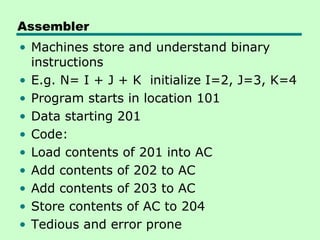
Assembler
• Machines store and understand binary
  instructions
• E.g. N= I + J + K initialize I=2, J=3, K=4
• Program starts in location 101
• Data starting 201
• Code:
• Load contents of 201 into AC
• Add contents of 202 to AC
• Add contents of 203 to AC
• Store contents of AC to 204
• Tedious and error prone
Improvements
• Use hexadecimal rather than binary
  —Code as series of lines
    – Hex address and memory address
  —Need to translate automatically using program
• Add symbolic names or mnemonics for
  instructions
• Three fields per line
  —Location address
  —Three letter opcode
  —If memory reference: address
• Need more complex translation program
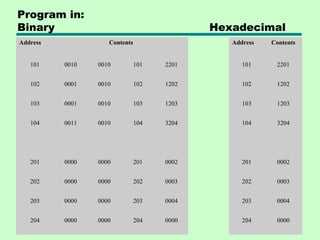
Program in:
Binary                                      Hexadecimal
Address             Contents                   Address   Contents


   101    0010   0010          101   2201         101     2201


   102    0001   0010          102   1202         102     1202


   103    0001   0010          103   1203         103     1203


   104    0011   0010          104   3204         104     3204


   201    0000   0000          201   0002         201     0002


   202    0000   0000          202   0003         202     0003


   203    0000   0000          203   0004         203     0004


   204    0000   0000          204   0000         204     0000
Symbolic Addresses
• First field (address) now symbolic
• Memory references in third field now
  symbolic
• Now have assembly language and need an
  assembler to translate
• Assembler used for some systems
  programming
  —Compliers
  —I/O routines
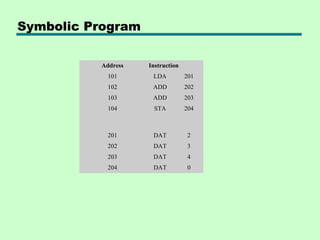
Symbolic Program

          Address   Instruction
           101       LDA          201
           102       ADD          202
           103       ADD          203
           104       STA          204


           201       DAT           2
           202       DAT           3
           203       DAT           4
           204       DAT           0
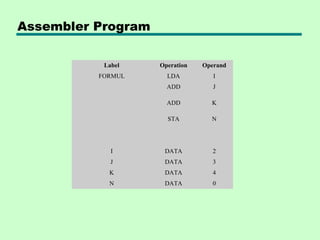
Assembler Program

           Label    Operation   Operand
          FORMUL      LDA          I
                      ADD          J

                      ADD         K

                      STA         N


             I       DATA          2
             J       DATA          3
            K        DATA          4
            N        DATA          0
Foreground Reading
• Stallings chapter 11
• Intel and ARM Web sites

11 instruction sets addressing modes

  • 1.
    William Stallings Computer Organization andArchitecture 8th Edition Chapter 11 Instruction Sets: Addressing Modes and Formats
  • 2.
    Addressing Modes • Immediate • Direct • Indirect • Register • Register Indirect • Displacement (Indexed) • Stack
  • 3.
    Immediate Addressing • Operandis part of instruction • Operand = address field • e.g. ADD 5 —Add 5 to contents of accumulator —5 is operand • No memory reference to fetch data • Fast • Limited range
  • 4.
    Immediate Addressing Diagram Instruction Opcode Operand
  • 5.
    Direct Addressing • Addressfield contains address of operand • Effective address (EA) = address field (A) • e.g. ADD A —Add contents of cell A to accumulator —Look in memory at address A for operand • Single memory reference to access data • No additional calculations to work out effective address • Limited address space
  • 6.
    Direct Addressing Diagram Instruction Opcode Address A Memory Operand
  • 7.
    Indirect Addressing (1) •Memory cell pointed to by address field contains the address of (pointer to) the operand • EA = (A) —Look in A, find address (A) and look there for operand • e.g. ADD (A) —Add contents of cell pointed to by contents of A to accumulator
  • 8.
    Indirect Addressing (2) •Large address space • 2n where n = word length • May be nested, multilevel, cascaded —e.g. EA = (((A))) – Draw the diagram yourself • Multiple memory accesses to find operand • Hence slower
  • 9.
    Indirect Addressing Diagram Instruction Opcode Address A Memory Pointer to operand Operand
  • 10.
    Register Addressing (1) •Operand is held in register named in address filed • EA = R • Limited number of registers • Very small address field needed —Shorter instructions —Faster instruction fetch
  • 11.
    Register Addressing (2) • No memory access • Very fast execution • Very limited address space • Multiple registers helps performance —Requires good assembly programming or compiler writing —N.B. C programming – register int a; • c.f. Direct addressing
  • 12.
    Register Addressing Diagram Instruction Opcode Register Address R Registers Operand
  • 13.
    Register Indirect Addressing •C.f. indirect addressing • EA = (R) • Operand is in memory cell pointed to by contents of register R • Large address space (2n) • One fewer memory access than indirect addressing
  • 14.
    Register Indirect AddressingDiagram Instruction Opcode Register Address R Memory Registers Pointer to Operand Operand
  • 15.
    Displacement Addressing • EA= A + (R) • Address field hold two values —A = base value —R = register that holds displacement —or vice versa
  • 16.
    Displacement Addressing Diagram Instruction Opcode Register R Address A Memory Registers Pointer to Operand + Operand
  • 17.
    Relative Addressing • Aversion of displacement addressing • R = Program counter, PC • EA = A + (PC) • i.e. get operand from A cells from current location pointed to by PC • c.f locality of reference & cache usage
  • 18.
    Base-Register Addressing • A holds displacement • R holds pointer to base address • R may be explicit or implicit • e.g. segment registers in 80x86
  • 19.
    Indexed Addressing • A = base • R = displacement • EA = A + R • Good for accessing arrays —EA = A + R —R++
  • 20.
    Combinations • Postindex • EA= (A) + (R) • Preindex • EA = (A+(R)) • (Draw the diagrams)
  • 21.
    Stack Addressing • Operandis (implicitly) on top of stack • e.g. —ADD Pop top two items from stack and add
  • 22.
    x86 Addressing Modes •Virtual or effective address is offset into segment — Starting address plus offset gives linear address — This goes through page translation if paging enabled • 12 addressing modes available — Immediate — Register operand — Displacement — Base — Base with displacement — Scaled index with displacement — Base with index and displacement — Base scaled index with displacement — Relative
  • 23.
  • 24.
    ARM Addressing Modes Load/Store •Only instructions that reference memory • Indirectly through base register plus offset • Offset — Offset added to or subtracted from base register contents to form the memory address • Preindex — Memory address is formed as for offset addressing — Memory address also written back to base register — So base register value incremented or decremented by offset value • Postindex — Memory address is base register value — Offset added or subtracted Result written back to base register • Base register acts as index register for preindex and postindex addressing • Offset either immediate value in instruction or another register • If register scaled register addressing available — Offset register value scaled by shift operator — Instruction specifies shift size
  • 25.
  • 26.
    ARM Data ProcessingInstruction Addressing & Branch Instructions • Data Processing —Register addressing – Value in register operands may be scaled using a shift operator —Or mixture of register and immediate addressing • Branch —Immediate —Instruction contains 24 bit value —Shifted 2 bits left – On word boundary – Effective range +/-32MB from PC.
  • 27.
    ARM Load/Store MultipleAddressing • Load/store subset of general-purpose registers • 16-bit instruction field specifies list of registers • Sequential range of memory addresses • Increment after, increment before, decrement after, and decrement before • Base register specifies main memory address • Incrementing or decrementing starts before or after first memory access
  • 28.
    ARM Load/Store MultipleAddressing Diagram
  • 29.
    Instruction Formats • Layout of bits in an instruction • Includes opcode • Includes (implicit or explicit) operand(s) • Usually more than one instruction format in an instruction set
  • 30.
    Instruction Length • Affectedby and affects: —Memory size —Memory organization —Bus structure —CPU complexity —CPU speed • Trade off between powerful instruction repertoire and saving space
  • 31.
    Allocation of Bits • Number of addressing modes • Number of operands • Register versus memory • Number of register sets • Address range • Address granularity
  • 32.
  • 33.
  • 34.
  • 35.
  • 36.
  • 37.
    ARM Instruction Formats • S = For data processing instructions, updates condition codes • S = For load/store multiple instructions, execution restricted to supervisor mode • P, U, W = distinguish between different types of addressing_mode • B = Unsigned byte (B==1) or word (B==0) access • L = For load/store instructions, Load (L==1) or Store (L==0) • L = For branch instructions, is return address stored in link register
  • 38.
  • 39.
    Thumb Instruction Set •Re-encoded subset of ARM instruction set • Increases performance in 16-bit or less data bus • Unconditional (4 bits saved) • Always update conditional flags —Update flag not used (1 bit saved) • Subset of instructions —2 bit opcode, 3 bit type field (1 bit saved) —Reduced operand specifications (9 bits saved)
  • 40.
    Expanding Thumb ADDInstruction to ARM Equivalent Fig 11.12
  • 41.
    Assembler • Machines storeand understand binary instructions • E.g. N= I + J + K initialize I=2, J=3, K=4 • Program starts in location 101 • Data starting 201 • Code: • Load contents of 201 into AC • Add contents of 202 to AC • Add contents of 203 to AC • Store contents of AC to 204 • Tedious and error prone
  • 42.
    Improvements • Use hexadecimalrather than binary —Code as series of lines – Hex address and memory address —Need to translate automatically using program • Add symbolic names or mnemonics for instructions • Three fields per line —Location address —Three letter opcode —If memory reference: address • Need more complex translation program
  • 43.
    Program in: Binary Hexadecimal Address Contents Address Contents 101 0010 0010 101 2201 101 2201 102 0001 0010 102 1202 102 1202 103 0001 0010 103 1203 103 1203 104 0011 0010 104 3204 104 3204 201 0000 0000 201 0002 201 0002 202 0000 0000 202 0003 202 0003 203 0000 0000 203 0004 203 0004 204 0000 0000 204 0000 204 0000
  • 44.
    Symbolic Addresses • Firstfield (address) now symbolic • Memory references in third field now symbolic • Now have assembly language and need an assembler to translate • Assembler used for some systems programming —Compliers —I/O routines
  • 45.
    Symbolic Program Address Instruction 101 LDA 201 102 ADD 202 103 ADD 203 104 STA 204 201 DAT 2 202 DAT 3 203 DAT 4 204 DAT 0
  • 46.
    Assembler Program Label Operation Operand FORMUL LDA I ADD J ADD K STA N I DATA 2 J DATA 3 K DATA 4 N DATA 0
  • 47.
    Foreground Reading • Stallingschapter 11 • Intel and ARM Web sites