
Cerebral malaria
                      By
             Dr Ranganath Koggnur S


11/25/2010          Cerebral malaria   1
Objectives

      •      Definition
      •      Epidemiology
      •      Pathophysiology
      •      Clinical features
      •      Investigations
      •      Treatment
      •      Conclusion


11/25/2010                         Cerebral malaria   2
Definition

• Manifestation of severe plasmodium falciparum malaria

• Unarousable coma more than 30 mts with a glasgow coma scale <7/15
  with evidence of acute falciparum infection(asexual form in peripheral
  blood smear)


11/25/2010                     Cerebral malaria                        3
Epidemiology

WORLD
    300 – 500 million cases ( 90% in Africa)
    1.1 - 2.7 million deaths annually
INDIA
    2.5 – 3 million cases / yr
    1000 deaths / yr ( under estimate )


11/25/2010                      Cerebral malaria   4
PATHOGENESIS OF
                     CEREBRAL MALARIA


1. MECHANICAL HYPOTHESIS
    Sequestration of RBC in the brain by
    cytoadherence / Rosetting

2. Toxin/cytokine HYPOTHESIS
    Malarial toxin induced cytokines
    stimulating excessive Nitric oxide
    Production.


11/25/2010                      Cerebral malaria   5
MECHANICAL HYPOTHESIS
•   Cytoadherence
    parasite after invading RBC membrane, 12/15 hrs later protruberances
    appear on the erythrocyte’s surface. These “knobs” extrude a high
    molecular weight, antigenically variant, strain specific erythrocyte
    membrane adhesive protien (pfEMP1) that mediates attachement to
    receptors on venular and capillary endothelium. Thus eventually block
    capillaries and venules.

•   Rosetting
    Binding of 2 or more uninfected RBC’s to an infected RBCs.

•   Agglutination
    The binding of 2/more infected RBC’s.


11/25/2010                       Cerebral malaria                           6
Toxin/cytokine HYPOTHESIS
•   Glycolipid material released on merozite rupture initiates cytokine
    cascade from macrophages and monocyte series and endothelium with
    release of interleukin-1, TNF alpha, interleukin-6 and interleukin-8.

•   Evidence of positive correlation cytokine levels and prognosis.

•   TNF alpha>100pg/ml is associated with cerebral pathology and death.


11/25/2010                         Cerebral malaria                         7
HUMORAL HYPOTHESIS
             MALARIAL TOXIN MACROPHAGE ACTIVATION
                          TNF alpha & IL – 6
                                   ↓
                     UNCONTROLLED NITRIC OXIDE
                             PRODUCTION
                                   ↓
               Nitric Oxide diffuse blood brain barrier
                  IMPAIRS SYNAPTIC TRANSMISSION
                ( like general anaesthetics / ethanol )
                                   ↓
                                 COMA


11/25/2010                   Cerebral malaria             8
•   CEREBRAL MALARIA MECHANICAL HYPOTHESIS CAN NOT EXPLAIN
    RELATIVE ABSENCE OF NEUROLOGICAL DEFICIT EVEN AFTER DAYS OF
    COMA.

•   TOXIN/CYTOKINE HYPOTHESIS CAN EXPLAIN THE RAPID RECOVERY OF
    COMA AND ABSENCE OF NEUROLOGICAL DEFICIT.


11/25/2010                   Cerebral malaria                     9
CLINICAL FEATURES
Onset
   Acute – following seizures
   Gradual

Consciousness
   Drowsiness, confusion, disorientation, delirium and agitation.

Seizures
    Repeated genaralised convulsions > 2/24 hrs.


11/25/2010                       Cerebral malaria                   10
OTHER CLINICAL FEATURES
•   Mild neck stiffness – no rigidity
•   Papilloedema in < 1%
•   Retinal hemorrhages – 15 %
•   Pupils and corneal reflex – normal
•   Transient dysconjugate gaze- no paresis
•   Jaw jerk may be brisk
•   Forced jaw closure/ Bruxism
•   Motor system
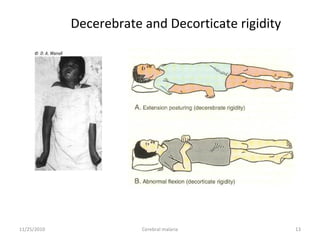
     - Decorticate rigidity
     - Decerebrate rigidity
     - opisthotonus
     -Tone may be increased, decreased or normal
     -Cremasteric and Abdominal reflex normal
     -DTR and Plantar reflex variable
11/25/2010                      Cerebral malaria   11
OTHER CAUSES OF NEUROLOGICAL
                     DYSFUNCTION
Very high fever – febrile seizures, altered consciousness,Psychosis.

Antimalarial drugs – chloroquine, mefloquine.

HYPOGLYCEMIA – severe parasitemia,quinine.

Hyponatremia – vomiting, elderly patients.

Severe anemia


11/25/2010                        Cerebral malaria                     12
Decerebrate and Decorticate rigidity


11/25/2010               Cerebral malaria           13
Assymetric gaze and opisthotonus


11/25/2010               Cerebral malaria       14
SEQUELE AND POST MALARIAL NEUROLOGICAL
                      SYNDROMES
3% in adults, 10% in children.
     50% recover completely
     25% partial recovery
     25% no recovery
• Hemiparesis, hemisensory deficits, cotical blindness,
• cranial nerve palsies,(isolated 6th nerve palsy) ,foot drop,
• Extra pyramidal symptoms(chorea,athetosis,tremors)
• Sudden blindeness due to vitreous haemorrhage.
• Cerebellar ataxia
     Acute febrile stage - with complete recovery, Delayed onset - 3-4 wks after
       malaria
    recovers by 3- 16 wks
• Psychiatric disturbances –
    Depression, Amnesia, psychosis, personality changes, Delusion and
    Hallucinations.
 11/25/2010                          Cerebral malaria                              15
Investigaions
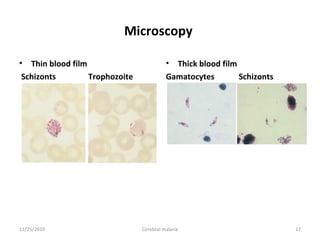
Microscopic examination of blood film is gold standard for diagnosis of
malaria.

•Thick blood film
    – Species specific and inexpensive.
•Thin blood film
    – Rapid, species specific and inexpensive.
•PfHRP2 dipstick card test
    – Rapid and sensitive, Detects only p falciparum.
•Role of PCR
    – most sensitive and specific
    – Results only after 24hrs


11/25/2010                        Cerebral malaria                        16
Microscopy

• Thin blood film                         • Thick blood film
Schizonts         Trophozoite             Gamatocytes        Schizonts


11/25/2010                      Cerebral malaria                         17
Treatment
•   Medical emergency Requires ICU care.
•   Ventilatory support, cardiac monitoring.
•   Correction of fluids, electrolytes and acid base balance.
•   Blood transfusion(where facilities are available)
•   Specific treatment
     – Artesunate is drug of choice - 2.4mg/kg(2vails) iv at 0hr and 24hrs
        then daily till pt can take orally.
     – Quinine in case of first trimester of pregnanacy – 20mg/kg in
        5%dextrose saline in 4hrs then 8th hrly orally to complete 7 days
     – Doxycycline 3.5mg/kg/day for 7 days
     – Tetracycline/clindamycin(children and pregnancy)
•   ACT- COMBINATION THERAPY


11/25/2010                        Cerebral malaria                           18
CONCLUSION
•     Changing profile of clinical features of plasmodium
      falciparum – cerebral malaria jaundice / renal failure/
      MODS.

•     Cytoadherence, rosetting, Nitric oxide and biomass
      of brain are important pathogenic mechanisms in cerebral
      malaria.

•      Quinine & doxy / Artesunate & doxy are effective
      combinations in treating cerebral malaria.


11/25/2010                         Cerebral malaria              19

Cerebral Malaria

  • 1.
    Cerebral malaria By Dr Ranganath Koggnur S 11/25/2010 Cerebral malaria 1
  • 2.
    Objectives • Definition • Epidemiology • Pathophysiology • Clinical features • Investigations • Treatment • Conclusion 11/25/2010 Cerebral malaria 2
  • 3.
    Definition • Manifestation ofsevere plasmodium falciparum malaria • Unarousable coma more than 30 mts with a glasgow coma scale <7/15 with evidence of acute falciparum infection(asexual form in peripheral blood smear) 11/25/2010 Cerebral malaria 3
  • 4.
    Epidemiology WORLD 300 – 500 million cases ( 90% in Africa) 1.1 - 2.7 million deaths annually INDIA 2.5 – 3 million cases / yr 1000 deaths / yr ( under estimate ) 11/25/2010 Cerebral malaria 4
  • 5.
    PATHOGENESIS OF CEREBRAL MALARIA 1. MECHANICAL HYPOTHESIS Sequestration of RBC in the brain by cytoadherence / Rosetting 2. Toxin/cytokine HYPOTHESIS Malarial toxin induced cytokines stimulating excessive Nitric oxide Production. 11/25/2010 Cerebral malaria 5
  • 6.
    MECHANICAL HYPOTHESIS • Cytoadherence parasite after invading RBC membrane, 12/15 hrs later protruberances appear on the erythrocyte’s surface. These “knobs” extrude a high molecular weight, antigenically variant, strain specific erythrocyte membrane adhesive protien (pfEMP1) that mediates attachement to receptors on venular and capillary endothelium. Thus eventually block capillaries and venules. • Rosetting Binding of 2 or more uninfected RBC’s to an infected RBCs. • Agglutination The binding of 2/more infected RBC’s. 11/25/2010 Cerebral malaria 6
  • 7.
    Toxin/cytokine HYPOTHESIS • Glycolipid material released on merozite rupture initiates cytokine cascade from macrophages and monocyte series and endothelium with release of interleukin-1, TNF alpha, interleukin-6 and interleukin-8. • Evidence of positive correlation cytokine levels and prognosis. • TNF alpha>100pg/ml is associated with cerebral pathology and death. 11/25/2010 Cerebral malaria 7
  • 8.
    HUMORAL HYPOTHESIS MALARIAL TOXIN MACROPHAGE ACTIVATION TNF alpha & IL – 6 ↓ UNCONTROLLED NITRIC OXIDE PRODUCTION ↓ Nitric Oxide diffuse blood brain barrier IMPAIRS SYNAPTIC TRANSMISSION ( like general anaesthetics / ethanol ) ↓ COMA 11/25/2010 Cerebral malaria 8
  • 9.
    CEREBRAL MALARIA MECHANICAL HYPOTHESIS CAN NOT EXPLAIN RELATIVE ABSENCE OF NEUROLOGICAL DEFICIT EVEN AFTER DAYS OF COMA. • TOXIN/CYTOKINE HYPOTHESIS CAN EXPLAIN THE RAPID RECOVERY OF COMA AND ABSENCE OF NEUROLOGICAL DEFICIT. 11/25/2010 Cerebral malaria 9
  • 10.
    CLINICAL FEATURES Onset Acute – following seizures Gradual Consciousness Drowsiness, confusion, disorientation, delirium and agitation. Seizures Repeated genaralised convulsions > 2/24 hrs. 11/25/2010 Cerebral malaria 10
  • 11.
    OTHER CLINICAL FEATURES • Mild neck stiffness – no rigidity • Papilloedema in < 1% • Retinal hemorrhages – 15 % • Pupils and corneal reflex – normal • Transient dysconjugate gaze- no paresis • Jaw jerk may be brisk • Forced jaw closure/ Bruxism • Motor system - Decorticate rigidity - Decerebrate rigidity - opisthotonus -Tone may be increased, decreased or normal -Cremasteric and Abdominal reflex normal -DTR and Plantar reflex variable 11/25/2010 Cerebral malaria 11
  • 12.
    OTHER CAUSES OFNEUROLOGICAL DYSFUNCTION Very high fever – febrile seizures, altered consciousness,Psychosis. Antimalarial drugs – chloroquine, mefloquine. HYPOGLYCEMIA – severe parasitemia,quinine. Hyponatremia – vomiting, elderly patients. Severe anemia 11/25/2010 Cerebral malaria 12
  • 13.
    Decerebrate and Decorticaterigidity 11/25/2010 Cerebral malaria 13
  • 14.
    Assymetric gaze andopisthotonus 11/25/2010 Cerebral malaria 14
  • 15.
    SEQUELE AND POSTMALARIAL NEUROLOGICAL SYNDROMES 3% in adults, 10% in children. 50% recover completely 25% partial recovery 25% no recovery • Hemiparesis, hemisensory deficits, cotical blindness, • cranial nerve palsies,(isolated 6th nerve palsy) ,foot drop, • Extra pyramidal symptoms(chorea,athetosis,tremors) • Sudden blindeness due to vitreous haemorrhage. • Cerebellar ataxia Acute febrile stage - with complete recovery, Delayed onset - 3-4 wks after malaria recovers by 3- 16 wks • Psychiatric disturbances – Depression, Amnesia, psychosis, personality changes, Delusion and Hallucinations. 11/25/2010 Cerebral malaria 15
  • 16.
    Investigaions Microscopic examination ofblood film is gold standard for diagnosis of malaria. •Thick blood film – Species specific and inexpensive. •Thin blood film – Rapid, species specific and inexpensive. •PfHRP2 dipstick card test – Rapid and sensitive, Detects only p falciparum. •Role of PCR – most sensitive and specific – Results only after 24hrs 11/25/2010 Cerebral malaria 16
  • 17.
    Microscopy • Thin bloodfilm • Thick blood film Schizonts Trophozoite Gamatocytes Schizonts 11/25/2010 Cerebral malaria 17
  • 18.
    Treatment • Medical emergency Requires ICU care. • Ventilatory support, cardiac monitoring. • Correction of fluids, electrolytes and acid base balance. • Blood transfusion(where facilities are available) • Specific treatment – Artesunate is drug of choice - 2.4mg/kg(2vails) iv at 0hr and 24hrs then daily till pt can take orally. – Quinine in case of first trimester of pregnanacy – 20mg/kg in 5%dextrose saline in 4hrs then 8th hrly orally to complete 7 days – Doxycycline 3.5mg/kg/day for 7 days – Tetracycline/clindamycin(children and pregnancy) • ACT- COMBINATION THERAPY 11/25/2010 Cerebral malaria 18
  • 19.
    CONCLUSION • Changing profile of clinical features of plasmodium falciparum – cerebral malaria jaundice / renal failure/ MODS. • Cytoadherence, rosetting, Nitric oxide and biomass of brain are important pathogenic mechanisms in cerebral malaria. • Quinine & doxy / Artesunate & doxy are effective combinations in treating cerebral malaria. 11/25/2010 Cerebral malaria 19

Editor's Notes